Home » landline networks » Recent Articles:

Verizon Preparing to Sell $15 Billion in Cell Tower/Wired Assets – Tex., Calif., and Fla., Landlines Likely for Sale

Phillip Dampier February 3, 2015 Consumer News, Verizon 2 Comments
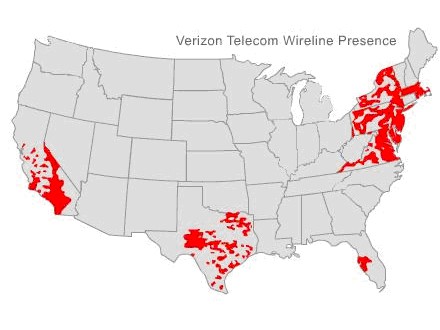
Verizon's landline coverage map.

Verizon’s landline coverage map.

Verizon is working on a sale of its cellphone towers and a portion of its landline assets in a series of deals that could fetch the company more than $15 billion, according to a breaking report in the Wall Street Journal.

The company is looking to raise cash to pay down debt incurred when it bought out Vodafone’s 45% share of its wireless unit and to cover $10.4 billion in wireless licenses the company just won in a government auction last week.

The most likely targets in a landline sale are Verizon territories outside of the northeast.

Verizon has already dumped its landline assets in Hawaii (sold to Hawaiian Telcom), northern New England (sold to FairPoint Communications), West Virginia and many smaller city and suburban territories acquired from GTE (all sold to Frontier).

In its 2010 sale to Frontier, Verizon retained assets in the Tampa-St. Petersburg area, central Texas and Southern California regions. But now all three states are prime targets for a sale. Likely buyers include Frontier Communications, which already has a major presence in Florida including a national call center, and CenturyLink, which acquired Qwest and has a large service area in the southwest and western United States. Frontier remains the most likely buyer, having aggressively expanded its landline network in legacy AT&T (Connecticut) and Verizon service areas.

Verizon CEO Lowell McAdam has shown little interest in maintaining Verizon’s wired assets or growing FiOS and has been willing to sell off major parts of Verizon’s landline network to continue prioritizing Verizon Wireless. McAdam led Verizon Wireless from 2006-2010, before being named CEO of Verizon Communications.

Verizon-logoHe foreshadowed the forthcoming landline sale in January when he told an investor conference he was willing to make significant cuts to Verizon’s wired networks.

“There are certain assets on the wireline side that we think would be better off in somebody else’s hands so we can focus our energy in a little bit more narrow geography,” he said at the time.

Verizon is also expected to follow AT&T’s lead in selling off much of its cell tower portfolio. It will lease access to the towers it sells.

Verizon maintains FiOS networks in Texas, California, and Florida, but that is not expected to deter the company from selling its landline assets. Frontier acquired Verizon FiOS properties in the 2010 sale in both the Pacific Northwest and Indiana. Those services operate under the Frontier FiOS banner today.

VDSL2 Vectoring and G.Fast: “Pixie Dust” or Pathway to Gigabit Copper?

Phone companies looking for a cheap way to increase broadband speeds are turning away from fiber optics and towards advanced forms of DSL that don’t bring cost objections from shareholders.

Whether your provider is AT&T or an ISP in Europe or Australia, financial pressure to improve broadband on the cheap is fueling research to wring the last kilobit out of decades-old copper phone wiring.

Alcatel-Lucent suggests VDSL2 Vectoring is one such technology that can enable download speeds up to 100Mbps using noise-cancelling technology to suppress interference.

Print

But the advice doesn’t impress fiber optic fans who suggest any reliance on deteriorating copper phone lines simply postpones an inevitable fiber upgrade that could come at a higher cost down the road.

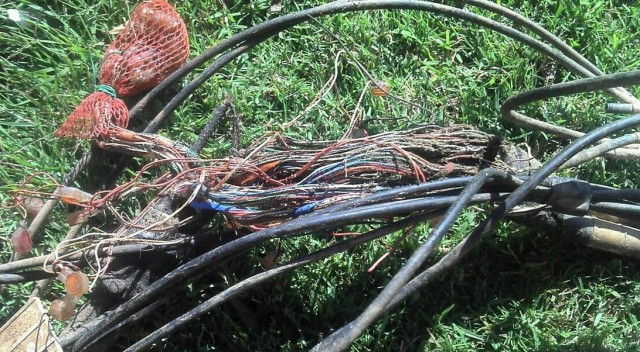
VDSL2 Vectoring and G.Fast are only as good as the copper wiring that extends to each customer. Up to 45 percent of North American wire pairs are in some state of disrepair.

VDSL2 Vectoring and G.Fast are only as good as the copper wiring that extends to each customer. Up to 45 percent of North American wire pairs are in some state of disrepair.

Vectoring has been described as “pixie dust” by Australia’s former Communications Minister Stephen Conroy. Conroy was overseeing Australia’s switch to fiber service as part of the National Broadband Network. But a change in government has scrapped those plans in favor of a cheaper fiber to the neighborhood broadband upgrade advocated by the new Communications Minister Malcolm Turnbull that resembles AT&T’s U-verse.

“Malcolm can sprinkle pixie dust around and call it vectoring and he can do all that sort of stuff but he cannot guarantee upload speeds,” Conroy told Turnbull.

As with all forms of DSL, speed guarantees are extremely difficult to provide because the technology only performs as well as the copper wiring that connects a neighborhood fiber node to a customer’s home or office. Upload speeds are, in practical terms, significantly slower than download speeds with VDSL2. Turnbull expected download and upload speeds on Australia’s VDSL2 network to be around a ratio of 4:1, which means a customer who has a download speed of 25Mbps per second would receive an upload speed of around 6Mbps.

In the lab, VDSL2 Vectoring delivers promising results, with speeds as high as 100Mbps on the download side. DSL advocates are excited about plans to boost those speeds much higher, as much as 1,000Mbps, using G.Fast technology now under development and expected in 2015. VDSL2 Vectoring and G.Fast both require operators to minimize copper line lengths for best results. Unfortunately, dilapidated copper networks won’t work well regardless of the line length, and with many telephone companies cutting back upkeep budgets for the dwindling number of customers still using landlines, an estimated 15-45 percent of all line pairs are now in some state of disrepair.

Assuming lab-like conditions, G.Fast can deliver 500Mbps over copper lines less than 100 meters long and 200Mbps over lines between 100 and 200 meters in length.

G.Fast also allows for closer symmetrical speeds, so upload rates can come close or match download speeds.

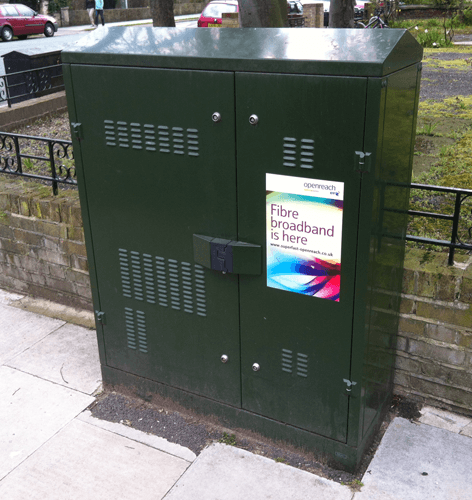
This cabinet houses the connection between the fiber optic cable and the copper phone wiring extending to dozens of customers.

This cabinet houses the connection between a fiber optic cable and copper phone wiring.

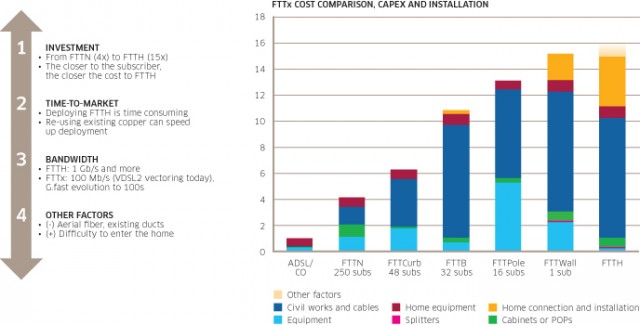
Providers prefer the copper-fiber approach primarily for cost reasons. There are estimates deploying a G.Fast-capable VDSL service to a home would cost around 70 percent less than fiber to the home service. Workers would not need to enter customer homes either, offering less-costly self-install options.

Telekom Austria and Swisscom are among providers committed to launching the technology. Both countries are mountainous and have many rural areas to serve. Fiber rich providers are also looking at the technology for rural customers too costly or too remote to service with fiber.

Critics question the real world performance of both VDSL2 Vectoring and G.Fast on compromised copper landline networks. Decades of repairs, deteriorating insulation, corroded wires, water ingress, and RF interference can all conspire to deliver a fraction of promised speeds.

Many critics also point to the required aggressive deployment of fiber/VDSL cabinets — unsightly and occasionally loud “lawn refrigerators” that sit either in the right of way in front of homes or hang from nearby utility poles. To get the fastest possible speeds, one cabinet may be needed for every four or five homes, depending on lot size. Australia’s VDSL network, without Vectoring or G.Fast requires at least 70,000 cabinets, each powered by the electric grid and temporary backup batteries that keep services running for 1-2 hours in the event of a power failure. The batteries need to be decommissioned periodically and, in some instances, have caused explosions.

The costs of electric consumption, backup batteries, infrastructure, and maintenance of copper lines must be a part of the cost equation before dismissing fiber to the home as too expensive.

Verizon Officially Ends Request to Make Voice Link Sole Landline Replacement in Parts of N.Y.

Verizon-logoVerizon Communications notified the New York Public Service Commission late Tuesday it was abandoning a request to replace damaged landlines anywhere in the state where the company’s facilities were substantially destroyed with a wireless service called Voice Link.

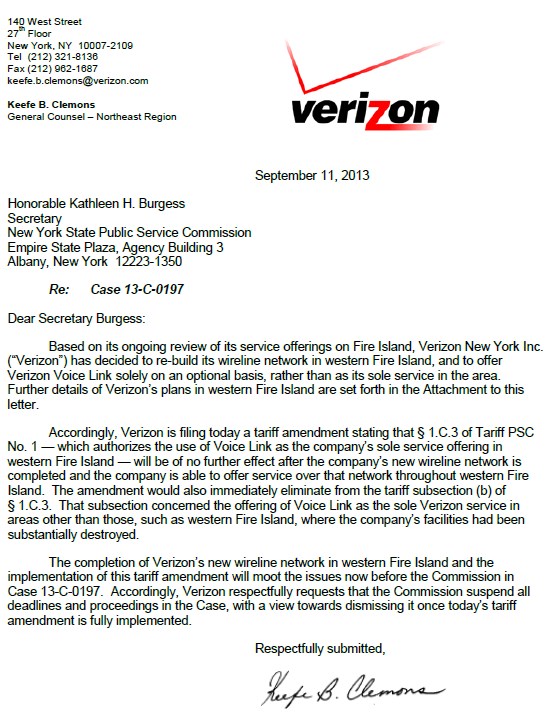
Verizon’s original tariff, if approved, would have allowed the company to drop landline service in areas of New York where it decided it was impractical to repair or replace heavily damaged wired infrastructure. Customers in these areas would no longer be able to obtain wired landline service or DSL broadband. Instead, under the original tariff request, Verizon would offer customers Voice Link as its sole service offering, providing voice-only service over existing telephones, assuming a good signal was available from a nearby Verizon Wireless cell tower.

Yesterday, Stop the Cap! reported a well-placed source in Albany indicated Verizon was unlikely to win approval of its tariff request after a summer of real-world experiences with Voice Link service on Fire Island. Customers overwhelmingly rejected the service, complaining about dropped and missed calls, poor voice quality, and the lack of an affordable broadband option. Yesterday, Verizon separately announced it was reversing an earlier decision and would now install its fiber network FiOS on Fire Island, offering customers the option of keeping Voice Link or switching to FiOS for telephone and/or broadband service.

Accordingly, Verizon today requested the PSC abandon proceedings regarding its request, calling the issue “moot,” and for now will no longer pursue an effort to drop landline service in New York. Verizon will continue to offer Voice Link in the state as an optional service, but will also provide traditional landline and DSL service (where available).

Verizon has not said whether it will continue to pursue regulators for permission to supply Voice Link as its sole service offering in part of New Jersey and Pennsylvania where the company’s landline networks were damaged by last year’s Hurricane Sandy.


verizon 9-10

NY CALL TO ACTION: Tell Regulators Your Thoughts About Verizon’s Future Landline Plans

nys pscNew York State residents have until July 2 to share their views about a proposal by Verizon Communications that would allow the company to drop landline service in rural upstate New York and other locations and replace it with a wireless substitute — Voice Link, as its sole service offering.

Stop the Cap! has covered the issue of rural landline service extensively since 2008. In the past few years, while CenturyLink, Windstream, FairPoint, and Frontier have developed business plans to sell lucrative landline telephone and broadband service in rural areas, AT&T and Verizon have proposed abandoning their landline networks in certain areas in favor of wireless.

Verizon has sought to stop offering rural landline service in areas where it feels no longer economically justified providing it. It ultimately means dismantling communications infrastructure that has provided reliable voice telephone service for more than 100 years.

Verizon-logoVoice Link is first being introduced as Verizon’s “sole service” for beleaguered residents living on the western half of Fire Island, which was devastated by last fall’s Hurricane Sandy. Verizon does not want to foot the bill to rebuild and repair the damaged copper wire infrastructure and does not believe installing its fiber optic network FiOS is economically justified either. That leaves residents with one option for basic phone service: Voice Link.

Unfortunately, many of the residents now encountering Voice Link have told the Public Service Commission it has proven unreliable or unsatisfactory and represents a downgrade from the landline service they used to have. (Stop the Cap! has repeatedly offered to test Voice Link’s workability and sound quality ourselves, but Verizon has not taken us up on that offer.)

The company does admit Voice Link is incompatible with basic data services, which means Verizon customers using Voice Link will lose DSL and dial-up Internet access. It also does not work with fax machines, home alarms, and medical monitoring services. Verizon has promised to address these issues in the future, but has offered no timeline or guarantees. Instead, it suggests customers consider purchasing added-cost services from Verizon Wireless, which could cost some residents hundreds of dollars a month for phone and broadband service.

verizon repairStop the Cap! believes Voice Link should be offered only as an optional service for customers who wish to use it. In its current form, it is unsuitable, unproven, and insufficient to serve as Verizon’s sole offering, particularly when the company is the carrier of last resort for many rural residents, as well as those on Fire Island.

At the very least, Verizon must be compelled to offer an equal or better level of service, not diminish it. That means better voice quality, rock solid cell coverage, an equivalently priced, unlimited wireless broadband service option for DSL customers, and compatibility with the data services that are now supported over the plain old telephone network.

The Commission should also explore the true costs of repairing and/or replacing wired infrastructure before allowing the company to dismantle it. Once the wired infrastructure is removed, the costs to provision rural New York with fast, reliable, wired broadband service in the future will become prohibitive. Wireless service is no panacea for rural New York, where coverage issues abound, especially in the mountainous areas upstate and across the rolling hills of the Southern Tier. Verizon’s lawyers admitted as much when they wrote the terms and conditions governing Voice Link and other wireless services, walking away from significant liability if calls to 911 go unconnected:

“In the absence of gross negligence or willful misconduct by Verizon, our liability to you, to anyone dialing 911 using the Service, or to any other person or party, for any loss or damage arising from any acts, errors, interruptions, omissions, delays, defects, or failures of 911 services or emergency personnel, whether caused by our negligence or otherwise, shall not exceed the amount of our charges for such Services during the affected period of time. This limitation of liability is in addition to any other limitations contained in this Agreement.”

In other words, Verizon’s only responsibility is to credit your account for the time you could not reach 911 or your call summoning help was dropped. You will see that credit reflected on a future bill, assuming you are still among the living when the emergency is over.

We strongly urge our fellow New Yorkers to share their personal views about Voice Link as a landline substitute with the PSC. This issue is important not only to Fire Island but to the rest of rural upstate New York as well, particularly pertaining to whether customers will have broadband service or not. Verizon management has clearly stated their agenda is to retire copper landline service and replace it with wireless in non-FiOS areas deemed too costly or unprofitable to keep up or upgrade.

Sharing your views is fast and easy and can be done in several ways. Be sure to reference “Matter/Case: 13-00986/13-C-0197” in your comments and include your contact information. All submissions will become publicly viewable on the Commission’s website under the “Public Comments” tab. You can find submissions from Stop the Cap! there as well.

Write (U.S. Mail):

Hon. Jeffrey C. Cohen, Acting Secretary
New York State Public Service Commission
Three Empire State Plaza
Albany, New York 12223-1350

E-Mail:

[email protected]

Online Comments:

You can post comments directly to the Commission’s Document and Matter Management System (DMM). Choose the “Post Comments” link on the upper-right of your screen. An online submission form will appear asking for your contact information. You can include your comments in the provided text box on that form or attach a .PDF, .DOC, or .TXT file.

Why Big Telecom’s Rural Wireless ‘Solution’ Is No Replacement for Upgraded DSL/Fiber

Phillip Dampier

Phillip Dampier

It is no secret that there is an urban-rural broadband divide.

The market-driven, private enterprise broadband landscape delivers the best speeds and service to urban-suburban areas, particularly those in and around large cities, short-changing rural communities.

This is true regardless of the technology: the fastest fiber optic services are delivered in large population centers, and wireless speeds are fastest there as well. But as the National Telecommunications and Information Administration has discovered, the further away you get from these urban sectors, the poorer the service you are likely to get.

The NTIA’s findings present a significant challenge to phone company claims that rural customers would be better served with wireless broadband instead of spending money to support and upgrade landline infrastructure, which supports DSL and is upgradable to fiber optics.

The NTIA finds these rural wireless networks to be severely lacking:

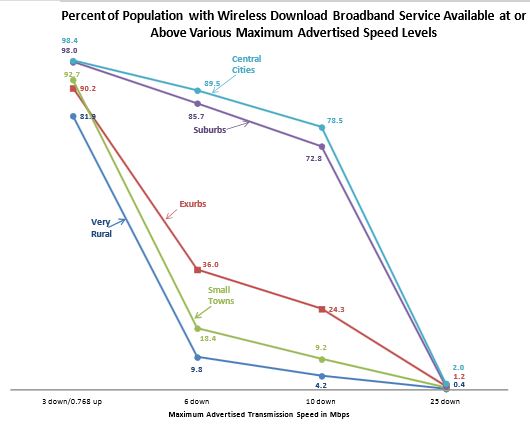
Not only are far fewer rural residents than urban residents able to access 4G wireless services (i.e., at least 6Mbps downstream), but a further divide also exists within rural communities. For wireless download services greater than 6Mbps, Very Rural communities have approximately half the availability rate of Small Towns, and Small Towns have about half the availability rate of Exurbs (10, 18, and 36 percent, respectively).

This represents nothing new. AT&T and Verizon have shortchanged their rural customers with catastrophically slow DSL service (or none at all) for years:

For wireline download service, Very Rural communities also have the least availability of all five areas. Though a rural/urban split continues to be useful in providing generalized information about availability, a five-way classification uncovers a more refined picture of the divide in broadband availability across the nation. For example, at wireline download speeds of 50Mbps, broadband availability varies from 14 percent (Very Rural), 32 percent (Exurban), 35 percent (Small Town), 62 percent (Central City), to 67 percent (Suburban), even though the overall broadband availability was 63 percent in urban areas compared to 23 percent in rural areas. In addition, wireline and wireless broadband availability, particularly at faster speeds, tends to be higher within Central Cities and the Suburbs compared to everywhere else.

Why the disparity? It is a simple case of economics. Wealthy suburbs can afford the ultimate triple play packages, so providers prioritize the best service for these areas, even above less costly to serve urban centers. Rural residents either get no service at all or only basic slow speed DSL. The Return on Investment to improve broadband is inadequate for these companies in rural areas.
Source: NTIA

Source: NTIA

The same is true with wireless 4G service. Rural areas struggle for access or endure poor reception because fewer towers provide service away from major highways or town centers.

The NTIA observed wireless download speeds of 6Mbps or more were available to 90% of urban residents, but only 18% of small town residents. Wireless upload speeds of 3Mbps or greater were found in only 14% of small towns.

Dee Davis, president, Center for Rural Strategies, based in Whitesburg, Va. said the implications were clear.

“The market’s always going to go to the well-heeled communities,” Davis observed. “It’s going to go to the densest population.”

Folks in rural communities end up paying more for a lower level of service, Davis said.

“That also means that they don’t get the same chance to participate in the economy,” Davis added. “They don’t get to bring their goods and services to market in the same way. They don’t always get to participate.”

The economics of cutting off rural landlines delivers most of the benefits to providers, and assures decades of inferior service to consumers.

Economic market tests, including Return on Investment, that impact rural broadband availability will not disappear if AT&T and Verizon abandon their rural landline networks. While cost savings will be realized once rural wired infrastructure is decommissioned, there is no free market formula that would encourage either provider to pour investment funds into rural service areas. For the same reasons rural customers are broadband-challenged today, their comparatively smaller numbers and economic abilities will continue to fail investment metrics for innovative new services tomorrow.

The primary reason broadband speeds are lower in rural areas is inferior network infrastructure. Providers argue it does not make economic sense to invest in network upgrades to boost speeds for such a small number of customers. While wireless technology can be cheaper to deploy than the upkeep of a deteriorating landline network, it is not cheap or robust enough to deliver comparable broadband speeds now available in urban areas, especially as broadband usage continues to grow.

Verizon’s chief financial officer Fran Shammo admitted as much during remarks at the at JPMorgan Global Technology, Media and Telecom Conference in May:

If you recall, way back I guess about two years ago we did a trial with DirecTV in Erie, Pa., where we did broadband on the side of a house and offered a triple-play, if you will, which consisted of broadband, voice, and linear TV provided by DirecTV.

What we found was people were adoptive to the broadband; but because of the consumption of broadband through that LTE network, it was really detrimental to the spectrum and to the network performance. Because they used so much data, it soaked up so much of the spectrum.

So what we felt was LTE for broadband works in certain rural areas, but you can’t compete LTE broadband in those dense populated areas because you can’t — first of all, you can’t match the speed with a 50-megabit or a 100-megabit delivery between cable and FiOS and U-verse. And you literally don’t have enough spectrum to be able to use that much consumption.

So what we felt was by partnering with the cable companies, and delivering our LTE network with voice and data, and having that hardwired connection into the home was a better financial way to do it than trying to go LTE broadband. Because we just didn’t see where the spectrum could hold up to the volume that would be demanded.

Without rural cable companies to partner with, Verizon’s decision to move rural broadband to wireless guarantees rural Americans will not benefit from ongoing speed and capacity upgrades that are necessary to support the evolving Internet.


Search This Site:

Contributions:

Recent Comments:

Your Account:

Stop the Cap!