
Home » internet service providers » Recent Articles:

FCC Looking for 10,000 Speed Test Volunteers — But Not If You Are Usage Capped or a ‘Heavy Downloader’

Stop the Cap! reader Bones sends word the FCC needs volunteers to help keep America’s broadband providers honest about their speed claims.  But the agency warns heavily usage capped consumers they probably shouldn’t apply, and anyone consuming over 30 GB per month is disqualified.

The FCC SamKnows Broadband Community aims to gather and report statistical data on the performance of America’s broadband providers.  Thus far, most of the earlier speed results being studied by public officials come from data aggregated from voluntary visits to speed test websites.  But the data is subject to considerable variation depending on the speed test site chosen, traffic and capacity issues that only impact the route to the test site, and what else a consumer may doing with their connection during the test.  Many also conduct speed tests when a technical problem is apparent, using the speed test site to verify their suspicions.

The FCC will send 10,000 volunteers a free router that will hook up to one’s broadband connection and quietly test it several times daily.  Comprehensive measurements to be taken include latency, packet loss, DNS query times and failures, web page loading times, as well as the obligatory suite of speed tests.  The testing is done in the background and the results are uploaded to SamKnows for review.  The FCC can use the data from all of the volunteers to identify the true performance of national and regional Internet Service Providers.  Do their speed claims actually match reality?  Do they suffer from congestion problems and at what times of day?

One group of ISPs the agency will have trouble measuring are those that heavily limit their customers’ use.  In fact, the Test My ISP website warns off customers with low data caps because the project is expected to send and receive about 4 gigabytes of data in full over the course of each month. While the program designers felt that much data was so insignificant it would not create a problem, some greedy ISPs out there beg to differ.  With some providers offering usage allowances at 5 or fewer gigabytes per month, the FCC quickly learned it doesn’t want to be responsible for spiking consumer broadband bills with any overlimit fees.

As a result, they’ve asked those usage capped consumers to think twice about applying for the traditional testing program:

Our units download approximately 2GB per month and upload around 2GB. If you’re on a product with a low usage cap then we’d advise against signing up, or at least informing us beforehand so that we can apply a different testing profile.

The FCC also isn’t interested in sending test units to customers they designate as “heavy downloaders”:

We’d classify anything above 30GB per month as being too heavy for us to gather useful results.

With the increasing use of multimedia content and other high bandwidth applications being released to the Internet masses, we beg to differ with the arbitrary definition that 30 GB constitutes “heavy downloading.”  We understand the agency doesn’t want other online usage to create an issue for the accuracy of its speed tests, but they should take better care with their language.  One could use a file backup service and easily consume more then 30 GB uploading and never download more than a gigabyte.
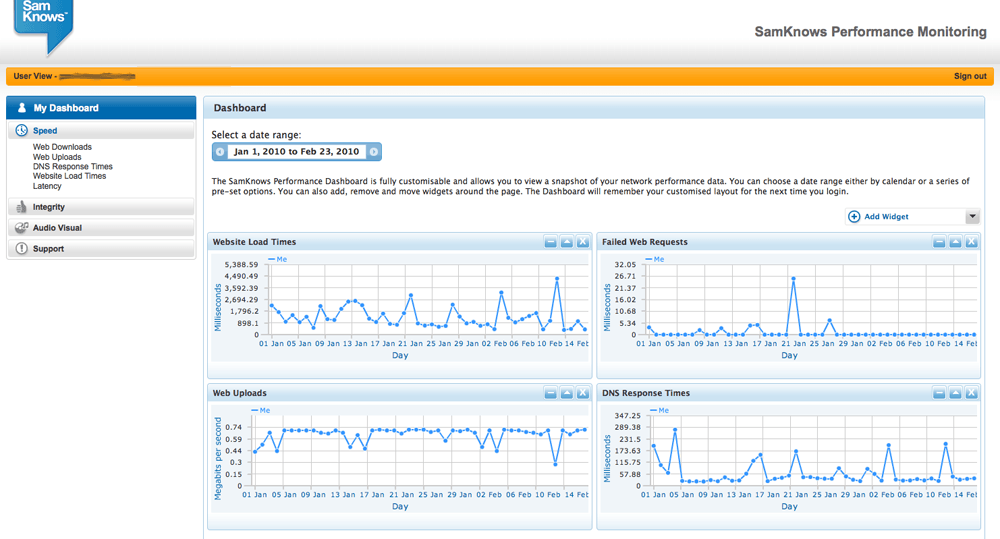
A screenshot of the types of data SamKnows will be collecting and measuring (click to enlarge)

Other restrictions:

  • You have a fixed line broadband Internet connection to your residence.  This is not for WISPs, mobile broadband, or other wireless broadband services.
  • You use a standalone device to connect to your broadband service – i.e not a USB ADSL modem.
  • You have a stable broadband connection (i.e. it doesn’t disconnect frequently). Note that this is just referring to the connection – not the speed.
  • You have a spare power socket near your existing router (or wherever you plan to connect the unit. Keep in mind that a network cable must run between the unit and your router though! We supply a 1m cable).
  • You need to be on one of the ISPs that we’re measuring.
  • You are not an employee or a family member of an employee of one of the ISPs being monitored.

Also, you must agree to the following:

  • Not to unplug the unit or your ISP’s router unless I’m away for an extended period of time.
  • Not attempt to reverse engineer or alter the unit.
  • To notify Samknows if and when I choose to change ISPs.
  • To return the unit to Samknows should I no longer wish to be involved (Samknows to pay reasonable postage costs).
  • To connect the unit in the way described in the documentation.
  • To keep Samknows updated with valid contact details (i.e. email and postal address).

SamKnows is a British company hired by the FCC to conduct the speed test project.  SamKnows is already familiar to British broadband consumers for its comprehensive broadband availability checker showing all of the broadband choices available based on the address where service is to be installed.

The company also reports on broadband news, mostly impacting Europe.

And before the paranoid start suggesting this is Obama’s Internet Spy Box, SamKnows offers this:

However, the unit simply acts as a standard switch or standard router and does not look at any of the packets flowing across your network. It only monitors traffic volumes for the purposes of deciding when to run (or not to run!) the tests and to measure consumption.

Testing information uploaded from the unit to our servers contains no information about you whatsoever. Furthermore, all such communications are encrypted, ensuring that results cannot be tampered with en-route.

Your individual unit’s test results will be available to you alone. Your unit’s results will also be aggregated with others from the same ISP to form a larger average set of results that can be viewed publicly.

We have absolutely no intention of doing anything that may adversely affect your privacy or security.

[flv width=”512″ height=”308″]http://www.phillipdampier.com/video/ITN News Ofcom report says broadband is not up to speed 7-28-09.flv[/flv]

The implications for the FCC’s national speed test program could mimic Great Britain’s, where providers were held to account for wide variations between speeds promised and those actually delivered.  Meaningful broadband reform in the States could include a requirement that providers’ marketing claims be provable, compelling at least some to perform competitive upgrades instead of delivering broken promises.  This ITN News report from last summer illustrates what happened when UK provider speed claims were put to the test.  (3 minutes)

Google Broadband: Faster Internet May Reach Mid-Missouri

[Stop the Cap! will be closely following Google’s experimental gigabit fiber-optic broadband network.  We’ll be bringing regular updates about the communities applying, the strategies they are using to attract Google’s attention, what the competition thinks, and the impact of the project on American broadband.]

Columbia, Missouri is excited about the prospect of being chosen as a test city for Google gigabit broadband.

It’s just one of tens of communities seeking to apply for Google’s new experimental fiber to the home network delivering super fast broadband to residents and businesses.

Columbia is the fifth largest city in the state, with 100,000 residents who call the heart of mid-Missouri home.  Columbia is a classic college town, supporting the University of Missouri.  It’s uniquely known as one of the most-educated communities in the country, with over half of its residents holding college degrees.  Columbia residents are quick to embrace new technology, and this drive to adopt the latest and the greatest has fueled interest in Google’s fiber network.

Columbia’s Regional Economic Development, Inc. (REDI), promoting local business and economic development, has been coordinating what to do next.  They’ve been joined by ComoFiber, which is working to generate public interest in the project and help devise a strategy to win Google’s attention.

courtesy: me5000

Columbia, Missouri

Mike Brooks, from REDI, said the city has seen a great deal of interest from the community to apply for Google’s plan.

Last week, both groups met to educate the public and start identifying why Columbia poses an attractive place for Google’s project.

Some believe Columbia would be the ideal city to build such a network.  ComoFiber explains:

The reasons are numerous, but the biggest reason is really quite simple: Columbia is on the knife’s edge: the sweet spot between big, highly-developed cities and small, under-served towns.

The reason this is so important is because it’s easy to see why Google might want to deploy its fiber in either a big city or a small town, but it’s equally easy to see why they wouldn’t. The big cities have high-tech industry, universities, highly educated populae and other capabilities that allow them to produce the kind of applications and creative products that Google wants to research. On the other hand, major cities already have a great deal of fiber infrastructure, and their broadband prices are generally reasonable. So really, they’re already enabled; adding marginally-faster service to those markets won’t be the kind of sea-change that the plan is designed to study.

ComoFiber compiled a list of strengths from both the “big city” and “small town” perspective:

Columbia/Boone County, Missouri

Columbia as Big City:

  1. Multiple colleges and universities, including world-class research facilities.
  2. A major life sciences epicenter. Life-science is perhaps the most data-intensive industry in the world.
  3. A highly-educated, technically-skilled populace. Thirteenth-most educated in America, to be exact.
  4. Many high-tech small businesses, including Internet-centric outfits such as Newsy.
  5. Several major hospitals and health care businesses, including some at the forefront of technological advancement.
  6. Small-business incubators run in cooperation with universities and the city.
  7. The world’s foremost journalism school and the Donald W. Reynolds Journalism Institute, which houses a state-of-the-art Technology Testing Center.
  8. Several existing Internet service providers who can take advantage of this new open network.
  9. Excellent data backhaul capability due to our position on the I-70 corridor.
  10. With over 100,000 people, the population is high enough to meet Google’s goal for project scale.

Columbia as Small Town:

  1. Sub-par broadband performance with high prices.
  2. Very little existing fiber-to-the-home infrastructure.
  3. High tariffed rates for enterprise-class data products (T1, DS3, etc.)
  4. Midrange population density should be a good microcosm for suburbia nationwide.
  5. Smaller building development (no high-rises) makes infrastructure deployment simpler.
  6. ”The District” contains the kind of mom-and-pop small-town businesses that can innovate unencumbered by corporate imperatives.
  7. Frequently listed in “best places to live” compilations, such as that of Money Magazine.
  8. Location in the heart of middle America sends a powerful symbolic message.
  9. Low cost of living will be nice for the employees Google will need to move in.
  10. With only a bit over 100,000 people, the population is low enough not to dwarf Google’s goal for scale.

The incumbent cable operator, Mediacom, can’t understand why there is such excitement over Google’s fiber project.

“Google is going to be in select markets, and it’s kind of a test that they’re rolling out,” Mediacom director of operations Bryan Gann told KOMU-TV in Columbia. “It may be limited to some commercial applications in the beginning.”

Mediacom is Columbia's incumbent cable company

Mediacom doesn’t think most residents have any need for super fast broadband.

“I think when you get up to those higher speeds that fast, it’s a select group that would even be interested in it going at that speed,” Gann said.

Despite that remark, Gann quickly added Mediacom was already providing the fastest broadband access in town.  In early February, Mediacom boosted its top broadband speed to 50Mbps, and Gann says the company already has plans to boost that speed to 100Mbps in the future.

“We’re already supposed to go to 100, so we can press on the accelerator anytime we want to,” Gann said.

When a new fiber-based competitor threatens to arrive in town, most cable companies downplay the competitive threat.  Mediacom was no exception.

Gann told KOMU Mediacom was used to competition in broadband service and doesn’t see Google Fiber as a threat.

“With the technology that the cable industry put into Columbia, we’re ready to increase our speed to match competition,” Gann said.

[flv]http://www.phillipdampier.com/video/KOMU Columbia Faster Internet May Reach Mid-Missouri 2-16-10.flv[/flv]
KOMU-TV talks about Columbia’s prospects as a chosen city for Google’s new fiber-to-the-home experiment. (2/16/10 – 1 minute)

FCC’s Net Neutrality Proposal Has Built-In Loopholes

Phillip Dampier February 1, 2010 Editorial & Site News, Net Neutrality, Public Policy & Gov't Comments Off on FCC’s Net Neutrality Proposal Has Built-In Loopholes

The Electronic Frontier Foundation is not happy with the Federal Communications Commission’s proposed Net Neutrality rules because they come with built-in loopholes, the most egregious being a clause which allows providers to throttle, block or otherwise interfere with traffic that could consist of “the unlawful distribution of copyrighted works.”

The movie and recording industries have been attacking Net Neutrality for months, accusing it of providing a copyright-violating-free-for-all.  The FCC seems all-too-willing to adopt that meme, and write a convenient lobbyist-friendly loophole into Net Neutrality policies that would suggest provider interference with broadband networks is bad… except when this or that special interest redefines it as “good and lawful network management.”

For years, the entertainment industry has used that innocent-sounding phrase — “unlawful distribution of copyrighted works” — to pressure Internet service providers around the world to act as copyright cops — to surveil the Internet for supposed copyright violations, and then censor or punish the accused users.

From the beginning, a central goal of the Net Neutrality movement has been to prevent corporations from interfering with the Internet in this way — so why does the FCC’s version of Net Neutrality specifically allow them to do so?

The EFF is asking consumers to sign an online petition asking the FCC to yank that exception out of their proposed Net Neutrality rules, and let the industry use existing law enforcement methods to protect copyrighted works.  Of all the industries that seem to do just fine zealously efforting to protect its copyright interests, Hollywood and the music industry don’t need additional special protection clauses inserted into broadband policy law.

Law enforcement can use existing laws to chase crime, and most honest Internet Service Providers would tell you they don’t want to police their users.  Allowing this exception is a convenient backdoor to do what some have wanted all along — to throttle or block high volume network traffic like torrents and newsgroups, this time under the guise of taking a bite out of crime.

While directly appealing to the FCC might be more effective, signing the petition at least gives the EFF the ability to draw media and political attention to a worthy endeavor.

Let’s not repeat the same mistakes certain other major policy initiatives have endured this past year, where good intentions were steamrolled by lobbyists into a loophole-ridden, industry-protectionist horror show.

The best way to ensure an open and free Internet is to literally demand exactly that — no exceptions.

The DC Circuit Court Likely to Protect & Preserve Corporate Broadband Control

Phillip Dampier January 21, 2010 Comcast/Xfinity, Net Neutrality, Public Policy & Gov't 6 Comments

DC Circuit Court

Once again, the United States Court of Appeals for the District of Columbia Circuit is proving to be the best friend corporations have to unravel regulatory policy and consumer protection laws that might violate corporate free-speech or trade rights.  It has become a favored venue for telecommunications providers who want to be rid of pesky prohibitions or reasonable regulation.

After a series of arguments, universally considered disastrous for the Federal Communications Commission’s authority to regulate broadband, the cable operator may want to send flowers to the Court… a lot of them.

Earlier this month, attorneys for the FCC defended their right to tell Comcast it cannot throttle its customers’ broadband speeds.  The FCC maintains it has regulatory authority over broadband service, claiming such power could be inferred from Title I, Section 230(b) of the Communications Act, which states that it is the policy of the United States “to preserve the vibrant and competitive free market that presently exists for the Internet” and “to promote the continued development of the Internet.”  From that the FCC wrote a policy statement stating it was, “necessary to ensure that providers of telecommunications for Internet access or Internet Protocol-enabled (IP-enabled) services are operated in a neutral manner.”  That was the basis for their crackdown against Comcast’s speed throttle.

After the arguments between Comcast and the FCC concluded, court-watchers believe the Commission’s days of broadband oversight are numbered.

Ars-Technica’s Matthew Lasar documented the probable train wreck for those who seek to rein in provider abuses.

At issue is whether the FCC has been granted direct legal authority for Internet regulation by Congress. Comcast, and as it turned out many on the Court, believe the FCC is relying on policy statements, not written law, for their regulatory authority over Internet Service Providers.  The Court transcript says it all:

Randolph

“In looking this over I found a good many situations in which Congress has instructed the FCC to study the Internet,” said Justice A. Raymond Randolph, [appointed to the Court by President George H.W. Bush in 1990], “and taxation of transit sales transactions on the Internet, and this, and that, and the other thing. But what I don’t find is any congressional directive to the FCC to regulate the Internet.”

It wasn’t hard for [Comcast attorney Helgi G.] Walker to summon a response to this observation. “That’s right,” she declared.

And with that, Comcast had won. Even before the FCC’s attorney got to the bench, the judges were doing Walker’s job, swatting aside arguments on behalf of the agency’s Order sanctioning the ISP. Pro-FCC briefs to the court had noted that the Supreme Court recognized the Commission’s ancillary authority in its Brand X decision, a crucial ISP access case. Randolph threw this bullet point into the trash icon, referring to the “offhand statement” in Brand X. “And the Supreme Court has moved so far away from that kind of an analysis in today’s modern jurisprudence,” he added, “it seems antiquated.”

By the time Commission lawyer Austin C. Schlick began his rebuttal, Randolph moved in for the kill.

“May it please the Court,” Schlick began. “Ms. Walker hasn’t attempted to defend the actual network practices that were employed here, and so I won’t spend time just… ”

Sentelle

[Justice David] Sentelle cut him off. “Well, her position is that she doesn’t have to,” he tersely noted. “She’s here to say that you don’t have any business inquiring into those practices, ergo we don’t either.”

That’s true, Schlick conceded. “Right,” Sentelle warned. “So you may want to move on to something that’s at issue then, Counsel.”

And that was largely that.  The Court is very likely to hand down a ruling that strips the FCC of its ability to regulate or oversee broadband service in the United States.  Even Schlick knew what has forthcoming:

By the end of the discussion Schlick was bargaining with the judges. “If I’m going to lose I would like to lose more narrowly,” he confided. “But above all, we want guidance from this Court so that when we do this rule-making, if we decide rules are appropriate we’d like to know what we need to do to establish jurisdiction.”

“We don’t give guidance,” Randolph grumbled, “we decide cases.”

Comcast should have bought lunch for everyone.

So now public policy groups and advocates of FCC oversight over broadband, particularly as it relates to Net Neutrality, are scrambling to figure out what to do next.

It comes down to four possible outcomes:

  1. One of the parties appeals the case;
  2. Corporate control of broadband without oversight is assured, as the FCC is stripped of any regulatory authority;
  3. The FCC manages to find some other wording from laws Congress passed that justifies lawmakers wanted the agency to oversee and regulate broadband services;
  4. Congress passes new laws specifically enacting broadband regulatory authority for the FCC.

Of course, today’s bland authority over broadband comes as a result of legislative compromise from the great regulatory battles over telecommunications during the Clinton Administration.  Providers argued less is more, and have grudgingly accepted limited FCC authority over some of their services, except when a challenge threatens to cost them control or a lot of money.

With a hostile reception at the Court, and the FCC’s “surrender first, fight later” legal argument, an appeal may only delay the inevitable.  The FCC does have plenty of Congressional directives to review which may permit it to enact Net Neutrality protection, but another provider lawsuit opposing Net Neutrality is inevitable.  In fact, without the passage of a clear, concise federal law providing the Commission with explicit broadband regulatory authority enacting Net Neutrality and other protections, the aptly-numbered “2” is the likely outcome for consumers.

Thankfully, Rep. Edward Markey’s (D-MA) Internet Freedom Preservation Act would solve much of this problem, by forbidding Internet service providers from doing anything to “block, interfere with, discriminate against, impair, or degrade” access to any lawful content from any lawful application or device.

Getting it passed in a Congress mired in division is another matter.  The best way to overcome that is a strong showing of support for Markey’s legislation in calls and letters to your members of Congress, and that you are carefully watching their votes on this issue.

Another Broadband Usage Meter Bungle: New Zealand’s Telecom Forced to Reimburse Customers for Internet Overcharging

New Zealand Telecom

New Zealand’s Telecom is the latest company caught with a defective broadband usage meter that overbilled 150,000 of their 500,000 customers for Internet usage never utilized.  The problem was tracked to a “technical problem” involving the company’s network upgrade in preparation for the introduction of TiVo.  Telecom’s engineering partner Juniper was held responsible for introducing the error which resulted in more than one hundred thousand customers finding their broadband speeds reduced for “excessive usage” to near-dial-up or billed steep overlimit penalties for the months of November and December.

On December 23, Telecom sent out letters to around 150,000 customers informing them of the error.

“Our reports show us that you will have experienced slowed internet speeds earlier than expected in your billing months,” said the letter, signed by Telecom’s general manager of broadband, Ralph Brayham.

Telecom spokeswoman Emma-Kate Greer told the New Zealand Herald all customers who had been affected by over-charging or slowed internet speeds had been identified.

They had been refunded and credits had been given to “customers who may have been incorrectly slowed.”

Customers shocked by their November and December bills were initially stuck taking Telecom’s word for the overbilling, resulting in lots of finger-pointing in New Zealand households.  The Herald reported:

Sarah Broughton, from Herne Bay in Auckland, said she had been frustrated by the slow broadband, and had accused one of her flatmates of downloading too many movies.

“There are six people living in our house. We all suspected everyone else was downloading heaps,” she said.

“We were blaming other people.

“I never suspected it was Telecom. You think when you give them money they are going to use it properly.

“It’s just been so annoying.”

Usage meters, a vital component of Internet Service Providers seeking an enhanced payday from Internet Overcharging schemes that bill customers based on how much data they consume, have been controversial because of questions regarding the accuracy of their measurements.  Most providers do not permit independent verification of the accuracy of their meters, despite their accounting for a significant portion of a customer’s monthly broadband bill.

It took a concerted, organized effort by members of the Geekzone website to “out” Telecom’s erroneous billing practices and get the company to issue compensation to impacted customers.

Search This Site:

Contributions:

Recent Comments:

Your Account:

Stop the Cap!