Home » History » Recent Articles:

Four Telcos-Four Stories: The Big Money is in Commercial Services — Today: CenturyLink

Four of the nation’s largest phone companies — two former Baby Bells, two independents — have very different ideas about solving the rural broadband problem in the country. Which company serves your area could make all the difference between having basic DSL service or nothing at all.

Some blame Wall Street for the problem, others criticize the leadership at companies that only see dollars, not solutions. Some attack the federal government for interfering in the natural order of the private market, and some even hold rural residents at fault for expecting too much while choosing to live out in the country.

This four-part series will examine the attitudes of the four largest phone companies you may be doing business with in your small town.

Today: CenturyLink — Our Commercial Customers Deliver 60% of Our Revenue; Our Attention Follows Accordingly

“Business customers now drive about 60% of our total operating revenues,” CenturyLink CEO Glenn F. Post III told investors in March. “Our focus on delivering advanced solutions and data hosting services to businesses are key factors in improving our top line revenue trend.”

With residential customers departing traditional landlines at an average rate of 5-10 percent a year, keeping customers has become an important priority for a number of phone companies, especially those who have plowed millions into mergers and acquisitions to build their businesses. For the past several years, CenturyLink has been acquiring small, regional independent phone companies, a former Baby Bell, and a competing landline provider Sprint used to think would be an important part of its business.

Century Telephone’s original customers were mostly cobbled together from acquisitions from other phone companies, including names like GTE, Central Telephone Company of Ohio (part of Centel), Pacific Telecom, Mebtel and GulfTel. But the biggest expansion of the company would come from acquisitions of Sprint-spinoff Embarq and former Baby Bell Qwest.

Today CenturyLink operates one of the nation’s largest independent phone companies, and serves markets large (primarily on the west coast) and small (rural communities primarily in the southeast, Missouri, Ohio, Indiana and Wisconsin).

CenturyLink’s revenues have often been uneven, mostly because of its acquisitions, landline losses, and the effects from competition in its larger markets. While CenturyLink’s acquisitions grew the company, they also saddled it with landline networks that have proved inadequate to meet the growing needs of customers. With a disconnect rate running between 6.4% this quarter and 7.6% in the same quarter a year ago, residential customers are leaving their voice lines behind in favor of cell phones and broadband customers are departing for faster speeds available from cable operators.

These “legacy services” lost the company $124 million in revenue — an 8.1% decrease over the past quarter. As customers depart, so do CenturyLink employees that used to handle the old landline network.

To make up the lost revenue, CenturyLink has gotten more aggressive in other areas of its business:

  • Increasing focus on business/commercial and governmental services, including managed hosting, cloud computing and other commercially-targeted broadband initiatives;
  • Deployment of fiber to cell towers as a growing revenue source;
  • Limited, but ongoing rural broadband expansion;
  • Development of Prism TV — a fiber to the neighborhood service targeting residential customers.

CenturyLink calls these their four key initiatives towards revenue stability, stable cash flow, and growth.

In the business services segment, CenturyLink sees enormous revenue potential selling businesses access to data centers, co-location services, and ethernet-speed broadband. Last year, CenturyLink acquired Savvis, an important enterprise-level service provider and owner of 50 data centers. Phone companies like CenturyLink are also in a race with large cable operators to be the first to offer cell phone companies access to “fiber-to-the-tower” service to support exploding data growth on 4G wireless networks.

Faster DSL, Fiber to the Neighborhood-Broadband Key to Keeping Residential Customers Happy
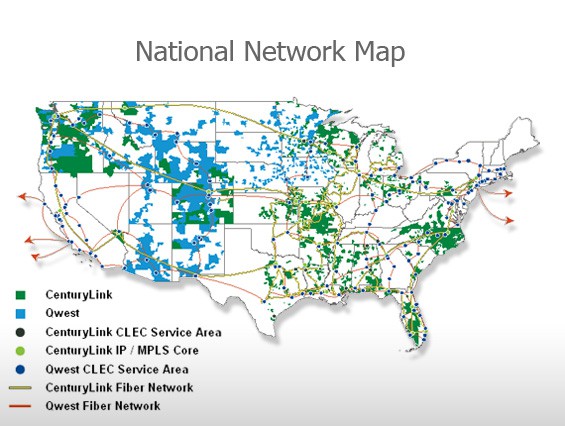
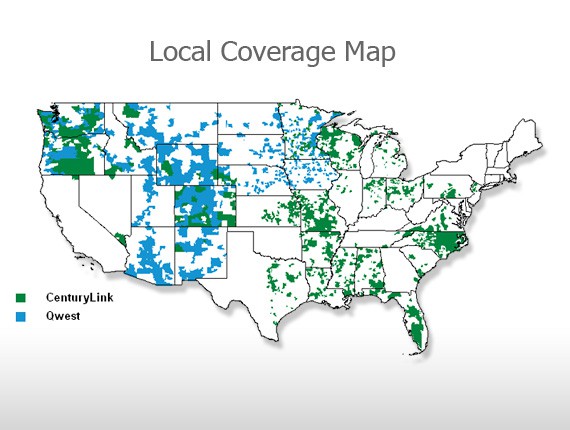
CenturyLink’s network map showing both its own service areas, and infrastructure obtained from the acquisition of Qwest.

For consumers, CenturyLink has been moderately aggressive in some areas boosting speeds of its DSL services. The company claims 70% of their DSL-capable landline network provides speeds of at least 6Mbps. At least 55% supports 10Mbps or higher; over 25% can manage 20Mbps or faster.

The company’s Prism TV service, a fiber to the neighborhood upgrade comparable to AT&T U-verse, is now available to nearly 6.3 million homes and apartments in eight cities. By year end, CenturyLink says it will increase that to 7.1 million homes.

Prism represents a significant portion of CenturyLink’s investment in its residential business. So far, the results have not proven a major threat to the competition. CenturyLink added 15,000 Prism subscribers in the first quarter, but the company only has 8% of the market. Cable and satellite providers continue to dominate. But the company says Prism is helping to keep the customers they already have.

CenturyLink says it now taking Prism TV west into former Qwest territory, starting in and around Colorado Springs, Col.

Customers will likely be offered 130 channels starting at $59.99 a month with a free set top box (new customers typically receive a $20 monthly discount for the first six months of service).

The phone company will compete with Comcast, which sells 80 channels for $56 a month (new customers get a $26/mo discount for the first six months).

With CenturyLink providing a better deal, at least for television service, Colorado City officials hope the competition will bring down rates, at least for new customers. That may be exactly what happens, predicts Mark Ewell, a senior account executive with Windstream Communications.

“We could see some pressure on Comcast’s rates. I would like to see Comcast adopt a price model that doesn’t go up after a promotional period,” Ewell told The Gazette.

“CenturyLink is likely to be more of a threat to the satellite providers like DirecTV and Dish because they have a much higher market share in Colorado Springs than they do in most other markets because so many customers left Adelphia [acquired in bankruptcy by Comcast] when it had its financial problems. Those customers have already shown a willingness to leave the cable television provider and try another service.”

[flv width=”640″ height=”380″]http://www.phillipdampier.com/video/CenturyLink Prism TV.flv[/flv]

CenturyLink shows off its new Prism TV offering in this company-produced video.  (2 minutes)
CenturyTel acquires Embarq and changes its name to CenturyLink to reduce the emphasis on its traditional landline business.

CenturyLink’s arrival in the triple-play business of phone, Internet, and television service could be the first serious competition Comcast has gotten outside of satellite providers. WideOpenWest had a franchise to provide service in 2000 but never did. Falcon Broadband won a franchise in 2006, but only provides service to around 1,500 customers in the Banning Lewis Ranch, Black Forest, and Falcon areas. Porchlight Communications received a franchise in 2007, installed service for 500 customers but ultimately never charged them. Porchlight’s IPTV service never worked properly with its chosen set top boxes. That fatal flaw put the company out of the cable business, and the company turned the porch light off for good, abandoning its franchise.

Rural Broadband: Unless the Government Delivers More Subsidies, Rural Customers Will Continue Waiting

In late July, CenturyLink announced it would accept $35 million from the Federal Communications Commission’s new Connect America Program (CAP) to deploy broadband to homes and businesses in rural, broadband-deprived parts of its service area.

CenturyLink has the capability to extend broadband to 100 percent of its customers, but not the willingness to invest the money to make that happen, critics contend. CenturyLink freely admits it applies a financial test when considering when and where to expand its DSL broadband service into its most rural service areas.

In short, the company must recoup its costs of deploying broadband within a certain time frame, and be confident that a certain percentage of customers are going to sign up for broadband service, before it will agree to make the investment. Virtually all of CenturyLink’s current service areas have already met or failed that test, which leaves an indefinite group of broadband “have’s” and “have-nots.”

To shake up the status quo, the FCC proposed to shift Universal Service Fund money, collected from all phone customers, away from landline service towards rural broadband deployment. This invites CenturyLink, and other phone companies, to run those financial tests again. With urban customers footing part of the bill, theoretically more homes should squeak past the return on investment test.

In fact, more homes will finally get CenturyLink broadband — around 45,000 in semi-rural and suburban areas where the costs to provide the service are not as great as in truly rural areas.  The FCC is offering to cover just short of $800 per household to cut the costs of deploying rural Internet access.

But CenturyLink complains the money is not nearly enough to solve the really-rural broadband problem.

“In very rural areas where we really have the greatest need for support, this amount, on a per-location basis, will not be enough to allow us to really do an economic build-out,” Post told investors this spring. “So we’re still in the process really of evaluating our opportunities….”

That will leave CenturyLink likely spending considerably more upgrading its urban landline network to support Prism TV instead of supplying rural broadband service.

[flv width=”640″ height=”380″]http://www.phillipdampier.com/video/CenturyLink History.flv[/flv]

Jeff Oberschelp, vice president and general manager of CenturyLink of Nevada discusses the past history of CenturyLink and where phone companies are going in the future in this company-friendly interview.  (6 minutes)

Special Report: The Return of Wireless Cable, Bringing Along 50Mbps Broadband

A Short History of Wireless Cable

Spectrum offered Chicago competition to larger ON-TV, selling commercial-free movies and sports on scrambled UHF channel 66 (today WGBO-TV).

Long before many Americans had access to cable television, watching premium commercial-free entertainment in the 1970s was only possible in a handful of large cities, where television stations gave up a significant chunk of their broadcast day to services like ON-TV, Spectrum, SelecTV, Prism, Starcase, Preview, VEU, and SuperTV. For around $20 a month, subscribers received a decoder box to watch the encrypted UHF broadcast programming, which consisted of sports, popular movies and adult entertainment. The channels were relatively expensive to receive, suffered from the same reception problems other UHF stations often had in large metropolitan areas, and were frequently pirated by non-paying customers with modified decoder boxes.

With the spread of cable television into large cities, the single channel over-the-air services were doomed, and between 1983-1985,virtually all of their operations closed down, converting to all-free-viewing, usually as an independent or ethnic language television outlet.

But the desire for competition for cable television persisted, and in the mid-1980s the Federal Communications Commission allocated two blocks of frequencies for entertainment video delivery. The FCC earlier allocated part of this channel space to Instructional Television Fixed Services (ITFS) for programming from schools, hospitals, and religious groups, which could use the capacity to transmit programming to different buildings and potentially to viewers at home with the necessary equipment.

Home Box Office got its start broadcasting on microwave frequencies before moving to satellite.

In practice, ITFS channels allocated during the 1970s were underutilized, because running such an operation was often beyond the budgets and technical expertise of many educational institutions. Premium movie entertainment once again drove the technology forward. After signing off at the end of the school day, Home Box Office, Showtime, and The Movie Channel signed on, using microwave technology to distribute their services to area cable systems and some subscribers. As those premium services migrated to satellite distribution beginning in 1975, reallocation for a new kind of “wireless cable TV” became a reality.

Wireless cable (technically known as “multichannel multipoint distribution service”) began in earnest in the late 1980s and early 1990s, with a package of around 32 channels — typically over the air stations, popular cable networks, and one or two premium movie channels. Some operations in smaller cities sought to beam just a channel or two of premium movies or adult entertainment to paying subscribers, the latter at a substantial price premium. Installation costs paid by providers were more affordable than traditional cable television — around $350 for wireless vs. $1,000 for cable television. That made wireless attractive in rural areas where installation costs for cable television could run even higher.

However, it was not too long before wireless cable operators ran into problems with their business models. Obtaining affordable programming was always difficult. Some cable networks, then-owned by large cable systems, either refused to do business with their wireless competitors or charged discriminatory rates to carry their networks. By the time legislative relief arrived, the wireless industry realized they now had a capacity problem. As cable television systems were being upgraded in the 1990s, the number of channels cable customers received quickly grew to 60 or more (with many more to come with the advent of “digital cable”). Wireless cable was stuck with just 32 channels and a then-analog platform. Satellite television was also becoming a larger competitive threat in rural areas, with DirecTV and Dish delivering hundreds of channels.

American Telecasting gave up its wireless cable ventures, under such names as People’s Wireless TV and SuperView in 1997, selling out to companies including Sprint and BellSouth (today AT&T). BellSouth pulled the plug on the services in February, 2001.

Wireless providers simply could not compete with their smaller packages, and most closed down or sold their operations, often to phone companies. The few remaining systems, mostly in rural areas, have typically combined their wireless frequencies with satellite provider partners to deliver television, slow broadband, and IP-based telephone service.

Rebooting Wireless Cable for the 21st Century

By the early-2000’s the Federal Communications Commission proposed a new allocation for a “Multichannel Video and Data Distribution Service” (MVDDS). Designed to share the 12.2-12.7GHz band with Direct Broadcast Satellite (DBS) services DirecTV and Dish, MVDDS was partly envisioned as a potential way to deliver local stations to satellite subscribers over ground-based transmitters. But things have evolved well beyond that concept, especially after both satellite providers began using “spot beams” to deliver local stations to different regions from their existing fleet of orbiting satellites.

MVDDS was ultimately opened up to be either a competing cable television-like service or for wireless broadband, or both. Michael Powell, then-chairman of the FCC during the first term of George W. Bush, said the technology was free to develop as providers saw fit:

What is MVDDS? The short answer is that we do not know.  Its name, Multichannel Video Distribution and Data Service, seems to suggest everything is possible – and perhaps it is.

But the service rules the Commission has adopted do not require MVDDS to provide any particular kind of service – it could be a multichannel video, or data, or digital radio service, or any other permutation on spectrum use.

The Commission was once in the business of requiring spectrum holders to provide a certain type of service.  That approach failed because government is a very bad predictor of technology and markets – both of which move a lot faster than government.  Over the past decade or so, the Commission has adopted more flexible service rules that bound a service based largely on interference limitations and its allocation (fixed or mobile, terrestrial or satellite).  In this Order, we follow that flexible model for MVDDS.

In 2004 and 2005, licenses to operate MVDDS services were opened up for auction, and a handful of companies won the bulk of them: MDS America, which built a 700-channel wireless cable system in the United Arab Emirates, DTV Norwich, an affiliate of cable operator Cablevision, and South.com, which is really satellite provider Dish Network. Another significant winner was Mr. Bruce E. Fox, who wants to partner with other providers to finance and operate MVDDS services.

Cablevision and Fox are the two most active license recipients at the moment.

A Look at Today’s MVDDS Wireless Players

Fox launched Go Long Wireless in Baltimore as a demonstration project. Go Long transmits its signal from the roof of the World Trade Center at the Baltimore Inner Harbor to the Emerging Technology Center, a business incubator site a few miles away. Fox believes the technology is especially suited to multi-dwelling units like apartment complexes and condos. He plans to work with other service providers who will market and bill the service under their own brand names. Fox does not seem to be interested in challenging the marketplace status quo. He does not believe in using MVDDS to provide television service, for example. In Fox’s view, the real money is in broadband and Voice over IP telephone service.

Cablevision’s involvement is more direct-to-consumer. Its Clearband service– now operating under the new brand ‘OMGFAST’ — is now selling up to 50/3Mbps wireless broadband service in the Deerfield Beach, Fla. area. The company has had nothing to say about whether this service is slated to expand, and if it does, Cablevision will not be permitted to operate it in areas where they already provide cable service, due to the FCC’s cross-ownership rules.

OMGFAST originally bundled voice service in its broadband packages, which it sold at different price points: 12Mbps for $39.95 a month, 25Mbps for $59.95 a month, and 50Mbps at $79.95. The company also tested a 50Mbps promotion priced at $29.95 a month for three months, $59.95 ongoing. Today it offers a better deal: $29.95 a month for 50Mbps service as an ongoing rate. (Expect to pay $10 a month more for mandatory equipment rental, and $14.95 a month if you also want voice service.)

[flv width=”640″ height=”450″]http://www.phillipdampier.com/video/Clearband FAST 50 Mbps Internet.flv[/flv]

Here is a promotional video explaining how Clearband (now OMGFAST) wireless broadband works. (3 minutes)

MVDDS currently delivers broadband with similar constraints cable systems operate under — namely, download speeds are much faster than upload speeds. That is because upstream bandwidth relies on another transmission technology, often WiMAX, in the 3.65 GHz or 5 GHz bands.

The wireless technology is also very “line of sight,” meaning the tower must be within six miles of the subscriber and not blocked by any obstructions. Hills, buildings, even heavy foliage can all block MVDDS signals the same way satellite signals can be blocked (they share the same frequencies).

Most customers end up with an antenna that very much resembles a traditional satellite dish from DirecTV or Dish, mounted on a roof. To maximize available bandwidth, MVDDS uses a configuration similar to cellular systems, with up to 900Mbps of total bandwidth available to each 90-degree narrow beam sector.

Cablevision has MVDDS licenses to serve most large cities in the United States.

The question is, how will license holders ultimately use the technology. Although originally proposed as a competitor to traditional cable or satellite TV, deregulation has left the fate of MVDDS in the hands of the operators.

Some are considering not selling the service to consumers at all, but rather making a market out of providing backhaul connectivity for cell towers. Dish may be interested in using its licenses to offer customers a triple play package of broadband and phone service with its satellite TV package. Nobody seems particularly interested in providing television service over MVDDS, primarily because programmers’ demands for higher carriage payments would cut into revenue.

Even Cablevision isn’t completely sure what it wants to do. Although it currently is trialing broadband and phone service in Florida, the company earlier petitioned the FCC for increased power to establish a more suitable wireless backhaul service it can sell to mobile phone companies.

For the moment, reviews seem relatively positive for the Florida market test. Of course, as more customers pile on a wireless service, the less speed becomes available to each customer. OMGFAST does not appear to be currently concerned, noting it has no usage caps on its service.

Want to know which provider may be coming to your area? See below the jump for a list of the top-three bid winners and the cities they are now licensed to serve, in order of market size.

… Continue Reading

Corporate Doublespeak: “Price Signaling” is Just Another Way of Saying “Collusion”

Phillip Dampier July 9, 2012 AT&T, Competition, Consumer News, Editorial & Site News, History, Public Policy & Gov't, Verizon, Wireless Broadband Comments Off on Corporate Doublespeak: “Price Signaling” is Just Another Way of Saying “Collusion”

History repeats itself. In 1889, it was railroads, steel, iron, and energy. Today it is telecommunications.

My first introduction to the concept of corporate doublespeak — designed to cushion the blow of bad news behind a wall of barely-comprehensible babble came in October 1987 when I heard one Wall Street analyst refer to the great stock market crash that had just befallen the financial district as a “fourth quarter equity retreat.”

Holy euphemism, Batman!

You weren’t fired — you were “made redundant.”  The bankruptcy of Detroit automakers and the layoffs that followed were not as bad as they looked. It was merely “a career-alternative enhancement program.”

And, no, Verizon and AT&T are not engaged in should-be-illegal marketplace collusion on pricing and services. They are just practicing some harmless “price signaling.”

That’s the awe-struck view of management consultant Rags Srinivasan, who just gushes over the marketing “stroke of genius” that threatens to give customers a stroke when they open their monthly bill.

Srinivasan’s piece, worthy of the Wall Street Journal editorial page, turns up instead on GigaOm, where it gets some pretty harsh treatment from tech-lovers who hate the rising prices of wireless service.

Price signaling has always existed between the number one and number two players in any market. Agreeing to not engage in a price war is truly a win-win for the market leaders. Since outright price fixing is illegal, market leaders resorted to signaling to tell the other company their intentions or send a threat about their cost advantages.

But traditionally, it was more like flirting — ambiguous enough that the underlying intentions could be denied. Why are these two not shy about admitting to flirting now? The simple answer is the iPhone.

Not too long ago we worried about running out of talk minutes and paying overage. Service providers offered us tiered plans that offered more minutes for a higher price and unlimited minutes for an even higher price. With the additional revenue flowing directly to their bottom line, these higher priced plans were real cash cows.

For those who have any doubt about the profits from unlimited plans, I’d point out that the costs of a mobile service provider are sunk with zero marginal cost for additional minutes. And texts don’t even consume traffic channels — they piggyback on control channels.

[…] In another genius pricing move, Verizon Wireless is presenting this $100 mobile service plan to customers in a bundle — talk minutes plus data. In the past, around $70 was allocated to talk because consumers valued it more. Now subscribers pay only $40, but they still pay the same $100 total price. This is nothing short of pricing excellence, protecting customer margin while also using strong price signaling to make sure that the next biggest market share leader follows suit.

What Srinivasan calls “business at its best” and “pricing excellence” we call collusion at its most obvious. The GigaOm author says he does not want the government tinkering with this kind of marketplace “signaling,” and it does not appear likely he has much to worry about. AT&T and Verizon executives have grown increasingly brazen (and obvious) with their near-identical pricing and “me-too” plans which leave little to differentiate the two carriers from a pricing perspective. The likely result will be at least 100 million cell phone customers eventually stuck paying for unlimited voice and texting services they neither want or need.

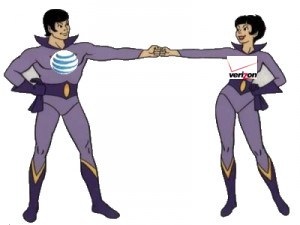
Wireless Wonder Twins Powers Activate: Shape of anti-competitive marketplace for consumers; form of collusion.

True, AT&T charges Cadillac prices but has the customer service image of a used 1995 Kia… but they did have the original exclusive rights to the Apple iPhone and Apple devotees proved they will endure a lot. Verizon Wireless has a better network and has always charged accordingly.

Unfortunately for consumers, the also-rans Sprint and T-Mobile (and the smaller still) depend on AT&T and Verizon for roaming off the city highway and into the countryside, and they are often stuck with devices that are a step down from what the bigger two can offer.

Srinivasan would have a better argument if the wireless marketplace had not become so consolidated. Had AT&T had its way with T-Mobile, America would have just a single national GSM network — AT&T. Verizon does not consider its CDMA competitor much of a bother either, and Sprint Nextel CEO Dan Hesse has to divide his time between fighting with Wall Street over why the company has not already sold out to the highest bidder (and now wants to spend a fortune upgrading its network) and customers who consider Sprint too much of a trade-off in coverage and its dismal “4G” Clearwire WiMAX network too slow for 2012.

Srinivasan is probably too young to understand AT&T and Verizon never invented “price signaling.” A century ago, the railroad robber barons did much the same, leveraging their anti-competitive networks-of-a-different-kind to maximize prices in places that had few alternatives. Where competitors did arrive, they were typically bought out to “maximize savings and eliminate market inefficiencies.” The same was true in the steel and energy sector of the early 20th century.

The result is that consumers were turned upside down to shake out the last loose change from their pockets. Eventually, government stepped in and called it marketplace collusion and passed antitrust laws that began a new era for true competition.

How soon some forget.

A History Lesson: Wireless Spectrum “Crisis” Hoopla vs. Solid Network Engineering

Phillip Dampier April 18, 2012 AT&T, Audio, Bell (Canada), Broadband "Shortage", Competition, Consumer News, Editorial & Site News, History, Public Policy & Gov't, Rogers, Sprint, T-Mobile, Verizon, Video, Wireless Broadband Comments Off on A History Lesson: Wireless Spectrum “Crisis” Hoopla vs. Solid Network Engineering

“Somehow in the last 100 years, every time there is a problem of getting more spectrum, there is a technology that comes along that solves that problem. Every two and a half years, every spectrum crisis has gotten solved, and that’s going to keep happening. We already know today what the solutions are for the next 50 years.” — Martin Cooper, inventor of the portable cell phone

Despite the fear-mongering by North America’s wireless phone companies that a spectrum crisis is at hand — one that threatens the viability of wireless communications across the continent, some of the most prominent industry veterans dispute the public policy agenda of phone companies like AT&T, Verizon, Bell, and Rogers.

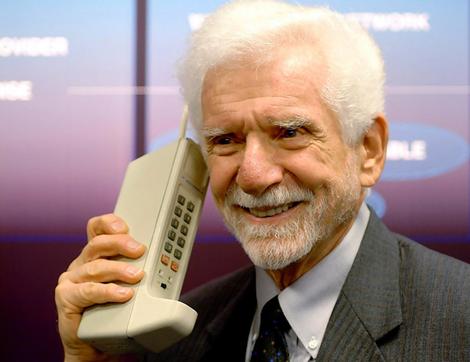
Martin Cooper ought to know.  He invented the portable cell phone, and remains involved in the wireless industry today.  Cooper shrugs off cries of spectrum shortages as a problem well-managed by technological innovation.  In fact, he’s credited for Cooper’s Law: The ability to transmit different radio communications at one time and in the same place has grown with the same pace since Guglielmo Marconi’s first transmissions in 1895. The number of such communications being theoretically possible has doubled every 30 months, from then, for 104 years.

National Public Radio looks back at the earliest car phones, which weighed 80 pounds and operated with vacuum tubes. Innovation, improved technology, and lower pricing turned an invention for the rich and powerful into a device more than 300,000,000 North Americans own and use today. (April 2012) (3 minutes)
You must remain on this page to hear the clip, or you can download the clip and listen later.

A traditional car phone from the 1960s.

The earliest cell phones have been around since the 1940s.  St. Louis was the first city in the United States to get Mobile Telephone Service (MTS).  It worked on three analog radio channels and required an operator to make calls on the customer’s behalf. By 1964, direct dialing from car phones became possible with Improved Mobile Telephone Service (IMTS), which also increased the number of radio channels available for calls.

In the 1970s, popular television shows frequently showed high-flyers and private detectives with traditional looking phones installed in their cars.  But the service was obscenely expensive.  The equipment set customers back $2-4,000 or was leased for around $120 a month.  Local calls ran $0.70-1.20 per minute.  That was when a nice home was priced at $27,000, a new car was under $4,000, gas was $0.55/gallon, and a first run movie ticket was priced at $1.75.

With many cities maintaining fewer than a dozen radio channels for the service, only a handful of customers could make or receive calls at a time.  The first “spectrum crisis” arrived by the late 1970s, when car phones became the status symbol of the rich and powerful (the middle class had pagers). Customers found they couldn’t make or receive calls because the frequencies were all tied up.  Some cities even rationed service by maintaining waiting lists, not allowing new customers to have the technology until an existing one dropped their account.

Instead of demanding deregulation and warning of wireless doomsday, the wireless industry innovated its way out of the era of MTS altogether, switching instead to a “cellular” approach developed in part by the Bell System.

[flv width=”412″ height=”330″]http://www.phillipdampier.com/video/ATT Testing the First Public Cell Phone Network.flv[/flv]

In the 1970s, when the first cell phone “spectrum crisis” erupted, the Bell System innovated its way out the the dilemma without running to Congress demanding sweeping deregulation.  This documentary, produced by the Bell System, explores AMPS — analog cell phone service, and how it transformed Chicago’s mobile telephone landscape back in 1979.  (9 minutes)

“Arguing that the nation could run out of spectrum is like saying it was going to run out of a color.” David P. Reed, one of the original architects of the Internet

Instead of one caller tying up a single IMTS radio frequency capable of reaching across an entire city, the Bell System deployed lower-powered transmitters in a series of hexagonal “cells.”  Each cell only served callers within a much smaller geographic area.  As a customer traveled between cells, the system would hand the call off to the next cell in turn and so on — all transparently to the caller.  Because of the reduced coverage area, cell towers in a city could operate on the same frequencies without creating interference problems, opening up the system to many more customers and more calls.

Inventor Martin Cooper holds one of the first portable mobile phones

In Chicago, Bell’s IMTS system only supported around a dozen callers at the same time. In 1977, the phone company built a test cellular network it dubbed “AMPS,” for Advanced Mobile Phone System.  AMPS technology was familiar to many early cell phone users.  It was more popularly known as “analog” service, and while it could still only handle one conversation at a time on each frequency, the system supported better call handling and many more users than earlier wireless phone technology.  By 1979, Bell had 1,300 customers using their test system in Chicago.

AMPS considerably eased the “spectrum crunch” earlier systems found challenging, and subsequent upgrades to digital technology dramatically increased the number of calls each tower could handle and allowed providers to slash pricing, which fueled the spectacular growth of the wireless marketplace.

Yesterday it was voice call congestion, today it is a “tidal wave” of wireless data.  But inventors like Cooper believe the solution is the same: engineering innovation.

“Somehow in the last 100 years, every time there is a problem of getting more spectrum, there is a technology that comes along that solves that problem,” Cooper told the New York Times. “Every two and a half years, every spectrum crisis has gotten solved, and that’s going to keep happening. We already know today what the solutions are for the next 50 years.”

Cooper believes in the cellular approach to wireless communications.  Dividing up today’s geographic cells into even smaller cells could vastly expand network capacity just like AMPS did for Windy City residents in the late 1970s. Using especially directional antennas focused on different service areas, placing new cell towers, innovating further with tiny neighborhood antennas mounted on telephone poles, or building out Wi-Fi networks can all manage the data capacity “crisis” says Cooper.

New technology also allows cell signals to co-exist, even on the same or adjacent frequencies, without creating interference problems. All it takes is a willingness to invest in the technology and deploy it across signal-congested urban areas.

Unfortunately, network engineers are not often responsible for the business decisions or public policy agendas of the nation’s largest wireless companies who are using the “spectrum crisis” to argue for increased deregulation and demanding additional radio spectrum which, in some cases, could be locked up by companies to make sure nobody else can use them.

[flv width=”600″ height=”358″]http://www.phillipdampier.com/video/NY Times Mobile Carriers Warn of Spectrum Crisis.flv[/flv]

The New York Times offers this easy-to-follow primer on wireless spectrum and why it matters (or not) in the current climate of explosive growth in mobile data traffic.  (3 minutes)

“Their primary interest is not necessarily in making spectrum available, or in making wireless performance better. They want to make money.” — David S. Isenberg, veteran researcher, AT&T Labs

Innovation, not wholesale deregulation, allowed the Bell System to solve the spectrum crisis of the 1970s by creating today's "cell system" that can re-use radio frequencies in adjacent areas to handle more wireless traffic.

Spectrum auctions bring billions to federal coffers, but actually deliver a hidden tax to cell phone customers who ultimately pay for the winning bids priced into their monthly bills.  It also makes it prohibitively expensive for a new player to enter the market.  Already facing enormous network construction costs, any new entrant would then face the crushing prospect of outbidding AT&T, Verizon Wireless, Bell or Rogers for the frequencies essential for operation.

As the New York Times writes:

When a company gets the license for a band of radio waves, it has the exclusive rights to use it. Once a company owns it, competitors can’t have it.

Mr. Reed said the carriers haven’t advocated for the newer technologies because they want to retain their monopolies.

Cooper advocates a new regulatory approach at the Federal Communications Commission — one that mandates wireless phone companies start using today’s technology to amplify their networks.

Cooper points to one example: the smart antenna.

Smart antennas direct cell towers to focus their transmission energy towards the specific devices connected to it.  If a customer was using their phone from the southern end of the cell tower’s coverage area, why direct signal energy to the north, where it gets wasted?  New LTE networks support smart antenna technology, but carriers have generally avoided investing in upgrading towers to support the new technology, expected to be commonplace inside new wireless devices within two years.

T-Mobile calls these technology solutions “Band-Aids” that won’t address the company’s demand for more frequencies to manage its network.  But that kind of thinking applied to the mobile phone world of the 1970s would have maintained the exorbitantly expensive IMTS technology discarded decades ago, since replaced by innovation that made more efficient use of the spectrum already on hand.  That innovation also transformed wireless phones from a tool (or toy) for the very wealthy to an affordable success story that now threatens the traditional wired phone network in ways the Bell System could have never envisioned.

[flv width=”412″ height=”330″]http://www.phillipdampier.com/video/Its a Whole New System.flv[/flv]

It’s A Whole New System: AT&T and other wireless phone companies might want to learn the lesson the Bell System was trying to teach their employees back in 1979: Meet Change With Change.  This company-produced video implores the phone company to do more than the same old thing.  No, this video is not “PM Magazine.”  It is about innovation and actually listening to what customers want. With apologies to Mama Cass Elliot, there was indeed a New World Coming — the breakup of the Bell System just five years later.  Don’t miss the diabetic-coma-inducing, sugary-sweet jingle at the end.  Then reach for a can of Tab.  (10 minutes)

Analysis: Breaking Down the CenturyTel-Qwest Merger

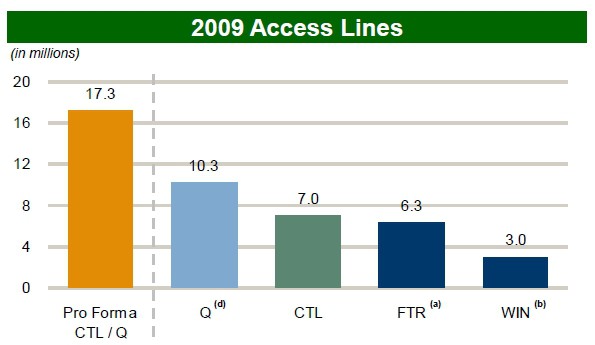
Today’s merger between CenturyTel (soon to be CenturyLink) and Qwest will combine 10 million Qwest customers and 7 million from CenturyTel into a single company serving 37 states in every region of the country except the northeast and much of California and Nevada.  CenturyLink gains access to Qwest’s highly valued portfolio of services sold to business customers and Qwest gets a partner that can help manage its $11.8 billion debt and help grow the last remaining Baby Bell, formerly known as US West, into a national player capable of withstanding ongoing erosion of landline service.

The deal will impact consumers and businesses, and will challenge regulatory authorities to consider the implications of ongoing consolidation in the traditional telephone service marketplace.  It brings implications for broadband service strategies for both companies, which we’ll explore in greater detail.

Breaking Up Was Too Hard to Do, So Let’s Put It Back Together

Ultimately, the genesis of this, and most of the other big telecom deals that we’ve witnessed over the past few years comes from the 1996 Communications Act, which deregulated large parts of the telecommunications industry and triggered a massive wave of consolidation that is still ongoing.  That legislation was the antithesis of the 1984 court ruling which ultimately led to the breakup of AT&T and the Bell System monopoly in 1984.  When President Clinton signed the 1996 bill into law, it allowed much of the Bell System to eventually recombine into two major entities:

  • AT&T ultimately pieced itself back together with the acquisitions of:

BellSouth — serving the southeastern United States

Ameritech — serving the upper Midwest

SBC/Southwestern Bell — serving Texas and several southern prairie states

Pacific Telesis — serving California and Nevada

  • Verizon became a regional powerhouse by combining:

NYNEX — serving New England and New York

Bell Atlantic — serving mid-Atlantic states

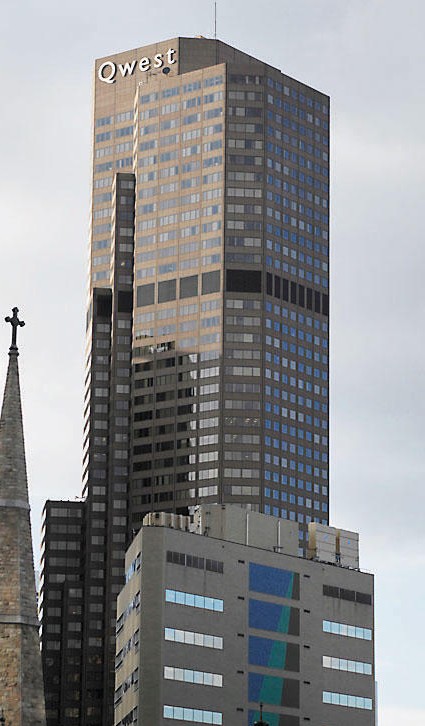
Qwest Tower - Denver

The remaining orphaned Baby Bell was US West, which comprised Mountain Bell serving the Rocky Mountain states, Northwestern Bell which covered the Dakotas, Minnesota, the prairie states not covered by SBC, and Pacific Northwest Bell which managed service for Oregon, Washington, and northern Idaho.  US West was subjected to a hostile takeover in 2000 by an upstart telecommunications company that was laying fiber optic cable in the late 1990s alongside the railways its owner, Philip Anschutz, also happened to own.  Qwest assumed control of US West that summer and rechristened it with its own name.  Owned by a Bell outsider, Qwest has always been the company that didn’t quite fit with the rest.

The company gained respect for its enormous fiber backbone that weaves across many American cities, including several in the northeast.  It is best known for its services to business customers.  On the residential side, the story is less impressive.  The company’s customer service record is spotty and the company has accumulated an enormous amount of legacy debt left over from earlier acquisitions.  Despite the company’s repeated efforts to find a partner, it took until today for it to finally find one.  There are several reasons for this:

  1. Qwest’s service area is notoriously rural and expensive to serve.  Outside of its corporate headquarters in Denver, the majority of its service area is either mountainous or rural.  Even today, Qwest serves only 10 million residential customers, almost matched by CenturyTel’s own seven million largely rural customers scattered across the country.
  2. Qwest’s history has been littered with financial scandals, starting with a series of deals with disgraced Enron from 1999-2001.  That was followed with charges of fraud and insider trading in 2005.
  3. Qwest does not own its own wireless division and its previous efforts to deliver television service to customers were largely unsuccessful.  That made Qwest’s ability to withstand erosion in its core business – landline phone service, more difficult.
  4. Qwest’s debt is downright frightening for would-be suitors.

Why Does CenturyTel Want to Buy Qwest?

CenturyTel claims such a transaction allows a combined company to become a larger player on the national scene.  By combining Qwest’s good reputation in the business telecommunications sector with combined efforts to deliver broadband products including high speed Internet, the company thinks the combination can’t be beat.  CenturyTel envisions packages of video entertainment, data hosting and managed services, as well as fiber to cell tower connectivity and other high bandwidth services to deliver replacement revenue lost from disconnected landlines.  It also believes it can realize cost savings from the merger and keep the company relevant on a stage dominated by Verizon, AT&T, and a few large cable companies.

But there are other reasons.  For the three super-sized independent phone companies that Americans are growing increasingly familiar with — Frontier Communications, Windstream Communications, and CenturyTel, their business models depend on their ability to constantly engage in deal-making and acquisitions.  All three companies have built their businesses on investors who see their stocks as “investment grade” financial instruments that dependably return a dividend back to shareholders.  As we’ve seen in countless quarterly financial results conference calls, all three companies are preoccupied answering questions from Wall Street about the all-important dividend.  TV personalities like Jim Cramer has specifically recommended these telecom stocks based, in part, on their dividend payout.  If that dividend dramatically shrunk or stopped, the share price for all three stocks would likely plummet.

One of the side effects of companies dependent on dividend payouts is their constant need to be on the lookout for additional merger and acquisition opportunities.  Here’s how it works.  Let’s say CenturyTel’s debt load and reduced revenue, caused by customer defections to cell phones or cable phone service, delivered a bad fiscal quarter for the company.  Cash flow was down, and company officials simply couldn’t keep the dividend payout at the same level as the previous quarter.  Since many people hold CenturyTel stock specifically because of the dividend, a downward turn in that payout could cause some to sell their shares, driving the stock price downwards.

CenturyTel is still digesting a previous merger with EMBARQ, which led it to rechristen the company CenturyLink

One way around this is to seek out a new merger or acquisition target.  By bringing two companies together, preferably one with a healthy cash flow, suddenly the big picture changes.  Your balance sheet now reflects the combined revenue from both companies, which incidentally makes the percentage of debt versus revenue look a lot healthier.  Cash flow immediately improves, especially if you can slash redundant costs.  Come next quarter, that dividend payout is right back up in healthy territory.

Sometimes companies become so preoccupied with their dividend and corresponding stock price, it can lead them to pay out more in dividends than a company earns in revenue.  While that’s great for investors, it is unsustainable in the long run.

Many critics of telecommunications companies employing this strategy claim it’s evidence that a company is biding time and unwilling to invest in innovation for the future.  Some also believe dividend payouts shortchange customers because they can eventually bleed a company’s ability to invest in service improvements, research and development, and capital investments to maintain their network and expand service.

As consolidation continues, the number of new buyout opportunities begins to shrink, and one shudders to think what happens when there is no one else to buy.  How long is this business model sustainable?

Both CenturyTel and Qwest also recognize the impact of ongoing disconnections from landline service, now averaging 10 percent of their customers a year.  Those departing customers are now relying on their cell phones or alternative calling services like cable company “digital phone” service or broadband-based calling from companies like Vonage or Skype.

The one service they hope can stem customer defections is broadband.  Unfortunately, telephone companies are increasingly losing ground against their cable modem competitors, who have an easier time increasing broadband speeds for customers now seeking online video and other high bandwidth applications.

Of course, one of the benefits of being a “rural phone company” is the fact cable competition is often unlikely.  In fact, some of the lowest erosion rates for landline service are in rural communities where the telephone company is the only game in town.  There is plenty of money still to be made offering high priced slow speed DSL service in communities with no cable competitor and spotty wireless broadband that is often slower and usage-limited.

All three of these big independent players are well aware of this, and maintaining a strong position in relatively slow speed DSL service also protects another revenue stream — Universal Service Fund revenue given to rural providers to equalize telephone rates.  CenturyTel recognizes the increasing likelihood much of that money will be diverted to stimulating broadband expansion, something the phone company is more than willing to do if it means preserving their subsidies.

The new combined Qwest-CenturyTel company hopes the merger can help both survive obsolescence.

For Qwest, a debt reduction may make it possible to spend more to deliver fiber-to-the-curb service, similar to AT&T U-verse.  That could increase broadband speeds and prompt them to reconsider their earlier decision to abandon IPTV in the western half of the country.

CenturyTel can continue to offer traditional DSL service with a more incremental upgrade approach in its more rural service areas, but tap into Qwest’s fiber network to reduce backhaul expenses and potentially pick up new business customers by offering Qwest-branded business services.  Company officials strongly hinted that, at least for now, CenturyTel’s existing customers will continue to find the video portion of their “triple play” package delivered by DirecTV satellite service, so no IPTV for them.

CenturyTel and Qwest's combined local service areas

What Does This Mean for Employees of Both Companies?

Mergers like this always generate great excitement over “cost savings” made possible by the merger.  Much of these savings typically come from employee expenses.  When you hear “cost savings,” think layoffs and pay cuts for all but top management.  Based on past precedent, Qwest employees can anticipate some serious job losses if this transaction closes, especially in the business office.  The combined company will be henceforth known as CenturyLink, with headquarters remaining in Monroe, Louisiana.  That is potentially bad news for Qwest’s employees in Denver.

The transaction is expected to generate annual operating cost savings (which CenturyTel calls “synergies”) of approximately $575 million, which are expected to be fully realized three to five years following closing.  The transaction also is expected to generate annual capital expenditure “synergies” of approximately $50 million within the first two years after close.  That means spending less on infrastructure improvements.

Billing and customer service are traditionally handled by CenturyTel when a company joins the CenturyTel family.  North Carolina customers can attest to that as EMBARQ, an earlier CenturyTel target, finally moves to CenturyTel’s billing system in the coming weeks.

For the sake of pushing the merger through state regulatory agencies, cutbacks in unionized technicians who handle service installations, repairs, and maintain the lines are not expected.  The Communications Workers of America issued a statement today that mildly acknowledged the merger announcement, saying the union “looked forward to serious negotiations with both companies” regarding employment security and assurances of aggressive high speed broadband rollout throughout both companies’ territories.

How the combined CenturyTel-Qwest company stacks up against other independent phone companies. (Q-Qwest, CTL-CenturyTel, FTR-Frontier, WIN-Windstream)

What Does This Mean for Qwest and CenturyTel Customers?

In the short term, nothing.  This merger will take at least a year to complete, assuming regulatory approval in every state where a review is required by state officials.  In 2011, should the merger be approved, Qwest customers can anticipate transition headaches as the Denver-based company winds down operations in favor of CenturyTel.  Billing and customer service will both be impacted.  Long term plans for major projects are likely to be stalled until the merger settles into place.  CenturyTel business customers will eventually see Qwest’s strong business products line become available in many CenturyTel service areas.  Eventually, some larger CenturyTel-served cities may find Qwest’s more advanced DSL service arriving on the scene delivering faster speeds.

Although CenturyTel has hinted it may review whether it’s now large enough to operate its own wireless mobile division, for the near term, expect the partnership to resell Verizon Wireless service to continue.

What is the View of Stop the Cap! on the CenturyTel-Qwest Merger?

Generally speaking, most of the industry consolidation that has been fueled by a deregulatory framework established by the Clinton Administration has not benefited consumers anywhere near the level promised by deregulation advocates.  The three largest independent phone company consolidators — Frontier, Windstream, and CenturyTel are spending more time and resources looking for new acquisitions and schemes to pay out dividends than they are working to enhance service in their respective service areas.  Smaller independent phone companies are deploying fiber to the home networks and answer to the communities where they work and live.  From companies like Frontier, we get Internet Overcharging schemes combined with slow DSL service, tricks and traps from “price protection agreements” that automatically renew, rate increases, and cost cutting.  Windstream plagues some of their customers with extended service outages, and CenturyTel’s promised broadband speeds often don’t deliver.

Unfortunately, bigger is not always better in telecommunications.  While the biggest players like Verizon seek to discard rural American customers, getting one of these three companies instead doesn’t always represent progress.  Our regulators are too often satisfied with basic answers to questions about broadband and service improvements that come with few details and deadlines.  It is just as important to ask what kind of broadband service a company will bring, at what speeds and price, and what usage limits, if any, will accompany the service.

Companies engaged in these mergers hope regulators don’t pin them down to specific service commitments and standards, which could harm the financial windfall these deals bring to a select few.  But they must be the first thing on the table, guaranteeing that customers also get the enjoy the “synergies” these deals are supposed to bring.

Search This Site:

Contributions:

Recent Comments:

Your Account:

Stop the Cap!