Home » google » Recent Articles:

Federal Communications Commission Votes to Start Drafting Net Neutrality Policy That Verizon Seems to Suddenly Support

Phillip Dampier October 22, 2009 Data Caps, Editorial & Site News, Net Neutrality, Online Video, Public Policy & Gov't, Verizon, Video Comments Off on Federal Communications Commission Votes to Start Drafting Net Neutrality Policy That Verizon Seems to Suddenly Support

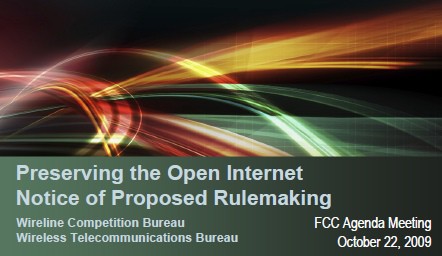
fccThe FCC today voted unanimously to begin writing a formal Net Neutrality policy to govern broadband services across the United States.  Three Democratic commissioners voted yes and applauded the concept of Net Neutrality.  The two Republican commissioners also voted to move the process forward, but signaled they would likely oppose the final draft of the rules.

Support for Net Neutrality, which would prohibit providers from slowing down, blocking, or charging higher pricing for favored access to web content, was spearheaded by FCC Chairman Julius Genachowski.

Genachowski said the rules were needed to protect consumers from abusive behavior by telecommunications companies that might seek to block or restrict access to broadband content, including telephone and video services.

“Internet users should always have the final say about their online service, whether it’s the software, applications or services they choose, or the networks and hardware they use to the connect to the Internet,” Genachowski said.

Other Democratic commissioners agreed with Genachowski.  Commissioner Michael Copps stated it was important to hear from everyone about the proposed rules.

“We need to recognize that the gatekeepers of today may not be the gatekeepers of tomorrow,” Copps said.

John McCain

John McCain

Many Republicans were unconvinced of the need to establish Net Neutrality as formal policy.

“I do not share the majority’s view that the Internet is showing breaks and cracks, nor do I believe that the government is the best tool to fix it,” Republican commissioner Robert McDowell said.

“These new rules should rightly be viewed by consumers suspiciously as another government power grab over a private service provided by private companies in a competitive marketplace,” Sen. John McCain wrote in an opinion piece published by The Washington Times.

McCain compared Net Neutrality with the federal bailout of Wall Street and the American auto industry.

Under the draft proposed rules, subject to reasonable network management, a provider of broadband Internet access service:

  1. would not be allowed to prevent any of its users from sending or receiving the lawful content of the user’s choice over the Internet;
  2. would not be allowed to prevent any of its users from running the lawful applications or using the lawful services of the user’s choice;
  3. would not be allowed to prevent any of its users from connecting to and using on its network the user’s choice of lawful devices that do not harm the network;
  4. would not be allowed to deprive any of its users of the user’s entitlement to competition among network providers, application providers, service providers, and content providers;
  5. would be required to treat lawful content, applications, and services in a nondiscriminatory manner; and
  6. would be required to disclose such information concerning network management and other practices as is reasonably required for users and content, application, and service providers to enjoy the protections specified in this rulemaking.

The draft rules make clear that providers would also be permitted to address harmful traffic and traffic unwanted by users, such as spam, and prevent both the transfer of unlawful content, such as child pornography, and the unlawful transfer of content, such as a transfer that would infringe copyright.

Today’s vote marks only a beginning of the process to begin writing the formal policy of Net Neutrality governing Internet use in the United States.  As with the ponderous debate on health care reform, what ends up defining “Net Neutrality” will be open to interpretation, and a barrage of lobbyists and arm twisting from politicians will be part of what comes next.

On the eve of the historic vote, Verizon Communications seemed to join Google in affirming some of the basic principles of Net Neutrality.

However, the devil is in the details, as is always the case in telecommunications policy.

verizon

Verizon supports its own interpretation of Net Neutrality, which is wrapped in a concept they call “innovation without permission,” which is code language for a deregulatory open free-market environment.  It broadly accepts the concept that telecommunications companies should not interfere with legal content, but the company doesn’t want a whole barrage of new regulations to specifically define what would constitute “interference.”  Verizon believes onerous rules would stifle investment, and that existing rules already in place at the FCC are sufficient protection.

Things get downright dicey when Verizon spells out its “network management” principles, warning the FCC overly specific rules in this area could have unintended consequences.

Broadband network providers should have the flexibility to manage their networks to deal with issues like traffic congestion, spam, “malware” and denial of service attacks, as well as other threats that may emerge in the future–so long as they do it reasonably, consistent with their customers’ preferences, and don’t unreasonably discriminate in ways that either harm users or are anti-competitive. They should also be free to offer managed network services, such as IP television.

It is in this area where very specific rules are appropriate to write, because what one company defines as appropriate “network management,” could be discriminatory against selected content those providers seek to “manage.”

No broadband user has ever objected to network management that controls spam, “malware,” denial of service attacks, and other like-minded traffic.  In fact, most consumers wish more could be done to control these things.  Nothing in the current framework of telecommunications regulations or in those proposed have ever sought to impede this type of management.

No consumer minds having access to additional content, such as IP television.  But consumers do object when such content is used as an excuse to ram through Internet Overcharging schemes limiting broadband usage or imposing higher fees for using the types of services companies like Verizon now advocate.  “The broadband sky is falling” rhetoric about “exafloods,” overloaded “Internet brownouts,” and other such scaremongering nonsense often comes from the same providers that now want to provide IP television.  What they provide with their left hand, they want to limit with their right.

It’s anti-competitive, because the same companies with an interest in selling these pay television services (FiOS, cable television, fiber-telephone U-verse, etc.) also provide the broadband service that companies like Netflix and Hulu use to indirectly challenge their video business models.

Another concern is “traffic congestion” management, which all too often has meant speed throttles selectively imposed on “offending” applications, particularly peer to peer traffic.  There is good traffic management, such as routing equipment that provides even delivery of services like streaming video and Voice Over IP telephone calls, which rapidly deteriorate on loaded down networks, and then there is bad traffic management which selectively slows down the speed of whatever the provider deems to be of “lower priority.”  Allowing the customer to make the decision about which traffic gets priority is one thing.  Allowing a provider to do it without the consent of the customer is quite another.

Too often, the “unintended consequences” Verizon and Google speak about in the joint statement go to the provider’s favor, not to the consumer.  Overly broad, non-specific language opens loopholes through which providers will eagerly leap through.

Verizon also advocates transparency — “All providers of broadband access, services and applications should provide their customers with clear information about their offerings.”

Disclosure alone doesn’t suffice for consumers, particularly if there are few competitive places to take your business if you disagree with company policies.  Those rules should include realistic speed information (marketing stating “up to 10Mbps” that in reality only delivers 3Mbps would be one example).  It should not simply be an escape clause for providers to abuse their customers with throttled, slow service, and give them the excuse that “we disclosed it.”

<

p style=”text-align: center;”>

Federal Communications Commission Open Meeting

October 22, 2009

112 minutes

(Warning: Loud audio)

Facebook and Twitter Are New Allies in the Net Neutrality Battle

Phillip Dampier October 19, 2009 Net Neutrality, Public Policy & Gov't 4 Comments

facebook_logoFacebook and Twitter have officially signed up for the Net Neutrality battle on the side of consumers demanding a free and open Internet.

Facebook co-founder Mark Zuckerberg and Twitter’s Evan Williams added their signatures to a letter expected to reach Federal Communications Commission Chairman Julius Genachowski this morning. The letter, signed by 24 high profile Internet executives, calls on the FCC to continue efforts to “begin a process to adopt rules that preserve an open Internet.”

Both companies have not been major players in the political debate surrounding Net Neutrality until now.

The correspondence comes after two weeks of sustained attacks on Net Neutrality from several dozen Republicans on Capitol Hill and intense lobbying from telecommunications companies to drop the issue.

One signer, twitter_logoEchostar CEO Charlie Ergen, is no stranger to pro-consumer telecommunications legislation.  Prior to the launch of DISH Network, Ergen sold satellite dish equipment to consumers and was an active participant in the battle to pass the 1992 Cable Act, which mandated fair and open access to cable programming networks making DirecTV and DISH Network possible.  Ergen’s company owns Sling Media, manufacturer of the Slingbox, a device that streams television programming over the Internet for private use.  The Slingbox has been banned from certain wireless mobile networks, a prohibition that would end should Net Neutrality rules take hold.

… Continue Reading

Kudlow Drinks the Kool-Aid: CNBC Lovefest With Wireless Lobbyist, Attacks Pro-Net Neutrality Consumer Groups as “Radical”

"I think these are radical consumer groups," says Larry Kudlow

"I think these are radical consumer groups," says Larry Kudlow

CNBC host Larry Kudlow engaged in on-air lovemaking with the wireless phone industry in a shameless segment decrying Net Neutrality.  His guest, Chris Guttman-McCabe, vice president of regulatory affairs at CTIA – The Wireless Association, was strictly in friendly territory as Kudlow tossed him softballs.  It was an industry talking point Blitzkrieg on consumers from start to finish:

Kudlow: Potential government control of the Internet: is Net Neutrality going to limit investment and innovation and even customer service?

Reality: Saying Net Neutrality is “government control” of the Internet is like saying safety inspections are “government control” of the food industry.  Without Net Neutrality, big cable and phone company providers will be the ones controlling the Internet.  Will Net Neutrality really limit investment, or continue the Internet success story that investment and innovation has already produced before providers demanded you pay more.  As for impacting customer service, that’s about as valid as claiming Net Neutrality will cause snakes to hide in your bed.

Guttman-McCabe: It’s a perfect storm of usage.  If we’re forced to deliver every bit all the time you’re going to lead to some form of commoditization of the product.

Reality: Gasp!  We can’t have that!  For those who may miss the meaning, commoditization refers to a perfect storm of competition, with providers generally competing on price because their products are of similar scope and quality.  Providers cannot extract higher pricing in such environments, because consumers won’t pay.  In the wireless industry’s eyes, Net Neutrality forces them to actually deliver the service they promise in their marketing materials.  You, as a consumer, get to choose the applications and services you wish to use and pay accordingly.  The market they want is to closely control and manage the content you use on their networks, blocking or impeding “unauthorized” services that don’t have a relationship with, or approval from, your wireless phone company.  Consumers actually want every bit delivered all the time, and providers are throwing a hissyfit because of it.

Kudlow: If you’re forced to deliver every bit all the time and meet the demands of these radical consumer groups, what happens to the profits of the deliverers?  The profits that are supposed to go into the investments to expand the broadband delivery?

Reality: Radical consumer groups?  Attacking real consumer groups that represent what consumers actually want, while providers stomp their feet when forced to deliver, doesn’t solve “the problem.”  And what of the profits?  That’s a good question Guttman-McCabe isn’t prepared to fully answer.  The enormously profitable broadband industry, in general, earns billions and invests a small percentage of that back into expanding their networks.  As our readers have learned on the wired broadband side, the logical assumption that providers will at least maintain a level percentage of revenue going back into network infrastructure isn’t always the case.  Instead, some providers raise prices and limit service, blaming “increased demand.”  Kudlow could ask providers what percentage of their revenues go into network expansion, and whether that has changed in the last ten years.  Of course he doesn’t.

Kudlow (to Guttman-McCabe): …obviously you’re not from the telephone company or the cable company, what’s your meat in the game here, who are you representing?

Reality: The CTIA has among its members AT&T, Cox, and Verizon.  Guttman-McCabe’s meat is paid for by all three, and many other industry members who belong to the group.  Who does CTIA not represent?  Consumers.

Guttman-McCabe: (Here come the shiny keys of distraction and misinformation, folks) I posit a question.  Are they (Google) allowed to cache their content closer to the customer to provide a better service under these Net Neutrality rules?

What about this pen -- will it be allowed under the new Net Neutrality rules?

What about this pen -- will it be allowed under the new Net Neutrality rules?

Reality: Yes!  Having redundant and strategically placed content delivery servers is a widespread, industry-accepted practice not harmed by Net Neutrality.  Akamai delivers vast quantities of video content from regionally placed servers.  Cable operators will be able to place servers to deliver TV Everywhere to their customers wherever they like, if they so choose.  Net Neutrality does not compel web providers to run everything from a central server farm.  It would, however, tell broadband providers they cannot identify and artificially slow that content delivery down just because they don’t like it on their networks.  Big difference.

Guttman-McCabe: Is the Amazon Kindle, which is basically a wireless (single purpose) device — is that allowed to exist under the new Net Neutrality rules?  I think these are some of the questions that will come out as the Commission considers these new rules.

Reality: Yes!  Mr. Boots, your cat, will also be allowed to exist under Net Neutrality rules if he happens to jump on your keyboard while you access web pages.  Your wireless picture frame, which receives digital images to display on your bookcase will also be allowed to exist even if it cannot be used to play World of Warcraft.  I’m certain Guttman-McCabe and his friends will concern troll their way through the debate by throwing up lots of non-germane “concerns and questions” that they know have no relationship to the matter at hand.  They are well paid to do so.

Kudlow, of course, doesn’t challenge his guest on any of these issues, because he seems in perfect agreement with the industry position.  The shameless segment wraps up with the ominous notice that Net Neutrality has a long way to go and the CTIA has a “lot of educating to do.”  I’ll bet.

Larry Kudlow is the host of CNBC’s The Kudlow Report (M-F, 7pm/ET).

[flv width=”400″ height=”300″]http://www.phillipdampier.com/video/CNBC Kudlow Net Neutrality 2009-09-21.flv[/flv]

Larry Kudlow interviews Chris Guttman-McCabe, vice president of regulatory affairs at CTIA – The Wireless Association on Net Neutrality (9/21/09) (4 minutes)

Verizon Wireless & Google Announce Open Platform Strategic Alliance, AT&T Reverses Course on Blocking Voice Over IP

ceosVerizon Wireless and Google this morning surprised the wireless mobile industry when it went far beyond a much-anticipated agreement between Verizon and Google to market smartphones using Google’s Android operating system, and instead seemed to embrace Net Neutrality for unrestricted use of online services on Verizon Wireless’ network.  Is this a consumer-friendly about face or a strategic effort to take the wind out of the sails pushing for formal adoption of Network Neutrality regulations?

Today’s announcement represents a complete reversal for Verizon Wireless, which announced opposition for wireless Net Neutrality in September.  Tom Tauke, Verizon’s executive vice president of regulatory affairs said then: “We believe that when the FCC reviews the record and looks at the facts, it will be clear that there is no current problem which justifies the risk of imposing a new set of regulations that will limit consumer choices and affect content providers, application developers, device manufacturers and network builders.”

Google and Verizon have been on opposite sides of the Net Neutrality debate for several years now.  The phone company spends millions of dollars lobbying Washington to keep Net Neutrality off its back, in direct opposition to Google’s strong advocacy for the consumer-friendly open network rules.  One might anticipate a joint webcast between the two companies would be reserved in tone at best.

It wasn’t.

In fact, Verizon Wireless CEO Lowell McAdam and Google Chairman and CEO Eric Schmidt fell all over themselves praising one another, and attacked Verizon’s nemesis AT&T.

McAdam took a shot at AT&T for the recent controversy over their decision to block Google Voice and other Voice Over IP services from working with AT&T’s wireless network.

“Either you have an open device or not. This will be open,” McAdam said.

Schmidt praised Verizon Wireless’ nationwide mobile broadband network, calling it “by far the best in the United States.”

AT&T understood the implication of the partnership between its biggest rival and the super-sized Google and announced it was reversing its decision to block Voice Over IP applications on its network.

Ralph de la Vega, chief executive of AT&T’s consumer wireless unit, said “the iPhone is an innovative device that dramatically changed the game in wireless when it was introduced just two years ago.  Today’s decision was made after evaluating our customers’ expectations and use of the device compared to dozens of others we offer.”

That’s a remarkable statement coming from a company that has routinely ignored the wishes and expectations of its iPhone customers for less expensive, higher quality, less restrictive service.

AT&T’s reversal was praised by FCC Chairman Julius Genachowski, who is pushing for adoption of Net Neutrality as part of FCC broadband policy.

“When AT&T indicated, in response to the FCC’s inquiry, that it would take another look at permitting VoIP on its 3G network I was encouraged,” Genachowski said. “I commend AT&T’s decision to open its network to VoIP. Opening wireless services to greater consumer choice will drive investment and innovation in the mobile marketplace.”

Have AT&T and Verizon suddenly realized taking a customer-friendly position of Net Neutrality is better for their corporate image?

Perhaps, but one might also consider the reversals to be part of a strategic effort to demonstrate a lack of need for Net Neutrality rules in a ‘remarkably open and free competitive wireless marketplace.’  Expect to see that line or something akin to it coming from the anti-Net Neutrality lobbying campaign within hours of today’s events.

AT&T has also spent millions on lobbying efforts in Washington to keep Net Neutrality and other telecommunications legislation at bay.  The prospect of a sudden role reversal for two of the biggest spenders on influencing public policy would be remarkable, if it actually happened for consumers’ sake.

Verizon Wireless & Google Joint Webcast — October 6, 2009 (18 minutes)
You must remain on this page to hear the clip, or you can download the clip and listen later.

“Internet Evangelist” Opposes Volume Caps, Limits; “They’re Not Very Useful”

Phillip Dampier August 4, 2008 Broadband "Shortage", Data Caps Comments Off on “Internet Evangelist” Opposes Volume Caps, Limits; “They’re Not Very Useful”

Vint Cerf, “Chief Internet Evangelist” for Google’s Public Policy Blog, raised objections and concerns about the broadband industry’s efforts to impose “consumption-based billing” on customers.

Cerf noted plans by several cable operators to test usage caps in an effort to manage their Internet traffic.

“At least one proposal  has surfaced that would charge users by the byte after a certain amount of data has been transmitted during a given period, […] a kind of volume cap, which I do not  find to be a very useful practice,  ” said Cerf.

“Given an arbitrary amount of time, one can transfer arbitrarily large amounts of information,” he said.

Excerpt: “Network management also should be narrowly tailored, with bandwidth constraints aimed essentially at times of actual congestion. In the middle of the night, available capacity may be entirely sufficient, and thus moderating users’ traffic may be unnecessary. Some have suggested metered pricing — charging by the megabyte rather than flat fee plans — as a solution to congestion, and prices could be adjusted at non-peak periods. These kinds of pricing plans, depending on how they are devised or implemented, could end up creating the wrong incentives for consumers to scale back their use of Internet applications over broadband networks.”

To date, the two largest cable broadband providers, Comcast & Time-Warner are already considering moving to a consumption-based billing system, but with no decrease in existing rates.   Instead, customers exceeding those usage caps will find overage charges on their monthly bills.

Several DSL providers, most notably Frontier Communications, have already imposed even more draconian usage caps on their customers; Frontier now limits DSL customers to just 5GB of traffic per month.

Search This Site:

Contributions:

Recent Comments:

Your Account:

Stop the Cap!