Paralleling the debate for better broadband is the fight for renewable, domestically-produced energy, and outspoken former CNN founder Ted Turner has run into the same kind of corporate-backed opposition strategies broadband advocates face in a quest to deliver improved service to Americans. As part of an event with T. Boone Pickens to promote the cause of renewable energy, Turner launched into an all-out assault on his former colleagues at Time Warner, who he characterized as inept.
“This is what I said at the Time Warner board room. I’m not on the board anymore because they didn’t get it, but I said ‘we’ve got to stop doing the dumb things and start doing the smart things. We had 5 percent of Google in a music merger and I said to [former CEO] Dick Parsons, ‘Dick, I think we ought to hang onto that Google stock.’ This was about 10 years ago. He said, ‘That company’s a bunch of bullshit.’
Then, listen to this one. We had CNNfn, which was in 50 million homes, as Fox [Business] is in now. And they made the decision to close it down. It was breaking even, a cable network that was breaking even. We should have been in there competing with CNBC and Bloomberg.
They closed it down without even calling Rupert up, who said publicly he was looking really hard at getting into the financial news business. We could have gotten $100 million or $200 million from him just for the name and the 50 million subscribers. They didn’t even call him — they closed it down without even doing that, and he was sitting there with the money wanting to give it to ‘em. I mean, you know, how dumb can you be?”
Whenever incumbent interests are threatened with new innovations that challenge conventional business models, look out. The well-financed opposition will do everything possible to stop new sources of competition, something a befuddled Pickens noted when he encountered a representative from oil and gas interests opposing his domestic production ideas. He likened the guy to “Baghdad Bob.” Turner also confronted corporate-friendly Fox Business News who interviewed both about their joint effort, leading Turner to drop the “BS-bomb” at one point on live television.
It’s just more evidence that the fight for better broadband with fiber-based networks, Net Neutrality, competition, and more affordable access will be resisted in much the same way entrenched incumbents always fight to preserve their profitable positions in the marketplace. Your interests come second.
As for characterizations of Time Warner management’s ability to predict trends and make smart business decisions, Turner has the credentials to back up his beliefs as a vice-chairman of Time Warner from 1996-2006.
[flv width=”480″ height=”290″]http://www.phillipdampier.com/video/Turner Blasts Time Warner 4-26-10.flv[/flv]
Speaking at the Milken Institute Global Conference in Los Angeles, Ted Turner had choice words for his former partner, Time Warner. (2 minutes)
[flv width=”640″ height=”380″]http://www.phillipdampier.com/video/Fox Business News Renewable Energy 4-26-10.flv[/flv]
T. Boone Pickens and Ted Turner sit for an interview with Fox Business News about renewable energy. We’re into the weeds with this clip, but it’s useful to see the same kinds of astroturf campaigns drive other causes crazy as well. Also fun to watch Turner drop the “BS-Bomb” on live television, causing some consternation for Fox Business News, which also challenged Turner’s notions of how to pay for smart grids. (7 minutes)
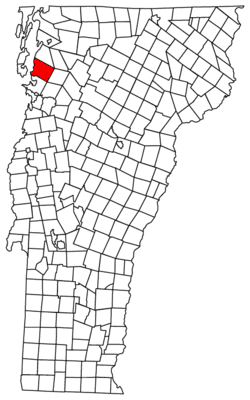
Jesse and his nearby neighbors on the west side of Milton are frustrated. They live just 20 minutes away from Burlington, the largest city in the state of Vermont. Despite the proximity to a city with nearly 40,000 residents, there is no cell phone coverage in western Milton, no cable television service, and no DSL service from FairPoint Communications. For this part of Milton, it’s living living in 1990, where dial-up service was one’s gateway to the Internet.
Jesse and his immediate neighbors haven’t given up searching for broadband service options, but they face a united front of intransigent operators who refuse to make the investment to extend service down his well-populated street.
“After many calls to Comcast, they eventually sent us an estimate for over $17,000 to bring service to us, despite being less than a mile from their nearest station,” Jesse tells Vermont Public Radio. “They also made it very clear that there was no plan at any point in the future, 2010 or beyond, to come here unless we paid them the money.”
Jesse and his neighbors want to give Comcast money, but not $17,000.
For at least 15 percent of Vermonters, Jesse’s story is their story. Broadband simply remains elusive and out of reach.
Three years ago, Vermont’s Republican governor Jim Douglas announced the state would achieve 100 percent broadband coverage by 2010, making Vermont the nation’s first “e-State.”
Vermont Public Radio reviewed the progress Vermont is making towards becoming America’s first e-State. (January 20, 2010) (30 minutes)
You must remain on this page to hear the clip, or you can download the clip and listen later.
<
p style=”text-align: center;”>
Gov. Douglas
In June 2007 the state passed Act 79, legislation that established the Vermont Telecommunications Authority to facilitate the establishment and delivery of mobile phone and Internet access infrastructure and services for residents and businesses throughout Vermont.
The VTA, under the early leadership of Bill Shuttleworth, a former Verizon Communications senior manager, launched a modest broadband grant program to incrementally expand broadband access, often through existing service providers who agreed to use the money to extend service to unserved neighborhoods.
The Authority also acts as a clearinghouse for coordinating information about broadband projects across the state, although it doesn’t have any authority over those projects. Lately, the VTA has been backing Google’s “Think Big With a Gig” Initiative, except it promotes the state as a great choice for fiber, not just one or two communities within Vermont.
Vermont used this video to promote their bid to become a Google Fiber state. (2 minutes)
Some of the most dramatic expansion plans come from the East Central Vermont Community Fiber Network. ECFiber, a group of 22 local municipalities, in partnership with ValleyNet, a Vermont non-profit organization, is planning to implement a high-capacity fiber-optic network capable of serving 100% of homes and businesses in participating towns with Internet, telephone and cable television service. In 2008, the group coalesced around a proposal to construct a major fiber-to-the-home project to extend broadband across areas that often don’t even have slower speed DSL.
The ECFiber project brought communities together to provide the kind of broadband service private companies refused to provide. Vermont Public Radio explores the project and the enthusiasm of residents hopeful they will finally be able to get broadband service. (March 8, 2008) (24 minutes)
You must remain on this page to hear the clip, or you can download the clip and listen later.
<
p style=”text-align: center;”>
ECFiber's Partner Communities
The Vermont towns, which together number roughly 55,000 residents, decided to build their own network after FairPoint Communications and local cable companies refused to extend the reach of their services. Providers claim expanding service is not financially viable. For residents like sheep farmer Marian White, interviewed by The Wall Street Journal, that means another year of paying $60 a month for satellite fraudband, the speed and consumption-limited satellite Internet service.
White calls the satellite service unreliable, especially in winter when snow accumulates on the dish. Unlike many broadband users who vegetate for hours browsing the web, White actually gets an exercise routine while trying to get her satellite service to work.
“I open a window and I take a pan of water and, a cup at a time, I launch warm water at the satellite dish until I have melted all the snow off the dish,” Ms. White says. “It works.”
Other residents treat accessing the Internet the same way rural Americans plan a trip into town to buy supplies.
Kathi Terami from Tunbridge makes a list of things to do online and then, once a week, travels into town to visit the local public library which has a high speed connection. Terami downloads Sesame Street podcasts for her children, watches YouTube links sent by her sister, and tries to download whatever she thinks she might want to see or use over the coming week.
A fiber to the home network like ECFiber would change everything for small town Vermonters. The implications are enormous according to project manager Tim Nulty.
“People are truly afraid their communities are going to die if they aren’t on the communications medium that drives the country culturally and economically,” he says. “It’s one of the most intensely felt political issues in Vermont after health care.”
Despite the plan’s good intentions, one obstacle after another has prevented ECFiber from making much headway:
The VTA rejected the proposal in 2008, calling it unfeasible;
Plans over the summer and fall of 2008 to approach big national investment banks ran head-on into the sub-prime mortgage collapse, which caused banks to stop lending;
An alternative plan to build the network with public debt financing, using smaller investors, collapsed along with Lehman Brothers on September 14, 2008;
An attempt by Senator Pat Leahy (D-Vermont) to insert federal loan guarantees into the stimulus bill in February 2009 was thwarted by partisan wrangling;
Attempts to secure federal broadband grant stimulus funding has been rejected by the Commerce Department;
Opposition to the plan and objections over its funding come from incumbent providers like FairPoint, who claim the project is unnecessary because they will provide service in those areas… eventually.
For the indefinite future, it appears Ms. White will continue to throw warm cups of water out the window on cold winter mornings.
Vermont Edition takes a comprehensive look at where the state stands in broadband and wireless deployment. (April 8, 2009) (46 minutes)
You must remain on this page to hear the clip, or you can download the clip and listen later.
<
p style=”text-align: center;”>
For every Tunbridge resident with a story about life without broadband, there are many more across Vermont living with hit or miss Internet access.
Take Marie from Middlesex.
Most residents in more rural areas of Vermont get service where they can from FairPoint Communications
“I am in Middlesex, about a half-mile off Route 2, and five minutes from the Capitol Building. Yet up until just recently, we had no sign of high-speed Internet. I understand that my neighbors just received DSL a few weeks ago, but when I call FairPoint, they tell me it’s still not available at my house, which is a few hundred yards up the hill. Hopefully, they’re wrong and I’ll see DSL soon,” she says.
Marie is pining for yesterday’s broadband technology — FairPoint’s 1.5Mbps basic DSL service, now considered below the proposed minimum speeds to qualify for “broadband” in the National Broadband Plan. For Marie, it’s better than nothing.
Geryll in Goshen also lacks DSL and probably wouldn’t want it from FairPoint anyway.
“We have barely reliable landline service. A tech is at my house at least three times per year. I was told the lines are so old they are decaying. Using dial-up is impossible. I use satellite which is very expensive and is in my opinion only one step up from dial-up. I am limited to downloads and penalized if I reach my daily limit,” he says.
Many Vermonters acknowledge Douglas’ planned 100-percent-broadband-coverage-by-2010 won’t come close to achievement and many are highly skeptical they will ever see the day where every resident who wants broadband service can get it.
Chip in Cabot is among them, jaded after six years of arguments with FairPoint Communications and its predecessor Verizon about obtaining access to DSL. It took a cooperative FairPoint engineer outside of the business office to finally get Chip service. His neighbors were not so lucky, most emphatically rejected for DSL service from an intransigent FairPoint:
“I laughed when Governor Douglas announced his e-State goal “by 2010” three years ago. Now I’m thinking I should have made some bets on this claim. It took years of legal battles and a zoning variance to obtain partial cell coverage here in Cabot. Large parts of the town still do not have any cell coverage. Governor Douglas can perhaps be forgiven – he has no technical knowledge, and as a politician would be expected to be wildly optimistic about such “e-State” claims. The Vermont Telecommunications Authority and the Department of Public Service should know better however. We’re talking about rural areas where there is no financial incentive to provide either DSL or cell service. It will take a huge amount of money to provide service to those remaining parts of the state. I’m not optimistic.”
[flv width=”512″ height=”308″]http://www.phillipdampier.com/video/Wall Street Journal Vermont Broadband Problems 03-02-09.flv[/flv]
The Wall Street Journal chronicled the challenges Vermonters face when broadband is unavailable to them. ECFiber may solve these problems. Some of the stories in our article are reflected in this well-done video. (3/2/2009 — 4 Minutes)
Tomorrow, the Federal Communications Commission is anticipated to release its long-awaited National Broadband Plan (NBP) for the United States.
The proposed road map to better broadband is supposed to bolster availability in rural communities, improve access in urban and suburban areas, and lay the groundwork for 21st century service and speeds.
FCC Chairman Julius Genachowski and Blair Levin, executive director of the FCC Broadband Initiative, have provided plenty of clues along the way. But one thing is certain — the true impact of the NBP will be to pass a de facto national stimulus program for corporate lobbyists, who will spend the rest of the year loving the goodies in the plan and lobbying away the parts they don’t.
Everyone but consumers have plenty of cash on hand to pay for a full assault on Capitol Hill, bending the ears of lawmakers to deliver the changes they can believe in, and outlawing the changes they don’t. Since those words will be underlined with fat campaign contributions, more than a few lawmakers are likely to listen.
National Public Radio’s Morning Edition asked the question, will the National Broadband Plan come up short? (4 minutes)
You must remain on this page to hear the clip, or you can download the clip and listen later.
The Winners
Public Institutions: To be a health care provider, a school, or library is a good thing these days. Some of the most generous and non-controversial elements of the NBP will be directed to public institutions. The cosmetic impact can’t be beat. Every elected official sees great potential from ribbon-cutting a showcase project that improves health care, local schools, or a nearby public library. To all three will come fast access fiber connectivity, tele-learning funding, and support for educating the public about broadband. Libraries will be given special attention to address connectivity, schools will likely find free or low cost fiber in their future, and the digitization of health care records and results will also promise improvements in health care delivery.
None of these projects will create a significant competitive impact on current broadband players, and even earmark-wary politicians will pose for the cameras to launch an inner-city library’s fiber project. Public safety will also be provided for with plans to improve connectivity and leveraging broadband for our first responders.
Wireless Companies: It can’t hurt to be a big telecommunications company with a wireless division, either. That’s because one of the major priorities for the NBP will be finding additional wireless spectrum to improve mobile data services in hopes they can provide increased access in rural communities and increased competition in urban ones.
More airways for mobile data will be “a core goal,” FCC Chairman Julius Genachowski said in February. That means AT&T and Verizon stand to gain the largest benefits from expanded spectrum. Smaller carriers like T-Mobile and Sprint will also benefit to a lesser degree. The FCC wants to double the number of frequencies available to wireless carriers — 500MHz that must be reallocated from other uses and delivered to providers in new broadband spectrum auctions.
Those with the deepest pockets will win the most spectrum, which assures in priority markets where spectrum is in demand, AT&T and Verizon will likely outbid others.
With a mobile broadband future at stake, that guarantees added pressure on smaller players to merge so they can pool resources to compete for needed airwaves. That could ultimately reduce competition and choice among wireless providers. Pricing is unlikely to drop either, so long as providers try and recoup their auction expenses.
Levin, in particular, is a proponent of wireless competition.
“We don’t know necessarily whether wireless is going to provide perfect competition to wired. But we do know it’s a very important piece of the puzzle,” Levin believes.
Consumers know better, especially in a country replete with $60-for-five-gigabytes monthly usage plans.
Since wireless broadband is increasingly delivered by the same companies providing wired broadband, wired providers show few signs of fear from bolstered wireless competition. AT&T U-verse and AT&T Mobility are AT&T. Verizon FiOS, DSL, and Verizon Wireless are all Verizon. Comcast and Time Warner Cable are both major investors in Clearwire, a wireless “competitor.”
Equipment & Infrastructure Providers: If you haven’t bought shares in Corning, manufacturer of fiber optic network components, or Cisco, which supplies broadband infrastructure, you might want to consider it. Both companies, among dozens of others, stand to reap millions in profits from the sale of components to construct 21st century broadband. All of the major equipment manufacturers and their respective trade associations have already submitted piles of comments to the FCC to help identify priorities and speed implementation of the NBP. Not only do they promote the use of their products, they also speak in terms of helping to create thousands of new jobs for those building the next generation of broadband. What’s not to like about that?
Big Broadband Users: Major companies like Google and Amazon are expected to benefit from improved broadband, especially if it also includes increased competition and open access to privately owned networks. Constructing larger national and regional networks assures increased capacity and reduced pricing, especially if networks face additional competition. To underscore the point, the NBP is expected to announce a review by the FCC of the wholesale rates big carriers charge for access.
The Losers
Broadcasters: The nation’s broadcasters are clearly the biggest potential losers in the NBP. Threatened with plans to capture large amounts of the UHF television band and selling it off to wireless providers may cripple at least some of the nation’s free over-the-air broadcasters. For some at the FCC, the fact that less than half of all Americans watch television over-the-air must have made their frequencies a rational target. Most Americans pay a cable, telephone or satellite company to deliver local stations. If the FCC reallocated half of the current UHF dial and sold it to wireless carriers, the remaining channel space would mean a far more crowded, interference-prone TV dial.
Some wireless industry advocates of the reallocation plan believe stations can get by with reduced power on a network of cell-tower-like relay transmitters delivering signals to more distant suburbs in their service area. Reduced power means reduced interference, they advocate, although it also means significantly reduced coverage areas, especially for rural Americans which depend on distant stations for free over-the-air television.
Right now, the NBP reallocation proposal will likely be “voluntary,” meaning stations can give up their channel and move to a different one, earning compensation from a federal auction fund to pay 100 percent of the expenses involved with the channel change. The National Association of Broadcasters, the television industry’s trade association, fears what begins as “voluntary” may evolve into “compulsory.”
Open Access Proponents: Least likely to be included in the NBP is a broad-reaching requirement that broadband providers open their networks, usually a duopoly in most American cities, to would-be competitors at fair terms and prices. The industry has been down this road before with traditional telephone service, and spent countless millions fighting proposals that would allow consumers to choose different local telephone companies. In the end, choice for residential phone service over landlines never really got off the ground because the terms and conditions never made economic sense to would-be competitors.
Should the FCC try to mandate that cable and telephone industry broadband lines be opened to third party competitors, that will unleash a full scale lobbying assault on Washington. In an election year, antagonizing big telecommunications companies is unlikely. Besides, the industry can always sue, claiming any open access mandate violates their corporate constitutional rights.
The Jury Is Out
Consumers: That’s you and I. Don’t expect the FCC to announce large, government-constructed, fiber to the home projects for every American now living with a broadband duopoly that delivers the least amount of speed for the highest possible price. When a significant minority of Americans believes any government project to improve broadband is really a Barack Obama Socialist Wiretapping project, no national scale version of municipal fiber is forthcoming. Not even close.
Most of the media attention will likely focus on speed goals, cosmetic projects for local institutions, and general statements about increased competition.
The immediate benefits for consumers will be nebulous at best. We’ll likely gain more from Net Neutrality protections. The only likely direct benefit, should it come to fruition, is the plan to create a nationwide, free wireless network to ease the digital divide. Specific speeds, technology used, and service areas aren’t known at this point. But private providers will work particularly hard to prevent this plan from ever seeing the light of day.
Consumer complaints about telecommunications companies have been skyrocketing. The Better Business Bureau reports that the most complaints the group received in 2009 pertained to cell phone providers and the cable, telephone, and satellite-providers.
Consumers are screaming for competition and they get rate increases instead.
Without clear measures promoting increased competition and oversight, American broadband will evolve into an expensive, usage-limited experience for most urban customers, and “good enough for you”-slow speed DSL service delivered by a de facto telephone company monopoly in rural areas.
Relief for consumers does not come from handing additional few-strings-attached benefits and resources to the same providers that are responsible for the current state of broadband service in America.
Hollywood: Lobbyists for the music and movie studios have been peppering Washington with demands that broadband-related legislation include increased penalties and restrictions to reduce copyright theft. They seek a mandate that repeat copyright offenders be banned from broadband service, that consumer electronics incorporate digital rights management technology to thwart unauthorized distribution or access to copyrighted content, and increased financial penalties for those who try.
Should the FCC incorporate these concepts in the NBP, it will likely create a consumer backlash because of past memories of overzealous copyright controls that hamper legitimate use of purchased content. It will also raise opposition from consumer electronics manufacturers.
Cable and Telephone Providers: There are benefits and risks to companies like Comcast, Time Warner Cable, Verizon, AT&T, Frontier Communications, and Windstream, among others.
Reform of the much-maligned Universal Service Fund, which currently benefits traditional telephone customers, could be a game-changer for many companies. Currently, Verizon and AT&T pay more into the USF than they receive from it. That is especially true for Verizon which is abandoning rural markets by selling off service areas to smaller providers. The USF provides a subsidy for rural phone companies to deliver affordable service at comparable pricing enjoyed in larger communities. By transitioning the USF into a Broadband Service Fund — using the money to construct and improve broadband service — many companies stand to benefit.
Frontier, CenturyLink, and Windstream are among those specializing in “rural phone service” and could use funding to defray the costs of broadband networks otherwise built with investor money. Verizon and AT&T could earn broadband funding for projects in their service areas currently not delivering broadband, or only providing anemic DSL service.
That has cable companies worried, particularly if the funds can be used to provide service in areas where they already offer service. Even worse, the thought of a new wireless broadband entrant in a community already served by cable and telephone company broadband.
McSlarrow
The cable industry is also worried about a proposal to let consumers ditch cable-owned cable boxes in favor of their own purchased alternatives.
Cable companies rent tens of millions of cable boxes that they control and manage. The FCC wants consumers to be able to purchase and manage their own devices capable of utilizing the services cable operators provide, without having to pay several dollars a month to borrow one from the cable company.
Kyle McSlarrow from the National Cable & Telecommunications Association sent a letter Friday to Genachowski offering the FCC a compromise. Offering seven points the NCTA says cable is willing to voluntarily abide to, McSlarrow suggests consumers should be able to buy such devices, but that they should not be required to access every possible service on offer from his cable members. Indeed, such devices also must incorporate security and copyright controls to limit unauthorized access and use of cable-delivered content.
That guarantees the same success rate consumers have today with CableCARD technology, which few consumers use or understand.
Regardless of what comes from tomorrow’s National Broadband Plan, look beyond the happy talk, general promises, and visionary language. The devil is in the details, definitions, schedules, and clear path from tomorrow’s platitudes into next year’s broadband improvement reality.
Broadband providers love to tout their Internet services as “unlimited, always on access at blazing fast speeds.” Increasingly, their service isn’t unlimited, it’s not always working, and those blazing fast speeds are doused in a shower of asterisks leading to fine print indicating “speeds are not guaranteed.”
Take Comcast, for example.
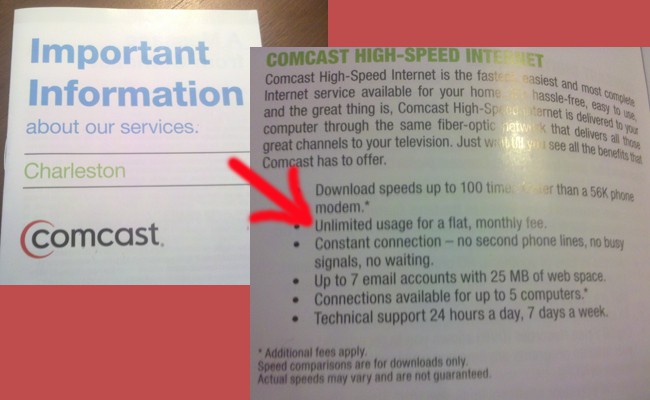
The Consumerist‘s reader Matt received a brochure from America’s largest cable operator filled with inaccuracies, falsehoods, and fine print. In order of appearance, let’s fact check:
Source: The Consumerist
Fiber Fiction: “Comcast High Speed Internet is delivered to your computer through the same fiber-optic network that delivers all those great channels to your television.”
Fiber Fact: Comcast does not operate an all-fiber network. Their distribution system uses a mix of fiber and standard copper coaxial cable. The fiber network is only a backbone, which connects to the same coaxial cable companies like Comcast have used since the 1970s. If you want a true fiber-optic network, you’ll need to sign up with Verizon FiOS or a municipally-run fiber provider. No national cable operator runs one. It’s part of their marketing rhetoric to try and capitalize on the benefits of fiber without actually spending the money to actually build a fiber system.
Speed Trap: “Download speeds up to 100 times faster than a 56K phone modem.”
Autobahn: This one has one of those asterisks attached — “actual speeds may vary.” Comcast doesn’t guarantee speed, and relies on the familiar “up to” disclaimer that phone companies love to use with their DSL service. If your neighborhood is clogged with users, the websites you visit run slowly, or Comcast has a problem somewhere, your speed will suffer.
Unlimited That Isn’t: “Unlimited usage for a flat, monthly fee.”
Unlimited Reality: Comcast has a usage limit of 250 GB per month. Exceed it and you potentially will get a call from Comcast lecturing you about your usage. Ignore them and you may be without your broadband service for a year.
Consumerist reader Matt was a victim of Comcast’s marketing doublespeak when he exceeded the limit and got a phone call from the company. Instead of being browbeaten by Comcast customer service, he was ready and armed with the brochure the company sent him:
I was told I used more data than they allow (250GB). I do not argue that I used over 250GB, in fact I went quite a bit over. Though I did want to ask for proof that affected their network, I figured it wasn’t the nicest way to start the interaction. I informed them that I used this because it was sold as “Unlimited usage for a flat, monthly rate.” He then told me it said “access.”
I had the brochure right next to me and quoted, “Unlimited usage for a flat, monthly rate.” He told me their website says something different, and my local franchise overstepped its bounds, and their website overrules the “Important Information about our services, Charleston SC” sales brochure sent to me. If I went over again (It goes by calender month, not billing cycle) I would be disconnected for 1 year without giving me a call.
I asked if Comcast had a tool to help me monitor bandwidth. “Not in your market” he told me. “Download something from Google that will do it for you.”
As consumers continue to expand their broadband usage to take advantage of services like online video and file backup, services Comcast itself offers, more and more will run up against Comcast’s monthly usage limit. Although your Comcast bill increases year after year, their usage limit has not. It was 250 GB in 2008 and remains the same in 2010. Thanks to Stop the Cap! readers Dave and Michael who sent word our way.
[Stop the Cap! will be closely following Google’s experimental gigabit fiber-optic broadband network. We’ll be bringing regular updates about the communities applying, the strategies they are using to attract Google’s attention, what the competition thinks, and the impact of the project on American broadband. You can read our earlier community profiles, and news about the project here.]
Topeka wants Google’s fiber experiment so badly, it is willing to rename itself to Google, Kansas — at least for the month of March, anyway.
Mayor Bill Bunten signed a proclamation Monday rechristening the city “Google, Kansas — the capital city of fiber optics.”
It’s all part of a well-organized effort to bring Google’s fiber optics to 122,000 residents living and working in the capital city of Kansas.
Think Big Topeka, a local group started by three people just a few weeks ago, was launched to promote Topeka as a candidate city. It includes links to e-mail elected officials, complete Google’s online nomination form, and coordinate upcoming events.
It has since collected more than 10,000 Facebook fans and has gotten a big push from most of the local broadcast and print media, which have run more than a dozen stories about the group and the petition to nominate Topeka. Several stations even have prominent links back to Think Big Topeka’s website. The city government is also an enthusiastic supporter of the experimental project.
Think Big Topeka knows how to get media attention. The group recently started running “flash mobs” — events where hundreds of people silently promote the project by suddenly stripping off jackets to uncover T-shirts promoting the Think Big Topeka campaign. Engineering events that are “made for television” guarantee plenty of attention on the evening news.
The Google “Think Big With a Gig” experiment has excited communities from coast to coast, convinced advanced fiber optic networks will bring new jobs, high technology business, and improved broadband service for both consumers and area businesses. Many hope the competition will also finally lower prices.
Incumbent providers Cox Cable and AT&T are the largest local providers.
Cox currently offers three broadband tiers — Essential 3 Mbps/384 kbps ($29.99), Preferred 12/1.5 Mbps ($46.99), and Premier 25/2 Mbps ($61.99).
Cox Cable, when asked by KSNT-TV news what they thought about the project brought a response from Kelly Zega, a representative from Cox Communications: “We have always believed competition in the marketplace is a healthy thing, as it leads us all to improve and innovate in ways that ultimately benefit consumers.”
AT&T offers U-verse in selected areas of Topeka, but most areas are still served by AT&T’s traditional DSL service which offers considerably slower speeds — Basic 768/384 kbps ($19.95), Express 1.5 Mbps/384 kbps ($24.95), Pro 3 Mbps/512 kbps ($24.95), or Elite 6 Mbps/768 kbps ($24.95). (Note the prices for Express, Pro, and Elite are identical — apparently which plan you get depends on what actual speeds AT&T is capable of delivering to your home.)
If Google can deliver faster speeds and lower prices, it’s no surprise thousands of Topekans are excited.
The Topeka Capital-Journal, the community’s daily newspaper, is also promoting the project on its editorial pages:
This excitement is being created by a lot of people who see opportunities to help the city grow and become an even better place to live, and are determined to do everything they can to make it happen.
Evidence of their enthusiasm and dedication was on display Thursday evening when about 500 of them gathered at the Ramada Hotel and Convention Center to talk about plans to revitalize downtown Topeka. Granted, the audience consisted of two different groups, but each had visions that, if fulfilled, would mean great things for our city.
We’ve written recently in support of Think Big Topeka, a group trying to convince Google that Topeka is the place to test an ultrafast Internet connection that promises to provide Internet service about 100 times faster than anything we are working with now. The effort has attracted about 7,875 supporters in a very short time and some of them turned out for Thursday’s meeting, sponsored by Heartland Visioning, to encourage others to jump on the bandwagon.
Supporters of the Google project and those interested in revitalizing downtown meshed during the evening as the discussion flowed between both issues.
Such a confluence of people and organizations with visions, dreams or plans — call them what you will — is a healthy, and welcome, development itself that bodes well for the city’s future. Most good things start with someone’s vision or dream, and they aren’t to be scoffed at or dismissed out of hand.
Think Big Topeka has more than 10,000 fans on its Facebook page
Dreams can come true… if a city actually applies. The city of Topeka will.
“The city of Topeka welcomes the opportunity to participate in this unique technological experiment, if selected as Google trial community, to benefit our citizens in providing all opportunities to access Internet technologies,” city officials wrote on the city’s Facebook page.
The city’s information technology department has been tasked with working on what they characterized as a very long and detailed application. Mark Biswell, IT director for Topeka city government, said his department has been hard at work on the application from the moment Google announced the project.
Shawnee county, which includes Topeka, is conducting an online survey running until Saturday asking residents about their interest in the Google fiber project. They are seeking input on what kinds of broadband speeds residents actually obtain, instead of relying on marketing promises made by the incumbent providers. They also want to learn how satisfied residents are with Cox and AT&T.
For Topeka, a city coincidentally working on its own revitalization plan for downtown development, the prospect of Google gigabit fiber could be the crown jewel of a complete city makeover.
[flv width=”640″ height=”500″]http://www.phillipdampier.com/video/KTKA Topeka Google Fiber 3-1-2010.mp4[/flv]
KTKA Topeka aired three reports about the Google fiber experiment, including an interview with one of the founders of the Think Big Topeka group. (3 minutes)
[flv width=”640″ height=”500″]http://www.phillipdampier.com/video/WIBW Topeka Group Wants Google’s Blazingly-Fast Internet To Come To Topeka 2-17-10.flv[/flv]
WIBW Topeka has these two reports featuring the Think Big Topeka group and how the city government is involved in the project. (4 minutes)
[flv]http://www.phillipdampier.com/video/KSNT Topeka City Renames Itself Google for March 3-1-10.flv[/flv]
KSNT Topeka has several reports about the organizing effort, a “flash mob” and Topeka city government’s strong belief in the project. (6 minutes)
[flv]http://www.phillipdampier.com/video/Think Big Topeka.flv[/flv]
Finally, Think Big Topeka has some of its own videos on offer, answering residents’ questions and cheerleading the effort to bring better broadband to Topeka. (3 minutes)
Be Sure to Read Part One: Astroturf Overload — Broadband for America = One Giant Industry Front Group for an important introduction to what this super-sized industry front group is all about. Members of Broadband for America Red: A company or group actively engaging in anti-consumer lobbying, opposes Net Neutrality, supports Internet Overcharging, belongs to […]
Astroturf: One of the underhanded tactics increasingly being used by telecom companies is “Astroturf lobbying” – creating front groups that try to mimic true grassroots, but that are all about corporate money, not citizen power. Astroturf lobbying is hardly a new approach. Senator Lloyd Bentsen is credited with coining the term in the 1980s to […]
Hong Kong remains bullish on broadband. Despite the economic downturn, City Telecom continues to invest millions in constructing one of Hong Kong’s largest fiber optic broadband networks, providing fiber to the home connections to residents. City Telecom’s HK Broadband service relies on an all-fiber optic network, and has been dubbed “the Verizon FiOS of Hong […]
BendBroadband, a small provider serving central Oregon, breathlessly announced the imminent launch of new higher speed broadband service for its customers after completing an upgrade to DOCSIS 3. Along with the launch announcement came a new logo of a sprinting dog the company attaches its new tagline to: “We’re the local dog. We better be […]
Stop the Cap! reader Rick has been educating me about some of the new-found aggression by Shaw Communications, one of western Canada’s largest telecommunications companies, in expanding its business reach across Canada. Woe to those who get in the way. Novus Entertainment is already familiar with this story. As Stop the Cap! reported previously, Shaw […]
The Canadian Radio-television Telecommunications Commission, the Canadian equivalent of the Federal Communications Commission in Washington, may be forced to consider American broadband policy before defining Net Neutrality and its role in Canadian broadband, according to an article published today in The Globe & Mail. [FCC Chairman Julius Genachowski’s] proposal – to codify and enforce some […]
In March 2000, two cable magnates sat down for the cable industry equivalent of My Dinner With Andre. Fine wine, beautiful table linens, an exquisite meal, and a Monopoly board with pieces swapped back and forth representing hundreds of thousands of Canadian consumers. Ted Rogers and Jim Shaw drew a line on the western Ontario […]
Just like FairPoint Communications, the Towering Inferno of phone companies haunting New England, Frontier Communications is making a whole lot of promises to state regulators and consumers, if they’ll only support the deal to transfer ownership of phone service from Verizon to them. This time, Frontier is issuing a self-serving press release touting their investment […]
I see it took all of five minutes for George Ou and his friends at Digital Society to be swayed by the tunnel vision myopia of last week’s latest effort to justify Internet Overcharging schemes. Until recently, I’ve always rationalized my distain for smaller usage caps by ignoring the fact that I’m being subsidized by […]
In 2007, we took our first major trip away from western New York in 20 years and spent two weeks an hour away from Calgary, Alberta. After two weeks in Kananaskis Country, Banff, Calgary, and other spots all over southern Alberta, we came away with the Good, the Bad, and the Ugly: The Good Alberta […]
A federal appeals court in Washington has struck down, for a second time, a rulemaking by the Federal Communications Commission to limit the size of the nation’s largest cable operators to 30% of the nation’s pay television marketplace, calling the rule “arbitrary and capricious.” The 30% rule, designed to keep no single company from controlling […]
Less than half of Americans surveyed by PC Magazine report they are very satisfied with the broadband speed delivered by their Internet service provider. PC Magazine released a comprehensive study this month on speed, provider satisfaction, and consumer opinions about the state of broadband in their community. The publisher sampled more than 17,000 participants, checking […]


 Subscribe