

Home » google » Recent Articles:

Online Video Hits Corporate Roadblocks – Google TV Blocked By Networks, Hulu+ Gets Thumbs Down

Phillip Dampier October 25, 2010 HissyFitWatch, Online Video, Video 4 Comments

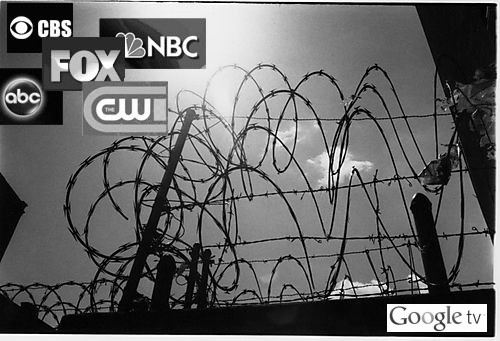
Early adopters of Google TV will find nothing but frustration if they want to watch ABC’s “Modern Family” and Fox’s “Glee” with the new broadband-driven TV service.  They can’t, thanks to America’s content companies erecting Berlin Wall-like blockades of programming the service was supposed to provide.

Google TV has already come under a state of siege from a coordinated campaign by the four major broadcast networks to keep programming off the new service until Google agrees to pay retransmission consent fees.  Even Hulu, which delivers online access to hundreds of shows for free, has successfully manned the barricades to keep “unauthorized” Google TV out in the cold.

Some of the virtual barbed-wire fences have become so sophisticated, many wonder whether the biggest players in online video are spending more time and energy on innovating new ways to stop people from accessing content than on actually delivering it.

For a service trying to gain attention out of the starting gate, Google TV has remarkably little mainstream programming to show on it.  To date, their most significant content partners are HBO’s Go service, available only to authenticated HBO subscribers, Turner’s TNT and TBS channels, also only available to current cable, satellite, or telco-TV video subscribers, and a CNBC “app.”

The spat between Google and the broadcasters is similar to the one between Cablevision and Fox in suburban New York City — until a company like Google agrees to pay a fee for the right to deliver content already given away for free online, the online portals that provide access will identify and block Google TV customers from accessing any of it.

Those fees are likely to be passed down to subscribers, and now some are wondering just how successful ventures like Google TV can be if consumers have to pay another monthly TV bill.

Wall Street is one, Variety notes:

Richard Greenfield, analyst for BITG Research, is a keen observer of the struggle for TV programmers to make money through Internet distribution of their high-priced programming. Amid the retrans battles for the major broadcasters, putting too much content online for immediate viewing, even with embedded advertising, undercuts their business and their rationale for seeking top dollar from subscription TV providers.

“We find it harder and harder to comprehend how broadcast television stations can demand retransmission consent fees from multichannel video providers, but at the same time place their content online for free,” Greenfield wrote in a research note titled “Broadcast TV Manifesto: If You Want to Be Paid Like Cable Nets, Start Acting Like Cable Nets on the Web.”

“While we acknowledge that the greatest value from retrans is access to sports programming (NFL, MLB, etc.) and other live events (‘American Idol’ finale, Oscars, etc.), none of which are streamed online for free, how can broadcast TV stations (and in turn broadcast networks) maximize value when so much content is being given away?”

That’s a major problem for any business plan, but excessive fees could also destroy interest in Google’s nascent entry into the world of online entertainment television.  Consumers already face steep hardware costs up to $300 just to make Google TV work.  Whether they would also part with a monthly subscription fee should not be too difficult for the folks in Mountain View to answer.

In fact, it’s the same answer Hulu’s owners are getting from viewers about its Hulu Plus pay-TV service, which delivers the same commercials as its free companion and charges $10 a month to watch them.

Subscribers to Hulu’s premium tier were promised access to entire runs of popular shows, programming not available on its free alternative, and a library of episodes that don’t expire and disappear after a few weeks.  But many paying customers complain Hulu Plus still limits most of its shows and offers few exclusives. Even less-in-demand shows like Fox’s “COPS,” profiling the criminally stupid for more than 23 years, remain limited on the premium (and free) service to a single month of episodes.

But nothing causes more annoyance than Hulu’s recently-increased advertising load, dumped equally on both sides of the pay wall.

“Why should I pay $10 a month when I get (mostly) the same shows for free on Hulu, and have to watch the same ads?” asks our reader Stephanie.  “It should be one or the other — ad-free pay or ad-supported free.”

Because Stephanie is hardly alone in asking that question, there are reports Hulu is about to slash its premium asking price in half to attract more subscribers.

Peter Kafka, who writes The Media Memo for All Things Digital, wrote Hulu is preparing to change its pricing as early as this week.

The idea is that paying subscribers get access to a deeper catalog of TV shows and movies than what the free service offers, as well as the ability to watch Hulu on devices like Apple’s iPhone and iPad, Microsoft’s Xbox 360 game machine and Internet-connected TVs from Samsung and Sony.

But a price cut would indicate that consumers haven’t bought in to the pitch. That shouldn’t be a shock, considering the other video options that consumers have, and the limits that Hulu’s content providers have placed on the service.

But even at half-price, many former Hulu Plus customers won’t be back.

Zwei, commenting on the rumored price change, said he dropped his subscription before the first month was up because of the Hulu’s byzantine rules and technical limitations over how premium shows can be accessed.

Watch it their way or not at all.

“You aren’t guaranteed the ability to stream to anything but your computer! “Fringe?” Not available to stream to my other devices. “Caprica?” Not available to stream to my other devices.  Why the heck would I want to pay $10 a month if I still have to watch a lot of the content on my Mac,” he writes.

Paul notes it’s also hard to attract paying customers when most of your library consists of old shows already rerun into the ground:

“The problem is that they are cutting all the most appealing content from the service, Hulu Plus has a huge catalog of content, but it’s 95% leftovers from the 80’s.  Give us current content when and how we want it (quickly and on the devices we want) and people will pay for it, even more than $10/mo.  But if they give us 20 year-old content that we might not even have liked the first time, they shouldn’t expect our money,” Paul says. “It’s funny when they get worked up about piracy too. It’s just another market force — people only go to it when they don’t have other valid options,  just like they’re doing here.”

Networks increasingly treat their programming as a valued commodity that can be sold, re-purposed, re-packaged, and re-sold again and again.  Syndication, DVD box sets, online rental, cable company on-demand, and online ad-supported streaming each can fetch plenty of money, and many agreements include temporary restrictions on other distribution mechanisms to avoid “diluting” the programming’s value.

Consumers don’t care about these restrictions, because many will simply search out the shows they want regardless of the source — legal or otherwise, preferably for free.

[flv width=”640″ height=”500″]http://www.phillipdampier.com/video/Google TV 10-25-10.flv[/flv]

Two reports about Google TV — a review of the service from KSTU-TV Salt Lake City’s ‘Kurt the Cyberguy’ and a report from KTBS-TV in Shreveport, Louisiana (5 minutes)

Jon Stewart & Taiwanese Animators Take On Net Neutrality

Phillip Dampier August 18, 2010 Net Neutrality, Video 1 Comment

Jon Stewart spent a few minutes last night making a tentative stab at Net Neutrality on The Daily Show, trying to begin educating viewers about an Internet controversy many net users don’t even know exists. (3 minutes)

From the people who brought you the incredibly creepy computer animation re-enactments of Tiger Woods’ blowout and Lindsay Lohan’s jail stint for Taiwanese television, the Verizon-Google deal is now fair play, right down to devil’s horns for executives at both companies.  (1 minute)

Crying Poverty: More Nonsense in the Media About Poor, Unfairly Compensated Big Telecoms

Phillip Dampier August 17, 2010 Data Caps, Editorial & Site News, Net Neutrality, Public Policy & Gov't, Wireless Broadband Comments Off on Crying Poverty: More Nonsense in the Media About Poor, Unfairly Compensated Big Telecoms

Phillip "Cry Me a River, Guys" Dampier

Like two peas in a pod, Robert Cyran and Bob Cox are back for the umpteenth time with their views on something.  A few years ago, they were upset because the group Radiohead decided consumers should name their own price for one of their albums.  This time it’s about Net Neutrality and variable pricing for broadband.  Writing for Reuters BreakingViews, they’re deeply concerned poor traditional phone and cable companies are being shortchanged — saddled with the costs of building and maintaining networks that content companies like Google, Apple, Cisco, and Microsoft get to use for free.

As for the four leading [content companies], they have a combined net cash pile of around $140 billion. Last year they spent $4.9 billion on capital expansion, a tenth of what the big four [telecom companies] paid to erect new cell towers, buy routers and extend fiber-optic cables.

[…]The introduction of variable pricing, or charging customers based on the data they consume, will help pay for the needed gear. But it means that the already unpopular [telecoms] will stick their customers with far larger bills — a recipe for political interference. Meantime, the [content companies] would continue to carry away what the telecom operators see as a disproportionate share of the benefits.

This analysis is a mile wide and an inch deep — fundamentally flawed because of information Cyran and Cox either ignored, didn’t know about, or didn’t care to consider.

First, Cisco is hardly a content company.  It is doing quite nicely feeding rumors of the forthcoming great tsunami of data — the “zettabyte era of broadband” that will result in a global traffic jam only they can help overcome. Cisco’s success comes from the sale of advanced networking equipment that can manage the growth of the Internet.  The amount of data that crosses today’s broadband wires has grown exponentially, even as the costs to manage it are increasingly declining on a per-gigabyte basis.  Apple is partly a content company, but more importantly is a developer of devices like the iPad and iPhone which are driving growth in wireless networks and helping justify the acceptance of monthly wireless phone bills easily over $100 a month in many households.  Google has content, but is also willing to take a plunge into being a provider itself, with plans to deploy an advanced 1Gbps fiber network that big telecom providers say cannot be built in a sensible way (to their investors.)  Finally, love or hate Microsoft, they have successfully powered the growth of personal computing which made the concept of broadband something telecom companies could actually sell to their shareholders as a viable business.

Cyran and Cox equate content providers and big telecom companies as unequal beneficiaries of the broadband revolution.  But just like many other powerful interests opposed to Net Neutrality, they forget those big telecom companies earn enormous revenue and profits from their customers — you and I.  The financial reports of all of these companies tell the story Cox and Cyran don’t.  Broadband profits among large telecom companies are the biggest growth area these companies have.  Deploying the service reaps financial windfalls.  Even with capital expenses involved in constructing fiber optic networks, broadband revenue can still make shareholders smile like no other component in today’s triple play packages.

On the wired side, Verizon has announced it has suspended further expansion of its fiber network FiOS indefinitely.  No other national cable or phone company is currently constructing true fiber to the home networks. Instead, most deploy fiber to the neighborhood and let coaxial or copper wiring cover the rest of the way.  Indeed, capital spending by many telecom companies is actually dropping.

On the wireless side, more than 90 percent of Americans now carry cell phones.  The monthly prices most pay for service exceeds that of their landline provider, if they have one.  Yet for all of the awful costs wireless providers face, AT&T and Verizon can’t wait to devote more time and energy to the wireless side of their business, because that is where the real money can be found.

It’s difficult to claim “victim” status of unequal treatment when you’re standing in a room filled with piles of cash.

The authors also completely ignore the fact companies that produce content don’t just throw it on the web for free.  An entire industry devoted to delivery of streaming media and other high bandwidth content buys fat pipelines from these telecom companies to deliver content to consumers.  Every content provider already pays their fair share for the traffic they generate.  Consumers pick up the rest as part of their monthly bill.

But Cyran and Cox believe these content companies (and consumers) should pay dramatically more to telecom companies for “upgrades” that may or may not materialize, and are frankly just the cost of doing business, which can be recouped from the relatively expensive broadband pricing Americans already pay for service.  The profit margins for broadband service are enormous.

Variable pricing, which we consistently call Internet Overcharging, is nothing more than price gouging, and the one true fact in their piece we agree with is that customers will get stuck with the bill.

CNET’s Marguerite Reardon: She Doesn’t Know Why Big ISPs Would Do Bad Things to Good People

Reardon is fine with this vision of your online future.

Marguerite Reardon confesses she’s confused.  She doesn’t understand what all the fuss is about regarding Google and Verizon teaming up to deliver a blueprint for a corporate compromise on Net Neutrality.  In a column published today, Reardon is convinced she’s on a debunking mission — to deliver the message that rumors of the Internet apocalypse are premature.

As I read the criticism of Google and Verizon’s supposed evil plan to demolish the Internet, and as I hear about “protests” of several dozen people at Google’s headquarters, I scratch my head and wonder: am I missing something?

The Google-Verizon Net neutrality proposal I read last week doesn’t sound nearly as apocalyptic as Free Press, a media advocacy group, and some of the most vocal critics out there have made it sound.

In fact, most of proposal sounded a lot like a plan FCC Chairman Julius Genachowski offered nearly a year ago, which many Net neutrality proponents seemed to support.

In short, Google and Verizon say they agree to a set of rules for the Internet that would prohibit broadband providers from blocking or degrading lawful content on the Internet. Broadband providers would also not be allowed to take action to impede competition.

This is pretty much what Genachowski has proposed.

OK, terrific. There is agreement.

But wait, Net neutrality zealots are still unhappy.

Hmmm… “zealots?”  Reardon probably just angered the majority of CNET’s readers, who now find themselves labeled as crazed Internet online freedom fighters — net fundamentalists who want absolute protection against big Internet Service Providers tampering with their Internet Experience.

Where can I get my membership card?

Reardon’s “debunk” consists of her narrow, inaccurate definition of Net Neutrality pounded into a pre-conceived notion of what is and is not possible in a competitive broadband marketplace.  In short, she’s satisfied we can all move along… there is nothing to see here:

What Free Press and Public Knowledge don’t seem to realize is that AT&T and Verizon already offer differentiated services today with enhanced quality of service to business customers. Verizon’s Fios TV and AT&T’s U-verse TV services are also examples of managed Internet services that are delivered to consumers. And the last time I checked, no one, other than their cable competitors, has complained about AT&T and Verizon offering competition in the TV market.

The truth is that if Verizon and AT&T wanted to cannibalize their broadband business with premium broadband services, they’d already be doing it. But they aren’t, because there hasn’t been a market for it.

The reality is that consumers are in control of what type of services are offered. If the public Internet can adequately deliver a service for free, then there’s no need to pay for it. But if someone can provide a better service over a dedicated network and there are consumers willing to pay for it, then why shouldn’t it be offered? Isn’t that why some people subscribe to a 768Kbps broadband service for $15 a month, and others pay $100 for a 50Mbps service?

So let’s debunk the debunk.

First, Net Neutrality is not about stopping broadband providers from offering speed-based tiers of service.  In fact, that’s the Internet pricing model we’ve all come to know and love (although those prices are just a tad high, aren’t they?)  Free Press and Public Knowledge do not object to ISPs selling different levels of broadband speed tiers to consumers and businesses to access online content.

Net Neutrality isn’t about stopping ISPs from selling some customers “lite” service and others “mega-super-zippy Turbo” service — it’s about stopping plans from some ISPs to establish their own toll booths on the Internet to charge content producers twice — once to upload and distribute their content and then a second time to ensure that content reaches a particular ISPs customers on a timely, non-speed-throttled basis.  Consider this: you already pay good money for your own broadband account.  How would you feel if you sent an e-mail to a friend who uses another ISP and that provider wanted to charge you 20 cents to deliver that e-mail?  Don’t want to pay?  That’s fine, but your e-mail might be delayed, as paying customers enjoy priority over your freebie e-mail.

A lot of broadband customers may never understand the implications of giant telecom companies building their own toll lanes for “preferred content partners” on the Internet because they’ll just assume that stuck online video or constantly rebuffering stream is the fault of the website delivering it, not their provider intentionally pushing it aside to make room for content from companies who paid protection money to make sure their videos played splendidly.

Second, Reardon need only look to our neighbors in the north to see a non Net Neutral Internet experience in Canada.  There, ISPs intentionally throttle broadband applications they don’t want users running on their networks.  They also spank customers who dare to try what Reardon insists Verizon would never stop — using their broadband service to watch someone else’s content.  With the application of Internet Overcharging like usage limits and consumption billing schemes, cable companies like Rogers don’t need to directly block competitors like Netflix.  They need only spike customers’ broadband bills to teach them a lesson they’ll not soon forget.

Within days of Netflix announcing their imminent arrival in Canada, Rogers actually reduced the usage allowances of some of their broadband customers.  If you still want to watch Netflix instead of visiting Rogers pay-per-view cable menu or video rental stores, it will cost you plenty — up to $5 per gigabyte of viewing.

Reardon seems to think giant providers like AT&T, Verizon, and Comcast care about what their customers want and wouldn’t jeopardize the customer relationship.  Really?  She herself admits she hates paying for hundreds of channels she never watches, yet providers are deaf to complaints from customers demanding an end to this practice.  What about the relentless price hikes?  Wouldn’t that drive off customers?  Perhaps… if customers had real alternatives.  Instead, with an effective duopoly market in place, subscribers pay “the man,” pay an almost identical price from the “other guy,” or go without.

Providers understand their power and leverage in the marketplace.  Until serious competition arrives, it would be a disservice to stockholders not to monetize every possible aspect of broadband service in the United States.

The check against this naked aggression on consumers’ wallets is from consumer groups who are fighting against these big telecom interests.

Before dismissing Net Neutrality “zealotry,” Reardon should experience the Internet in Canada and then get back to us, and more importantly those consumer groups she flicks away with disdain, and join the fight.

Search This Site:

Contributions:

Recent Comments:

Your Account:

Stop the Cap!
