Home » google » Recent Articles:

Kansas City Reacts to Google Fiber Project

Party time in Kansas City, Kansas

Kansas City, Kansas is creating some jealousy across the river in the much larger Kansas City, Missouri in reaction to Google’s announcement yesterday that it was bringing its 1 gigabit per second fiber to the home network to KCK.

Local bloggers called Google’s announcement “a game changer” for the city’s software developers and health care providers, who represent a large part of the city’s high tech economy. The announcement also thrilled local schools and universities, who will be able to deliver broadband service that rivals world leader South Korea in as little as one year from today.

Speculation about why Google chose the Kansas-based suburb of Kansas City has been rampant.  Among the biggest theories is that the local utilities, with whom Google must negotiate for space to accommodate its fiber cables, are owned by the local municipality, not private corporations.  With local government officials eager to cut red tape and avoid political or economic minefields which could delay the project, having public utilities as a partner may have made a decisive difference in the final decision.
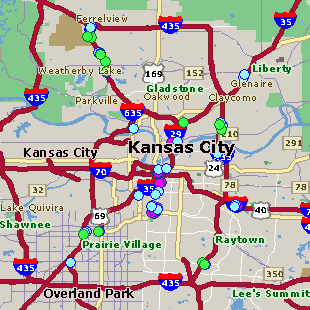
The 'Kansas City' in the smaller type represents the Kansas suburb of the much larger Kansas City, Mo.

Demographics experts suggest Google might have chosen KCK because it represents classic middle-America with a growing digital economy — a perfect laboratory to watch what comes from ultra high speed Internet access.

The presentation by Google rivaled a glowing Hollywood production, one TV news team remarked.  Live-streamed on the web to a global audience, company officials vaguely promised the choice of KCK was the beginning of a potentially broader fiber network not just limited to a single Kansas city, although company officials seemed to restrain themselves out in the parking after the event, suggesting the network could be expanded regionally, saying nothing about other cities further afield.

Local newscasts told the Google story to Kansas City viewers in varying degrees of intensity, often relegated to pointless outdoor live stand up shots scattered around the city.  There isn’t much to show for a network that exists only in the form of a website.

A Silicon Valley expert echoed the sentiment that faster broadband can bring dramatic development to the communities that have it, sometimes in surprising ways.  It’s less about what one can do with 1Gbps service today and more about the possibilities for tomorrow.  But CNBC’s Jon Fortt added some applications may have only limited national appeal if the rest of the country lives with slower broadband service than cannot support the latest online innovations.

Still, excitement is easy to find among the journalists, local politicians, and other community members across the range of local news coverage.

It brings to mind just how ironic it is that a city like KCK will soon have some of the fastest broadband connections in the country while states like North Carolina are on the cusp of enacting legislation that will guarantee they will never be a part of the transformative broadband revolution — at least those who don’t live in Wilson or Salisbury.  Every member of the legislature in that state should watch and learn.

[flv width=”480″ height=”380″]http://www.phillipdampier.com/video/KSHB Kansas City Google to KCK 3-30-11.flv[/flv]

KSHB-TV Kansas City’s NBC station devoted the most time to Google’s arrival, including a special interview by satellite with CNBC reporter Jon Fortt, discussing the implications of 1Gbps broadband for KCK.  (11 minutes)

[flv width=”640″ height=”380″]http://www.phillipdampier.com/video/KCTV Kansas City Google to KCK 3-30-11.flv[/flv]

KCTV-TV Kansas City’s CBS affiliate spent more than five minutes in their newscast covering Google’s gigabit network, including interviews with a local blogger and health care expert.  (7 minutes)

[flv width=”512″ height=”308″]http://www.phillipdampier.com/video/WDAF Kansas City Google to KCK 3-30-11.flv[/flv]

WDAF-TV, the Fox station for Kansas City, emphasized what Google will do for area students in bringing faster, more reliable broadband to the region.  (7 minutes)

[flv width=”640″ height=”380″]http://www.phillipdampier.com/video/KMBC Kansas City Google to KCK 3-30-11.flv[/flv]

KMBC-TV, Kansas City’s ABC station, tries to explain what 1Gbps broadband represents with a water faucet.  The station’s coverage continues with the impact fiber broadband will have on local health care.  (4 minutes)
Breaking News: Google Selects Kansas City, Kansas for 1Gbps Fiber to the Home Service

Google announced this morning it has chosen Kansas City, Kansas as the site of the search giant’s experimental 1Gbps fiber to the home service.

The announcement came at 12 Noon ET on Google’s blog:

After a careful review, today we’re very happy to announce that we will build our ultra high-speed network in Kansas City, Kansas. We’ve signed a development agreement with the city, and we’ll be working closely with local organizations, businesses and universities to bring a next-generation web experience to the community.

Later this morning we’ll join Mayor Reardon at Wyandotte High School in Kansas City, Kansas, for an event we’ll carry live on the Google YouTube channel—be sure to tune in at 10am PDT to watch.

In selecting a city, our goal was to find a location where we could build efficiently, make an impact on the community and develop relationships with local government and community organizations.

Google’s video talked a lot about bandwidth and the need for more of it.  While Google is striving to bring one gigabit access to ordinary consumers, other providers like AT&T are seeking to limit it.  The competition between cities looking for super high speed access was fierce, demonstrating Americans are hungry for better, faster, and unlimited broadband service.  Unfortunately, some of the country’s largest providers want to deliver the least amount of service possible for the highest price.

Google’s project is likely to call out more than a few providers, but until companies like Google can deliver real competition to America’s phone and cable broadband duopoly, only a handful of communities like Kansas City will exist as an oasis in the broadband desert AT&T wants to create across its middle-America service area.

[flv width=”640″ height=”380″]http://www.phillipdampier.com/video/Google and Bandwidth.flv[/flv]

Google released this video showcasing what its 1Gbps network will do for the people of Kansas City, Kansas.  (3 minutes)

Google Fiber Will Have to Wait Until 2011; Applications “Exceeded Our Expectations”

Phillip Dampier December 15, 2010 Broadband Speed, Community Networks, Editorial & Site News, Google Fiber & Wireless Comments Off on Google Fiber Will Have to Wait Until 2011; Applications “Exceeded Our Expectations”

Some 1100 communities will have to wait until next year to learn if they are among the one(s) chosen for Google’s new 1 gigabit fiber to the home network.

An announcement on Google’s official blog broke the news to anxious readers this morning:

We had planned to announce our selected community or communities by the end of this year, but the level of interest was incredible—nearly 1,100 communities across the country responded to our announcement—and exceeded our expectations. While we’re moving ahead full steam on this project, we’re not quite ready to make that announcement.

We’re sorry for this delay, but we want to make sure we get this right. To be clear, we’re not re-opening our selection process—we simply need more time to decide than we’d anticipated. Stay tuned for an announcement in early 2011.

Google has also been working on a “beta” network, serving 850 private homes and condominiums on the main campus of Stanford University, owned primarily by the faculty.

That a company the size of Google faces delays from the challenges involved in building a fiber-to-the-home network speaks to similar delays that often slow down municipal broadband deployments.  Community broadband critics often seize on such delays as evidence the networks are not viable and run by unqualified personnel.  But as Google illustrates, such delays are common whether they are run by private or public entities.

Better Late Than Never: FCC Chairman Admits Displeasure with Verizon-Google Net Neutrality Pact

Courtesy CTIA

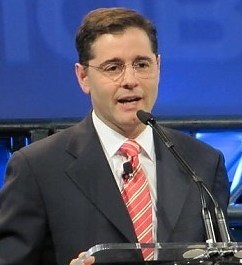
Julius Genachowski

Federal Communications Chairman Julius Genachowski signaled recognition he was outmaneuvered by some of America’s largest broadband companies when he told attendees at the Web 2.0 Summit last week that a Verizon-Google compromise on Net Neutrality did serious harm to the Commission’s own plans on the subject of a free and open Internet.

“I would have preferred if they didn’t do exactly what they did when they did. It slowed down some processes that were leading to a resolution,” Genachowski said.

Genachowski was referring to last summer’s sudden agreement between the two tech giants — former opposites on Net Neutrality — regarding a proposed compromise.  Under its terms, Verizon would guarantee free speech rights on the Internet, but Google would concede Verizon’s rights to use limits, throttles, and other “network management” techniques on its wireless networks, which are critically important to Verizon’s bottom line.  Genachowski had been advocating broad-based Net Neutrality protections for all technologies, including wireless.

When word of Verizon and Google’s proposal hit the New York Times, it caused a series of confidential talks among industry players and FCC staffers to collapse.  That wasn’t bad news for consumer groups, who were locked out of the discussions from the start.  But it also may have also taken the wind out of the sails of the regulatory body’s urgency to implement broadband reform policies, as members of Congress opposed to the concept used news of the voluntary agreement as cannon fodder against “unnecessary and intrusive” government regulations.

It also embarrassed the FCC, which Daily Finance calls the most ineffectual regulatory agency in Washington.

Ever since the talks collapsed, all sides have been frustrated by the Commission’s apparent ongoing inaction on Internet policy.  Genachowski had made speeches earlier this year that left many with the impression Net Neutrality was a front burner issue at the Commission.  But as 2010 draws nearer to a close, the Commission has made no progress on the issue.  The incoming Republican Congress will not make it any easier, and consumer groups continue to call on the Commission to act before the end of the year.

Free Press President and CEO Josh Silver issued this statement:

“We are heartened to hear Chairman Genachowski finally express his disappointment with the Verizon-Google proposal. The loud public backlash made it evident that consumers would not accept a deal that would have divided the Internet into fast and slow lanes and allowed Internet service providers to block and prioritize content accessed through wireless devices. Clearly, relying on backroom deals cut between giant industry players is not the way to make policies that protect the public interest.

“The American people are still waiting for the chairman to deliver on his promise to establish real Net Neutrality rules that would prevent AT&T, Comcast and Verizon from creating toll roads on the Web. There is only one Internet, and consumers need clear rules to ensure that they are protected from Internet service providers who are seeking to monetize and monopolize the Web to pad their bottom lines.”

Search This Site:

Contributions:

Recent Comments:

Your Account:

Stop the Cap!