Home » google » Recent Articles:

Just About Everyone Supports Levying New $1-5 Tax on Your Broadband Service

Outside of a handful of consumer groups, just about everyone — including one “anti-tax” Republican on the Federal Communications Commission — favors the imposition of a new broadband tax on your Internet connection.

It is all a part of the Federal Communications Commission’s effort to transform a badly-outdated Universal Service Fund (USF) into the Connect America Fund (CAF) — an ongoing project to help defray the costs of wiring rural America for broadband service.

Phone and cable companies are on board. So are several state regulators. Even search engine giant Google favors applying a surcharge to consumer bills to retire a funding formula currently dependent on declining landline phone revenue.

In April, the FCC began accepting comments on its proposal to expand the number of telecommunications services subject to the surcharge, currently found on telephone bills. The FCC has proposed a number of possible taxes including the new broadband fee, a tax on text messages, or moving to a flat fee for each phone line instead of a variable tax rate (currently around 18%).

Virtually every major telecommunications company provisionally supports the new tax, for at least three reasons:

  1. Most can benefit from future CAF funding opportunities, dipping into the fund to help subsidize expanding broadband into areas where current “return on private investment”-standards make deployment unprofitable;
  2. Consumers will pay the tax, not providers;
  3. The companies are confident their fierce lobbying will get the FCC to drop a proposed requirement the fee be included in the advertised price of broadband service. They want the fee broken out separately on customer bills, in part because they fear higher-advertised-prices for broadband will discourage customers from buying.
Google also supports the new tax because they profit from a larger broadband audience accessing their web pages and services. If the FCC were to tax online services, as Google fears, it would be bad news.

“Saddling these offerings with new, direct USF contribution obligations is likely to restrict innovative options for all communications consumers and cause immediate and lasting harm to the users, pioneers, and innovators of Internet-based services,” Google argued.

The Fiber to the Home Council, another industry group, was disturbed by one FCC proposal that would levy an increasingly higher percentage of the new tax on customers with progressively faster high speed connections. Although the Council agreed with many consumer groups that any new broadband tax would discourage broadband adoption, it was alarmed with the proposition of taxing consumers the most for selecting the highest speed broadband tiers.

“The Commission should not impose a fee that increases with greater performance capabilities (capacity/speed) because that would discourage plant and service upgrades and hinder the expansion of critically important high-speed broadband services,” the Council wrote in its comments to the FCC.

The Fiber to the Home Council is concerned about one proposal that would levy increasingly higher taxes the higher your connection speed.

With 19 million Americans currently unable to obtain broadband service, adding a new tax on existing broadband customers’ bills would bring in millions that the CAF will ultimately award to rural landline providers and cable operators to encourage them to expand their broadband networks.

But consumer groups including Free Press worry the new tax would rob Peter to pay Paul, and further discourage poor Americans who can’t afford current broadband prices from ever signing up for service.

“In other words, as the Commission reforms the overall USF system in the name of greater broadband adoption, particularly among rural, poor and elderly consumers, assessing [a broadband tax] could lead to an overall lower level of broadband adoption, despite the availability of new broadband subsidies,” writes Free Press research director S. Derek Turner in an official filing with the FCC.

Free Press called the current comments from industry players largely as expected.

“Industry commenters simply offered self-serving proposals that will ensure that their (but not necessarily their customers’) contribution burdens are as low as possible,” Turner wrote. “We instead are strongly encouraging the Commission to conduct actual cost-benefit analysis prior to adopting rule changes that could have massive unintended consequences for consumers.”

Thinks a broadband tax will reduce broadband adoption.

Outside of a small handful of remarks from end users, the overwhelming majority of comments received by the FCC are from providers, industry groups, and telecommunications regulators. Almost none come from actual consumers, who will ultimately pay the proposed tax.

Some conservative anti-tax groups have been alarmed by the tax expansion and Republican FCC Commissioner Robert McDowell’s apparent support of it. McDowell issued a statement in April declaring his support for reform of the USF system to broaden the tax to additional telecommunications users:

[…] “To put the importance of contribution reform into perspective, the contribution factor, a type of tax paid by telephone consumers, has risen each year from approximately 5.5 percent in 1998 to almost 18 percent in the first quarter of this year. This trend is unacceptable because it is unsustainable. Furthermore, the cryptic language on consumers’ phone bills, combined with the skyrocketing “tax” rate, has produced a new form of “bill shock.” We must tame this wild automatic tax increase as soon as possible.

[…] “Controversy, however, should not deter us from lowering the tax rate while broadening the base according to the authority granted to us by Congress. The current pool of contributors is shrinking. It must be expanded, but we must do so only within our statutory authority while keeping in mind the international implications of our actions.”


Selling Google Fiber: It’s Not $70 Broadband That Will Win the Masses

Phillip Dampier

While tech fans in Kansas City rejoice over 1Gbps broadband for $70 a month, the average broadband user will think long and hard about the prospect of paying $840 a year for broadband at any speed.

That is why Google Fiber-delivered broadband in and of itself is not a cable/phone company-killing proposition.

We too easily forget our friends and neighbors that seem clueless satisfied with their 3Mbps DSL account from AT&T that they were sold with a phone line package for around $60 a month. Web pages slow to load and constantly-buffering multimedia? In their world, that means “the Internet is slow today,” not their provider.

Phone and cable companies have the internal studies to back up their claims that price matters… a lot. Those who treat the Internet as a useful, but not indispensable part of their life are going to be a tough sell at $70 a month. In fact, it is my prediction many future income-challenged and older customers will splurge on Google’s free-after-paying-for-installation 5Mbps service, satisfied that speed is currently “good enough” for the web browsing, e-mail, and occasional web video they watch on their home computer.

That is why Google was smart to offer the ultimate in “budget Internet.” Free after the $300 installation fee (thank goodness for the interest-free budget $25 payment plan) is far better than $20-25 a month for 1-3Mbps service many cable and phone companies offer their “light users.” It also brings Google’s fiber into the customer’s home, a perfect way to up-sell them later or offer other services down the road.

But the smartest move of all was Google’s very-familiar quasi-triple play package price point — $120 for broadband and television service (they really should bundle Google Voice into the package and cover the phone component for those who still want it). With the phone and cable company charging upwards of that amount already for after-promotion triple-play service, the sticker shock disappears. It’s no longer $70 for broadband, it’s $120 for everything. That is a much easier sell for the non-broadband-obsessed.

It also provides Google a critically-important broadband platform to roll out other services, including those that will appeal to customers who don’t have the first clue what a megabit or gigabit is all about. They don’t really care — they just want it to work and deliver the services they want to use hassle-free.

For Google Fiber to prove a profitable proposition, the search engine giant has to:

  • Find a way to manage the huge infrastructure and installation costs, especially bringing fiber lines to individual homes. Middle-mile networks with fiber cables that string down major roadways, but ultimately never connect to individual homes and businesses are far less expensive than providing retail service. Google’s $300 installation fee is steep, but manageable with payments and even better when customers commit to a multi-year contract to waive it;
  • Offer the services customers want. An incomplete cable television package can be a deal-breaker for many customers who demand certain sports or movie channels. Although younger customers may not care a bit about cable television service, they also may not be able to afford the $70 broadband-only price. Google will need to attract families, and most of them still subscribe to cable, satellite, or telco TV. They are also the most grounded customers, an attractive proposition for a company dealing with high infrastructure expenses that will take years to pay off. It’s harder to cover your costs selling to a customer still in school and likely to move after they graduate in a few years;
  • Sell customers on the hassle and inconvenience of throwing out the incumbent provider in favor of fiber, which will require considerable rewiring. It is one thing to express dissatisfaction with the local cable or phone company, it is another to take a day off from work to return old equipment and have unfamiliar installers in your home to provision fiber service. Some don’t want the hassle or lost time, others won’t switch until they get around to cleaning their messy house or apartment before they invite Google inside;
  • Deliver an excellent customer service experience. Google’s current level of support for its web-based services would never be tolerated by a paying broadband/cable customer. Google will have to learn as they go in Kansas City, but first impressions can mean a lot;
  • Expansion to get economy of scale. It is highly likely Google Fiber is a marketplace experiment for the company, and one it will study for a long time before it decides where to go next. Google’s “beta” projects are legendary and long, and if their fiber experiment does prove successful (or at least potentially so), the company will need to expand it rapidly to enjoy the kinds of vendor discounts a super-player can negotiate.

Verizon FiOS is the largest fiber to the home network in the United States. Their “take rate” of customers willing to sign up for the service has not exactly put incumbent cable companies into bankruptcy, even with $300-500 reward debit rebate cards and ultra-cheap introductory rates. Motivating subscribers to switch has never been as successful as theory might suggest. But Verizon has also shown other providers they can hard-negotiate significant discounts on hardware and equipment, and price cutting sessions have become ruthless.

At least Google has set its targets at reasonable levels. Only between 5-25% of eligible families have to commit to signing up for service in each “fiberhood” for Google to proceed with service rollout in that immediate area. That’s a realistic target with all of the factors necessary to deem the project a success.

Adam Smith’s Invisible Hand in Broadband: You Don’t Need More than 2Mbps

The views of the Adam Smith Institute, despite the near-global financial meltdown engineered by the Masters of the Universe.

Forbes columnist Tim Worstall is unimpressed with Google’s foray into fiber optics.

Worstall, a Fellow at the Adam Smith Institute in London, has repeatedly penned columns tsk-tsking the global broadband speed race.

In his world view, nobody except certain specialists needs any connection faster than 2Mbps:

The most obvious being that outside certain very specific uses (video editing for example, where people can pay up for their own T1 line) there’s not really much evidence that speeds above 2 Mbps or so actually improve productivity or economic performance/growth. Sure, they’re great for consumers who want to download movies but that’s not really a justification for a large scale infrastructure program.

Worstall’s Luddite-like knowledge of broadband technology makes it difficult to take him seriously. Notwithstanding the fact a T1 line delivers just 1.5Mbps (at a cost several times a typical cable or DSL broadband connection), Worstall’s declaration that faster speeds are only good for “downloading” movies (the concept of streaming also escapes him) is simple nonsense.

Worstall’s tantrum is really part of a bigger discussion about how to do broadband better in both the United Kingdom and the United States. Incumbent providers are dragging their feet while reaping profits for overpriced, too-slow service. Consumers and businesses are fed up, and some are now increasingly turning to the government to do-something to shake up the status quo.

Government? For those slavishly devoted to free market ideals at the Adam Smith Institute, such a notion guarantees an intemperate outburst with phrases like “government takeover,” “government interference in private business,” or “government monopoly” — all ideas Worstall complains are “blindingly awful.”

“The idea that the solution to anything is a government run engineering monopoly just boggles the mind,” Worstall declares.

In his piece, “Why High Speed Broadband Just Doesn’t Matter,” Worstall has just a single litmus test to define broadband worthiness: how much economic value can be extracted from the Internet — Ferengi economics at their finest.

Worstall (Image: Forbes)

Worstall:

So more people can watch TV. Apologies, but this doesn’t really convince. Higher definition TV just isn’t the sort of technology that boosts the economy of a country. It might be nice to have but it most certainly does not justify taxing some to provide the service to others.

[…] The truth is that as long as you’re getting broadband of a kind (2 Mbps say) then it’s possible to extract that economic value. Faster speeds might be nice but they’re just not necessary for economic development.

Even if you accept Worstall’s inaccurate contention fast Internet is only good for watching online entertainment, he evidently forgets PricewaterhouseCoopers estimated the value of that industry at $2 trillion, and that was by 2011. Why even have a cable television business, if the only thing it is good for is watching reality shows and Law & Order reruns? Because it makes money — lots of it.

Back to Google, which is creating a bit of a pickle for the cable and phone companies — an increasingly fat and happy bunch earning easy profits selling broadband at duopoly market prices. Proponents for better broadband advocating for new, publicly-owned broadband networks have had to confront astroturf and conservative groups using popular memes that “big government” cannot do anything right and if there was a market for gigabit broadband, private companies would already be selling it.

Starting this summer, Google is.

That spells t-r-o-u-b-l-e for the corporate love muffins at the Adam Smith Institute and their industry friends who are quite happy with the way things are today, thank you very much. Google just happens to be an example of a free market success story — a ‘responsible’ company willing to invest money in the game-changing broadband Worstall and friends spent years arguing we don’t actually want or need.

As Kansas City residents line up around the virtual block, eagerly plunking down $10 to “pre-register” for Google service, it becomes difficult to continue the standard line that super-fast Internet is just a tech-geek curiosity.

So what does a free-market-knows-best-devotee do in light of all this? Change the story.

Worstall picks up a premise first offered by The Guardian and runs with it. Namely, Google is actually riding the wave of past phone company failures to cheaply benefit from assets those companies deployed first:

There’s a very large difference between being able to do something usefully experimental with an orphaned asset and having to pay for the construction of that asset in the first place. The telecoms companies lost fortunes on laying that fibre (indeed, several, including such as Global Crossing, went resoundingly bust for billions in doing so). That something that was built for $100 can find a use when it is sold for $1 (just to make up some numbers) is not an argument in favour of spending the $100.

Yet that is exactly what the argument being proposed is. Look, Google’s got really cool fast broadband, now we should build it for everyone! What’s being missed is that, at least so far as we know as yet, that really fast broadband isn’t worth the cost of building it. It only makes sense even for Google because they’ve not had to pay full price for it.

Google got a discount, so that is why they are in the business.

Worstall’s declaration is news to Kansas City, which has been enduring Google’s construction crews for months as they lay fiber infrastructure across the metropolitan area. Evidently Google hired illusionist David Copperfield to perform the masterful trick of shading the truth:  re-purposing already-there fiber while pretending it was being buried and strung for the first time.

Adam Smith didn’t have super fast broadband when he posited his views on unfettered free markets in the 1700s. If his devoted followers are left in charge, you won’t either.

AT&T Sticks It to Google, Blocking Play Store Movies on Its 3G/4G Wireless Network

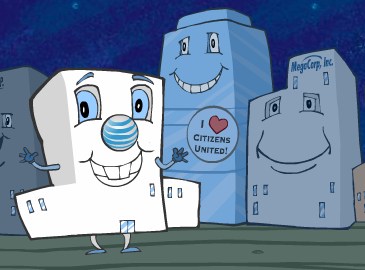
AT&T loves corporate free speech rights, the same ones it is using to deny customers access to Google’s Play Movies service.

With wireless Net Neutrality rendered largely ineffective with the help of AT&T and Verizon Wireless’ extensive lobbying and legal threats, AT&T has leveraged its right to govern its own network by deciding to block its wireless customers from watching Google Play Store’s streaming movie service over its 3G and 4G networks. This block is enforced even though AT&T already throttles heavy “unlimited” users and charges others more for using more data.

Geek.com was the first to discover AT&T’s curious dislike of Google Play Movies, while leaving other streaming services like Netflix, HBO Go, YouTube, and others alone (for now):

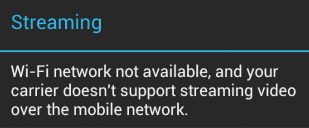
Instead of The Anchorman […] I was greeted with an error message telling me that I was not allowed to stream this movie over the mobile network. Assuming it was just an error, I tried again and got the same message. After a few minutes of playing with settings, it became clear that I was not going to be able to watch this movie without WiFi.

Yes, it seems that AT&T has removed the ability to watch Google Play Movie files over their 3G and LTE networks. This only happens with Google Play Movies, and only on AT&T. […] Curiously enough, you can download or “pin” a Google Play Movie over 3G and LTE and the only warning you get is one from Google explaining that you might incur data costs.

AT&T and Verizon have both declared Net Neutrality violates their free speech rights as corporate citizens — rights further expanded with the Supreme Court’s “Citizens United” decision.

When Federal Communications Commission chairman Julius Genachowski sought to introduce mild Net Neutrality protections for the Internet, both companies threatened to sue (Verizon has a case pending) and conservative commentators launched into tirades about “an Obama takeover of the Internet.”

RUSH LIMBAUGH: Today the FCC approved a proposal by chairman Julius Genachowski to give the FCC power to prevent broadband providers from selectively blocking web traffic. And that’s just a ruse. Net Neutrality is not what this is really all about. This is about the feds wanting to control the Internet just as they control the public airwaves. They want to be able to determine who gets to say what, where, how often — they want to be able to determine what search services are providing what answers to your queries. It’s total government control of the Internet, and the regime has just awarded it to itself.

It’s another gleaming aspect of free speech, free market, private industry Obama has decided to take over as a Christmas present to himself and the Democrat National Committee and to Mr. Soros. He’s even beaten Hugo Chavez to the punch. Chavez is just talking about taking over the Internet in Venezuela; Obama has got it done.

Geek.com doesn’t think the Obama Administration is blocking Google Play over AT&T — AT&T is. They just cannot understand the reasoning why:

I can’t imagine any real world justification for this behavior. If you pay your carrier for an internet connection to your phone, should the provider really be allowed to control how you use that connection? What’s more is that this happened over AT&T’s high speed and mostly empty LTE network. I can easily create a wireless hotspot on this same phone and stream a video from the Nexus 7, using the exact same data connection to accomplish the exact same task. This move is confusing at best, and AT&T is going to quickly alienate customers eager to take advantage of their brand new LTE devices as they receive them.

[flv width=”640″ height=”500″]http://www.phillipdampier.com/video/Corporateland.flv[/flv]

Mark Fiore channels Disney-sentimentality schtick on a whole new level with his take on AT&T’s Pinocchio-CorporateLand dream come true: the right to be human. (1 minute)

Comcast Brings Back Its Usage Cap… Now With Overlimit Fees for Your Inconvenience

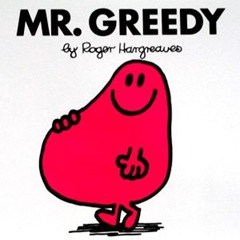
Mr. Greedy has just landed in Nashville and wants another $10 from Comcast customers who blow through their allowance.

Comcast’s temporary withdrawal of its 250GB usage cap did not last long. Although the company rescinded its usage limit in May to consider new options on how to handle “heavy users,” it hinted caps might be back, sometimes accompanied by automatic overlimit fees for customers who exceed their allowance.

Broadband Reports has learned Comcast plans to introduce a new 300GB usage cap on its customers in Nashville with an overlimit fee of $10 for each 50GB a customer runs over their limit.

Comcast customers in Nashville were told in an e-mail message from the company the new usage cap and overlimit fee represented “an evolution” for Comcast’s broadband service.

From Comcast’s website in Nashville:

When you exceed 300 GB of data usage, you will receive an email, an in-browser notice and an additional 50 GB will be automatically allocated. In order for customers to get accustomed to the new data usage management plan, we will be implementing a courtesy period. That means you will not be billed for the first three times you exceed the monthly 300 GB allowance during a 12-month period. Should you exceed the monthly allowance after the courtesy period expires, you will automatically be charged $10 each time we need to provide you with an additional 50 GB of data for usage beyond your plan.

How generous of them.

Customers traveling southeast from the city down Interstate 24 can be in Chattanooga in several hours and experience EPB Fiber — a community broadband provider that provides speeds up to 1,000Mbps and does not have usage caps, nor a “need” to charge customers another $10 whether they exceed their usage cap by 1 or 49 gigabytes.

Comcast’s newest Internet Overcharging scheme takes effect Aug. 1, and currently applies only to Nashville customers. Those who want to give Comcast a piece of their mind about the subject of usage caps can share their feelings by calling Comcast Customer Security Assurance at 1-877-807-6581 to speak with a service representative. Let them know you want no part of Comcast’s unnecessary usage caps and overlimit fees. If EPB and Google Fiber can offer unlimited broadband without any problems, so can Comcast. Let them know how you feel.

Search This Site:

Contributions:

Recent Comments:

Your Account:

Stop the Cap!