Home » google » Recent Articles:

Building a Broadband Superhighway 5 Miles Long: How Usage Caps Ruin Faster Speeds

Phillip “Tollbooths are not innovation” Dampier

Federal Communications Commission chairman Julius Genachowski last week wrote a guest editorial on TechCrunch espousing the benefits of faster broadband networks, but the advances he celebrates often come with innovation-killing usage caps and overlimit fees he continues to ignore.

We feel the need – the need for speed. As Tom Friedman and others have written, in this flat global economy a strategic bandwidth advantage will help keep the U.S. as the home and most desired destination for the world’s greatest innovators and entrepreneurs.

[…] But progress isn’t victory, particularly in this fast-moving sector. Challenges to U.S. leadership are real. This is a time to press harder on the gas pedal, not let up. The first challenge is the need for faster and more accessible broadband networks. We need to keep pushing because our global competitors aren’t slowing down. I’ve met with senior government officials and business leaders from every continent, and every one of them is focused on the broadband opportunity. If we in the U.S. don’t foster major investments to extend and expand our broadband infrastructure, somebody else will take the lead.

We need to keep pushing because innovators need next-generation bandwidth for next-generation innovations – genetic sequencing for cancer patients, immersive and creative software to help children learn, ways for small businesses to take advantage of Big Data, and speed- and capacity-heavy innovations we can’t yet imagine.

We need to remove bandwidth as a constraint on our innovators and entrepreneurs. In addition to steadily increasing broadband speed and capacity for consumers and businesses throughout the country, we need – as we said in our National Broadband Plan – “innovation hubs” with super-fast broadband, with speed measured in gigabits, not megabits.

[…]Some argue the private sector will solve these challenges itself, and that all government has to do is get out of the way. I disagree. The private sector must take the lead, but the public sector has a vital though limited role to play.

Among the policy levers government needs to use is the removal of barriers to broadband buildout, lowering the costs of infrastructure deployment with new policies like “Dig Once” that says you should lay fiber when you dig up roads. The President recently issued an Executive Order implementing this idea, suggested in our Broadband Plan. Government must promote competition, which drives innovation and network upgrades.

We must ensure the Internet remains an open platform that continues to enable innovation without permission.
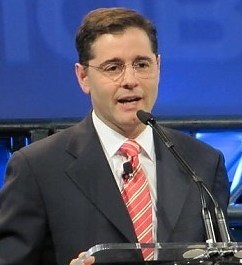
Genachowski

Genachowski’s vision for faster broadband has the noble goal of maintaining competitiveness with the rest of the world and putting the United States back on top in broadband rankings and innovation. But while hobnobbing with his industry friends at recent industry conventions, he may have gotten too close to one of the biggest impediments holding us back — big cable and phone companies merrily working their magic to create a comfortable duopoly with pricing and service plans to match.

Back in the late 1990s, most cable operators thought of broadband as an ancillary service easy enough to operate, but probably hard to monetize. Just like digital cable radio services like Music Choice and DMX, “broadband” would likely appeal only to a tiny subset of customers.

“Back in the 1990s, Time Warner was primarily a TV company in a TV industry.  Broadband then was an innovating and radical thing, and a lot of people thought it was stupid and wouldn’t work,” Time Warner Cable CEO Glenn Britt said in April, 2009.

The launch of “Road Runner” was not the most auspicious marketing effort undertaken by the cable operator. In fact, the service was rarely targeted for price adjustments, hovering at around $40 a month for a decade.

When the Great Recession hit the United States, something unexpected happened. Cable operators discovered people were willing to cancel their cable and phone services, but not their broadband. In fact, as high bandwidth online video became an increasing part of our lives, the cable industry realized they were in the catbird seat to deliver the best broadband experience, and be well-paid for it. With little competition, increasing prices brought little risk and, thanks to the insatiable drive to boost revenue and reduce costs, implementing usage caps to control “excess” usage and costs were within their grasp.

In 2008, when Stop the Cap! launched, only a handful of ISPs had usage caps. Now most providers, with the exception of Time Warner Cable, Verizon, Cablevision, and a handful of others, all have usage allowances and overlimit fee Internet Overcharging schemes to further pad their bottom lines.
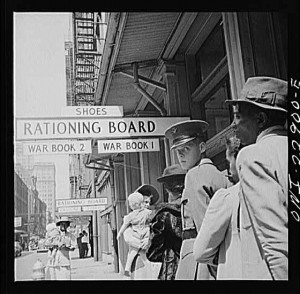
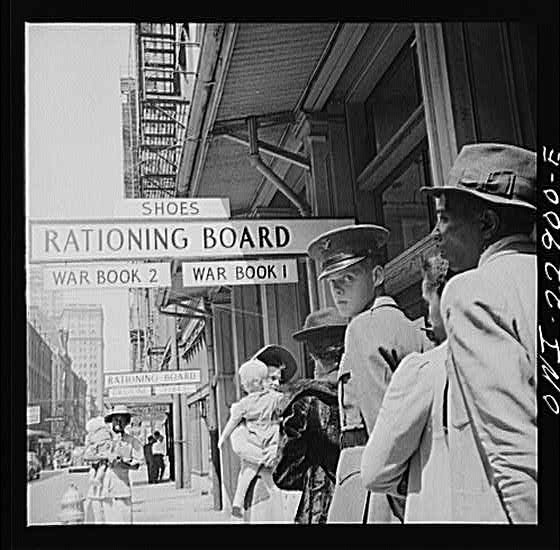
Innovation: Rationing Your Internet Experience — Stick to e-mail and web pages.

Genachowski has completely ignored the growing pervasiveness of usage caps, and even excused them as an experiment in marketplace innovation. But limits on broadband usage will also limit the broadband innovation revolution he wants, especially when most Americans have just one or two realistic choices for broadband service:

  1. Usage caps are the product of artificial scarcity. Rationing Internet usage, even with now-pervasive cost-effective upgrades like DOCSIS 3, simply does not make sense (but it will make dollars). Cable operators are switching off analog television service to free up bandwidth to provider faster Internet speed and fatten the pipeline that delivers it. They have plenty of capacity, but continue to proclaim they must limit usage for “fairness” reasons, without providing a single shred of evidence to prove the need for usage caps. Consumers will self-ration just to avoid the prospect of being cut off or handed a bill with overlimit fees.
  2. Usage caps make faster speeds irrelevant. Selling customers premium-priced, super fast broadband speed is hardly compelling when accompanied by usage caps that constrain the benefits of buying. Why pay $20-50 more for faster speeds when customers cannot take practical advantage of them. Customers using their Internet service to browse web pages and read e-mail have no interest in upgrading to 30+Mbps. Customers streaming video or moving large files do.
  3. Usage caps retard innovation. Google’s new 1Gbps fiber optic network was built on the premise that usage caps were unnecessary on a fiber-based network and would retard innovation. Developing the next generation of innovative apps that Genachowski celebrates will never happen if developers are discouraged by Internet usage toll booths and stop signs. The cost to provide the service is not largely dependent on customer usage. It is the initial price of last mile infrastructure that really matters. Both cable and phone companies have reduced their investments to upgrade their networks, and AT&T and Verizon both contemplate getting rid of their rural landlines. Most cable operators paid off their networks years ago.
  4. Usage caps create a whole new digital divide.  Time Warner Cable’s discounted Internet Essentials program delivers only a $5 discount with a harsh 5GB usage cap. For an income-challenged home compelled to switch to a provider’s budget plan, the result is a different Internet experience than the rest of us enjoy. Imagine if your home broadband account was limited to 5GB a month. What online services would you have to avoid to stay under the provider’s limit? Traditionally, operators sell the lowest speed tiers with the lowest usage allowances. Slower speeds already offer a disincentive to use high bandwidth services, but many providers typically drive that disincentive home even harder with a paltry allowance that will cost plenty to exceed.
  5. Usage caps harm our broadband standing. While Genachowski celebrates increasing broadband speeds, he ignores the fact the rest of the world is moving away from usage caps even as the United States moves towards them. Both Australia and New Zealand elected to construct their own national fiber networks in large part because the heavily usage-capped experience was holding both countries back. Usage caps are a product of a barely competitive market.

[flv width=”640″ height=”380″]http://www.phillipdampier.com/video/Bandwidth Caps 7-2011.flv[/flv]

Tech News Today debunks providers’ claims that usage caps are fair and control those who “overuse” their networks, noting the same phone companies (AT&T) pushing for usage caps are also moving voice calling to unlimited service plans. (August, 2011) (4 minutes)


More Than a Dime’s Worth of Difference Between GOP/Dems on Telecom Policy

On important issues for the online community, there are some substantial differences between the Democratic and Republican parties, particularly regarding Net Neutrality.

A review of the yas and nays in both party platforms (and past history in Congress) shows your vote can make a difference when Washington ultimately deals with privacy, network traffic, piracy, cybersecurity, and broadband expansion.

Net Neutrality – “Preserving the free and open Internet”: Prohibits providers from discriminating against different types of network traffic for profit or control

  • Democrats: Yas
  • Republicans: Nay

While the Democratic platform specifically states, “President Obama is strongly committed to protecting an open Internet,” one “that fosters investment, innovation, creativity, consumer choice, and free speech,” Republicans have treated Net Neutrality as anathema to the free market. Although virtually every Republican member of Congress has voted against Net Neutrality or publicly opposed the concept, some Democrats have as well, particularly those who have received significant financial contributions from the largest phone and cable companies lobbying against the policy.

Net Neutrality has not proved to be a major issue in Congress this year, with most of the recent battles taking place at the Federal Communications Commission. FCC chairman Julius Genachowski applauded a ‘third way’ for Net Neutrality, staking out a middle-of-the-road policy that pleased few outside of the FCC. It largely leaves the concept a “suggestion” for wireless carriers. Replete with loopholes and enforcement issues, even wired providers like Comcast have run around the policy for their own benefit.

Network Privacy – Full disclosure when websites track your browsing habits, and how online companies protect your private information

  • Democrats: Yas, provisionally
  • Republicans: Yas, provisionally

Net privacy is a topic many consumers hear about the most when a website gets hacked and private customer information is stolen in the process. But a growing number of consumers are also concerned about what websites are doing with their information and how their web visits are being tracked for advertising purposes. Large online companies like Facebook and Google have a vested interest in keeping this space as unregulated as possible to maintain lucrative revenue earned selling demographic information to advertisers. But consumers may not want advertisers to know the websites they visit, and members of both political parties have expressed growing interest in taming who gets their hands on your private stuff. Republicans are primarily concerned about tracking by government agencies, Democrats are more concerned with for-profit use of customer data.

The Republican platform abhors government intrusion into private liberty — primarily a reference to certain forms of surveillance. But the GOP platform is silent on enhancing privacy rights of consumers. The Obama Administration has been calling for a “Privacy Bill of Rights” that permits consumers to opt out of web tracking cookies and other tracking technology. Democrats separately want companies to do a better job disclosing and explaining how private information is being used. But Congress, under heavy lobbying to avoid the issue, never acted on the administration’s request.

Expanding Broadband: Finding New Wireless Spectrum and Improved Rural Access

  • Democrats: Yas on both
  • Republicans: Yas on one, vacillating  on the other

While neither party fully embraces their respective platforms while governing, their stated positions often reflect political positioning when new laws are contemplated.

The Democrats tout both their National Broadband Plan and the Obama Administration’s commitment to find Internet access for 98 percent of the country and expand spectrum available to meet the growing demands for wireless data. The Democratic platform touted President Obama’s proposal to promote wireless broadband as a possible rural Internet solution.

Republicans also want more wireless spectrum to be auctioned off as soon as possible. They also believe the solution to rural broadband is additional deregulation to stimulate private investment and a private marketplace solution. But they are short on specifics about how that can happen in areas deemed too unprofitable to serve.

Democrats are generally more tolerant of public and private broadband expansion projects and stimulus funding for expanded Internet access. The Obama Administration has overhauled the Universal Service Fund to help underwrite rural broadband expansion, a notion Republicans often oppose as unnecessary taxpayer or ratepayer-financed subsidization.

Online Piracy – Stopping those illegal file transfers of copyrighted content and Chinese-manufactured counterfeit DVDs sold by street peddlers.

  • Democrats: Yas
  • Republicans: Yas

Both parties are pointing fingers at China for supplying an endless quantity of counterfeit merchandise sold in flea markets, online, and by street peddlers in large cities. An enormous sum of Hollywood’s lobby money, and the presence of former Sen. Chris Dodd (D-Conn.) as head of the Motion Picture Assn. of America guarantees a Washington audience receptive to the industry’s arguments. Members of Congress from both political parties representing entertainment nerve centers in California and New York have adopted piracy legislation largely as written by industry lobbyists.

But there are limits. The Obama Administration ended up opposing the overreaching Stop Online Piracy Act because it failed to balance intellectual property rights with online privacy for consumers.

The Democratic platform said the administration is “vigorously protecting U.S. intellectual property—our technology and creativity—at home and abroad through better enforcement and innovative approaches such as voluntary efforts by all parties to minimize infringement while supporting the free flow of information.”

Cybersecurity: Tech Terrorism and CyberWars

  • Democrats: Yas
  • Republicans: Yas

Cyberattacks from foreign entities on American computer systems and the Internet receive near-equal attention from both political parties. But the GOP still feels the current administration has not done enough, accusing the Obama Administration of insufficient vigilance that has “failed to curb malicious actions by our adversaries.” The Republican platform demands an overhaul of a 10-year-old law governing computer security and demands more collaboration between the government and the private sector on cyber-incursions.

Democrats defend their performance expressing a pledge to, “continue to take steps to deter, prevent, detect, and defend against cyber intrusions by investing in cutting-edge research and development, promoting cybersecurity awareness and digital literacy, and strengthening private-sector and international partnerships.”

Head of Verizon FiOS TV Doesn’t Watch Much Live TV; Nothing on Data Caps “Just Yet”

Maitreyi Krishnaswamy, Verizon’s head of FiOS TV admits she practically never watches live television — she records everything on her DVR first.

Krishnaswamy has been responsible for many of the interactive video services offered on Verizon’s FiOS TV platform, including on-screen apps, the media program guide, and how customers connect various devices to the FiOS television experience.

Now she’s directing Verizon’s consumer video services — deciding which channels make the lineup on FiOS TV and the networks available for streaming to mobile devices.

Krishnaswamy told the Tampa Tribune she recognizes the way Americans watch television has changed over the past few years, and she admits it has led to the “growing” trend of customers’ cord-cutting their cable TV subscriptions in favor of online viewing.

Krishnaswamy

“The question is: Is it growing enough for us? For us, it’s a matter of cord-cutters versus cord-shavers — people who switch to smaller tiers,” Krishnaswamy said. “Is the migration to a-la-carte enough that we can go that route? It has a way more important impact that just on them. It impacts how we negotiate TV contracts with studios. It’s not something we can do overnight, but definitely something we’ve been looking at.”

Verizon has made it clear it intends to compete for customers regardless of how they watch television, but Krishnaswamy signals the company is also considering protecting their core video business model, and would only say Verizon had no announcements to make “just as yet” regarding an Internet Overcharging scheme including usage caps and overlimit fees. Critics of data caps argue that limiting broadband usage prevents customers from taking their viewing experience online because it threatens consuming the majority of their monthly data use allowance.

But Verizon does not mind offering customers a TV Everywhere experience — streaming video content over its broadband network, so long as a customer also subscribes to its TV package. The company already offers live streaming television of many channels on its lineup and wants to bolster that with on demand content. Verizon also is experimenting with non-traditional set top boxes, and although Krishnaswamy had nothing to say about supporting the forthcoming Apple TV, she is actively working on improving how Verizon’s television service works away from the traditional company-provided set top box.

Some highlights:

  • Verizon’s partnership with Redbox will let the company offer a new streaming and DVD rental service for customers, regardless of whether they live in a Verizon FiOS area or not. Customers will be able to access the service over mobile broadband, Wi-Fi, or any home broadband connection;
  • Verizon will introduce an online viewing app for forthcoming versions of Amazon’s Kindle;
  • The company has thus far only managed to secure streaming rights for in-home viewing and has run into difficulty getting content providers to let customers watch shows while on the go;
  • Google Fiber is “interesting,” but Krishnaswamy doesn’t believe they are “a real operator” when only offering service in one city. She thinks the project is a good idea, however, because it forces competing providers “to increase your speed;”
  • Verizon is considering simplifying its family of apps to reduce customer confusion. They currently have different apps for home security, home media, the remote control, and the program guide. Verizon wants its MyFiOS app to become a “super-app” that manages everything.

[flv width=”640″ height=”500″]http://www.phillipdampier.com/video/TVnext Interview – Maitreyi Krishnaswamy Verizon FIOS 1-28-11.m4v[/flv]

Back in 2011, Maitreyi Krishnaswamy explained her thinking about where Verizon FiOS was taking the TV experience. Many of these applications have since been released, but Verizon — like most providers — still runs into brick walls with content providers getting licensing to allow more flexible viewing of content.  (12 minutes)

Kansas’ Fiber Broadband Cup Runneth Over: New SureWest Projects Compliment Google

Phillip Dampier September 5, 2012 Broadband Speed, Competition, Consumer News, Google Fiber & Wireless, SureWest Comments Off on Kansas’ Fiber Broadband Cup Runneth Over: New SureWest Projects Compliment Google

Did you miss out on Google Fiber’s forthcoming gigabit broadband network in Kansas City, Kansas and Missouri? Kansans may not be out of luck, as provider SureWest aggressively continues work to expand its own fiber to the home network in several Kansas City suburbs and nearby communities.

SureWest, which believes strongly in fiber service, is busy laying fiber in conduits in Fairway, Mission, Roeland Park — all in Kansas. It also offers service in Lenexa, Overland Park, Shawnee and parts of Kansas City, Mo.

With all of this fiber, some Kansans may soon be able to choose between two competing fiber to the home providers.

SureWest General Manager of Kansas City operations Matt Zuschlag says SureWest’s fiber broadband service, which tops out at 50/50Mbps, will work just as well as Google’s gigabit (1,000Mbps) service because most web sites don’t need super fast speeds to load equally as fast. Even some bandwidth-intensive applications will not be able to take full advantage of Google’s fiber speeds because the networks currently supporting them were not designed to deliver sustained gigabit speed to end users.

SureWest works good enough for communities like Prairie Village, which is asking the company to wire its community for fiber service, regardless of where Google expands next.

SureWest competes with traditional cable and phone companies — Time Warner Cable and AT&T in the case of northern Kansas, and sells traditional triple play packages of phone, Internet, and television service.

But SureWest says its fiber network is always laid underground, which the company says offers improved reliability. Google Fiber is being installed largely on overhead lines alongside other utility services. SureWest says going underground allows it to skip the delays associated with obtaining pole use permits.


Fact Check: Time Warner Cable’s $25 Million Fiber Upgrade: For Business Use Only

Despite glowing media reports about Time Warner Cable’s announcement it is investing $25 million to expand its fiber optic network in parts of Brooklyn and Manhattan, in fact the fiber expansion is part of a previously-reached franchise agreement with New York City officials and will only be available to large business customers that can afford the asking price.

Time Warner Cable’s press release, which generated favorable media coverage in The Wall Street Journal and Bloomberg News, focused considerable attention on fiber upgrades for the Brooklyn Navy Yard, since reborn as a modern tech-friendly business park.

TWCBC also announced that the Brooklyn Navy Yard Development Corporation, a 501(c)(3) organization, will receive a state-of-the-art Time Warner Cable Learning Lab in its Employment Center, located inside the massive complex and accessible to the public.

“We are very pleased to work with the City of New York to make significant investments to ensure that this city has the technology infrastructure to successfully compete in a worldwide marketplace,” said Ken Fitzpatrick, President of Time Warner Cable Business Class, East Region. “Our fiber optic network provides dedicated Internet access at incredible speeds and high-bandwidth capabilities to serve the communications needs of any business.”

Time Warner Cable was required to make its investment in the Brooklyn Navy Yard as part of its franchise agreement with NYC officials.

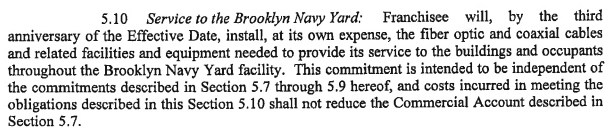
Time Warner Cable did not, however, provide this investment out of the goodness of their heart. They were required to under the terms of the current franchise agreement the company signed with city officials:

[Time Warner Cable] will install, at its own expense, the fiber optic and coaxial cables and related facilities and equipment needed to provide its service to the buildings and occupants throughout the Brooklyn Navy Yard facility.

Time Warner Cable is also extending its network to more commercial establishments throughout the city, in keeping with its previously-announced interest in expanding services to business customers. Nothing new to see here either.

That did not stop Bloomberg News from comparing Time Warner’s network expansion with Google’s gigabit network in Kansas City:

Time Warner Cable Inc. will expand fiber-optic lines to businesses in New York, a move that boosts Internet speeds as much as 20 times and provides an East Coast counterpoint to Google’s ultrafast network in Kansas City.

The company faces a threat from Google more than 1,000 miles away in Kansas City, where the Internet-search giant is building a fiber-optic network as a test project. Time Warner Cable is the main broadband provider for the area, which spans parts of Missouri and Kansas. While Google’s network will be available to both companies and households, Time Warner Cable’s New York fiber network is focused on businesses.

Google’s network initially will only be sold to residential customers, which are the primary targets for the service. Time Warner Cable’s fiber backbone network primarily works in tandem with its coaxial cable network and does not provide a fiber to the premises connection except for the company’s largest corporate customers.

Time Warner Cable Business Class sells different speeds and services to commercial clients. Most choose speeds considerably lower than 1,000Mbps because of the cost.

What was missing from the coverage is the fact ordinary residential Time Warner Cable customers in New York City will not benefit from these fiber upgrades — they are targeted only to commercial clients. Residential customers will continue to receive the same hybrid fiber-coax service they always have from the cable company.

If New York customers want fiber service, they will have to buy it from Verizon, assuming FiOS has made its way to your borough and neighborhood.

Search This Site:

Contributions:

Recent Comments:

Your Account:

Stop the Cap!