Home » google » Recent Articles:

Austin Media Gushing for Google Fiber

Austin’s television news has gone all out for Google Fiber, which is being unveiled today at a press event. Stop the Cap! will have coverage of the announcement, but in the meantime, here is a roundup of local coverage about Google Fiber in Austin:

[flv width=”640″ height=”380″]http://www.phillipdampier.com/video/KTBC Austin Google Fiber Headed to Austin 4-8-13.mp4[/flv]

Austin’s local Fox affiliate KTBC reports city officials stayed tight-lipped about Google Fiber, but Google may have previewed its intentions by adding The Longhorn Network to its television lineup several months ago. Local technology experts say the upgrade is worth the wait and will be a boon to Austin’s economy. (2 minutes)

[flv width=”640″ height=”380″]http://www.phillipdampier.com/video/KXAN Austin The wait is on for Google Fiber 4-9-13.mp4[/flv]

Now that Austin will get Google Fiber, how long will residents have to wait to sign up? Mid-2014 is the estimate. KXAN explored how Google was unveiled in Kansas City. The station also took a look at other cities with gigabit fiber networks, many of them publicly owned alternatives to big phone and cable companies. KXAN compares the cost for 1,000Mbps service in different cities around the country. (3 minutes)

[flv width=”640″ height=”380″]http://www.phillipdampier.com/video/KEYE Austin Google Announcement Draws Near 4-9-13.flv[/flv]

KEYE notes Gov. Rick Perry is showing up for this morning’s unveiling of Google Fiber. In between some minor technical glitches in the report, some viewers say they are ready to sign up for $70 gigabit Internet now, just to stick it to Clearwire ($50 a month) and Time Warner Cable.  (2 minutes)

[flv width=”640″ height=”380″]http://www.phillipdampier.com/video/KVUE Austin Google Going to Austin 4-9-13.mp4[/flv]

KVUE says Google Fiber could boost Austin’s economy by luring even more high-tech companies. It could also stop Time Warner Cable and AT&T from trying more Internet Overcharging schemes on area customers.  (2 minutes)

Multiple Sources Confirm Austin As Next Google Fiber City; Here Are Some Clues Why

austin

Austin, Texas is likely the next Google Fiber city.

Austin, Texas will be the second major U.S. city to receive Google Fiber’s 1,000/1,000Mbps service, perhaps as early as 2014.

A “major announcement” at a news conference scheduled for Tuesday morning is expected to bring more than 100 community leaders together to hear Google’s plans for the city.

Local media reports, an accidental mention of Austin as the next Google Fiber city on Google’s Fiber Blog, and at least one confidential source at Austin’s public utility company (that owns the poles Google Fiber will be strung across) makes it all-but-certain Austin and its nearby suburbs will get the service.

Austin would seem a natural target for Google as home to the high-tech South by Southwest. Austin also hosts Dell, Texas Instruments, AMD, Samsung, IBM, Intel, and a myriad of Internet start-ups. But a key factor for Google also seems to be the presence of Austin Energy, the nation’s 8th largest community-owned electric utility, serving more than 420,000 customers and a population of almost one million. Kansas City, the first choice for Google Fiber, also has a municipal utility company.

Milo Medin, Google’s vice president of access services, made it clear that Google is targeting cities where it does not have to deal with intransigent privately owned utility companies that make life difficult (or expensive) to attach Google Fiber to utility poles. Municipally owned providers have proved easier to work with, and in Kansas City elected officials also helped cut through administrative red tape and facilitated a working relationship between Google and government officials responsible for issuing work permits and clearing up zoning headaches.

Areas served by investor owned electric giants like Southern California Edison, Florida Power & Light, Commonwealth Edison, Consolidated Edison, Georgia Power, Dominion Resources, Detroit Edison, Public Service Enterprise Group, and others may be at an immediate disadvantage in the race to become the next Google Fiber city if those companies attempt to throw expensive roadblocks or disadvantageous bureaucracy in front of Google.

google fiberAnother factor in Kansas City’s favor was the large amount of pre-existing conduit available to pull fiber infrastructure through without tearing up streets. Cities with this type of infrastructure already in place dramatically reduces construction costs and permit delays.

Google Fiber’s project in Austin will compete directly with Time Warner Cable and AT&T U-verse. Time Warner Cable customers antagonized Austin residents in the spring of 2009 with a planned market test of consumption billing and usage caps for its Internet service. Google Fiber makes a point to say its broadband service is never usage-limited. AT&T U-verse customers in Austin have so far  not faced punitive measures from the phone company when exceeding its 250GB U-verse usage cap.

Many cable industry analysts predicted Google Fiber was simply a show project in Kansas City, designed to embarrass the telecommunications industry’s mediocre and expensive broadband service offerings. But a move into Austin signals Google more likely sees its fiber network as a lucrative business opportunity — one that could gradually be expanded to other cities.

What communities could get the service next? Google seems likely to avoid serving areas covered by Verizon FiOS, because competing fiber networks would likely not produce the bang for the buck Google needs to draw subscribers, and Medin makes it clear the company has found working with publicly owned utility companies easier than privately owned ones, so future Google Fiber cities will likely have these factors in common:

Having a publicly-owned utility helps.

Having a publicly owned utility helps.

  • A high-tech business community and well-educated workforce in a medium to large city;
  • A publicly owned municipal utility willing to work with Google;
  • Pre-existing infrastructure to support fiber service without tearing up streets and neighborhoods;
  • A local government willing to cut red tape and ease Google’s expansion;
  • No Verizon FiOS fiber service in the immediate metropolitan area;
  • A reasonable level of regulations covering environmental impacts of utility infrastructure work, permits, and licensing.

Such requirements would wipe out almost all New York (except Rochester, Binghamton and the Southern Tier around Ithaca — all completely bypassed by Verizon FiOS) and New Jersey as possible candidates. California outside of Mountain View would also seem untenable because of government regulations, sprawling cities, and private utilities. Florida and Georgia have two major private power companies to contend with as well. But there are opportunities in Texas, the Carolinas, Minnesota, Washington, Arizona, Colorado, Tennessee, Massachusetts, and across several midwestern states, especially those served by AT&T’s inferior U-verse system.

[flv width=”640″ height=”380″]http://www.phillipdampier.com/video/KXAN Austin Google Fiber Expected in Austin 4-5-13.mp4[/flv]

KXAN in Austin spent almost seven minutes of its weekend evening newscast talking about forthcoming Google Fiber in Austin.  (7 minutes)

Google Fiber Announces Next Gigabit Fiber City: Olathe, Kansas

Phillip Dampier March 20, 2013 Broadband Speed, Competition, Consumer News, Google Fiber & Wireless, Public Policy & Gov't, Video Comments Off on Google Fiber Announces Next Gigabit Fiber City: Olathe, Kansas

google fiberThe city of Olathe, Kansas will be the next home for Google Fiber, according to an announcement published yesterday on the Google Fiber Blog.

The Olathe City Council unanimously approved an agreement to wire the city for the benefit of its 127,000 residents, located 20 miles southwest of Kansas City.

This is the first expansion of Google Fiber outside of the immediate Kansas City area, but unlikely to be the last.

Rich Greenfield from BTIG Research predicts Google will likely announce a second major city for its fiber network sometime this year. Olathe doesn’t qualify at that city because it technically within the greater Kansas City metropolitan area.

The agreement with the Olathe City Council also includes permission to build a city-wide Wi-Fi network.

olatheGoogle noted the city’s willingness to cut red tape and to ease the introduction of the service were partly determining factors. Google earlier cited the importance of having a smooth working relationship with utility companies and local government officials that make fiber installation a lot easier.


Comcast will be Google’s largest competitor in the city.

“We think that fiber and widespread Internet access will help to create jobs, grow local businesses, and make Olathe even stronger as it grows,” said Rachel Hack, community manager for Google Fiber. “We still have a lot of planning and engineering work to do before we’re ready to bring fiber to Olathe. Once we get those processes underway, we’ll be able to announce more about pre-registration and construction timing.”

[flv width=”640″ height=”380″]http://www.phillipdampier.com/video/KCTV Kansas City Olathe OKs Google Fiber Deal 3-19-13.mp4[/flv]

KCTV in Kansas City reports the Olathe City Council unanimously approved the entry of Google Fiber into the community of 127,000.  (2 minutes)

[flv width=”640″ height=”382″]http://www.phillipdampier.com/video/KMBC Kansas City Olathe OKs Google Fiber deal 3-20-13.flv[/flv]

KMBC in Kansas City notes Olathe is Kansas’ fastest growing city, but Google’s decision is leaving residents of larger cities like Overland Park feeling left out. But Olathe already has a lot of pre-existing fiber installed independent of Google, making it easier to provide service.  (2 minutes)

NY Times Can’t Tell the Difference Between a Consumer Watchdog and an Industry Sock Puppet

profile

Dampier

One of the most frustrating things about covering the public policy issues surrounding broadband is an-often lazy mainstream media that cannot tell the difference between an industry sock puppet and a consumer broadband advocate. One expects that the New York Times will do better than most.

It certainly did not this morning in a sloppy front page piece on Google’s privacy invasion concession.

New York Times reporter David Streitfeld seemed utterly out of his league from the lede paragraph in the story, where he suggested Google “casually scooped up passwords, e-mail and other personal information from unsuspecting computer users.”

That is a bit histrionic considering any “data theft” would have only occurred for the 5-15 seconds Google’s Street View vehicle was in range of an entirely unprotected home Wi-Fi network, and that you were actively using it at the time of Google’s “drive-by.” If you enabled any wireless network security, Google would have captured nothing beyond the name of your Wi-Fi network (assuming you had not hidden it with another setting) — something anyone could capture with a Wi-Fi sniffer.

Even more concerning was the sudden appearance in the piece of paid Google critic Scott Cleland, who runs a suburban Washington, D.C. corporate public strategy lobbying firm called Precursor LLC that has as its chief mission:

Help companies anticipate change to better exploit emerging opportunities and guard against emerging risks.

Attacking Google and broadband advocacy groups is Cleland's bread and butter.

Attacking Google and broadband advocacy groups is Cleland’s bread and butter.

The New York Times called him a “consumer watchdog.”

At this point I coughed up my peppermint patty.

Cleland, whose rhetoric about Google ranges from alarmist to lugubrious — America must worry about being on the cusp of a Google-run online dystopia — is well-known to those of us who encounter his various paid-for campaigns. Cleland is best known for his anti-Google rhetoric and his reflexive defense of all-things-Big Telecom, hardly surprising considering his client list.

What is disturbing is that I know this and the reporters at the New York Times apparently do not:

“Google puts innovation ahead of everything and resists asking permission,” said Scott Cleland, a consultant for Google’s competitors and a consumer watchdog whose blog maintains a close watch on Google’s privacy issues. “But the states are throwing down a marker that they are watching and there is a line the company shouldn’t cross.”

At least the Times casually disclosed he was a “consultant for Google’s competitors.” But consumer watchdog? That is a line the Times shouldn’t cross because it is reality only in a world where Goldman Sachs is considered a model for altruistic investment banking.

Google Illustrates the Big Broadband Ripoff: Costs Flat Despite Huge Traffic Growth

BBand

One of the side benefits of Google getting into the broadband provider business is learning first-hand what is reality and what represents provider spin and marketing nonsense used to justify high prices and usage limits.

As Google Fiber slowly spreads across Kansas City, the search engine giant is gaining first hand-experience in the broadband business. Google understands what cable operators endured in the 1980s and what Verizon was coping with until it pulled the plug on FiOS expansion: the upfront costs to build a new network that reaches individual subscribers’ homes and businesses can be very high. But once those networks are paid off, revenue opportunities explode, particularly when delivering broadband service.

Milo Medin, a former cable Internet entrepreneur and now vice president of access services at Google, presented a cogent explanation of why Google can make gigabit broadband an earner once construction costs are recouped. He demonstrated the economics of fiber broadband at a meeting of the San Jose chapter of the IEEE.

BB2

In addition to a long term investment in fiber, and the new business opportunities 1,000Mbps Internet provides, Google has learned from the mistakes other utilities have made and is trying to establish close working relationships with local governments to find ways to cut costs and bureaucracy.

In Kansas City, Google has placed staff in the same office with city zoning and permit officials. Working together in an informal public-private partnership to cut red tape, local inspectors have agreed to coordinate appointments with Google installers to reduce delays. That alone reportedly saves Google two percent in construction expenses.

“Governments have policies that can make it easy or hard, so I say, ‘if you make it hard for me, enjoy your Comcast,’” Medin said.

Internet traffic vs. costs

Internet traffic vs. costs

Medin notes broadband adoption and expansion in the United States is being artificially constrained by the marketplace, where wired providers are resting on their laurels.

More than a decade ago, people paid $40 a month for 4-5Mbps service, Medin noted.

Providers have kept the price the same, arguing they create more value for subscribers with ongoing speed increases.

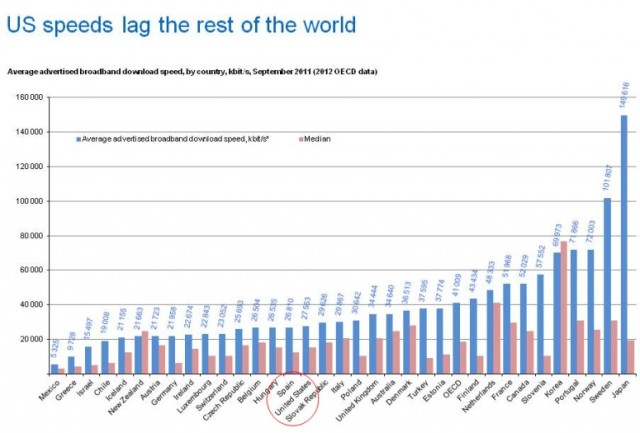
But Medin notes overseas, prices are falling and speeds are increasing far faster than what we see in North America.

“Broadband in America is not advancing at nearly the pace it needs to be,” Medin argues. “Most of you have seen dramatic changes in wireless, but there’s never been a real step function increase in wired. That’s what’s needed for us to retain leadership in technology — and not having it is a big problem.”

CostsX

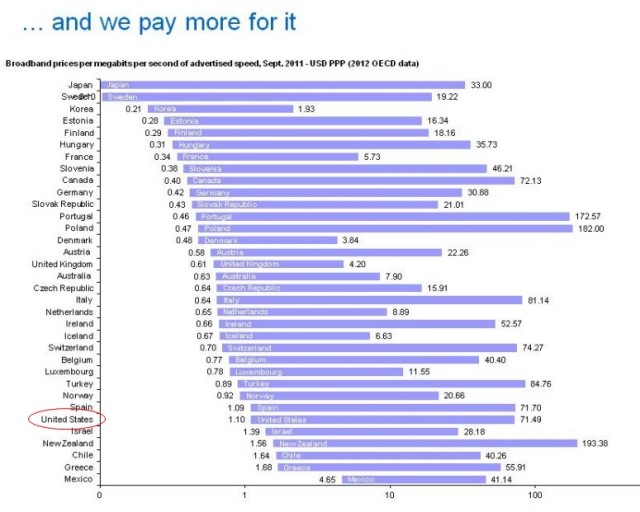
Medin points to OECD statistics that show the cost per megabit per month in the U.S. is the sixth highest among 34 OECD nations. Only Mexico, Chile, Israel, New Zealand, and Greece pay higher prices. Every other OECD nation pays less.

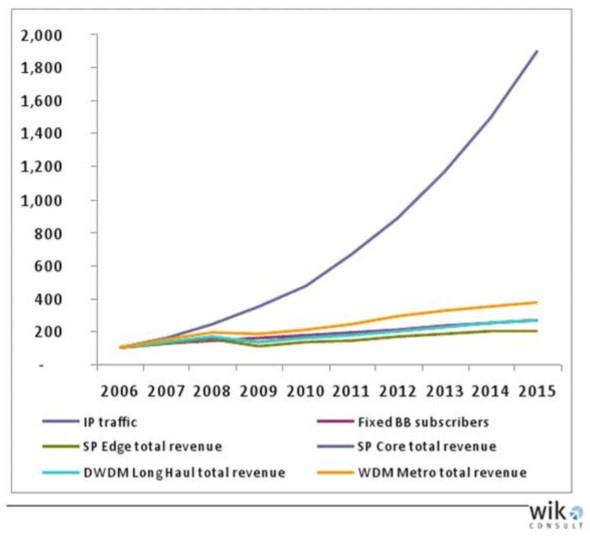
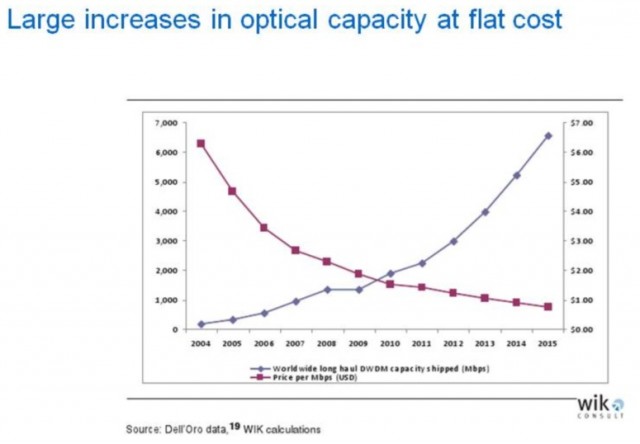
By leveraging fiber optics, which every provider uses to some extent, costs plummet after network construction expenses are paid off. In fact, despite the explosion in network traffic, provider bandwidth costs remain largely flat even with growing use, which makes the introduction of Internet Overcharging schemes like usage caps and consumption-based pricing unjustified.

“Moving bits is fundamentally not expensive,” said Medin.

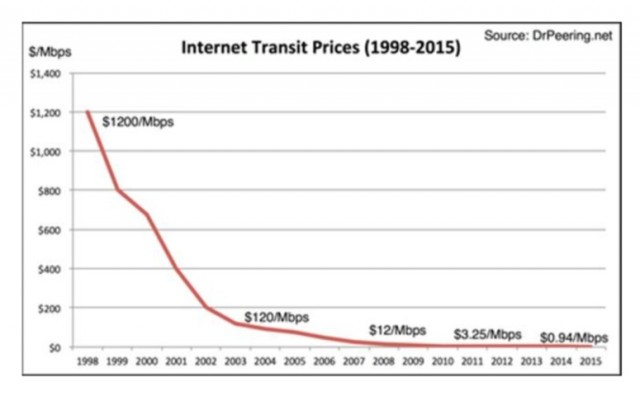
In 1998, when cable broadband first became available in many markets, the monthly price for the service was around $40 a month. Internet transit prices — the costs to transport data from your ISP to websites around the world averaged $1,200 per megabit that year. Today that cost has dropped below $4 per megabit and is forecast to drop to just $0.94 by 2015.

Costs2

Search This Site:

Contributions:

Recent Comments:

Your Account:

Stop the Cap!