Home » FiOS » Recent Articles:

“The Verizon FiOS of Hong Kong”: Fiber to the Home 100Mbps Service $35/Month

Phillip Dampier September 27, 2009 Broadband Speed, Competition, Recent Headlines, Video 3 Comments
HK Broadband offers 100% Fiber Optic service to residents of Hong Kong

HK Broadband offers 100% Fiber Optic service to residents of Hong Kong

Hong Kong remains bullish on broadband.  Despite the economic downturn, City Telecom continues to invest millions in constructing one of Hong Kong’s largest fiber optic broadband networks, providing fiber to the home connections to residents. City Telecom’s HK Broadband service relies on an all-fiber optic network, and has been dubbed “the Verizon FiOS of Hong Kong” for its dramatically faster broadband speeds.

Hongkongers have had several choices for broadband service over the years, most offering traditional DSL service throughout the Hong Kong Special Administrative Region (Hong Kong is a territory of the People’s Republic of China). Priced around $32 a month, the most popular service choice offers residents 6Mbps downstream speeds and 0.6Mbps upstream. Some modern residential multi-dwelling units have a more advanced from of DSL service offering up to 18Mbps downstream and 1Mbps upstream.

HK Broadband represents a major competitive threat for traditional DSL service in Hong Kong, because the fiber optic network provides customers with faster speeds ranging from 25Mbps-1000Mbps.  The company also offers a bundle including broadband, a Voice Over IP telephone service, and IPTV (cable television) service with 80+ channels. HK Broadband offers symmetrical speeds on their network, which means your upload speed is as fast as your download speed. The company has pummeled its telephone network-reliant competitors with humorous ads that call out DSL’s slower speeds, particularly for uploads.

<

p style=”text-align: center;”>[flv width=”450″ height=”360″]http://www.phillipdampier.com/video/HKBN Ad – Ants.flv[/flv]
HK Broadband “Ants” Advertisement: Ten Kung-Fu-Fighting-Ants, representing the downstream speed of a traditional DSL broadband connection, are shown ganging up on a single helpless ant, who represents the weaker upstream speed, demonstrating how traditional DSL services typically offer upload bandwidth that is only a 10th of the download speed.

HK Broadband offers 100Mbps service for $35 per month, just a few dollars more than DSL. But there is an interesting catch. HK Broadband, like other providers in Hong Kong, cope with inadequate international broadband connections. Instead of engaging in Internet Overcharging schemes like usage caps, such as those found in Australia and New Zealand, the company has instead capped the speed for websites located abroad at 20Mbps for both uploads and downloads. The 100Mbps speed is reserved for domestic websites. Some subscribers note they couldn’t get speeds much faster than that when accessing overseas sites regardless of the cap, so it has not presented a major problem. As connectivity improves, so should the speeds, according to company officials.

The company also has a unique residential service guarantee — they promise that you will receive at least 80% of the speed you subscribe to, or they refund double your money back. Of course, this applies only to connections made to websites within Hong Kong.

When you’ve got it, flaunt it, and HK Broadband’s fiber speeds are the hallmark of their marketing campaigns.

[flv width=”480″ height=”284″]http://www.phillipdampier.com/video/HKBN 100Mbps Ad.flv[/flv]

HK Broadband “Fat Pipe” Advertisement: Real life characters representing Internet content force themselves into a tiny pipeline, representing DSL, but are later liberated by a wide open fiber optic pipeline they can run through with room to spare.

The investment by City Telecom in their fiber optic broadband network has brought impressive financial results to the company, with customers taking more of their telecommunications business in HK Broadband.  That increases the average revenue per subscriber.  The company has also aggressively increased the level of investment to build out its network, producing an economy of scale that has reduced the costs to wire new subscribers.

Traditional Wall Street investors have often been unimpressed with expensive technology upgrades undertaken by telecommunications companies.  Notably, Verizon Wireless’ FiOS fiber to the home network was pummeled by several investor groups who complained Verizon was spending too much on their fiber network, even though their costs to wire each new customer has dramatically decreased with time.  City Telecom has turned that criticism on its head.  Among many of its competitors, City Telecom is the second most profitable, earning an 11% profit margin.

China Securities has showcased the company, noting it enjoys subscriber growth at levels greater than industry growth, is positioned with technology that assures it of long term stability in revenue and income growth, and despite all of the investments the company has made, retains a strong free cash flow.  Most of all, it has very happy subscribers who enjoy a well regarded broadband service, available at fast speeds and a reasonable price.

The incumbent telephone company’s network of copper wire, supporting lower speed DSL service, is not in the same position.  HK Broadband brought Alexander Graham Bell back to life to chastise the notion that a network more than 100 years old is appropriate for 21st century broadband.

[flv width=”480″ height=”360″]http://www.phillipdampier.com/video/HK Broadband Bell Ad.flv[/flv]

HK Broadband “Alexander Graham Bell” Advertisement: The inventor of the telephone makes a “special-guest” appearance pointing out the fact that the 100 year old telephone network wasn’t designed for today’s broadband connections. This is set in a traditional Chinese Hell-like environment to imply the hellish experience of surfing the Internet with a slow connection.

<

p style=”text-align: left;”>HK Broadband has not escaped the attention of its competitors, of course.  PCCW Limited, Hong Kong’s dominant telephone company, has been aggressively marketing its own fiber, DSL, and wireless broadband products, not allowing HK Broadband to win without a fight. PCCW has had to play catch-up with HK Broadband’s aggressive fiber deployment, which focused on residential and business customers from the outset.  PCCW’s fiber network was primarily intended for business customers, and now the company has been rapidly expanding their fiber network to residential customers.  Today, where PCCW fiber is available, customers can choose from 18Mbps, 30Mbps, 100Mbps, or 1000Mbps service plans.  Many PCCW customers will also be aggressively marketed a wireless mobile Netvigator add-on, one of PCCW’s more successful product lines.

[flv width=”294″ height=”240″]http://www.phillipdampier.com/video/PCCW Fiber Optics Ad.flv[/flv]

PCCW “Fiber Optics” Advertisement: Lampooning HK Broadband’s fiber optic network, PCCW says it had their own extensive fiber optic network laid before HK Broadband came around.  Its tagline, “…the real fiber optics broadband.”

A detailed presentation of HK Broadband and its potential attractiveness to investors was produced by China Securities and features an interview with NiQ Lai, the Chief Financial Officer of City Telecom.

[flv width=”640″ height=”480″]http://www.phillipdampier.com/video/Chinasecurities-City Telecom Presentation September.flv[/flv]

[13 minutes]

Doubletake: Company With 5GB Limit in Acceptable Use Policy Promises “Near-Unlimited Bandwidth Capacity” to West Virginia

bullJust like FairPoint Communications, the Towering Inferno of phone companies haunting New England, Frontier Communications is making a whole lot of promises to state regulators and consumers, if they’ll only support the deal to transfer ownership of phone service from Verizon to them.

This time, Frontier is issuing a self-serving press release touting their investment of some $4 million dollars in its broadband networks in Charles Town and Princeton, West Virginia.  But the best part was the claim the upgrades would “offer customers fast broadband speeds and near-unlimited bandwidth capacity.”

In Princeton, 44 miles of fiber-optic cable will connect all Frontier High-Speed Internet (HSI) equipment to the exchange`s main switch, and 37 additional miles of fiber cable are being installed in the Charles Town exchange. These upgrades will allow Residential HSI speeds of up to 6 Meg and Business HSI speeds of up to 12 Meg. The upgrades will allow provisioning of Metro Ethernet service of up to 100 Meg, resulting in very high data speeds for private networks among multiple business locations.

These upgrades are all well and good, and are perhaps more than urban-focused Verizon was willing to do in the state, but before West Virginians get too excited by the words “fiber cable” and “near-unlimited bandwidth capacity,” it might be wise to consider the implications of transferring an entire state’s telephone business to a company that still insists on defining an “appropriate amount of usage” on that near-unlimited network at a piddly 5GB per month.

The company also promoted their “computer giveaway” program:

Recognizing that the lack of a personal computer is a barrier for many families, since 2006 Frontier has provided more than 10,000 free computers to qualifying customers in West Virginia. A large percentage of the computers went to first time computer households, who also benefited from free on-site installation.

To the uninitiated, that may suggest a benevolent phone company handing out free computers to the needy with no strings attached.  In fact, this was a Frontier customer acquisition promotion.  Customers signing up for a bundle of telephone and broadband and/or satellite service could qualify for a free basic Dell Netbook (valued at under $400), if they are in good standing with the company, agree to a “price protection agreement” holding them to the company for two years (or facing a nasty early termination fee running several hundred dollars), and also pay a handling fee:

Customer pays handling charges and taxes totaling $45. Customers must subscribe to a new package of Frontier residential local service with features, Unlimited Nationwide or Statewide Long Distance voice-calling and qualifying High-Speed Internet service. Requires a two-year Price Protection Plan on Frontier services (excludes satellite TV) with a $300 early termination fee. Offer available while supplies last. Frontier reserves the right to substitute a comparable Mini Laptop. Other offers available for existing High-Speed Internet customers. Applicable taxes and surcharges apply. Electronic or other written contract signature for Frontier services is required. Some Frontier services are subject to availability. Installation charges may apply. Unlimited U.S. Long Distance minutes are for residential voice usage and exclude 900, international, directory assistance and dial-up Internet calls.

For a whole lot of West Virginia, broadband service means one thing – DSL from the phone company.  Satellite broadband is costly, capped, and has terrible customer satisfaction ratings.  Cable television is a dream for significant parts of the mountainous state.  Do West Virginians want to risk their broadband future on a company that insists on an Acceptable Use Policy with a 5GB usage limit in it?

Residents of Rochester, New York know Frontier Communications all too well.  They’ve been our local telephone company since being absorbed by Citizens Communications after the colossal downfall of Global Crossing, which took ownership of the formerly independent Rochester Telephone Corporation.

Don’t let dreams of fiber dance too much in your head.  Frontier routinely installs fiber, but only between their central offices and remote equipment that helps reduce the distance between telephone switch equipment and the copper wiring out on the telephone poles.  It does help provide the potential of speed increases for DSL service by reducing the length of copper wire DSL travels on, but by no means should imply West Virginia will see fiber to the home in their near future.

If Frontier Communications lacks the means and the will to wire New York’s second largest economy and third largest metropolitan area with more than 1,000,000 residents with fiber to the home, don’t think for a moment they’re going to be any hurry to light up the state of West Virginia.

Indeed, for many residents of the Flower City, the bloom is well off Frontier’s rose, trapping this community in a broadband backwater with a telephone company unwilling and/or unable to provide the kind of 21st century broadband service that is presently being provided in several other upstate cities as Verizon installs its FiOS fiber network.  For Rochester, and for too many other cities, the broadband superhighway from the phone company has little more than tumbleweeds blowing across.

This site was founded last year when Frontier introduced its 5GB usage cap, and we coordinated a consumer response which forced the company to pull back from its enforcement.  But the threat still looms over the heads of their customers from coast to coast as long as it remains a part of their Acceptable Use Policy.

The time has come for Frontier to banish the 5GB language from its Acceptable Use Policy once and for all and stop toying with Internet Overcharging schemes altogether, especially as it seeks to bring the threat of those schemes to millions of Americans that may find their only realistic broadband option coming from this provider.  Otherwise, it’s time for consumers to get on the phones and tell their elected officials and public utility commissions how they feel about getting broadband service from a phone company that tells them:

Frontier may suspend, terminate or apply additional charges to the Service if such usage exceeds a reasonable amount of usage. A reasonable amount of usage is defined as 5GB combined upload and download consumption during the course of a 30-day billing period. The Company has made no decision about potential charges for monthly usage in excess of 5GB.

Comcast $hopping $pree: What To Buy First? — The Coming Cable Consolidation

Phillip Dampier September 10, 2009 Comcast/Xfinity, Competition 4 Comments

“Comcast isn’t looking to make a $50 billion purchase.”

Stephen Burke, Comcast Chief Operating Officer

Burke

Now that Comcast has been freed from that pesky provision of the 1992 Cable Act, authorizing the Federal Communications Commission to set a maximum size for large corporate cable operators, the nation’s largest cable operator is now considering breaking out the checkbook and going on a shopping spree.  That is likely to spark a merger and acquisition frenzy among several players in the industry which could dramatically reduce America’s choices for telecommunications services.

Bloomberg News this evening quotes Stephen Burke, Comcast’s Chief Operating Officer, that it will consider buying other cable operators at a “good price.”

“If there is a way to acquire cable systems for what we consider a good price, ones that are well managed, we would certainly look at whatever is out three,” Burke, 51, said today at a Bank of America Corp. conference in Marina del Rey, California. Still, the company “isn’t waking up every morning” evaluating how it can become bigger, he said.

The Wall Street Journal calls the decision by the U.S. Court of Appeals in Washington, freeing Comcast from its limits, the start of “the coming cable consolidation.”

Martin Peers, writing for the Journal, said that when the dust settles, phone companies might own satellite TV providers and cable companies might end up consolidating into one or two super-sized providers blanketing the entire country with service.

Consumers would be left with a handful of providers for all of their communications needs, from telephone to broadband to television, if the courts open the door with more decisions favorable to the industry and antitrust reviews aren’t aggressively undertaken.

Starting with Comcast, Burke thinks Comcast’s first priority might be to buy up more programmers.  Comcast already has ownership interests in several cable networks, and Burke feels “content channels are good businesses, and we wouldn’t be doing out job if we didn’t try to figure out a way to get bigger in those businesses.”

With Comcast and Cablevision joining forces to sue their way out of the cable network exclusivity ban, owning and controlling those networks, and what competitors get access to their programming, could be an important asset in an ever-consolidating marketplace.  Imagine if U-verse or FiOS was denied access to ESPN, The Weather Channel, CNN, and other popular cable channels.  Would subscribers be compelled to switch providers if they could no longer get the channels they want to watch?

The Journal ponders the coming consolidation frenzy:

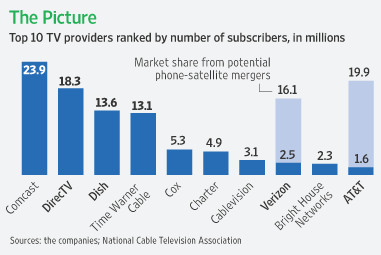
Comcast and other cable companies will probably need to consider more consolidation — if not now, in the next couple of years. They are still losing market share to satellite and phone rivals. Comcast lost nearly 700,000 basic subscribers in the year to June. Time Warner Cable has fallen to No. 4 among TV providers, behind satellite firms DirecTV Group and Dish Network.

Cable operators are more than offsetting video losses by selling phone and Internet-access. Eventually, though, those opportunities will peter out. And phone companies’ competitive threat in video could be enhanced by a combination with satellite TV.

The newspaper speculates about this kind of marketplace in the near future:

Today's pay television marketplace

Today's pay television marketplace

AT&T DirecTV: The Journal ponders an AT&T buyout of DirecTV resulting in a reduction in AT&T’s investment in U-verse, pushing consumers to its newly-acquired satellite service and redirecting investment into the overburdened AT&T mobile phone network.

VerizonDISH: A Verizon buyout of DISH would allow the phone company to push more rural customers to DISH satellite service, and reduce the expense of wiring all but the nation’s largest cities with fiber optics.

Comcast (formerly Comcast & Time Warner Cable, if not others): A supersized Comcast absorbs Time Warner Cable and becomes an even more dominant cable operator, leveraging its investment in Clearwire to offer a  wireless data option to stay competitive with the mobile phone companies like AT&T and Verizon Wireless.

That would leave most Americans with just three choices for telecommunications services capable of bundling multiple products together.  Wouldn’t such a merger-mania trigger antitrust implications and government review?

The Journal doesn’t think so:

Would such a deal pass antitrust scrutiny, even absent the ownership cap? There is a good chance, say several antitrust lawyers. A major focus of antitrust law is whether a merger reduces competition in a way that could raise prices or otherwise hurt consumers. As cable operators generally don’t compete with one another, merging wouldn’t cut competition.

But what kind of benefits would be found for consumers?  If one resides in a city too small to be judged worthy of fiber optic deployment, consumers could be told to get the satellite television service and live with the copper wiring the phone companies provide today.

Cable operators would be in a fine position to compete, as they traditionally have, against satellite television because of the technical limitations of satellite service, ranging from consumer objections to having a dish on their home, to a limit on the number of sets that can be wired, to the inability to get a clear view of the satellite because of nearby trees or other obstructions.

Who pays for the debt likely incurred from a bidding war during a merger frenzy?  Guess.

Time Warner Cable-Verizon FiOS Price War Likely In Syracuse

Phillip Dampier September 7, 2009 Competition, Verizon, Video 2 Comments

Competition does occasionally bring lower prices, but only to those who threaten to abandon their current provider to take their business elsewhere.

Residents in several suburbs of Syracuse, New York have learned that trick as Verizon nears the launch of FiOS service in their area, and the result is significant savings of more than $240 a year, just for the asking.

“Where we find the competition really paying off is for those consumers who might already be with Time Warner,” Doug Williams, a Cambridge-based analyst with Forrester Research told the Syracuse Post-Standard.  “People whose promotional deals are ending are often able to get a sweet deal with nothing more than a phone call and a mention of the word “FiOS.”

It worked for Doug himself up in Boston, where his mother is served by Comcast:

Doug Williams had a fool-proof plan for his mother-in-law to get at least $20 knocked off her cable bill: Call the cable company and tell them Verizon FiOS television was in her neighborhood.

It worked without a hitch. The operator looked up her address, then gave her a discount without any hesitation. Williams’ family lives in the Boston area, where Verizon’s fiber optic television service is the first real competition to the area’s entrenched cable provider, Comcast.

The Syracuse suburbs of Clay, Cicero, East Syracuse, North Syracuse and Fleming already have, or will soon have access to FiOS.  The towns of DeWitt and Salina last week approved franchise agreements with Verizon to provide the service, and Camillus approved the franchise agreement on August 25.

The addition of the Camillus television franchises brings to 161 the total number of New York municipalities that have authorized Verizon to provide FiOS TV service.

The company is in the process of building and installing the necessary video equipment in local central offices in the central New York region, and anticipates that FiOS TV service will be turned on for new customers in
municipalities there in the fall.

[flv width=”296″ height=”222″]http://www.phillipdampier.com/video/WSYR Syracuse FiOS Coming to CNY.flv[/flv]

WSYR-TV Syracuse covers the announcement by Clay officials of Verizon’s first franchise agreement in the area. (3/16/2009)

Time Warner Cable has been preparing for Verizon for at least a year, starting with complaints about how the franchise agreement was handled in Clay, where Time Warner officials claimed they were given insufficient notice to review the franchise proposal.  That claim was brushed aside by the New York Public Service Commission, which has a history of rubber stamping franchise proposals anyway.  Time Warner has had little to say about other franchise agreement negotiations since.

The cable company has also been wringing its hands about fears Verizon’s construction crews will be digging up their customers’ lawns, making a mess, and accidentally interrupting service for their customers.  Time Warner’s concerns may have come in part from a WSYR-TV report back in June highlighting the frustrations of Clay residents who have been inconvenienced by Verizon’s slow work in their area.  But most consumers welcome the competition.

[flv width=”296″ height=”222″]http://www.phillipdampier.com/video/WSYR Syracuse Preparing for FiOS.flv[/flv]

WSYR-TV Syracuse highlights the plight of Clay residents running out of patience as Verizon wires their community for FiOS. (6/4/09)

“People are excited. It looks like there will be an opportunity for choice,” Cicero town supervisor Chet Dudzinski told the newspaper.

Verizon FiOS installation crews start to wear out welcome in Clay, N.Y.

Verizon FiOS installation crews start to wear out welcome in Clay, N.Y.

Time Warner claims it’s not worried by the competition, noting it successfully competes in many other FiOS-wired communities.  But Time Warner’s marketing efforts have changed with the looming threat of competition.  First, the company brought a “price protection agreement” to the area, trying to lock in existing customers to a lengthy contract before the competition arrived, limiting their chances to switch providers.  Then the company embarked on a major HD channel expansion, quickly bringing Syracuse residents more than 100 HD channels.  Time Warner promoted their heavy emphasis on local sports programming, touting Syracuse University football and basketball games, and local high school sports coverage.

Verizon shot back they will feature more than 115 HD channels, and 70% of their 15,000 videos on demand are available for free.  Verizon also will carry many Syracuse sports events, and will also bring NFL Network and ESPN 360 to the area, services Time Warner has refused to carry.

Consumers enjoy the competitive choice, and with the possibility walking their cable and broadband service to the “other guy” across town, will be able to leverage some additional savings off their service.

For Syracuse city residents, the wait will be somewhat longer.  City officials are wrangling over the kinds of public access programming and service policies Verizon will be required to provide before they will negotiate a franchise agreement with them.  The foot dragging may last a year or longer, as the city will vote Monday on whether to spend $30,000 of taxpayers’ money just to ascertain what the city needs from Verizon when negotiations begin.  City residents who want competition now may want to inform their elected officials spending $30,000 to “study” the issue is just a tad excessive, especially considering The Google provides ample information, for free, about what other communities across the northeast have accomplished as part of their negotiations with the dominant phone company in the region.

Verizon’s complete list of franchises in New York state is below the jump.

… Continue Reading

Verizon FiOS Wins Franchise in Easton, Mass. – Marks 100th FiOS TV Franchise Agreement in the State

Phillip Dampier September 1, 2009 Comcast/Xfinity, Competition, Verizon 1 Comment

Easton,_MA_SealVerizon today announced the 100th franchise agreement in the state of Massachusetts for FiOS TV. The Easton Board of Selectmen on Monday granted a cable franchise to Verizon to begin wiring the town of 23,000 with fiber optic service. Residents will receive visits from Verizon employees to explain and market the service, which will compete directly with incumbent cable provider Comcast.

Verizon’s growth in the state has already put them in second place behind Comcast as the largest provider of wired television and broadband service.  That position was formerly held by RCN, a cable overbuilder providing service in the Boston area.

Verizon celebrated the 100th franchise agreement by donating $1,000 to the Easton Area Public Library to purchase 100 new books.

“As a result of this new franchise, consumers in Easton will be able to choose their cable provider as easily as they choose their phone company,” said Cupelo. “Competition drives innovation, value and service quality, and it puts the consumer in control.”

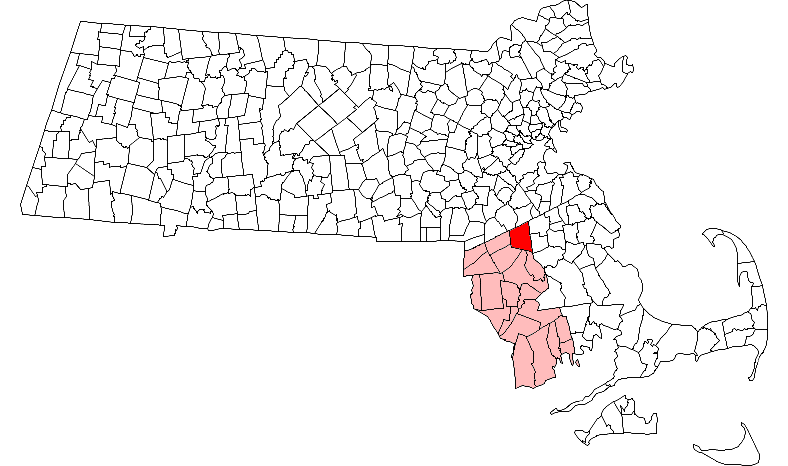
Easton, Massachusetts

Easton (in dark red), part of Bristol County, Massachusetts

Verizon research indicates 87 percent of Massachusetts residents favor more competition and choice for video services.  Independent studies suggest competition in the video market can bring reduced prices, better packages and improved service, although experiences in many communities indicate providers are more apt to compete on services and packaging, and not as much on price.

Verizon’s license agreement with the city of Easton is for 10 years.  The agreement contains provisions for the network’s future growth; financial support and capacity for educational and government access channels; cable service to government buildings; and other important benefits to the city, including insurance, indemnification and enforcement protections.

“Verizon will compete aggressively for subscribers in Easton with our FiOS services, which are fueled by our lightning-fast fiber-optic network,” Cupelo said. Verizon soon will begin its door-to-door sales campaign in Easton, explaining the many advantages of FiOS TV to local consumers.

For some local residents, the competition can’t arrive soon enough.

Comcast has alienated many Easton residents by not carrying all of the HD signals from Boston area television stations.  Easton, although essentially halfway between Boston and Providence, Rhode Island, has been defined by the Federal Communications Commission as being in the “Providence DMA” (an area of significant influence.)  That’s because parts of Bristol County have towns that are considered suburbs of Providence.  Easton’s allegiance, in the minds of many who live there, is to Boston, and residents are upset that the majority of HD broadcast stations on Comcast Cable are from Providence.

The town is actually part of a regional effort to redefine their part of Bristol County to be in the “Boston DMA” so they can petition the FCC to make a change.

The Easton Cable Commission has gotten an earful from annoyed residents, who have faced an intransigent Comcast.  They have even prepared an FAQ for residents on the matter:

Why can’t I get some Boston based HD channels on Comcast?
This is an important issue to many Easton cable subscribers. We want to take some time to explain the relevant issues just so you understand why most believe Easton residents are not getting the channels they want and the channels that they believe serve them best.

The starting point is the DMA that Easton is in.  What is a DMA?  Well, that is our problem.  DMA is short for Neilsen Media Research Designated Television Market Area. DMA’s are generally split up according to county.  Easton is in Bristol County.  A good part of Bristol County is actually considered part of suburban Providence.  Therefore, Easton, although not a suburb of Providence, is in the Providence DMA.  All cable providers must carry the primary channels that serve a DMA.   At present, Comcast must carry Providence DMA stations.  There is an effort underway to move towns inside of Route 495 into the Boston DMA.  We will petition the FCC for this change.

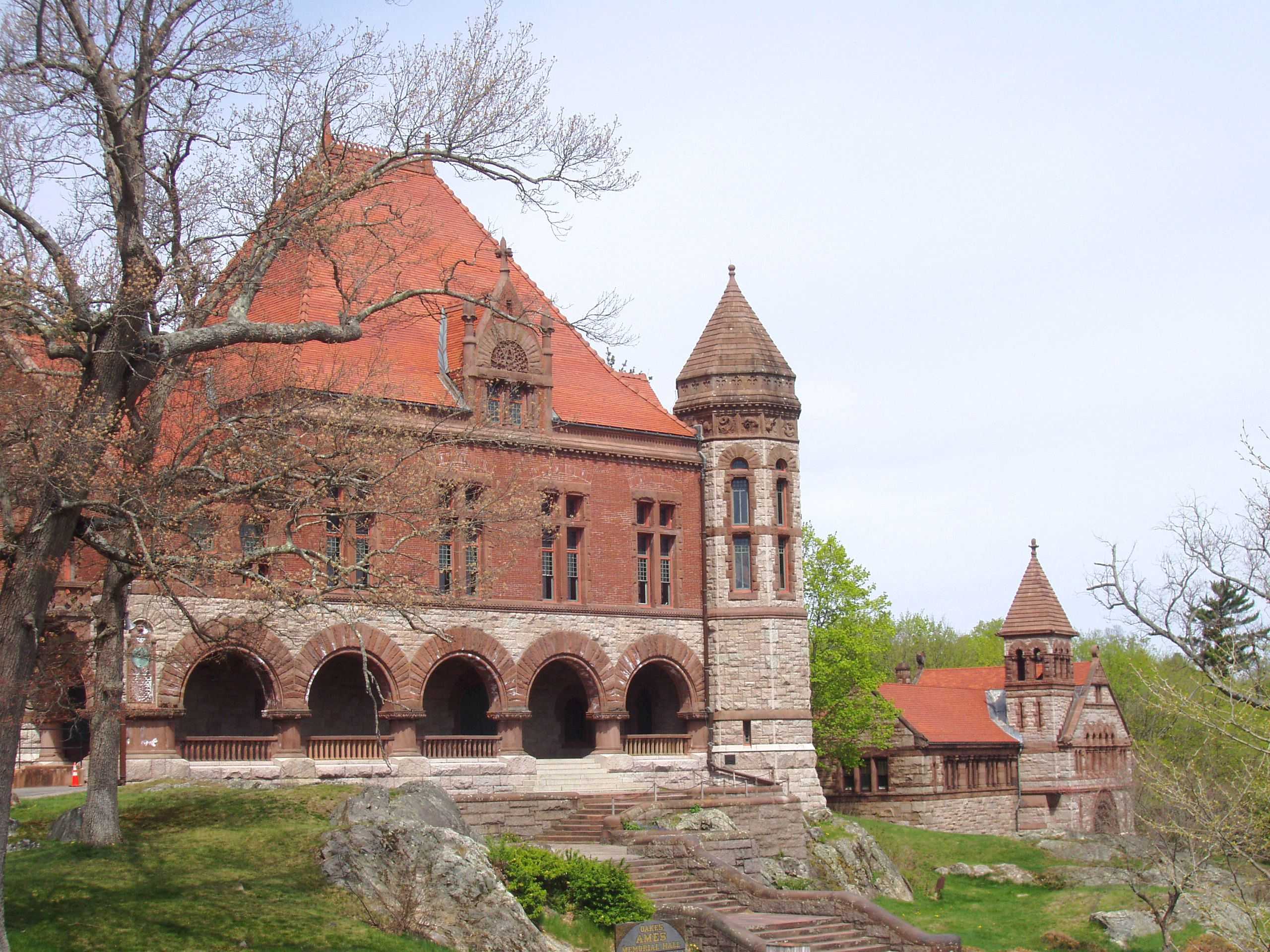
Oakes Ames Memorial Hall and Ames Free Library (North Easton, MA)

Oakes Ames Memorial Hall and Ames Free Library (North Easton, MA)

But the greater issue here is whether Comcast chose to eliminate Boston channels in High Definition or whether they had no choice.  For the most part, this is a Comcast choice.  The Town of Easton and our Cable Committee, unfortunately, cannot force Comcast to provide Boston channels in High Definition.  Along with the concept of DMA, there is also the concept of “Significantly Viewed” channels in an area.  This is another FCC concept which relates to stations not in the local DMA which may be referred to as “distant signals”.  A “distant signal” is one that originates outside of a satellite (or cable) subscriber’s local television market, the DMA. In addition to stations in their DMA, satellite (cable) subscribers who receive local-into-local service may, under certain circumstances, receive individual stations from markets outside their DMA that are deemed “significantly viewed” in their community. It is up to the satellite carrier whether or not to offer significantly viewed stations and a subscriber must be subscribing to local-into-local service in his or her DMA to be eligible to receive significantly viewed stations. The determination of whether or not a station is significantly viewed in a community depends on several statutory factors.  The FCC has posted the list of stations that are eligible for carriage as significantly viewed signals and the communities in which they are significantly viewed.
The following is the list for Bristol County:

Bristol
WLNE-TV, 6, Providence, RI (formerly WTEV)
WJAR, 10, Providence, RI
WPRI-TV, 12, Providence, RI
+WNAC-TV, 64, Providence, RI
WBZ-TV, 4, Boston, MA
WCVB-TV, 5, Boston, MA (formerly WHDH)
WHDH-TV, 7, Boston, MA (formerly WNAC)
WSBK-TV, 38, Boston, MA
WLVI-TV, 56, Cambridge, MA (formerly WKBG)

So, Comcast has every right to provide the above channels (which include 4,5, and 7) in High Definition.  It is their choice not to do so.  You may ask why Channel 25 is not on the above list and that is a great question.  But the answer is that the determinations for this list were made a long time ago when Channel 25 was owned by religious broadcasters.  That is how outdated all of these rules are.  It is also the reason that Comcast is forced to black out FOX 25 network programming.

There may be an alternative to Comcast in Easton by the end of the year.  We are going through a licensing process with Verizon.  They want to offer Fios tv, internet, and phone in Easton by December.  It is all of our hopes that Verizon will provide the channels that you are looking for and that competition will benefit all cable tv subscribers in Easton.

For further information please contact the Comcast Customer Care line at 1-800-COMCAST (1-800-266-2278).

In Massachusetts, FiOS TV is available in Abington, Acton, Andover, Arlington, Ashland, Bedford, Bellingham, Belmont, Boxborough, Boxford, Braintree, Burlington, Canton, Danvers, Dedham, Dover, Dunstable, Framingham, Franklin, Georgetown, Grafton, Groton, Hamilton, Hanover, Hingham, Holliston, Hopkinton, Hudson, Hull, Ipswich, Kingston, Lakeville, Lawrence, Leominster, Lexington, Lincoln, Littleton, Lynn, Lynnfield, Malden, Mansfield, Marion, Marlborough, Marblehead, Marshfield, Mattapoisett, Maynard, Medfield, Medway, Melrose, Mendon, Methuen, Middleborough, Middleton, Millbury, Nahant, Natick, Needham, Newton, Norfolk, North Andover, North Reading, Northborough, Norwood, Norwell, Plymouth, Reading, Rochester, Rockland, Rowley, Sherborn, Southborough, Stoneham, Stoughton, Stow, Sudbury, Sutton, Swampscott, Taunton, Tewksbury, Topsfield, Tyngsborough, Wakefield, Walpole, Waltham, Wareham, Wayland, Wellesley, Wenham, West Newbury, Westborough, Weston, Westwood,  Wilmington, Winchester, Wrentham and Woburn, and will soon be available in Chelmsford, Easton and North Attleborough.

Search This Site:

Contributions:

Recent Comments:

Your Account:

Stop the Cap!