Home » FiOS » Recent Articles:

Comcast Raising Prices… Again, But Their Usage Cap Remains Firmly In Place; 3.5 Percent Increase For Many

Phillip Dampier March 9, 2010 Comcast/Xfinity, Competition, Data Caps 3 Comments

Comcast is back with another rate increase effective April 1st, amounting to 3.5 percent for many cable, broadband, and telephone customers.

Although prices vary depending on your specific service area, the range of the price increase is more consistent.

In southern New Jersey, for example, here is the breakdown — all prices are by the month:

  • Expanded/Standard service cable-TV tiers are increasing $2.  Expanded service customers could pay up to $50.10, Standard customers $60.55;
  • Triple Play customers will see a $5 increase in the second year of their two-year contract from $114.99 to $119.99.  First year pricing remains $99 for new customers;
  • Digital Premium Packages are increasing $2;
  • Economy Broadband (1Mbps) increases $2, Performance (12Mbps) increases $2, Blast! (16Mbps) increases $2, Ultra sees no price increases (but goes away for new customers effective 4/1);
  • Comcast phone line prices are also increasing in certain cases;
  • Each additional DVR drops by $5 — Verizon FiOS was hammering Comcast about DVR pricing.

There are no rate changes for business service customers or subscribers with “limited basic service.”  There is also no change in the company’s broadband usage allowance — 250 GB, the only part of Comcast’s service that seems to stubbornly remain at the same level year after year.

Comcast, the nation’s largest cable operator, blamed the mid-year price increases on increased programming and other business costs.

But the company is not exactly hurting.  Comcast’s 4th quarter earnings last year jumped 132 percent to $955 million dollars.  Rate increases that are designed to drive consumers into profitable service bundles, combining television, Internet, and telephone service, guarantee even better financial results in 2010.

Verizon is already capitalizing on Comcast’s rates by offering residents in southern New Jersey an even better price for Verizon FiOS — dropping from $109.99 for two years to $89.99, not including taxes and fees.  But like Comcast, Verizon wants you take a bundle of services, or else face higher prices.  The company recently increased the price for FiOS TV to $64.99 for standalone service.

Cablevision Redux: Cable Customers May Lose WABC-TV New York in Another Rate Dispute

Phillip Dampier March 2, 2010 Cablevision (see Altice USA), Competition, Video 1 Comment

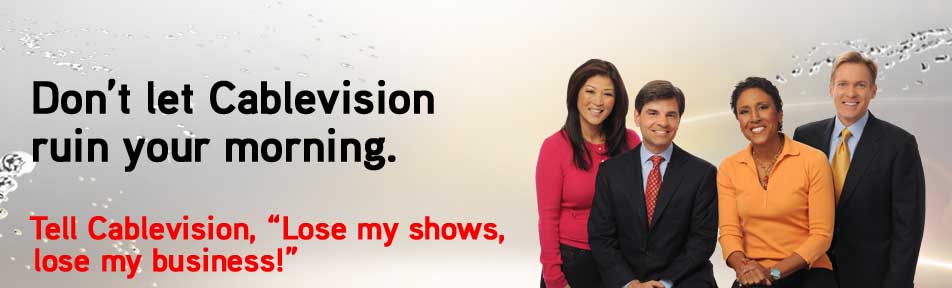
Cablevision subscribers: Just two months after facing the loss of HGTV and the Food Network, get ready to lose WABC-TV — the ABC affiliate in New York, just hours before the Oscars telecast is set to begin.

Cablevision’s contract with Disney-owned WABC-TV will expire March 7th, and both sides have not reached an agreement.

The dispute centers around retransmission rights fees.  Currently, WABC permits Cablevision to carry its channel on their lineup for free.  But now the station wants to be paid.  WABC claims Cablevision earns $18 million a month from its broadcast basic lineup of mostly-local channels, and it’s time to share a portion of that with the station.

Cablevision has so far not agreed to the asking price.

“Cablevision’s position is that ABC7 is worth little to nothing to its business and its proposed offers have been consistently unreasonable and unrealistic,” said Rebecca Campbell, president and general manager of WABC-TV. “We think these shows are valuable, and your bill shows that Cablevision must agree since you already pay for ABC7 as part of your Broadcast Basic Tier – a service for which, as a Cablevision customer, you pay as much as $18 each month.  Cablevision charges you for ABC7 and then keeps all the money.”

WABC has started a website to educate customers how to drop Cablevision and switch to a competitor such as Verizon FiOS, or get access to the station over-the-air.

Cablevision fired back accusing ABC of asking consumers to pay a TV tax amounting to $40 million that would have to be passed onto subscribers in another rate increase.

“It is not fair for ABC-Disney to hold Cablevision customers hostage by forcing them to pay what amounts to a new TV tax,” said Charles Schueler, Cablevision executive vice president.

Both sides indicate negotiations are continuing, and some compromise may still be reached before the deadline.

[flv width=”600″ height=”356″]http://www.phillipdampier.com/video/WABC New York Cablevision viewers may lose Channel 7 on cable service 3-2-2010.flv[/flv]

WABC-TV is running this 30-second ad telling viewers about the dispute with Cablevision, along with stories on their newscasts. (4 minutes)

Time Warner Cable – Trying to Keep Customers From Leaving After Substantial Rate Hikes

Phillip Dampier February 15, 2010 Competition 10 Comments

Some communities are luckier than others.  When your cable company boosts rates, some consumers have another provider available, letting them take their business elsewhere.  That’s especially true if there is another provider in town that doesn’t require you to attach a satellite dish to your roof.

For those who have no other alternative, it’s time for the family meeting to discuss what action, if any, will be taken to deal with a bill that relentlessly increases year after year.  The solutions usually come down to “grin and bear it” when paying the higher price, start dropping channels, or go cold turkey and get rid of cable altogether.

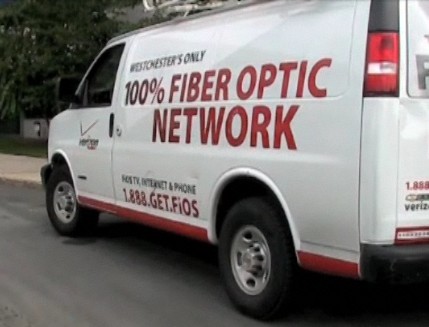
In economically troubled western New York, just accepting a higher bill isn’t always an option.  For residents of Buffalo, many have the choice of switching from Time Warner Cable to Verizon FiOS.  Many Queen City residents have threatened to do just that, often extracting concessions from Time Warner Cable when they call to cancel.

Stop the Cap! reader Marion, who lives in Amherst, wrote she was outraged to receive word of yet another rate hike from Time Warner Cable.

“Our family had been pestered by Verizon ever since FiOS came around our area, but having the phone company tear up your house to rewire everything and change your e-mail address was a real hassle, so we just kept Time Warner,” she writes.  “I’m fed up paying for all these filthy channels I never watch and I frankly can’t afford to keep paying them more and more every year whenever they have one of their programmer disputes.”

Marion called to cancel service and was transferred to a “retention specialist” who is trained to rescue departing customers before they cut the cord or show up at the cable office with their set top boxes in hand, waiting to turn them in.

“They always want to argue what a great value they are and how messy and time-consuming FiOS is to install, and you have to pay extra for HD channels I’m too old to appreciate anyway, but I just kept saying ‘cancel’ and said the only thing I cared about was the price,” Marion adds. “In the end they offered to cut the bill twenty dollars a month and give me a discount only new customers would get if I agreed to stay with a term plan.  I decided I would, for now.  I’m on a fixed income and with no Social Security increase this year, the price is very important to me.”

Alan Pergament is the TV Critic for the Buffalo News

Time Warner Cable is well aware when customers leave.  The company’s “churn” rate, measuring departing customers, has been on the increase in highly competitive service areas.  Consumers have learned to use new customer promotional offers from the competition against their current provider, threatening to cancel if they refuse to match them.  The costs of getting those customers back can be higher than just handing over a temporary discount, so many providers relent and give customers the lower price they want.

In Buffalo, convincing customers the local cable company is a better value and offers better service than the fiber-based FiOS competition might keep customers from thinking about switching in the first place.  That’s the idea, anyway.

The Buffalo News Tuesday published an interview with Time Warner’s Jeff Unaitis on the recently-announced rate hike and what changes the company is making to try and hold onto their customers.

Unaitis started with a range of new and upcoming improvements the cable operator is planning to make across upstate New York:

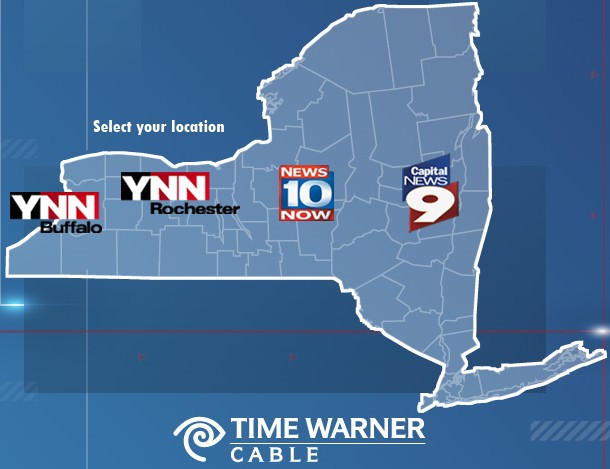
• The 24-hour news channel YNN —or Your News Now—will be the title of all TWC news channels across the state shortly to give it a “seamless news presence across the state.”

“You are beginning to see more shared coverage across the state,” said Unaitis.

Additionally, viewers in Western New York will get an upconverted HD version of YNN on Channel 709 by April or so. In other words, it isn’t shot in HD but it is HD quality. It already has been done on TWC’s news channel in Syracuse. “The reality is when you are accustomed to see HD content going back to something that is standard digital, let alone analog, is more difficult viewing,” Unaitis said.

• A new interactive, user-friendly, online programming guide will be available soon. One bonus: It will be easier to order On Demand titles.

In the next few months, the satellite feature celebrated in the ads with “Pysch” star Dule Hill that allows subscribers to program their DVRs remotely while they are away from home will soon be available to TWC subscribers with this guide.

• TWC is looking at the possibility of expanding “significantly more” HD channels that the public has requested. BBCAmerica, Lifetime and all the Viacom channels (VH1, MTV, Comedy Central and Nickelodeon among them) are among the most requested. “Some of them are contingent on carriage deals,” said Unaitis. “Others we do have the rights to carry, we just haven’t done the engineering required to have them yet.”

• The popular Start Over feature — which is up to 90 channels here and allows viewers to start shows from the beginning during the time window it airs — will be augmented some time this year by a new “Look Back” feature. “Look Back” enables viewers to watch shows for up to 72 hours after they air rather than just the window in which they air.

Unaitis added that viewers may not realize that the Free on HD Demand channel offers subscribers many of the same programs that are available on Prime Time On Demand, but in HD.

YNN provides 24/7 local news coverage on individual channels in Buffalo, Rochester, Syracuse, and Albany

The newspaper’s TV critic, Alan Pergament, noted the service changes, but immediately pelted Unaitis with the concerns local residents actually have about their Time Warner Cable service.  To save time, and because of complaints I’ve had about my verbosity, I’ve boiled it all down for you:

Q. Why isn’t Time Warner Sports-Net, the local sports channel, in HD?

A. Because it costs too much, but Unaitis claimed the channel will be upconverted to HD, which will “give it an HD-quality signal.”  Not really.

Q. Buffalo gets Canadian networks from Toronto-area stations on their lineup.  Why aren’t they available in HD?

A. Who knows.

Q. Why can’t people pay for only the channels they want?

A. Because programmers won’t allow it, and the cable company would end up charging you the same price you pay for 75 channels today that you’ll pay for 20 channels tomorrow. Plus, you’ll need a box on every TV in the house and that also increases your bill.

Q. How much do western New Yorker’s pay for YNN?

A. None of your business.

Q. How many subscribers does Time Warner Cable have in western New York?

A. None of your business.

Q. Why do those in western NY pay a higher price for cable service than elsewhere?

A. Unaitis didn’t know if that was true or not, but then explained it was because of the weather, labor costs, high state taxes and the difficulty building and maintaining the cable lines.

Okay, then.

Rebutting Bray Cary’s Cheerleading For the Verizon-Frontier Deal in West Virginia

Phillip "Doesn't Worship Wall Street" Dampier

Bray Cary, president and CEO of a group of West Virginia television stations enjoying advertising revenue from Frontier Communications, was back on his Decision Makers program to allow an opposing viewpoint to the puff piece interview he held earlier with Frontier’s Ken Arndt, Frontier’s Southeast region chief.  This time, he invited Ron Collins, vice-president of the Communications Workers of America to give the CWA side.  Cary’s Tea-‘N-Cookies Breakfast Club With Ken this was not.  Cary decided to play hardball with Collins, leaving no viewer in doubt where Cary stood on the question of Frontier’s proposed purchase of West Virginia’s phone lines from Verizon.

Unfortunately, Collins was not completely prepared to rebut Cary’s pro-Wall Street, pro-deal propaganda and looked ill at ease at times during the interview.  We’re not, and Cary’s “facts” deserve some investigation.  After all, how hard should it be to rebut a guy who believes Wall Street and the banks have all the right answers for West Virginians’ phone service?

  • Video No Longer Available.

Right from the outset, Cary wants to play “devil’s advocate” with Collins, asking why in the world the CWA is opposed to this deal.  That was a major departure from his cheerleading session with Arndt.

Bray Cary, Host of Decision Makers

“I’ve looked at this […] their stock has been extremely stable.  Wall Street appears to be signaling their financial viability is okay.  Why is the stock market not reacting negatively?  If it’s good for stockholders, how can it be bad for their financial stability.  Stockholders want financial stability,” Cary said in a series of statements about the deal, including mentioning a Moody’s report on the deal.

The Moody’s report Cary talks about is for shareholders who will reap the rewards or suffer the losses based on the success or failure of the deal.  Moody doesn’t rate the deal’s impact on consumers who have to live with the results.  What’s good for Wall Street is not necessarily what’s best for customers.

“What you don’t have is anyone in the financial community suggesting this is a bad financial deal,” Cary said December 13th.

Wrong.  Almost a week earlier, on December 7th, D.A. Davidson, a respected Wall Street analyst said the opposite.  In a story published in Barron’s: “Frontier Communications’ Shares Not Wired for Success,” the analyst firm argued the regional telecom’s acquisition of Verizon’s rural lines will be… wait for it… bad for the stock.

Cary’s claim that Wall Street is concerned with the long term viability of companies belies the growing reality that much of the investment culture in America has a long term obsession with short term results.  Your company is only as good as your last quarter’s financial earnings statement, and several bad ones in a row are usually enough to bring a recommendation to dump shares.  Frontier has kept its stock value stable largely as a result of their steady dividend payment.  Collins claims Frontier has gone beyond reason, paying 125% of earnings in dividends.  That may make the stock a popular choice for income investors, but is also eerily familiar.

FairPoint Communications also enjoyed a healthy stock price because of its high dividend payout.  Wall Street only got concerned when they thought that deal might not go through.  Morgan Stanley issued a report in 2007 suggesting the deal between FairPoint and Verizon to take control of landline customers in Vermont, New Hampshire, and Maine, was itself helping to prop up the stock’s value.  We saw how far that got FairPoint when the company declared bankruptcy a few months ago.
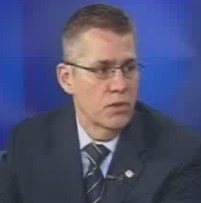
Ron Collins, CWA's vice president

Indeed, smaller independent phone companies commonly use high dividends to remain attractive to investors and stay viable in a tough market.  Windstream is another such company and even CNBC’s Jim Cramer gave due diligence to the fact high dividends and stock value by themselves don’t necessarily predict the company’s long term success or failure.

Make no mistake, Frontier has sold this deal to investors based on dividend payouts, claimed cost savings, and a safe bet that any broadband in rural America will earn them increased revenue, especially where consumers have no other place to go for service.

Frontier will take on massive additional debt to finance the deal, but on paper it actually appears to reduce their debt ratio.  That’s because when you add millions of new customers, the debt doesn’t look so big next to the increased revenue those additional customers will bring, assuming they stay with Frontier.  Should Frontier’s performance underwhelm customers, they’ll drop service if they can.  If mobile phone networks do a better job of reaching these rural customers, many will drop landline service anyway.  When wireless broadband service becomes a more realistic option, customers might toss Frontier’s slow speed DSL overboard.

AT&T and Verizon have read the writing on the wall — an ongoing decline in landline service and the eventual death of the kind of service Frontier is providing its customers on its legacy network.  Would you be better off with a company that recognizes the truth about the future of wired basic phone service, or the one that wants to buy up obsolete networks and hang on until the last customer leaves?

Cary’s concern starts and stops with shareholder value, not the individual long term needs of consumers across West Virginia.

“All of the bankers and all of Wall Street are saying financially this is a good deal financially for Frontier,” Cary argued.

“Good for Wall Street, bad for West Virginia,” Collins replied.

“Well, see I disagree… that has been a myth put out there, and the reason we don’t have any jobs in this state is companies don’t want to come here just because of that mentality.  People need to make money.  You look at where companies are flourishing, the workers flourish when they do,” Cary said.

Really.  Then why are several of these telecommunications companies awash in revenue also continuing to reduce their workforce in their relentless effort to obtain “cost savings.”  Someone is making money, just not the average employee.  Every state has pro-business acolytes claiming businesses don’t want to come to their state because of regulation and a hostile business climate, even those with the fewest regulations, lowest taxes, and little protection for employees and consumers.

Cary does make one valid point: Verizon wants out of West Virginia and refuses to invest a dime in the state as it looks for a quick exit.  Instead the company has diverted resources from serving smaller states’ phone service needs into its larger city FiOS fiber to the home system where it believes it can reap more revenue.  Whether that disinvestment should be permitted in the first place is a question that needs to be asked.

Verizon is a regulated utility that is required to meet certain performance standards, and the company’s long history of operations under that framework, under which it profited handsomely, does require consideration.  But the state can also provide additional incentives to make it more attractive for Verizon to commit more resources in the state, ranging from tax credits, public-private investment, rewards for performance and service improvements, etc.  It can also find someone else to provide the service, or let local communities band together into cooperatives to run their own networks, should customers find that could deliver better service.

At the very minimum, Frontier should he held to strict conditions that require a fiscally responsible transaction for ratepayers, not just for shareholders and management.  Verizon’s workforce, already cut to the bone, should not bear the brunt of “cost savings” either, both now and into the future.  If Frontier wants to deliver broadband, they should commit to offering 21st century speed (not the 1-3Mbps service typical for their smaller service areas) without their draconian 5GB usage limit in their Acceptable Use Policy.

Cary doesn’t concern himself with those kinds of details, but consumers and small businesses in his state sure do.

Cary wants more jobs and more earnings for West Virginia.  In the changing digital economy, high speed broadband isn’t an option — it’s a necessity.  Verizon has a proven track record of being able to provide 21st century broadband — Frontier does not (sorry, 1-3Mbps DSL is more 1999, not 2010).

Cary makes an astonishing statement in the third segment of the interview which makes me question his ability to grasp the reality-based community most Americans live in today.

“I have great faith in the banking system in America, in Wall Street, to evaluate these things.”

That stunned Collins, who asked, “even after the 2008 crash?”

Cary seems to think “everything is back to normal.”  Unfortunately, after the bailouts and big lobbying dollars being spent in Washington to preserve the status quo as much as possible, everything is back to normal… for Wall Street and the banks.  The rest of the country, including West Virginia, is another matter.
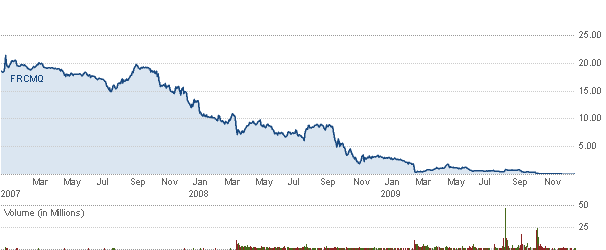
FairPoint's Stock Price from 2007, when it announced the deal with Verizon, to late 2009 when the company declared bankruptcy. By late 2008/early 2009, what seemed like a great deal for investors was apparently not, as the panicked rushed for the exits.

I’ll put my trust in the wisdom of West Virginians who want good service and reasonable prices.  If Cary wants to read from the Good Book of the “paragons of virtue” like AIG, Bear-Stearns and Goldman Sachs, let him sell his TV stations to help finance the bailouts.  Remember that when we went through this before with Hawaii Telecom and FairPoint Communications, the cheerleading session on Wall Street lasted only as long as the quarterly balance sheets looked good.  At the first sign of trouble, they bailed on the stock and both companies ended up in bankruptcy.

For them, it represented just another roll of the dice in the giant financial casino we call Wall Street.

For the rural residents of states like West Virginia who ultimately have to live with the results, this is their phone and broadband service we are talking about.  Before all bets are placed and the dice are thrown, isn’t it worth considering them?

Verizon Does ‘Home Technology Makeovers’ In Infomercials to Pitch Verizon FiOS Service

Phillip Dampier January 6, 2010 Competition, Verizon, Video 2 Comments

Liberally borrowing from ABC’s Extreme Makeover: Home Edition, and those home improvement shows on HGTV, Verizon has been producing their own “home technology makeovers” for infomercials airing in different Verizon service areas, designed to pitch their fiber to the home FiOS product line. It’s a non-threatening introduction for those not so technology-inclined, but love the premise of home makeovers.

The Reyes family of Clearwater, Florida is the latest to receive a Verizon-inspired makeover this March, which will air later as an infomercial in the Tampa Bay area.

The family was chosen from those who auditioned for the role during the past two months.

Verizon traditionally sets up each show by illustrating the challenges busy families face when trying to work with outdated electronics.  It’s also a great chance to bash the competition, suggesting their cable reception isn’t so great, their calls to 911 are broken up and unclear, and their Internet is slow and generally lousy.  At this point, Bright House Networks, Tampa’s predominate cable company, is supposed to be squirming, because you can bet these families aren’t complaining about Verizon phone service or Verizon DSL.

After the family leaves the home, a bandwagon of Verizon workers and self-described “Design,” “Tech,” and “FiOS”-Gurus show up and replace their obsolete equipment with Verizon’s family of products, ranging from FiOS for their television, phone, and broadband needs, and some extra goodies thrown in from Verizon Wireless for mobility.  Add some new electronics and some room makeovers and the job is complete.

When the family returns, they are suitably impressed with Verizon’s products (which they presumably obtain for free, at least for awhile), the company throws a block party for the entire neighborhood, and everyone goes away with a positive feeling about the company.

“I like the concept of the show, how one company can bring so much happiness to a family just by changing their home technology,” said Jessica Reyes. “It may seem simple to some people, but I know this will have a huge impact on our family.”

See?

Actually, it’s a brilliant execution of marketing to those who don’t suddenly start drooling at the mere mention of FiOS in their neighborhood.  For plenty of Americans, a decidedly non-technical demonstration of the technology products Verizon sells is a much better way to sell service to those who think fiber is a matter of diet, not home entertainment.

[flv width=”640″ height=”380″]http://www.phillipdampier.com/video/Verizon MyHome 2.0.mp4[/flv]

Verizon’s promotional reel for My Home 2.0 shows home technology makeovers, and can’t resist taking a few pokes at the competition’s service. (1 minute)

Search This Site:

Contributions:

Recent Comments:

Your Account:

Stop the Cap!