Home » FiOS » Recent Articles:

Frontier Dismisses Its FiOS Operation: “It Came Along With the Deal, It Was What It Was”

Phillip Dampier January 26, 2011 Consumer News, Data Caps, Editorial & Site News, Frontier, Video 3 Comments

Ft. Wayne, Indiana

Outrage over enormous price increases for Frontier’s fiber optic television service in Indiana are being met with little more than a shrug of the shoulders by one company executive, who seemed to dismiss as an afterthought the state-of-the-art FiOS network it acquired from Verizon.

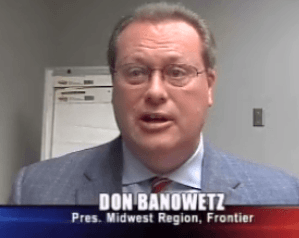
Frontier Communications’ president of its Midwest division, Don Banowetz, has been making the rounds with Fort Wayne-area reporters over news the phone company intends to boost prices for its FiOS TV service by $30 a month for most customers.

But Banowetz has done little to defend the price increases or the fiber network the company acquired with its purchase of landlines from Verizon.

“Look, we bought the whole company, right? All the assets. The FiOS part was part of that, so it was part of the deal,” said Banowetz.  “We couldn’t ride the previous arrangement. So in essence, it was what it was.”

WANE-TV reporter Aishah Hasnie seemed stunned with Banowetz’s response, finally asking what customers should do if they can’t afford the rate increases.

“Get DirecTV,” came the reply.

Starting February 18th, customers who subscribe to a FiOS TV basic package will see their rates go by up $12 per month. Customers who subscribe to other FiOS TV packages will see a $30 increase. The increase does not affect customers under a price protection plan.

That kind of price increase would normally provoke blanched faces in a corporate boardroom over fears of a mass exodus of customers.  But not Frontier.

“The FiOS TV part of our business is actually a very small part of our business. It’s about three percent of our revenues,” said Banowetz.

But Frontier’s satellite package, pitched as an alternative, brings plenty of tricks, traps and other hidden fees inside the box.  In addition to signing a two-year service commitment with DirecTV, customers also have to sign a three-year “price protection agreement” with the phone company, which is another way of saying “contract.”  The total price adds up:

  • Customers opting for Frontier’s “free TV” promotion will face a three-year contract term with a $400 early cancellation fee;
  • Frontier’s satellite TV promotion has a three-year contract term with a $300 early cancellation fee;
  • “Care and handling” fees amounting to $69.99 apply to the “free TV” offer;
  • A $34.99 Frontier “video setup fee” applies to customers getting satellite service from the phone company;
  • DirecTV requires customers to pass a credit check and sign a contract with a 24 month commitment;
  • If you change any aspect of your programming package, you may forfeit the “free service” offered as part of the promotion.

In northwest Washington state, Frontier’s rate increases are alienating the company with one member of the state’s congressional delegation.

U.S. Representative Rick Larsen (D-Wash.) sent a letter to Frontier complaining about the huge rate hikes, telling the company it needs to find better alternatives for many of his constituents who cannot install a satellite dish.

“Folks in Northwest Washington are concerned about the future of cable service offered through Frontier Communications, and rightly so,” said Rep. Larsen. “I am calling on Frontier to offer consumers better and more affordable options for cable service in the region.”

Rep. Larsen’s letter to Frontier Communications:

Rep. Larsen

Dear Mr. Mason:

I am writing to express concerns that I share with many of my constituents in Northwest Washington about Frontier’s plans for cable service in our region. The Everett Herald recently published an article, “Switch to a Dish or pay more, Frontier tells FIOS customers,” that highlights some of the problems that people in Northwest Washington have with Frontier’s announcement that it will alter the existing framework of its fiber-optic television service. Specifically, Frontier’s decision to offer its customers a choice between continuing with their current FIOS television service—with a rate increase of 46 percent or switching their cable television service to the satellite provider DirecTV.

I am concerned with Frontier’s decision to substantially raise its cable television rates for its existing customers in the Pacific Northwest. Last September, Frontier Communications Chief Executive Maggie Wilderotter was quoted in The Oregonian newspaper stating that Frontier would distinguish itself from larger cable companies by holding down prices for its customers. I find it troubling that less than six months later Frontier is dramatically raising its cable television rates.

Additionally, it is problematic that Frontier has not offered an adequate alternative to those customers who live in apartment complexes where the installation of satellite dishes is prohibited and therefore cannot take advantage of the option to switch their cable service to DirecTV. — Rick Larsen, United States Representative, Washington State, 2nd District

Stop the Cap! reader John says he has sent a letter to CEO Maggie Wilderotter protesting the rate hikes and imploring the company to find a programming co-op to join.  Smaller providers need not pay “rack prices” for cable programming.  Municipal providers, family owned companies, and small independent cable operators have enjoyed substantial programming discounts through group buying power.  Frontier apparently is trying to negotiate for video programming on its own, a fatal mistake that has brought on this month’s rate hike.

If you want to help educate Frontier about how to run their business properly, here is their contact information:

Frontier Communications Corporation
3 High Ridge Park
Stamford, CT 06905-1390
Phone: 203-614-5600
Fax: 203-614-4602
[email protected]

When writing or calling, don’t forget to tell them to abandon their Internet Overcharging schemes — no usage caps or limits on Frontier broadband, or you will take your business somewhere else.

[flv width=”480″ height=”380″]http://www.phillipdampier.com/video/WANE Fort Wayne Frontier Frustration 1-24-11.flv[/flv]

WANE-TV in Fort Wayne delves into Frontier Frustration as angry customers react to news of enormous rate increases.  (2 minutes)

FiOS TV Rate Hike in Indiana: “It’s Not Just a Price Increase, It’s an Offer,” Says Frontier Exec

Phillip Dampier January 19, 2011 Competition, Consumer News, Data Caps, Editorial & Site News, Frontier, HissyFitWatch, Online Video, Video Comments Off on FiOS TV Rate Hike in Indiana: “It’s Not Just a Price Increase, It’s an Offer,” Says Frontier Exec

Talk. Watch. Surf. Cancel. -- Major price increases on the way for Frontier FiOS customers in Indiana.

When is a rate increase not just a rate increase?  When it’s also “an attractive offer.”

Frontier Communications is getting heat from consumers in Fort Wayne, Ind., with news their Frontier FiOS TV bill will skyrocket $12-30 higher in the coming month.

To distract from the disaster-in-the-making, Frontier representatives are waving shiny keys to customers preparing to depart, trying to “upgrade” Indiana residents back to satellite TV.

Don Banowetz, president of Frontier’s Midwest division, told Fort Wayne customers he was personally excited by the satellite offer, because customers can get free programming services for the remainder of 2011, a $700 value according to Banowetz.

“It’s not just a price increase, it’s an offer — a quite attractive offer,” Banowetz told INC Now.

Frontier is also pitching a free 32-inch “web-capable” digital television for customers signing an extended length contract.

Frontier says these televisions are going to revolutionize the way Americans watch TV over the next five years, and they believe their offer will be well-received by customers.

Not so much.

"It's not just a price increase, it's an offer!"

“I’ll bet their letter will leave out the part about how Frontier rations the Internet to their customers,” writes Fort Wayne resident Irv, who has been closely following Frontier’s Internet Overcharging antics in the Sacramento area.  “Will the coin slot be on the top or side of their television, because after you start watching, you’ll have to start paying.”

Frontier has sent letters to customers in Minnesota and California demanding up to $250 a month for residential broadband access because they used the company’s DSL service “too much.”

“Who wants to sign a two or three contract with Frontier, raise your hands,” Irv asks.  “They have just destroyed their FiOS TV service in Indiana — my fingers couldn’t dial the cable company fast enough as I take my business somewhere else.”

Another Fort Wayne resident — Nick Behm, has been following Stop the Cap! ever since Verizon announced it was selling Ft. Wayne’s phone lines to Frontier.

“You guys had this company nailed — Indiana’s regulators should hire you folks and some other actual consumers to review these deals before they get rubber-stamped, because Frontier is going to put themselves out of business and risk landline service throughout our area,” Behm writes.  “How can you ruin a fiber service that sells itself?  Let Frontier run it.”

Neither Behm or Irv will be taking up Frontier’s offer, although Behm still has a term contract of his own — with Verizon.

“I am protected from Frontier’s cash grab for several more months, so at least I have time to prepare for the forthcoming cancellation — bye, bye Frontier.”

[flv width=”432″ height=”260″]http://www.phillipdampier.com/video/INC Now Ft Wayne New Charges for Frontier Customers 1-18-11.mp4[/flv]

INC Now delivers the bad (and according to Frontier – good) news to Fort Wayne, Ind., FiOS TV customers — your rates are going up as much as $30 a month.  (1 minute)

Frontier’s Internet Overcharging Ripoff Coming to a Community Near You

"This will never end well."

Stop the Cap! and our allies Free Press teamed up to expose Frontier’s usage limits for what they are — a broadband ripoff.

KOVR-TV in Sacramento ran an excellent piece on Frontier’s latest embarrassing screw-up: driving their declining landline broadband customers away with unjustified and arbitrary usage caps.

One new piece of the story: Frontier could bring its usage rationing sideshow to a community near you.  As Stop the Cap! informed readers from the beginning, the company has quietly been tracking customers’ usage, looking for outliers they can suggest are using too much.  Now the company says it is ready to drop the hammer on heavy users.

Stephanie Beasly, Communications Manager — Frontier Communications:

“The company letters were sent to customers that are using an excessive amount of the network. Well beyond any reasonable amount for an average user and significant enough to negatively affect other customers’ user experience.

The letters are meant to communicate to these customers that their usage is in excess and we would like to work with them to adjust their plan or their usage. In most cases our customers were not aware of their usage patterns and are willing to work with us to adjust their plans to fit their lifestyles. We do not have a customer capacity on our network. We are looking to work with these customers to help prevent degradation on our network to ensure the customer experience.

The pricing structure was put in place to help us maintain the network experience for all customers. If you choose to use a significant amount of bandwidth we believe you should pay for the service accordingly.

The letters were sent to four markets across the company. We routinely review network usage patterns and these users jumped out as consuming an inordinate amount of bandwidth, enough to negatively affect other customers’ user experience.

All of Frontier markets are reviewed for usage patterns as the markets receiving the letters were reviewed. These specific markets were not targeted.

The customers using an excessive amount of data negatively impact the network for other users. Preventing us from providing adequate bandwidth to all of our users during peak and non-peak times.”

There is less and less to like about Frontier Communications, despite the fact they plan to deliver broadband service to rural Americans unlikely to see it from anyone else.  We’re glad someone is willing to provide the service, but 1-3Mbps broadband with arbitrary usage limits and potentially confiscatory pricing ($250 a month for residential customers), is a trade the devil might make.

Stop the Cap! will continue to organize opposition to Frontier’s foolish pricing schemes wherever they appear.  We will help customers find an alternate provider wherever possible, preferably one that remembers a customer should be treated like gold, not mined for it.

In suburban Sacramento, we highly recommend SureWest — a fiber-to-the-home service provider that not only has no Internet Overcharging scheme, but provides service at speeds that frankly embarrass Frontier’s last-century DSL.  They will even cover up to $200 of any early cancellation fee Frontier charges (and if Frontier tries, we want to know about it).

Our reader, Mr. Brown, was pleasantly surprised to find that SureWest’s speeds just blow Frontier out of the water.  He’s saying goodbye to his 6/0.5Mbps DSL line from Frontier and hello to 25/25Mbps service from SureWest that will also save him $10 a month!  He is also happy to see the back of Frontier’s Overcharging Nanny telling him to get off the Internet.

“[These caps] are a slippery slope and Internet providers need to know that action such as these will result in lost profits,” Mr. Brown wrote on KOVR’s website.  Departing customers typically drop -all- of their Frontier services, costing the company landline revenue as well.

Indeed, Frontier continues to lose more landline customers than its adds, and bungling policies like overcharging for Internet service will only accelerate the departure of angry customers.

Unfortunately, Frontier’s failures extend way beyond their broadband service.

The golden parachute for some, just not for you.

Frontier’s way of doing business has:

  • given customers one more reason to cancel their landline service;
  • ruined a fiber-to-the-home service that a child should be able to market successfully;
  • irritated subscribers with “price protection agreements” that are little more than tricks and traps — delivering all of the protection to Frontier’s bottom line and making you pay the price;
  • destroyed what few reasons remain for customers to waste their time with DSL broadband wherever cable or municipal providers exist;
  • delivered big dividends and results only to shareholders, siphoning away important financial resources needed to upgrade their facilities.

In Everett, Washington Frontier cannot even manage the steady flow of customers canceling FiOS video service after news of a shocking $30 a month rate increase.  After telling customers they should “upgrade” their Frontier service to DirecTV satellite, those customers that tried encountered news that DirecTV never heard of the promotion Frontier was offering:

Two hours on the phone, six customer service people and a disconnected call — it wasn’t the introduction to DirecTV that one local man had hoped.

A FiOS television customer, Rick Wright sought to take advantage of an offer made last week by Frontier Communications and its partner, DirecTV.

[…]When Wright called initially, the Frontier customer service person was familiar with Frontier’s offer and transferred Wright to DirecTV to get an installation date before cancelling his FiOS TV service. At DirecTV, Wright spoke to six people over a two-hour span before being disconnected. Wright called back to DirecTV the following day only to be told that he was misinformed about the offer. Frontier spokeswoman Stephanie Beasly said Thursday that she was taking care of Wright’s problem.

On Friday, more than a week after Frontier first announced its new offer, Wright said his television service still remained up in the air. Several other FiOS television customers in Snohomish County reported difficulty in getting the free DirecTV offer.

Late last week, Frontier acknowledged some miscommunication between the company and its partner, DirecTV. On Thursday, Beasly said she believed those issues had been resolved. She did not return a request for further information Friday.

DirecTV spokeswoman Jade Ekstedt suggested in an e-mail that FiOS customers should contact Frontier directly for assistance.

“The offer … is a valid Frontier Communications promotion that includes DirecTV service, and DirecTV always works with its partners on valid offers that they introduce into market,” Ekstedt wrote, when asked whether DirecTV is honoring Frontier’s offer.

Complaints are arriving at a steady pace, reports the Washington State Attorney General’s office.

This is a story that never ends well.  But don’t worry — the executives responsible for the notorious bungling have their spots on the compensation lifeboats already reserved.  Too bad customers will likely go down with the ship.

[flv width=”640″ height=”380″]http://www.phillipdampier.com/video/KOVR Sacramento Call Kurtis Bill May Triple For Excessive Internet Usage 1-13-11.mp4[/flv]

KOVR-TV in Sacramento worked with Stop the Cap! and Free Press to develop this story about Frontier’s unjustified Internet Overcharging schemes.  (4 minutes)

Frontier Announces Stunning $30 Monthly Rate Hike for Basic Fiber TV Service in Oregon, Washington

Phillip Dampier January 5, 2011 Competition, Consumer News, Frontier, Verizon 5 Comments

"Too rich for my blood."

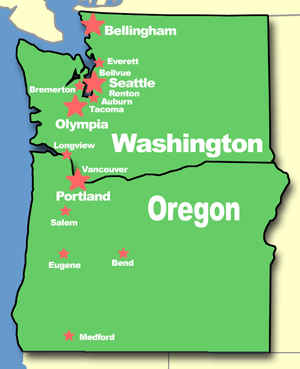
Former Verizon FiOS customers now served by Frontier Communications in Oregon and Washington are receiving word of astonishing rate increases of as much as 46 percent from the phone company.  The massive rate increase is being blamed on “increasing programming costs” charged by the cable networks carried on a cable system that competes with Comcast, which charges far less for the same channels.

Frontier’s rate hikes are so dramatic — $30 a month for the popular standard 200-channel package, some customers are wondering whether the company is trying to sabotage their own fiber-to-the-home service.

“They sent us a rate increase letter stating our former standard package, priced at $65 a month, is now going up to a ridiculous $95 a month for basic cable,” says Tom, a regular Stop the Cap! reader. “That’s a rate increase only my health insurance company could love.”

New customers face the new rates immediately, but existing customers have until Feb. 18 before the new high price kicks in.  Many are preparing to move back to Comcast, which raised rates this year as well — but is now a relative bargain at $63 a month for a similar package.

“As much as I love FiOS, Frontier has managed to screw it up as badly as the rest of their services and now I am going back to Comcast,” Tom says. “You have to wonder if they are purposely incompetent or if it’s part of a larger plan to sabotage the Verizon FiOS network they inherited.  Either way, they’ve priced their service out of the market.”

When Tom called Frontier to complain, the company offered to rip out the advanced fiber network Verizon installed and stick a DirecTV satellite dish on his roof instead.

“Frontier is a real ‘Back to the Future’ kind of company — they just don’t get it,” Tom said.  “The operator actually told me she couldn’t understand why I would want to cancel service.”

Customers receiving new customer promotional discounts will get a real case of sticker shock when Verizon’s original promotional rates reset to Frontier’s new regular price.

“Washington County better beef up their hospitals because there are going to be a lot of heart attacks when that bill arrives,” Tom says.

The Oregonian newspaper reports customers are not the only ones to be shocked by Frontier’s enormous rate increase.  Regulators promised more competition and cheaper prices as part of Frontier’s purchase of Verizon landlines feel had as well.

“[Frontier’s rate hike] is essentially a white flag surrender and an exit from the head-to-head video competition,” lamented David Olson, director of the Mt. Hood Cable Regulatory Commission.

That’s a far cry from what Frontier Communications CEO Maggie Wilderotter told the newspaper in September when asked if the company would raise FiOS rates.

“That is not our plan. If I look across the board at our basic service pricing, I don’t think we’ve raised prices anywhere in the last four or five years,” she said.

The Oregonian quotes a Frontier representative who says the company’s relatively small customer base disqualifies them from volume discounts Verizon used to receive.

“Part of the challenge we have, compared to other providers, is that our footprint is so small,” said Frontier spokeswoman Stephanie Beasly. “They’re able to spread it out over a much larger customer footprint.”

That can’t be the whole story, said Fred Christ, policy and regulatory affairs manager for the Metropolitan Area Communications Commission, which regulates cable TV in Washington County.

“There’s more to it than programming costs. Anybody in the industry can pretty much figure that out. What more there is, we don’t know yet,” he said. “Unless programmers are trying to run Frontier out of business, why would they jack their rates that much?”

Smaller companies like Frontier generally do not try and buy programming on their own, but join group-purchasing plans like those offered by the National Cable Television Cooperative.  Municipal providers routinely purchase programming at substantial discounts.  It is not known if Frontier is a member, but they could be.

Frontier’s New Rates for FiOS in Washington/Oregon (courtesy: The Oregonian)
  • Basic local service package, with local broadcast stations: Rises from $12.99 to $24.99
  • FiOS TV Prime HD (220 channels, including the most popular sports and entertainment networks): Rises from $64.99 to $94.99
  • FiOS TV Extreme HD: Rises from $74.99 to $104.99
  • FiOS TV Ultimate HD: Rises from $89.99 to $119.99.

No rate increases are planned for broadband or telephone service.

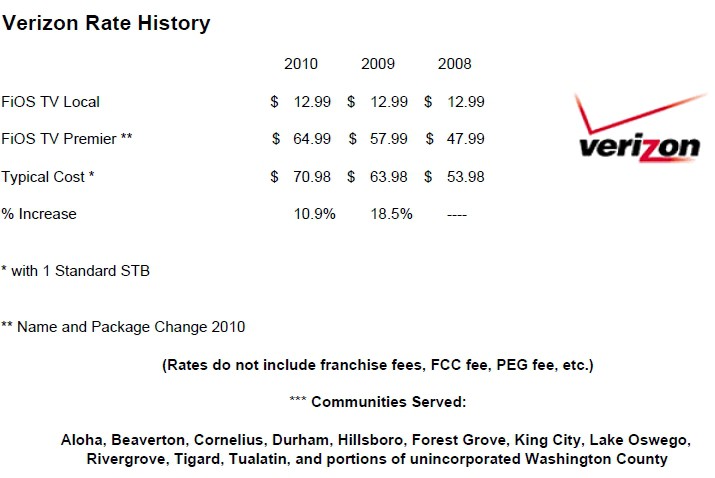
Verizon FiOS pricing increased at less than half the rate Frontier will demand from subscribers in 2011. (Source: Metropolitan Area Communications Commission, Tualatin Valley, Ore.)

Analyst Tells Phone Companies To Forget About Fiber – Copper Delivered DSL Good Enough for You

A British financial analyst has issued a new report telling phone companies they should forget about fiber optic upgrades — copper-based DSL service is adequate for consumers and doesn’t bring shareholders fits over capital expenditures.

Analysys Mason’s Rupert Wood believes companies are at risk of overspending on fiber networks that deliver speeds he claims few consumers want.

“The vague promise of future services may appeal to some early FTTH adopters, but will become increasingly ineffective as a selling point unless the rate of innovation in devices and services that are uniquely suitable for FTTH gets some new impetus from vendors and service providers,” writes Wood. “The future cannot be simply plotted against increasing fixed-line bandwidth.”

Wood believes wireless 3G and 4G broadband is where innovation and demand is greatest.  It also just happens to be where the biggest money can be made.  Providers can charge premium prices for wireless services while limiting access.

Wood

For at-home Internet, Wood believes copper-based DSL is fine for most consumers.  Wood points to American providers offering super-high-speed broadband tiers that attracts few buyers as proof there is little interest in ultra-fast connections.  DSL is cheap to provide, he argues.  Fiber is just ‘too risky’ and Wood suggests it’s not as “future-proof” as wireless.

So what should providers do with their fiber networks?  Short of abandoning them altogether, Wood recommends operators pull back on fiber roll-outs and deploy them only for experimental purposes.

“Conditions vary between markets, but in general the business case to move much beyond trials just isn’t there and we are already beginning to see some scale-back,” explains Wood.

“Bandwidth demand for fixed broadband is converging with the bandwidth required to stream TV, and its rate of growth will slow down,” he adds. “DSL [technology] might not be able to meet these demands at some point in the future, but we believe that this point is still a long way off.”

If you want to read more, it will cost you €5500 to purchase a copy of “FTTx roll-out and capex in developed economies: forecasts 2010–2015.”

Our analysis comes for free.

Wood ignores the most important reason why Americans are not signing up for ultra-fast premium speed tiers in droves — the current “early adopter” price tag.  Few consumers are going to justify spending $99 a month or more for the highest speed connections.  When price cuts deliver faster service at incrementally higher pricing, perhaps $10-20 for each step up, there will be greater demand.  If America was not interested in higher speed networks, Google’s proposal to build a 1Gbps fiber to the home system would have passed by without notice.  Instead, more than 1,100 communities applied to be chosen for the project, including just about every American city.

Wood’s report primarily speaks to a European market, where the majority of broadband connections come through telephone company DSL or wireless.  In the United States, the cable industry heavily competes with phone companies for broadband customers.  That is much rarer in Europe.  Wood’s claim that consumers care little about speed is belied by marketing campaigns that put cable broadband’s speed advantage front and center, and they have the market share to justify it.

In North America, although Wood’s report may be music to phone companies’ ears, refusing to upgrade copper phone networks comes at their peril.  Americans and Canadians are disconnecting their landlines at an increasing rate, abandoning those that abandoned innovation long ago. Cable operators report many of their new broadband customers come from those disconnecting slower speed DSL service from copper-loving phone companies.

The future is clear — sticking with standard DSL over copper phone lines in competitive markets is a losing proposition unless phone companies begin slashing prices to become a value leader for those who want more savings than speed.

Verizon determined the best way to “future proof” its network was to deploy fiber straight to the home in many areas.  Verizon’s vision carries a price tag analysts like Wood and those on Wall Street don’t like because it challenges short term profits.  But with Americans increasingly saying goodbye to their landline providers, not upgrading networks to give customers a reason to stay is penny wise and pound foolish.

Search This Site:

Contributions:

Recent Comments:

Your Account:

Stop the Cap!