Home » FiOS » Recent Articles:

Your DVR Uses More Electricity Than Many Refrigerators; The $48-120 Hidden Cost of Pay TV

Phillip Dampier July 11, 2011 Consumer News, Online Video, Video 9 Comments

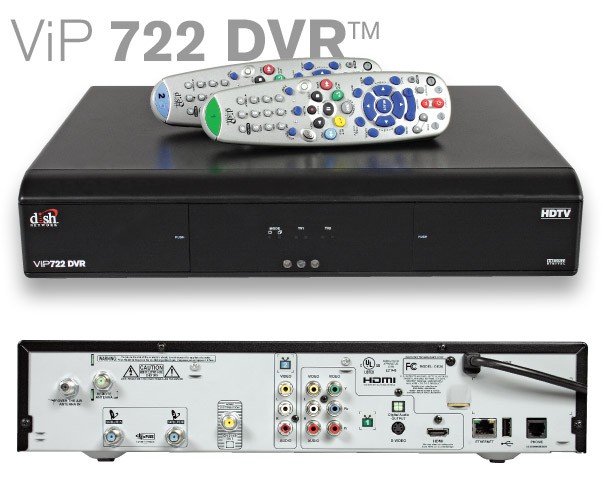
Dish Networks' ViP722: Leaving on a 60-watt bulb 24 hours a day uses just a tad more than the ludicrous power consumption of this set top box: 55W while active and 52W while in standby.

The average pay television subscriber is spending at least $4 a month in hidden electricity costs thanks to the small set top boxes found on top of many television sets across North America.  That’s more than you are paying to run a modern refrigerator.

That stunning revelation comes from a study by the Natural Resources Defense Council, financed by the Environmental Protection Agency.

Costs for residents in the northeastern United States, where electricity rates are often higher, can reach $10 per month for customers with a DVR in the living room and a traditional set top box in the bedroom.  That’s up to $120 a year in hidden charges.

The pay television industry, which has driven the set top box into millions of homes, has never paid much attention to energy consumption of their equipment, if only because they don’t pay the power bills of their customers.  The NRDC found that many boxes even attempt to fool consumers into believing they are running in a reduced-power mode, by programming them to slightly dim the front clock when the box’s “power button” is switched off.

In reality, most set top boxes use nearly as much power “shut off” as they use left on.

The cost of these little power demons to North America’s power grid exceeds 18 billion kilowatt hours. More than seven power plants could not sustain that level of power, even if running 24/7 every day of the year.  The combined electric use of Alberta and British Columbia in a year would still not match the power consumption of every set top box in North America.

These revelations have led the U.S. Department of Energy to lay the groundwork to regulate the power consumption of set top equipment.  Once again, the United States would be a follower.  Europe cracked down on excessive power consumption of electronic equipment years earlier.  In the United Kingdom, for example, satellite providers include a box that can achieve a standby status that only consumes a handful of watts.  The trade-off is that consumers have to wait up to 90 seconds for the box to re-boot every morning when the television is first switched on.  Consumers have the ability to choose different power states as a menu option on the devices.

Some cable operators program their DVR boxes to spin down internal hard drives overnight, assuming no recording is scheduled at those times.  But many of these initiatives were designed to spare the longevity of the hard drive, not reduce power consumption overall.

Popular Science dug through the data and uncovered the best reasonable options subscribers have for boxes that at least snort their way onto your monthly utility bill, as opposed to pigging out at the trough (your wallet):

If You Have Comcast

In terms of energy efficiency, Comcast comes out as the lesser of several evils, but not by much. Comcast’s most energy-efficient boxes tend to be slightly more efficient than their equivalents at Verizon, Time Warner, and the satellite companies, and they also offer more choices in terms of hardware. The NRDC’s data picks the Motorola DCH70 as the best standard-def box (sucking down 10W while active, and 10W while on standby), the Pace RNG110 as the best high-def box (13W active, 12W standby), and the Motorola DCX3400 as the best HD/DVR (29W active, 28W standby).

I spoke to a Comcast representative who told me that typically, the company installs whichever box they want, but that if you request a specific box that they have in stock, they’ll happily install that one for you. They won’t order you a box from elsewhere, and this kind of hardware rotates in and out of availability fairly quickly, but at least you might have the option to choose.

If You Have Verizon FiOS

Verizon’s most efficient boxes are just okay, while its least efficient are some of the worst of any surveyed. Even worse, Verizon gives the customer absolutely no option about which box they get–you can’t request a specific box at any point. That doesn’t matter too much for the non-DVR boxes, as the NRDC’s findings only turned up one standard-def and one high-def box, but there’s a big gap in efficiency between the company’s best and worst DVRs. The most efficient is Motorola’s QIP7216, at an unremarkably 29W active and 28W standby, but the older Motorola QIP6416 clocks in at a lousy 36W active and 35W standby.

If You Have Time Warner Cable

Time Warner has a smaller selection of set-top boxes than either Verizon or Comcast, with only one averagely (in)efficient DVR and one startlingly inefficient standard-def box. For a high-def, non-DVR box, the Cisco Explorer 4250HDC is the most efficient, at 19W active and 18W standby, but Time Warner told me that that’s an older box that might be tough to find. The Time Warner rep was (surprisingly, given the company’s lousy reputation here in New York) quite helpful, and offered to try to track down one of the 4250HDCs if that was what I wanted.

If You Have DirecTV

Here we get to the satellite folks. DirecTV’s offerings are only slightly less efficient than Comcast’s or Verizon’s, with the (currently only) standard-def box coming in at 12W active, 9W standby, the best HD box (the DirecTV H24) at 16W active, 15W standby, and the best HD/DVR (the DirecTV HR24) at 31W active, 31W standby. The DVR is pretty lousy, efficiency-wise, but that’s nothing compared to the Dish Network’s craziness.

If You Have Dish Network

I don’t know what is happening inside the Dish Network’s DVRs. Given the energy usage, they might well be powering nuclear reactors. The “best” DVR Dish offers, the ViP922, uses 43W while active, and 40W while in standby–but the worst one, the ViP722, uses a ridiculous 55W while active and 52W while in standby.

If You Use Internet Video Streaming

Many are ditching traditional cable services for online services like Netflix and Hulu, and luckily, there are a whole bunch of gadgets that can play that content (and more) on a TV. They are also invariably more efficient than a cable box, to a startling degree. The Apple TV (reviewed here), which streams Netflix and plays music, movies, and TV from Apple’s iTunes store, uses a mere 3W while active and 0.5W while in standby. Roku‘s XR-HD, which streams Netflix, Hulu, Amazon Instant Video, and a whole bunch more, uses only 7W while active and another 7W while in standby. The Boxee Box, a curiously shaped media streamer that uses the open-source, ultra-powerful Boxee software, can play Netflix, stream video from other computers on its network, play media from a hard drive or thumb drive plugged into one of its USB ports, and stream from lots of apps (with Hulu hopefully to come soon). It was tested by an Ars Technica commenter whose measurements probably differ from the NRDC’s, but roughly estimates that it uses 13W while active and 13W while in standby.

[flv width=”640″ height=”388″]http://www.phillipdampier.com/video/CBC TV boxes guzzle power 6-27-11.flv[/flv]

CBC TV took a closer look at the pay television set top box: a real power guzzler.  (2 minutes)
Frontier Fires Back at Comcast In Indiana – Comcast is Telling Stories About FiOS

Phillip Dampier June 30, 2011 Comcast/Xfinity, Competition, Frontier 2 Comments

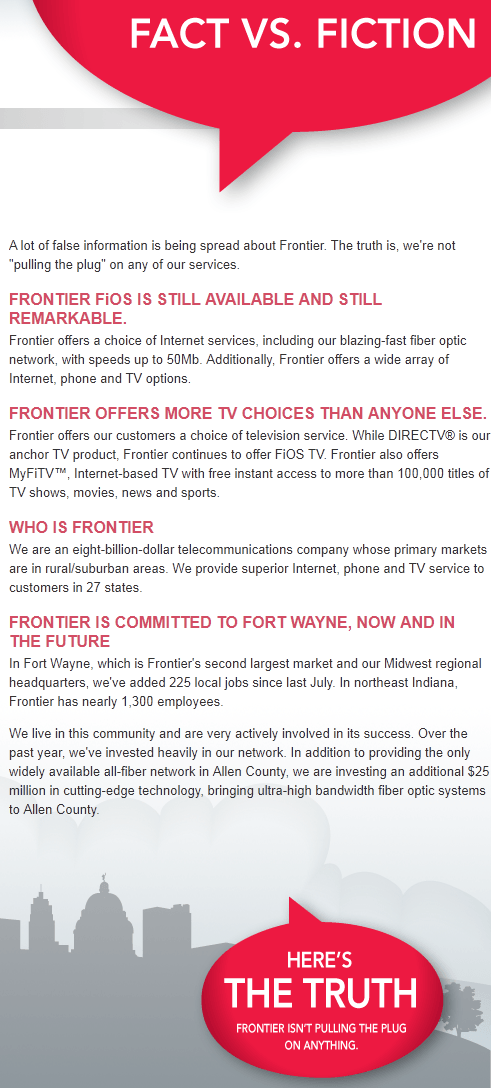
Frontier's Facts - Frontier's new website to counter Comcast's claims about FiOS. (click to enlarge)

Frontier Communications has fired back at Comcast after the Fort Wayne, Indiana cable company erected billboards telling residents Frontier was pulling the plug on its acquired FiOS fiber optic network.

On Wednesday, Frontier purchased a full-page ad in The Journal Gazette headlined, “Comcast Doesn’t Let the Facts Get in the Way of a Good Story! Here’s the Truth: Frontier Isn’t Pulling the Plug on Anything.”  It also launched a new website — Frontier Facts — telling customers it is not “pulling the plug” on any of its services.

Roscoe Spencer, Frontier’s local general manager, tells customers:

Recently, one of our competitors put up billboards, placed inserts in the newspapers and sent mailings to customers indicating we had pulled the plug on FiOS. This statement is simply not true, and we have taken legal action to insist that these false claims be stopped immediately.

Spencer

The spat began when Comcast began trying to recruit disaffected Frontier TV customers who found a massive rate increase notice in bills sent earlier this year.  Frontier blamed the rate increase on the loss of volume discounts former owner Verizon obtained for its FiOS TV service for television programming.  Frontier has sought to negotiate with programmers directly instead of working through a cooperative buying group, so the prices it pays for popular cable networks are much higher than what Comcast pays for a comparable video package.

Frontier watchers suggest the company is well aware its new video pricing is uncompetitive and customers will take their business elsewhere.  Frontier quickly began marketing DirecTV, a satellite provider, as a suitable replacement for those unhappy with the rate increase.  But Comcast also saw an opportunity to pick up new customers at the phone company’s expense, including through the use of billboards Frontier claims are misleading.

Frontier stresses its FiOS platform will continue to provide telephone, television, and broadband service, despite what Comcast’s billboards might suggest.

Despite the involvement of attorneys, Comcast has continued to thumb its nose at Frontier’s legal department.  Frontier spokesman Matt Kelley told the Journal Gazette Comcast was supposed to remove the billboards by Monday of this week, but they remain in place.

The cable company calls it a case of old fashioned competition.

Stop the Cap! reader Kevin calls Frontier’s marketing to get customers to drop FiOS TV for DirecTV a real blast from the past.

“It remains difficult for Frontier to sell people on its advanced fiber network when it is heavily marketing customers to get off of it and switch to DirecTV, a service that looked ultra-modern in the 1990s but today is just a rain-faded, pixellated nuisance,” Kevin says.  “Frontier blew it, Comcast took advantage of their strategic blunders, and now the whining has begun.”

Kevin is a former Verizon FiOS customer who was switched to Frontier when Verizon exited Fort Wayne.

“Verizon knew what they were doing, but eventually decided a few small cities in Indiana were not worth their time or interest, so they sold us off to Frontier, who ended up with a fiber network they’ve shown little interest in running except as an adopted curiosity,” Kevin adds.  “When we got notice of the rate increase, we canceled the TV service and now watch over the air television for free, supplemented with Netflix and Hulu.”

Kevin says Frontier ultimately did him a favor, discovering he was fine without a pay television package.

“Outside of breaking news and sports, you can get most everything else online.  Why pay more?”

Bright House Says No to Internet Overcharging: No Caps – Not Even Under Consideration

Phillip Dampier June 23, 2011 AT&T, Broadband Speed, Data Caps, Online Video, Verizon 1 Comment

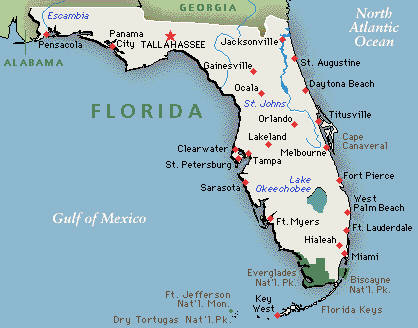
Bright House Networks, a cable company primarily serving Florida and other southeastern states says it has no plans to implement Internet Overcharging schemes like usage caps or consumption billing.  But a company spokesperson went even farther, telling Tampa Bay Online the cable company was not even considering them.

Bright House, which relies on Time Warner Cable’s programming negotiators and sells broadband under the Road Runner brand, was among the only companies in Florida that was willing to go on record stating they were not considering limiting broadband customers.

Other providers were unwilling to follow Bright House’s lead:

  • AT&T: “2 percent of our customers were using 20 percent of our bandwidth,” said an AT&T spokesman, so the company slapped 150GB usage limits on DSL customers, 250GB on U-verse customers.  The overlimit fee is $10 for every 50GB extra.
  • Verizon Florida: “At this point, we’ve not implemented any usage controls or broadband caps.  We’ll continue to evaluate what’s best to ensure our customers get the highest quality broadband service for the best value,” the company said.  But it also added: “We’re continuing to evaluate usage-based pricing for our wireline broadband customers.”

“Bandwidth caps stifle consumer choice,” said Parul Desai, public policy counsel for Consumer’s Union.  Desai notes customers do not sign up for pricey high-speed FiOS broadband service from companies like Verizon just to read e-mail.  Customers who are willing to pay premium prices for super high speeds certainly don’t want a usage cap devaluing their broadband package.

Comcast, for example, uniformly limits consumption to 250GB per month, even on high speed plans delivering over 50Mbps service.

“It’s like building a rocket that you blow up after it reaches 250 feet into the air,” says Stop the Cap! reader Will in Tampa, who shared the article with us.  “What is the point of having 50 or 100Mbps service from any provider if they slap a limit on it like that.”

Will thinks customers will abandon higher speed packages in droves once they realize they really can’t use them.

“With some of these companies talking about caps around 40GB per month, you can’t even take your connection for a test drive,” he says.  “You might as well stick with basic speeds, just to remind and discourage you from putting yourself over their stupid limits.”

Desai suspects broadband companies will try limiting their customers, if only because they face few competitors consumers can use instead and they have video services to protect.  But she suspects some consumers will either abandon or seriously downgrade their broadband service and find other ways to trade large files and content.

“It’s not inevitable they’re going to succeed,” she told TBO. “People only find value in broadband because of what they can access with it. If more people feel constrained, they’ll start looking for another way.”

HissyFitWatch: Frontier and Comcast Battle Over Billboards in Ft. Wayne, Ind.

Billboards sprinkled across Ft. Wayne, Ind., telling residents, “Frontier is pulling the plug on FiOS — Switch to Xfinity,” has infuriated Frontier Communications, who says it will continue to provide FiOS service in the area, at least for broadband, indefinitely.  Now the independent phone company has sent a “cease and desist” letter to Comcast officials demanding the billboards come down.

Frontier spokesman Matt Kelley accused Comcast of spreading false rumors in an effort to drum up business.

“Frontier is not planning on pulling the plug,” Kelly told WANE-TV. “We are going to continue providing FiOS service in Allen County and we have no plans to remove it.”

[flv width=”480″ height=”380″]http://www.phillipdampier.com/video/WANE Ft Wayne FiOS Not Going Away 6-9-11.mp4[/flv]

WANE-TV in Ft. Wayne led its newscast with the dispute between Frontier Communications and Comcast over fiber optic television.  Is the plug really being pulled? (Loud Volume Alert!) (3 minutes)

But Comcast officials note Frontier has been pushing existing customers hard to switch to satellite television service, and Frontier earlier announced dramatic rate increases for its fiber cable television service — rates much higher than other competitors.

Comcast issued a statement about the dispute:

“Comcast continues to invest in these markets, while Frontier has taken a number of steps to discourage new customers from signing up for its service and encourage current customers to seek alternative services from satellite. We are using these ads to make consumers aware of our Xfinity TV service as a better choice for consumers.”

HissyFitWatch: Oooh... Comcast!

From our own Stop the Cap! investigation, both companies are partly correct.

We called Frontier this afternoon posing as a new FiOS customer in Ft. Wayne trying to sign up for television service.  The only option available, we were told, was satellite television service.  While Frontier was happy to sign us up for telephone and fiber broadband, the company representative told us she could not take our order for FiOS TV because, “it’s not available in your area.”

But Comcast’s claims about FiOS lack the very important detail that FiOS broadband and phone service will be offered by Frontier without any interruption — only television service appears to be at issue, and remains available to current customers.

We heard from several Ft. Wayne customers who are unhappy with Frontier’s handling of FiOS.

“While Comcast is being clever, the fact is Frontier wants TV customers to switch to satellite, which is simply a stupid idea,” says our reader Kevin.  “Why would I want a satellite dish when I have fiber.”

Lee, another Frontier customer, believes the company broke its promise of no rate increases after buying out Verizon’s local operations.

“They promptly raised the TV rate by around $30, and if you are a new FiOS customer, expect to pay hundreds and hundreds of dollars for installation,” he says.

Last week, Frontier’s deadline for Comcast to pull down the billboards passed, but as of today those billboards are still on full display.  Comcast’s response to Frontier?

“We received their letter.”

[flv width=”480″ height=”380″]http://www.phillipdampier.com/video/WANE Ft Wayne Deadline day for billboard back-and-forth 6-17-11.mp4[/flv]

WANE-TV in Ft. Wayne updates viewers.  Frontier’s unilateral deadline for Comcast to pull down their billboards came and went.  The billboards are still there.  Now what? (2 minutes)

American Broadband: A Certified Disaster Area

Vincent, one of our regular Stop the Cap! readers sent along a link to a story about the decrepit state of American broadband: it’s a real mess for those who can’t get it, can’t get enough of it, and compare it against what other people abroad are getting.

Cracked delivers the top five reasons why American broadband sucks.  Be sure and read their take (adult language), but we have some thoughts of our own to share:

#5 Some of Us Just Plain Can’t Get It

Large sections of the prairie states, the mountain states, and the desert states can’t get broadband no matter how much they want it.  That’s because they are a hundred miles or more from the nearest cable system and depend on the phone companies — especially AT&T, Frontier, CenturyLink, and Windstream to deliver basic DSL.  AT&T is trying as hard as possible to win the right to abandon rural America altogether with the elimination of their basic service obligation.  Verizon has sold off some of their most rural territories, including the entire states of Hawaii, New Hampshire, Maine, Vermont, and West Virginia.  CenturyLink has absorbed Qwest in the least populated part of America — the mountain and desert west.

Frontier and Windstream are betting their business models on rural DSL, and while some are grateful to have anything resembling broadband, neither company earns spectacular customer ratings.

So long as rural broadband is not an instant profit winner for the phone companies selling it, rural America will remain dependent on dial-up or [shudder] satellite fraudband.

#4 Often There are No Real Options for Service (and No Competition)

Cracked has discovered the wonderfully inaccurate world of broadband mapping, where the map shows you have plentiful broadband all around, but phone calls to the providers on the list bring nothing but gales of laughter.  As if you are getting service at your house.  Ever.  Stop the Cap! hears regularly from the broadband-deprived, some who have had to be more innovative than the local phone company ever was looking for ways to get service.  Some have paid to bury their own phone cable to get DSL the phone company was reluctant to install, others have created super-powered Wi-Fi networks to share a neighbor’s connection.  The rest live with broadband envy, watching for any glimpse of phone trucks running new wires up and down the road.

Competition is a concept foreign to most Americans confronted with one cable company and one phone company charging around the same price for service.  The most aggressive competition comes when a community broadband provider throws a monkey wrench into the duopoly.  Magically, rate hikes are few and fleeting and speeds are suddenly much better.  Hmmm.

#3 Those Who Have Access Still Lag Behind the Rest of the World

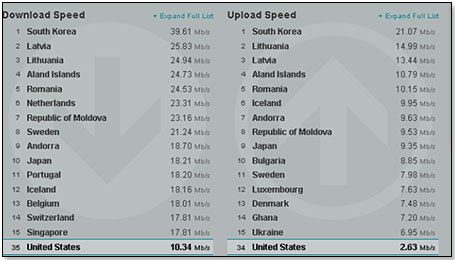
We're #35!

This is an unnerving problem, especially when countries like Lithuania are now kicking the United States into the broadband corner.  You wouldn’t believe we’re that bad off listening to providers, who talk about the innovative and robust broadband economy — the one that is independent of their lousy service.  In fact, the biggest impediment to more innovation may be those same providers.  Some have an insatiable appetite for money — money from you, money from content producers, money from taxpayers, more money from you, and by the way there better be a big fat check from Netflix in the mail this week for using our pipes!

Where is the real innovation?  Community providers like Greenlight, Fibrant, and EPB that deliver their respective communities kick-butt broadband — service other providers would like to shut down at all costs.  Not every commercial provider is an innovation vacuum.  Verizon FiOS and Google’s new Gigabit fiber network in Kansas City represent innovation through investment.  Unfortunately Wall Street doesn’t approve.

Still not convinced?  Visit Japan or Korea and then tell us how American broadband resembles NetZero or AOL dial-up in comparison.

#2 Bad Internet = Shi**y Economy

The demagoguery of corporate-financed dollar-a-holler groups like “FreedomWorks” and “Americans for Prosperity” is without bounds.  Whether it was attacking broadband stimulus funding, community broadband endeavors, or Net Neutrality, these provider shills turned broadband expansion into something as worthwhile as a welfare benefit for Cadillac drivers.  Why are we spending precious tax dollars on Internet access so people can steal movies and download porn they asked.  Why are we letting communities solve their own broadband problems building their own networks when it should be commercial providers being the final arbiter of who deserves access and who does not?  Net Neutrality?  Why that’s a socialist government takeover, it surely is.

It’s like watching railroad robber barons finance protest movements against public road construction.  We can’t have free roads paved by the government unfairly competing with monopoly railway companies, can we?  That’s anti-American!

The cost of inadequate broadband in an economy that has jettisoned manufacturing jobs to Mexico and the Far East is greater than we realize.  Will America sacrifice its leadership in the Internet economy to China the same way we did with our textile, electronics, appliances, furniture, and housewares industries?  China, Japan and Korea are building fiber optic broadband networks for their citizens and businesses.  We’re still trying to figure out how to wire West Virginia for 3Mbps DSL.

#1 At This Point, Internet Access is Kind of a Necessity

The United Nations this week declared the Internet to be a basic human right.  Conservatives scoffed at that, ridiculing the declaration for a variety of reasons ranging from disgust over any body that admits Hugo Chavez, to the lack of a similar declaration for gun ownership, and the usual interpretation of broadband as a high tech play-toy.  Some folks probably thought the same way about the telephone and electricity around 1911.

Yes, the Internet can be frivolous, but then so can a phone call.  Cursed by the U.S. Post Office for destroying their first class mail business, by telephone directory publishers, and those bill payment envelope manufacturers, the Internet does have its detractors.  But should we go back to picking out commemorative stamps at the post office?  Your local phone and cable company sure doesn’t think so.  We don’t either.

Search This Site:

Contributions:

Recent Comments:

Your Account:

Stop the Cap!