Home » FiOS » Recent Articles:

Customers Flee Frontier FiOS: Company Loses A Stunning 10,000 Customers in 3rd Quarter

Phillip Dampier November 3, 2011 Broadband Speed, Competition, Data Caps, Frontier Comments Off on Customers Flee Frontier FiOS: Company Loses A Stunning 10,000 Customers in 3rd Quarter

Now selling for the "go away" price of $500 for installation.

Frontier Communications has proven it can successfully herd customers off the award-winning advanced fiber network it inherited from Verizon Communications just by increasingly gouging customers until they call and cancel.

The phone company reports success in ridding itself of 9,900 FiOS TV customers in the third quarter alone, and 3,100 FiOS Internet customers left with them in Indiana and Oregon.

Frontier CEO Maggie Wilderotter and other company executives made it known last spring that FiOS fiber optics was the unwanted stepchild best left forgotten when telling investors the company considered the fiber network unprofitable.  The company has since taken to hike rates and raised the price for service installation to as much as $500.  The combined increases have made the cable competition — Comcast — blush and look downright cheap by comparison.

Where did Frontier’s customers go?  Several left for Comcast, but others were persuaded to switch to an aggressively-priced satellite TV promotion, at least until it expires.  Frontier added 12,200 satellite subscriptions nationwide last quarter and 16,200 new DSL customers, many in ex-Verizon service areas that currently have no other choice for broadband.

Cablevision Struggles With Recession, Self-Inflicted TV Wounds, and Verizon’s FiOS

Cablevision executives reported dismal financial numbers for the third quarter of this year, as the cable company lost 19,000 cable television customers while profits plummeted some 65% at the Bethpage, N.Y.-based company.

Not even 17,000 new broadband customers could erase the damaging losses incurred by Cablevision cord-cutting, some of it as a result of the cable operator’s damaging retransmission consent disputes that deprived viewers of popular local broadcast outlets and cable channels.  The company lost so much subscriber goodwill, company executives admitted they pared back an anticipated rate increase just to protect themselves from further customer defections.
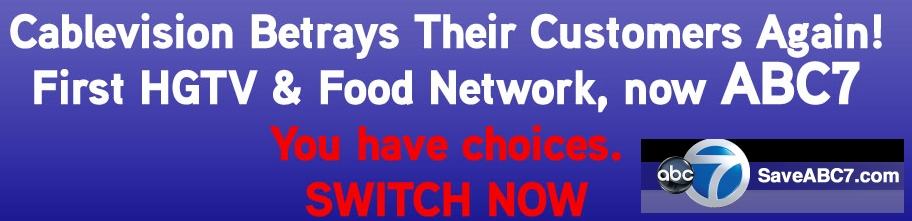
Programming disputes like this one with WABC-TV and their parent company Disney caused more than a few Cablevision customers to head for the competition.

Cablevision, like Time Warner Cable before it, won’t admit that cable cord-cutting is responsible for what one investment bank fears could be the start of an “ex-growth” era in cable television.  Instead, Cablevision executives continue to blame the poor economy for subscription losses, as well as aggressive pricing competition from their biggest rival — Verizon FiOS.  Adding pressure is the relentless demand for higher programming fees, which directly translates into relentless annual rate increases for cable television service.

“With regard to programming [costs, they are] an issue and it is an expensive part of our business.  It is the single biggest cost item we have,” said Gregg G. Seibert, Cablevision’s chief financial officer and executive vice-president. “And the fact that retransmission consent became necessary from the eyes of broadcasters, particularly after the 2008 recession, has been flowing through our business, and there was a large step up [in fees]. I think that the overall rate of programming [costs] going forward will moderate to some extent naturally.”

Seibert called the aggressive retransmission consent fee disputes between broadcasters and cable operators evidence of the collapse of the traditional “free TV” business model.  Because ad revenues are down, broadcasters are increasingly dependent on fees charged to cable operators for permission to include their stations on the cable dial.  That means cable subscribers are increasingly subsidizing the broadcast television business.

Seibert

Seibert’s revelation came too late to stop some of the nation’s most visible retransmission consent battles between Cablevision and network-owned New York-area television stations and cable networks.  When Cablevision blacked out a local station showing coverage of the World Series during the last dispute, fed up customers decided to take their cable business to Verizon or a satellite TV provider.

Cablevision has been trying to lick their wounds ever since, launching increasingly aggressive pricing promotions and “free gift” offers to keep existing customers while trying to win back old ones.

“We’ve recently introduced an offer that includes a new Apple iPod Touch primarily for win back situations,” said Thomas M. Rutledge, chief operating officer.  “Selling for the Triple Play package of video, data, and voice is now at 74% and roughly half of this selling is for our new Ultimate Triple Play, which includes a new higher-priced Boost Plus [broadband] service and a wireless router.”

Cablevision achieves triple-play signups by heavily discounting the package for new and returning customers.  It also hopes to succeed with a ‘more for less’ pricing strategy, delivering new features and services without necessarily charging extra for all of them.  With discounts, free gifts, and additional services, Cablevision is getting some of their old customers back.

Selling faster broadband is a key component in Cablevision's strategy to attract more broadband customers. Boost Plus delivers 50/8Mbps service for an additional $14.95 a month.

“As of September 30, our win back total is more than 45% of customers who once tried Verizon FiOS,” Rutledge claims.

Rutledge noted Cablevision’s participation in the industry’s TV Everywhere online video initiative has grown even stronger with the recent agreement to provide Cablevision cable-TV customers free access to Turner-owned cable network programming.

Seibert admits the more competitive business environment and high profile programming disputes in suburban New York City are impacting profits.

“We had a few significant items in the quarter affecting our results including higher programing costs and higher sales in marketing as we continue to aggressively promote our products and services while revenue growth was essentially flat,” Seibert said.

Those challenges are creating a sense of unease on Wall Street regarding the cable business’ core product: cable television and the increasingly aggressive pricing promotions necessary to keep customers from disconnecting service.

“There is growing concern among the investor community about [the] whole [cable] industry going to ex-growth,” said Jason Bazinet from Citigroup.

Rutledge

“Programming costs are rising faster than video revenues,” Sanford C. Bernstein, an analyst for Craig Moffett, told the Wall Street Journal. “Unless there’s growth somewhere else in the business model, you’ve got the worst of all worlds: a slow-or no-growing business with lower margins.”

Rutledge outlined Wi-Fi and broadband enhancements as part of Cablevision’s priorities for the upcoming quarter:

“We’ve been building out a Wi-Fi network and we’ve had continuous subscriber utilization increases on that network.  We now have more than one-half-million devices out there that can use Wi-Fi and watch our full cable television service in the home.

“And we’re deploying a new Boost product with higher speed broadband, which includes a more sophisticated wireless router as part of that package.

“We think Wi-Fi is a major strategic part of our business. We think that we can continue to take advantage of that. We think our video product today as a result of Wi-Fi is a superior product to our competitors – all of our competitors, and we think that our data service is enhanced by the Wi-Fi outside the home, and we continue to try to build value for our customers and take market share.”

The cable company is already aggressively marketing its Boost Plus service, which delivers 50/8Mbps broadband for an additional charge of $14.95 a month on top of the standard broadband rate.


No Matter the Technology, Fiber to the Home is Better… Period

Phillip Dampier October 18, 2011 Broadband Speed, Community Networks, Competition, Data Caps, Editorial & Site News, Public Policy & Gov't, Rural Broadband, Video Comments Off on No Matter the Technology, Fiber to the Home is Better… Period

Phillip "Wants a High Fiber Diet" Dampier

Believe it or not, there are still some people out there who believe wireless broadband, as it exists today, is the future of high bandwidth communications in North America.  Forget DSL, forget cable, forget fiber optics, they say.  Technology like 4G and WiMax are “far superior” and cheaper.

To be fair, most of the people advocating the technology Sprint is in the process of abandoning have a vested interest in stopping fiber broadband projects.  That is because while Verizon continues to sit on its hands expanding its excellent FiOS fiber-to-the-home service, some of the most aggressive fiber projects in the country are being built by your local town, city, or village government.  It’s community-owned broadband, by and for the people in your own area.  Large telecom interests that have always refused to deliver fiber service (or pretend to by using the word ‘fiber’ while not bringing a single strand to your home) have it in for potential competitors that are willing to provide the advanced fiber technology they won’t.

So why aren’t big phone and cable companies providing this level of service?  In a word, money.  Their shareholders don’t like the initial cost of deploying fiber to the home service, even though the technology is superior to what reaches your home today, is infinitely expandable without stringing new cables across town, and can support money-making applications developers and providers have not even dreamed of yet.  With a pervasive lack of competition, there is nothing to overcome Wall Street’s conclusion that fiber doesn’t deliver fast enough profits to justify the initial expense.

When you take Wall Street out of the equation, especially in the telecom sector, the math works very differently.  While the phone and cable company is probably telling you “no,” companies like Google are saying yes in Kansas City.  So are municipally-owned rural co-operative phone and cable companies.  Communities deciding broadband is too important to leave to the phone companies that deliver half their residents 1-3Mbps DSL and call it a day are saying yes to fiber optics as well.

Overseas, fiber networks are being built in countries in Eastern Europe where the economics would never make sense by Wall Street standards, yet residents (and perhaps more importantly new digital economy businesses) are now getting Internet speeds of 100Mbps or better.  The next countries that could import good-paying American jobs might be Lithuania, Latvia, Poland, Romania, and Bulgaria.

So what does it take to adapt to this reality in North America?  Providers that are willing to make a long term investment in fiber broadband — one that may take a few extra years to pay back, but will generate dividends like increased employment, capacity to provide better, faster service, more reliable networks, and earning a piece of the action powering North America’s new digital economy.  If they won’t listen, tell your elected officials to support policies that promote additional competition and back community broadband expansion that can make all the difference between 3Mbps DSL and 100Mbps fiber.

[flv width=”640″ height=”372″]http://www.phillipdampier.com/video/Fiber is Better.flv[/flv]

Watch and share this video with friends and family to educate them about the infinite possibilities of fiber optic broadband and learn why it is superior to usage-capped wireless, slow speed DSL, satellite fraudband, or lopsided cable “High Speed Internet” broadband that delivers high speed in only one direction. (3 minutes)

Buffalo Group Says Verizon May Be Redlining Poor Communities With FiOS; Investigation Demanded

Phillip Dampier September 21, 2011 Broadband Speed, Competition, Public Policy & Gov't, Verizon, Video Comments Off on Buffalo Group Says Verizon May Be Redlining Poor Communities With FiOS; Investigation Demanded

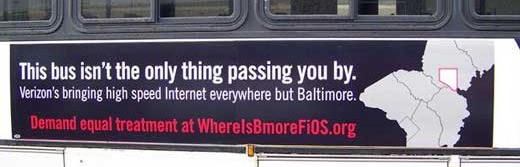
A similar group in Baltimore placed bus advertising complaining about the lack of FiOS in that city in 2010.

A Buffalo group backed by the Communications Workers of America is demanding a federal and state investigation into whether Verizon is intentionally bypassing urban, ethnic, and economically-challenged neighborhoods for its fiber-to-the-home service, FiOS.

The Don’t Bypass Buffalo Coalition has stepped up the pressure on Verizon with a new billboard campaign that accuses the company of exacerbating the digital divide in western New York.

“The Verizon FiOS deployment in Buffalo is a corporate redlining scheme undermining the City of Buffalo with intentional discriminate design,” said Coalition member Jim Anderson.

Verizon suspended FiOS deployment during the height of the economic downturn, leaving some cities with a patchwork of FiOS service in some locations, traditional copper phone wiring in others.  In Buffalo, suburban areas that quickly approved the FiOS network with few franchise pre-conditions were among the first to get the fiber network.  Other suburbs, and the city of Buffalo itself, were effectively bypassed when franchise agreements and negotiations were left uncompleted at the time Verizon suspended further expansion.

The Coalition released a letter signed by two dozen local officials and community leaders that suggests Verizon may be up to something more sinister, suggesting possible racial and economic discrimination by the company over its choice of areas to deploy the service.

Coalition members note that in the 10 suburbs where Verizon offers FiOS, the proportion of African American residents in those areas is more than 13 times lower than it is in the city of Buffalo, and the Hispanic population is nearly four times lower. Even more telling, the Coalition writes, is that the network infrastructure is already in place to deploy FiOS within Buffalo city limits.

The Coalition is among the most vocal among local pressure groups Verizon has faced since its decision to suspend further FiOS expansion.  Other cities, especially Baltimore, have their own coalitions to complain about Verizon’s apparent lack of interest in restarting fiber projects.

Verizon rejects most of the charges the Buffalo-based Coalition has made.

“As Verizon has told the Coalition and local officials countless times, our focus these days is meeting the buildout commitments in the 182 municipalities across the state where we currently have TV franchises,” a Verizon spokesman said in a statement. “The allegation of discrimination with respect to FiOS deployment is just plain wrong…period. The coalition simply needs to look at other FiOS deployment areas in New York and other states to see those allegations are off base.”

[flv width=”640″ height=”380″]http://www.phillipdampier.com/video/Is Verizon Redlining Baltimore City 3-16-10.flv[/flv]

In March, 2010 Progressive Maryland held a public rally protesting the lack of Verizon FiOS in Baltimore.  (8 minutes)

Turner Introduces New TV Everywhere App for Everyone But Time Warner Cable Customers

Cable, satellite and telco-TV subscribers around the country can now watch most of the hit shows on Turner’s TBS and TNT Networks for free, assuming two things are true:

  1. You pay for a package of television channels from Comcast, DirecTV, Dish Network, Cox Communications, Cablevision Systems, Suddenlink Communications, Verizon FiOS, or AT&T U-verse.
  2. You are not a Time Warner Cable subscriber.

The new TV Everywhere app, available for phones and tablets, comes free of charge.  Once authenticated as a legitimate pay television subscriber, users can watch hit series and some older shows from both networks.

Once again, Time Warner customers are on the outside, looking in.  The nation’s second biggest cable operator has not been a TV Everywhere team player, preferring to launch its own live streaming iPad application and steering clear, so far, from on-demand, online viewing from most of its partner networks, including HBO.  Time Warner Cable executives have, in the past, alluded to licensing fees and user authentication complications for not launching TV Everywhere on-demand viewing for its customers, but the company has not explained why it has not signed on for Turner’s app.

TV Everywhere, a concept on the drawing board for almost two years, is an attempt by the pay television industry to lock down online video programming for paying customers, in an effort to slow down “cord cutting” by consumers trying to save money on their cable TV bill.  The concept delivers unlimited access to popular cable programming, but only to those who already pay to subscribe.

Many TV Everywhere projects have been soft-launched without much publicity, but that is not true for Turner’s app.  The network has commissioned several clever advertisements featuring various network stars promoting the app, and now Turner wants to educate consumers about how to use it to watch shows online.

The most complicated part of the process is getting “authenticated” by the application for authorized viewing.  Some cable companies like Time Warner want customers to launch access to TV Everywhere programming from the cable company’s website, where customers have already been authenticated when they sign up for an online account.  Other companies are using customer account numbers, PIN codes, or passwords printed on monthly bills to let customers register directly for access.  When the application matches a customer account number or PIN code, the content becomes accessible.  It is typically a one-time-only hassle, but there have been cases where customers have had to grab a recent bill more than once to re-authenticate themselves.

Not every show will be made available for online viewing.  Many rerun off-network shows shown on TNT and TBS don’t currently include streaming rights.  So while users can watch past episodes of Conan O’Brien, they’re out of luck if they want to watch Friends.

[flv width=”640″ height=”500″]http://www.phillipdampier.com/video/Turner App.flv[/flv]

Watch a selection of spots from the new advertising campaign for Turner’s ‘TV Everywhere’ app.  (4 minutes)

Search This Site:

Contributions:

Recent Comments:

Your Account:

Stop the Cap!