Home » FiOS » Recent Articles:

NY City Wants Time Warner Cable to Refund Cable Customers for MSG-Less Cable Lineup

Liu

While Buffalo residents fume about missing the latest matchup between the Buffalo Sabres and Edmonton Oilers, the city of New York is pressuring Time Warner Cable to start compensating their subscribers for the loss of one of the most expensive channels on the basic cable dial.

New York City Comptroller John Liu has asked the Department of Information Technology and Telecommunications, which oversees cable franchise agreements for the city, to make certain Time Warner compensates customers for the loss of MSG and MSG Plus, both removed over a contract renewal dispute.

“Consumers deserve to be compensated for what they have gone through as a result of this dispute, plain and simple,” Mike Loughran, a spokesman for Liu, told Bloomberg News in an e-mail. Loughran said the comptroller’s office would discuss compensation plans with the Department of Information Technology and Telecommunications.

Time Warner says it has already effectively compensated impacted customers, primarily in New York State, with a free month of the company’s added-cost sports programming tier.  Time Warner has also replaced the two MSG networks with NBA TV and NHL Network, which are now likely to remain part of the basic package even if Time Warner reaches an agreement with MSG.  (Sorry football fans, NFL Network is still too costly to be deemed a suitable replacement network.)

Time Warner says there is no way they would pay MSG’s asking price for a renewed carriage contract, which the cable company says represented a 53% rate increase.

As Stop the Cap! reported earlier, the dispute is renewing rumblings about how pay television providers handle expensive sports programming.  An increasing number of cable executives are considering breaking sports networks out of the basic cable package and forcing interested sports fans to pay extra to receive them.  But sports remains a lightning rod issue for many pay TV companies, both among subscribers and politicians.  Disrupt a major sporting event at your peril — something Cablevision learned from an earlier dispute with Fox.

In Buffalo, some customers are dropping Time Warner Cable for Verizon FiOS, at least where that fiber to the home service is available.  Residents served by Frontier Communications or Verizon’s DSL have fewer choices — one of two satellite TV companies.

Verizon already carries a standard definition feed of MSG Networks.  AT&T announced this week it was adding MSG in HD to its U-verse lineup in Connecticut.  MSG has spent this week rubbing salt in Time Warner’s wounds, throwing MSG viewing parties in both Buffalo and New York City.  Now that the city of New York is pressuring Time Warner to cough up refunds as much as $4 or more a month for the loss of MSG, the dispute could prove increasingly expensive.  Some customers tell Stop the Cap! they are already receiving informal compensation for the loss of MSG after contacting the cable company by phone or e-mail to complain.

“I wrote Time Warner on their web contact form and a representative gave me a $5 courtesy credit for the loss of the channels after I explained I was shopping around for another provider,” writes Neil Thomowski who lives in Cheektowaga, near Buffalo.

[flv width=”360″ height=”290″]http://www.phillipdampier.com/video/WNLO Buffalo Sabres fans dismayed by cable dispute 1-3-12.mp4[/flv]

Buffalo Sabres fans who have Time Warner Cable were left in the dark Tuesday night and couldn’t watch the match-up between the Sabres and the Edmonton Oilers.  WNLO in Buffalo has the story.  (2 minutes)

Mutual Blame Game: Time Warner Cable <-> Pulls the Plug on <-> MSG Networks

Phillip Dampier January 2, 2012 Consumer News, HissyFitWatch, Video 7 Comments

Time Warner Cable subscribers who are passionate about their hockey and basketball won’t be watching all of the Buffalo Sabres or New York Knicks games, thanks to another year-end programming dispute primarily affecting cable subscribers in New York State.

MSG terminated their program feed for approximately 2.8 million Time Warner customers early Sunday, leaving the cable operator to make amends with irritated subscribers.

Once again, the cost of sports programming was the issue. MSG has raised prices at least 70 percent over the last five years, according to cable research group SNL Kagan.  The package that includes MSG and MSG Plus now sells at a wholesale price of more than $4.50 per month, rivaling the most expensive sports network ESPN, which will charge $5.06 a month in 2012.  Time Warner reportedly balked at a renewal deal for 2012 that would have increased prices well beyond the six percent the cable operator offered to pay.

Time Warner has e-mailed subscribers indicating MSG pulled the plug, and is offering some replacement programming to ease the suffering of sports-addicted subscribers:

At Time Warner Cable, we’re sports fans too – that’s why we fight hard to keep the sports you love on the air at a price you can afford.

With the game clock running down, MSG Networks rejected all proposals, refused to engage in any meaningful way, and refused to allow us to keep the channel on. In the end, MSG pulled the plug on Time Warner Cable customers. We regret that MSG Networks has taken away their sports programming, but remind fans that even without MSG, Time Warner Cable will carry nearly 20 percent of this season’s remaining Sabres games, and dozens of other NHL and NBA games and most of the NHL and NBA playoffs. For information on where to find your favorite teams, visit www.twcconversations.com/MSG.

We don’t think that MSG’s actions are fair to sports fans, so Time Warner Cable is offering the following in appreciation of our customers:

    • A special month-long preview of the Time Warner Cable Sports Pass, a package of more than 15 sports-oriented channels. This package—which normally costs $5.95 per month for residential customers—will be available from January 1 – 31, 2012. (Visit www.timewarnercable.com/sportspass to see the full list of channels and channel numbers.)
    • A free preview of the NBA League Pass premium sports package which offers up to 40 live games per week. This offer is good through January 8th and more details are available at www.twcconversations.com/MSG.
    • The launch of YNN Hockey Tonight, a new nightly hockey show, premiering January 2nd on YNN in Western New York, including the Buffalo and Rochester areas. YNN Hockey Tonight will feature live interviews & analysis, plus scores, standings and information from all around the world of hockey, every night at 11:15 PM through the end of the NHL season.

We think MSG is being unreasonable – and unfair to fans. They continue to demand a 53% price increase for their programming, which just doesn’t make sense. We do want MSG to return to our channel lineup, and we will continue to work hard to reach an agreement that gives you the sports you love at a price you can afford to pay.

Don’t forget: every TV provider is at risk for blackout threats. Last year MSG pulled the plug on DISH – so switching is not a solution. If MSG really cared about the fans, they wouldn’t be holding your sports hostage.

Thank you for your patience and continued loyalty.

Tell MSG to Get Real and Do the Deal.

MSG is telling Time Warner customers to cancel their cable service and sign up for Verizon FiOS TV or one of the satellite dish providers instead.  But those alternative providers are not happy with the rising cost of sports programming either.

DirecTV’s Michael White and Dish Network Corp. Chairman Charlie Ergen have both repeatedly criticized price inflation for sports networks, and both have fought their own battles over the issue.

[flv width=”480″ height=”290″]http://www.phillipdampier.com/video/WHAM Rochester MSG Pulls Programming Disappoints Sports Fans 1-1-12.mp4[/flv]

WHAM-TV in Rochester talks with irritated sports fans about the loss of MSG Networks on Time Warner Cable.  (3 minutes)

[flv width=”360″ height=”290″]http://www.phillipdampier.com/video/Bloomberg Harrigan Says Time Warner-MSG Deal Will Take Time 12-30-11.mp4[/flv]

Bloomberg News reports that wholesale rates for sports programming have grown so great, cable operators may be prepared to drop sports networks off cable television altogether.  (4 minutes)

Verizon’s Anti-Aggression Treaty With Big Cable May Be the End of FiOS

Ebenezer Scrooge could successfully serve as the CEO of any large telecommunications company these days, and the New York Times knows a Christmas tale of woe when it sees one.  That is why the venerable newspaper printed a Christmas Eve editorial blasting Verizon’s new “non-aggression treaty” with America’s largest cable companies that puts coal in the stocking for any Verizon customer waiting for FiOS fiber-to-the-home service.  The newspaper believes the days of FiOS are numbered:

Verizon — Verizon Wireless’s main shareholder — relieved itself of the need to expand FiOS, its high-speed, fiber optic network, beyond the 18 million homes it set out to reach six years ago, a rollout that cost $23 billion. For the other 114 million homes in the country, it can simply bundle its wireless service with the cable and wireline broadband services of its partners. The agreement between Verizon and the cable carriers includes a joint venture to develop technology to integrate the wireline and wireless platforms.

Verizon’s cable deals squashed hopes that cable carriers’ purchases of wireless spectrum would lead to more competition against the dominant players, AT&T and Verizon Wireless. And it puts in doubt whether FiOS will ever be a serious competitor to cable, reducing the likelihood that video transmitted over broadband could break up cable’s regional oligopolies.

[…] Verizon’s deals suggest a future in which cable carriers will get uncontested control of high-speed broadband into the home while AT&T and Verizon will get uncontested control over wireless. For consumers with expensive wireless plans, pricey bundles of cable channels and costly, slow broadband, this does not look like good news.

Verizon’s economic future lies in the lucrative world of wireless.  Its FiOS network was an expensive gamble to reinvent its antiquated telephone network to drive customers to keep their landlines and spent a hundred dollars more on video entertainment and super fast broadband.  Wall Street hated the price and loathed the potential for costly competition that would force earnings down through aggressive price-cutting.  In some markets, Verizon FiOS has forced Comcast, Cablevision, and Time Warner Cable to be a little more generous with broadband speed and lighten up a little on the annual rate increases.

But convincing cable customers to switch remains a difficult proposition even when Verizon offers the superior service.  Verizon has not achieved the level of penetration it expected in many markets.  In short, people just don’t want to wait around for installers.  Besides, cable companies slash prices for customers threatening to depart.

Verizon’s deal with Time Warner and Comcast delivers Verizon Wireless desirable spectrum.  But the agreement to cross-market and cross-bundle product lines smacks of collusion, and is exactly the kind of turf protection that has kept cable companies from competing head-to-head with each other for more than three decades.  Is it more lucrative for Verizon to build out its FiOS network to compete or simply refer people to Time Warner or Cablevision for cable TV.  So long as cable doesn’t offer a competing wireless product, Verizon seems to think there is little harm done.

But for consumers, the absence of competition brings rate increases, reduced innovation, and declining customer service.

The one thing the telecom marketplace needs less of is the “take it or leave it” attitude that earned the scorn of cable customers everywhere.

Cablevision Executives Head for the Hills: Rumors of Dolan Family Takeover or Buyout Emerge

Phillip Dampier December 19, 2011 Cablevision (see Altice USA), Competition, Video Comments Off on Cablevision Executives Head for the Hills: Rumors of Dolan Family Takeover or Buyout Emerge

Cablevision's top executives head on out. Tom Rutledge (left) and John Bickham (right) left within weeks of each other.

The unexpected and sudden departure of two senior executives at Bethpage, N.Y.-based Cablevision has pushed the rumor mill into overdrive the cable company is about to be sold or taken private.

John Bickham, president of cable communications and chief operating officer Tom Rutledge will both be spending more quality time with their respective families after departing Cablevision.  Last Thursday’s announcement that Rutledge would resign caused Cablevision’s stock price to drop by nearly 14% during trading Friday.

The inevitable conclusion on Wall Street: Cablevision is about to be sold or taken private.

Major shareholders and investment firms have criticized Cablevision over the years for being “too successful” signing customers to fixed price double or triple-play packages that provide a full suite of products and services, but deliver few growth opportunities shareholders demand. With heavy competition from Verizon FiOS in most of their service areas, Cablevision’s ability to simply raise rates is limited, especially when customers bounce between promotional offers from the phone and cable companies.

Rutledge’s departure, in particular, has been seen as a major negative on Wall Street because he was responsible for many of Cablevision’s most innovative products, including streamed video, his advocacy for boosting broadband speeds, and the company’s aggressive move into home security.

Craig Moffett, a Wall Street analyst from Sanford Bernstein, thinks Comcast and Time Warner Cable are set to divide the spoils in a shared buyout — Comcast grabbing northern New Jersey and Connecticut and Time Warner Cable assuming control of Cablevision’s systems in New York.  But other analysts don’t think that scenario is so likely, especially when considering the Dolan family’s long history in the cable business.

ISI Group Inc. analyst Vijay Jayant told Light Reading Cable he believes the more likely scenario would have the Dolan family buying out shareholders and taking the cable company private.

Time Warner Cable has repeatedly informed shareholders the company will not engage in bidding wars or overpay to win new acquisitions, and the Dolan family’s selling price for Cablevision is likely far higher than Time Warner would be willing to pay.  Comcast might have a political problem assuming control of more cable systems after its recent merger with NBC-Universal.  Shareholders may also rebel, as they did in a 2007 effort to take Cablevision private.  Investors felt they were offered too low a price to compensate them for their shares.

Moffett believes Cablevision’s days of high earnings and rapid growth are behind them, because just about everyone who wants cable service already has it, either from Verizon FiOS or Cablevision.

“No, we don’t think [Cablevision] can grow. And, no, we don’t think the rest of cable is doomed to the same fate,” Bernstein’s Moffett wrote in a report in late November. “The cause of [Cablevision’s] growth decline is straightforward: it has been so successful in achieving high product penetrations that growing further is quite challenging.”

[flv width=”360″ height=”290″]http://www.phillipdampier.com/video/Bloomberg Joyce Says Cablevision May Be a Takeover Target 12-16-11.mp4[/flv]

David Joyce, media analyst at Miller Tabak & Co., talks about Cablevision Systems Corp. Chief Operating Officer Tom Rutledge’s resignation and the outlook for the company.  Bloomberg News.  (5 minutes)

Western Massachusetts Fiber Network Underway, But Who Will Sell Service to Consumers?

If they build it, will Verizon, Time Warner Cable, or Comcast come?

The Massachusetts Broadband Institute (MBI) has just received a major shipment of cable it will use to construct part of its 1,300-mile fiber optic network, designed to provide better-than-dialup service to over 120 communities in western and north central Massachusetts.  That is, if providers show any interest in selling access to it.

The news that the broadband blockade in the western half of the state may finally come to an end is being trumpeted by local newspapers and TV newscasts from Springfield.  WSHM used the occasion to celebrate with current AOL dial-up user Ryan Newhouser, of Worthington:

A high-speed informational highway will be set up with thousands of miles of high-speed fiber optic cables. Those fibers will now be installed on utility polls across Western Mass.

Now residents sitting at their computers in frustration can finally look forward to high-speed internet access.

Perhaps.

As Stop the Cap! first explored earlier this year, the new fiber network is good news for western Massachusetts.  But it alone will not deliver service to the masses who desperately want faster Internet access.

The incumbent phone and cable companies have certainly not shown much interest.  Verizon treats western Massachusetts much the same way it served its landline customers in the rest of northern New England (Maine, New Hampshire, and Vermont.)  The company’s landline network was allowed to deteriorate along with Verizon’s interest in providing service in the largely rural states.  Eventually, it sold its operations north of Massachusetts to FairPoint Communications.  Comcast and Time Warner Cable are missing in action in many parts of the region as well.  As big phone and cable companies concentrate investments in more urban areas like Boston, many residents in places like Worthington can’t buy broadband service at any price.

MBI optimistically hopes the presence of its new fiber backbone and middle-mile network will change all that.  But outside of AT&T’s apparent interest it to provide service to its cell towers, there has been no publicly-expressed enthusiasm by Verizon or cable operators to begin serious investment in broadband expansion across the region.

The Last Mile Network Challenge

So what is holding western Massachusetts back?  The same thing that keeps broadband out of rural areas everywhere — the “last-mile” problem.  Traditionally, operators target urban and suburban areas for their investments because the construction costs — wiring up your street/home/business — can be recouped more easily when divided between a pool of potential customers.  Every provider has their own “return on investment” formula — how long it will take for a project to pay for itself and begin to return profit.  If your street has 100 homes on it, the chances of recouping costs are much higher than in places where your nearest neighbor needs binoculars to see your house.  Pass the ROI challenge and providers will invest capital to wire your street.  Fail it and you go without (or pay $10,000 or more to subsidize construction costs yourself.)

That is why eastern Massachusetts has plentiful broadband and the comparatively rural western half often does not.

MassBroadband 123 is the state’s solution to the pervasive lack of access across the western half of The Bay State.  It will consist of a fiber backbone and “middle mile” network, solving two parts of a three-part broadband problem.  The project’s commitment to deliver open access to institutions and commercial ISPs across the region is partly thanks to the availability of broadband grant money, particularly from the federal government.

Projects similar to MBI’s MassBroadband 123 typically include the hoped-for-outcome that private companies will step up and invest to ultimately make service available to end users.  Unfortunately, large incumbent providers often remain uncommitted to wiring the last-mile, and communities promised ubiquitous broadband end up with an expensive institutional network that only serves local government, public safety, schools, libraries, and health care facilities.

Thankfully, it does not appear MBI is depending on Verizon, which has shown no interest in spending significant capital on its legacy landline network or cable operators that are unlikely to break ground in new areas.

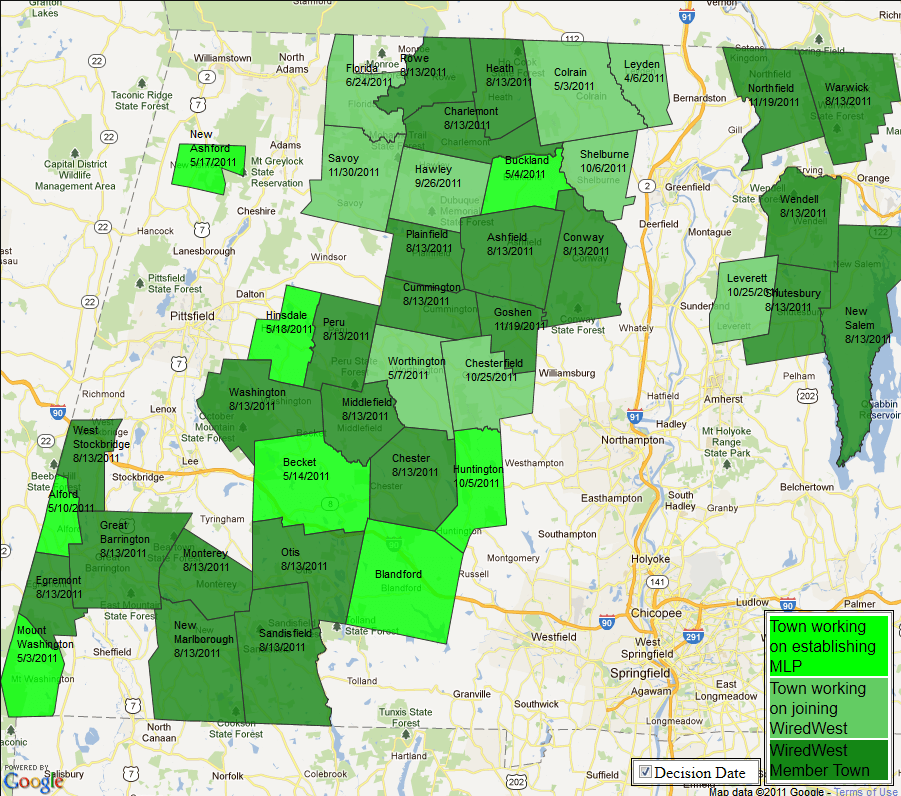
Communities are increasingly learning if they don’t have service today, the only real guarantee they will get it is by providing it themselves.  That is where WiredWest comes in.  It is a community-powered partnership — a co-op for broadband — pooling resources from 22 independent towns (with 18 more expected to join) to build out that challenging last mile, and deliver future-proof fiber to the home service.  No last generation DSL, slow and expensive fixed wireless, or limited capacity coaxial cable networks are involved.
WiredWest Members

Founding member towns span four counties, including Berkshire County towns of Egremont, Great Barrington, Monterey, New Marlborough, Otis, Peru, Sandisfield, Washington and West Stockbridge; Franklin County towns of Ashfield, Charlemont, Conway, Heath, New Salem, Rowe, Shutesbury, Warwick and Wendell; Hampshire County towns of Cummington, Heath, Middlefield and Plainfield; and the Hampden County town of Chester.

Most of the construction costs for the new network will likely come from municipal bonds, because government grants typically exclude last mile network funding.  Commercial providers often lobby against municipal-funded networks as “unfair competition,” a laughable concept in long-ignored western Massachusetts, where Verizon pitches slow speed DSL, if anything at all.

WiredWest compares rural broadband with rural electrification.  Community-owned co-ops provide service where few private companies bothered to show interest:

Think back to the rural electrification of America. Then, as now, it wasn’t profitable enough for private companies to build out electrical service to rural communities. Imagine where those communities would be today if the government hadn’t stepped in to help fund this essential service – which over time has sustained itself and become a profitable enterprise.

Rural fiber-to-the-home is affordable when you use an appropriate financing and business model that isn’t subject to the same short-term measures of profitability as a private company. A municipal model for example, allows capital investment that can be written off over a longer period of time.

This type of business model isn’t limited to community-owned broadband.  Other countries that treat broadband as an essential utility have, in some cases, boosted broadband beyond a simple cost/benefit “ROI” analysis.

Constructing a broadband network for western Massachusetts still presents some formidable challenges, however:

  1. There is a serious imbalance in government grant programs.  A largesse of government funding for institutional broadband has delivered scandalously underused Cadillac-priced networks communities, libraries and schools cannot afford to operate themselves once the grant money ends.  Meanwhile, funding to cushion the cost of wiring individual homes and businesses is extremely scarce.  Isn’t it time to divert some of that money towards the most difficult problem to overcome — wiring the last mile?
  2. Government impediments to community broadband must be eliminated.  Repeal laws that restrict public broadband development.  Early experiments in municipal telecom networks have taught valuable lessons on how to operate networks efficiently and effectively.  But the broadband industry engages in scare tactics that highlight failures of older public projects like community Wi-Fi in an effort to keep superior publicly-owned fiber-to-the-home networks out of their markets.
  3. The public is not always engaged on the broadband issue and accepts media reports that misunderstand institutional broadband as a solution for those stuck using dial-up.  No matter how good a network is, if the “last mile” problem remains unsolved, the closest consumers like Mr. Newhouser will get to fiber service is looking at the wiring on a nearby telephone pole.  In many communities, fiber broadband paid for by public tax dollars is only accessible at the local public library.  Taxpayers must demand more access to networks they ultimately paid for out of their own pockets, and should support existing public broadband initiatives wherever practical.

[flv width=”640″ height=”380″]http://www.phillipdampier.com/video/WSHM Springfield Broadband internet coming to western Mass 12-8-11.mp4[/flv]

WSHM in Springfield says if you don’t have broadband in western Massachusetts now, it should be coming to your area soon.  But will it?  (3 minutes)

Search This Site:

Contributions:

Recent Comments:

Your Account:

Stop the Cap!