Home » FiOS » Recent Articles:

Elmira Spins Its Wheels Negotiating for a Better Deal from Time Warner Cable

Phillip Dampier May 22, 2012 Competition, Consumer News, Public Policy & Gov't, Rural Broadband, Video Comments Off on Elmira Spins Its Wheels Negotiating for a Better Deal from Time Warner Cable

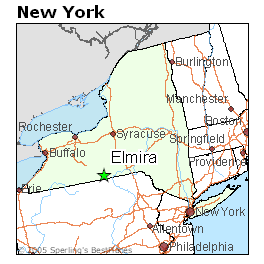
The southern tier city of Elmira, N.Y. is not too happy with Time Warner Cable’s lock on the local cable market.

“There’s no competition so their prices continue to go up, their offers continue to go down, and the people here with no other competition are just paying and paying and paying,” Elmira mayor Sue Skidmore told WETM News.

Skidmore and the city council intend to hold public hearings on the cable operator’s franchise renewal before they attempt to negotiate the next 10-year agreement with the cable company.

“This gives the public an opportunity to come and say anything good or bad pertaining to the cable franchise,” said city manager John Burin. The public meeting is scheduled for 7pm, June 4, on the second floor of Elmira City Hall.

Skidmore

The city’s ability to press Time Warner Cable for lower rates or service changes are extremely limited, however. Wholesale deregulation of the cable television industry has allowed most cable operators to manage their systems as they see fit, with no obligation to accept the recommendations of local government.

This fact of life was underscored when Time Warner mailed its own vision of what a renewal agreement with the city should look like, prior to any public discussion.

The city’s lawyer, John Ryan Jr., told the Ithaca Journal the company deleted several provisions in the proposed renewal agreement that are part of the current agreement. Ryan intends to speak with the operator about those changes, and wants to see changes in the city’s favor.

In most franchise renewal agreements, the only leverage a city typically has is to threaten not to renew a cable franchise. That is a very rare occurrence, however, because it is exceptionally rare for another major cable provider to agree to service a city that cancels a franchise renewal with another company. In the end, most renewal agreements come down to handshake agreements to correct any long-standing service issues, agree to wire certain unserved areas, and negotiate over public, educational, and government access channels and franchise fees payable to the city.

The local telephone company, Verizon Communications, has no plans to provide its FiOS fiber optic service in the city, leaving customers with the competitive option of landline phone service, DSL, and a contract with Verizon’s satellite TV partner, DirecTV.

[flv width=”360″ height=”290″]http://www.phillipdampier.com/video/WETM Elmira City Of Elmira To Negotiate With Time Warner Cable 5-21-12.mp4[/flv]

WETM in Elmira reports city officials are preparing for franchise renewal discussions with Time Warner Cable. The cable company is already on that, preemptively sending the city a franchise renewal agreement it wrote itself. (1 minute)

Frontier Says No Plans for National Video Service; Could Modify FiOS for IPTV

Phillip Dampier May 21, 2012 Audio, Broadband Speed, Competition, Consumer News, Frontier, Rural Broadband Comments Off on Frontier Says No Plans for National Video Service; Could Modify FiOS for IPTV

Frontier Communications will not roll out a national IPTV service to compete with cable operators in all of its service areas, but is still exploring its options for providing pay-TV service in larger cities.

That decision, announced by executive vice president and chief financial officer Donald R. Shassian, came at last week’s Global Technology, Media, and Telecom Conference sponsored by Wall Street investment bank J.P. Morgan.

Shassian used the occasion to clarify remarks made during the company’s first-quarter results conference call, which caused some shareholders and analysts concern about the company’s lackluster performance, capital spending plans, and company debt that will come due early next year.

Shassian

Shassian said Frontier will not deploy U-verse-like IPTV service across its entire national service area, but is considering the future option of delivering the service (and better broadband speeds) theoretically in selected markets.

Shassian also raised the prospect of modifying part of its acquired fiber-to-the-home FiOS network to fiber to the neighborhood technology that companies like AT&T are currently using. But for the foreseeable future, most Frontier customers will have to subscribe to satellite television if they want a video package with their home phone and broadband service.

Stop the Cap! was the first to report Frontier was considering licensing AT&T U-verse to use in selected larger markets where the company has lost considerable ground against cable competitors that deliver consistently faster broadband service.

Wall Street reaction to the proposal has been negative, with concerns Frontier will need to spend hundreds of millions, if not billions, to deploy such a network.

Shassian sought to distance the company from any suggestion they will further increase spending on network improvements. In fact, Shassian says Frontier will end its broadband expansion program, and the extra spending to pay for it, by 2013.

“Our capital expenditure spending will decrease in 2013 as the geographic broadband expansion of our network concludes,” Shassian said. “We expect capital expenditures to drop by approximately $100 million in 2013.”

In lieu of national IPTV service, Frontier remains committed to its resale partnership with satellite TV provider Dish Network. But Shassian did admit U-verse technology is among the options the company is exploring to remain competitive.

Surprisingly, Shassian also said the company was considering partially modifying its acquired FiOS network in Indiana and the Pacific Northwest, because of the cost savings it could deliver.

“We have been evaluating alternative platforms which could generate savings from capital expenditures, video transport and even content costs that can be significant to the FiOS video market business,” Shassian said. “I want to be clear that we have no plans to deploy IPTV across our nationwide network and therefore do not see upward CapEx pressure from any potential changes in our facilities-based video strategy.”

Asked about the potential cost savings afforded by swapping out FiOS technology for IPTV fiber to the neighborhood service, Shassian said it could open the door to expanding service in areas where existing copper-based last mile network facilities can sustain a minimum of 20Mbps broadband service. Frontier claims 1.9 million homes in its service area can receive 20Mbps today, of which 600,000 are currently within a Frontier FiOS service area.

“If we changed, we may have to change out set top boxes on [existing FiOS customers],” Shassian said.

In this clip, Frontier Communications’ executive VP and chief financial officer Don Shassian speaks to a J.P. Morgan investor conference in Boston about the company’s broadband and IPTV plans. (May 15-17, 2012) (4 minutes)
You must remain on this page to hear the clip, or you can download the clip and listen later.

The implication of substantially altering the company’s existing fiber-to-the-home network baffled some analysts.

One, who talked with Stop the Cap! asking not to be attributed, suspects Shassian’s role as a financial officer at Frontier may explain part of the mystery.

“He’s not the chief technology officer, and I suspect he is partly confused about the different technologies,” the analyst explains. “I can’t see Frontier tearing down their current network, but it may make sense for them to switch technology strategies when considering if and where they can expand their network.”

“Frontier’s first quarter results were more than disappointing, and the company is being exceptionally cautious about anything that requires spending right now,” the analyst said. “The next shoe to drop is another dividend cut, which would kill the stock in the market, and if we think Frontier will spend a billion to improve its network, that dividend is going down.”

Our source says he does not have much confidence in Frontier’s current management.

“They talk a nice story, but the numbers never finally add up,” he says. “Rescuing wireline is expensive and companies always promise it will cost incrementally little to expand revenue-enhancing broadband to their rural customers, but if that were true, the companies would have already done it, and without significant spending they have not.”

New York City Broadband “Sucks,” Says Village Voice

Waiting for FiOS

For those who admire the apparent pervasiveness of competition between Time Warner Cable and Cablevision Industries vs. Verizon Communications’ FiOS, the idea the Big Apple has a broadband problem seems a bit ridiculous, particularly if you can’t get your local cable company to pick up their phone and AT&T will only hand you a 1.5Mbps DSL line, if you can get it.

But according to the Village Voice, New York City broadband “sucks,” and it will continue to suck for at least the next eight years.

“Though entrepreneurs in most parts of the city can access a fast broadband connection today, many of those we interviewed said that New York’s telecom infrastructure is well behind where it should be for a city vying to be one of the nation’s two leading technology hubs,” the study notes.

What it comes down to is that New York — despite being the world’s media capital — does not have adequate access or bandwidth to support tech companies’ needs.

For example, some companies might be able to get either FiOS or Time Warner Cable, but not both, which means they can’t have broadband backup.

“It’s like the elephant in the room is that bandwidth here sucks,” one entrepreneur told the researchers. “You should be able to walk into any building and have at least 150 megabit connection available to you. There has to be ways for the city to construct much better bandwidth availability for start-ups.”

Many cited told the researchers that their internet routinely goes down. And startups who want to set up shop in cheaper, industrial districts often can’t, because the cable companies would rather provide service to more lucrative residential areas. Sometimes, telecom concerns are willing to dig up streets and lay cable, but at a hefty price — around $80,000.

That $80,000 bill is handed to a prospective customer and does not come from cable operators’ capital expense fund.

Researchers gave New York a broadband grade of B to B-, which isn’t too bad considering what broadband is like in the mid-south, the midwest, and the rural west. But it doesn’t cut it for helping New York become a bigger tech city.

Waiting for "Business Class"

While Time Warner Cable and Cablevision have wired multi-dwelling units and homes across New York City, cable operators have only recently started to turn their serious attention to corporate business customers.  Time Warner Cable agreed, as part of its franchise renewal deal with the city, to invest $1.2 million per year for fiber connections to commercial buildings yet to be wired for cable. Cablevision, which can be found in boroughs like Brooklyn and out on Long Island, agreed to spend a more modest $600,000 a year for the same purpose.

Time Warner Cable has already warned investors its capital spending on wiring commercial office buildings across the country is increasing as the company sees lucrative new revenue opportunities competing with their usual nemesis — the phone company.

Verizon treats FiOS deployment in New York City as a long, long-term project. There are neighborhoods in Manhattan that can’t wait much longer for the fiber optic network as Verizon increasingly lets its old copper wiring go to pot, leaving some New Yorkers without phone service for weeks.  The city of New York has given Verizon until 2014 to wire the city, and the company appears likely to need those two additional years at their current pace, and that agreement only covers residential properties, not commercial ones.

Robust broadband is essential for many high technology startups and the multi-million dollar data centers that support them. New York mayor Michael Bloomberg considers it a top priority to reduce the city’s economic dependence on Wall Street, which generates considerable tax revenue for both the city and state. High tech enterprises fit that bill. But the city’s broadband grades do not.

“For a city that’s trying to be a tech powerhouse, we need to have an A,” said Jonathan Bowles, the author of the study, “New Tech City.”

Verizon Preparing to Kill Grandfathered Unlimited Data Plans, Hike Rates for FiOS

Verizon Wireless will force customers off of their grandfathered unlimited data plans when they reach the end of their current two-year service contracts, according to the company’s chief financial officer.

It is all part of the cell phone company’s strategy to boost the average bills of customers with new, more expensive tiered family-shared data plans. With a significant number of current customers grandfathered on unlimited data plans that users likely will not forfeit voluntarily, Verizon will force the issue as customers come up for contract renewal.

The plan received considerable approval at today’s JPMorgan Chase TMT conference, a gathering for Wall Street investors and tech companies like Verizon.  Executive vice-president and chief financial officer Fran Shammo laid out the plan to switch customers to forthcoming family “data share” plans that are priced based on anticipated usage:

As you come through an upgrade cycle and you upgrade in the future, you will have to go onto the data share plan. And moving away from, if you will, the unlimited world and moving everybody into a tiered structure data share-type plan.

So when you think about our 3G base, a lot of our 3G base is unlimited. As they start to migrate into 4G, they will have to come off of unlimited and go into the data share plan. And that is beneficial for us for many reasons, obviously. So as you pick what tier you want to be and we think that there will be some price up in those tiers.

“Price up” is code language for bill hiking. Customers adopting family share plans may be able to share data across a larger number of devices, but at consumption pricing, many customers will find their Verizon bills substantially higher than before.

Shammo

“And the important part of that is we want the connections to come in and the way we have designed our plan, this plan is built on tiers and as we look at the future growth of LTE consumption because of the speeds and video consumption and consumption of other M2M-type devices, it is going to be more important that people will start to upgrade in their tiers as they start to really realize the benefits of the LTE network,” Shammo said. “As [customers] add more devices, they are going to have to buy up into tiers. So again, you will see the revenue increase there.”

Those revenue predictions were not sufficient to satiate Phil Cusick, an analyst at JPMorgan Chase. He questioned Shammo about the prospects for Verizon further increasing revenue with across-the-board rate increases on service plans.

Shammo would not commit to that, but was pleased with the lack of customer protests over their recent introduction of a $30 equipment upgrade fee. He called the new fee “the right thing to do.” More fees and surcharges are likely, according to Shammo.

“I think implementing these additional fees is probably where we are at,” he said. “With the construct that we have dealt with around data share and where we see consumption of LTE going, when you put the combination of them together, we are fairly confident that we will see people start to uptake in the tiers, which is really where we will get the revenue accretion in the future.”

Shammo also said Verizon’s fiber to the home network FiOS has gotten such rave reviews, it almost sells itself. That means the company will pull back on promotional offers and plans a general rate increase for all customers in the coming months, if only to bolster company profits.

“We have to do a better job in discipline of price increases and I think that you’ll see us do some price increases here over the next two quarters to offset the content increase and that will also contribute more profitability to the bottom line,” Shammo said. “You are going to have to concentrate more on reducing the amount of promotions, reducing the amount of retention that you put on the table to retain a customer and then also you are seeing that the industry is pricing up.”

Verizon FiOS customers will find rate increases applying both to equipment rental and service pricing nationwide, according to Shammo.

“We were actually below-market compared to our competitors on the amount of fee that we charge on the rental of a set-top box or a digital converter box,” Shammo explained. “We are switching around our bundles and the customers that are coming out of the current bundles will be priced up to the newer bundles. So you are going to see really a shift over the next two to three quarters in price-ups coming out of FiOS.”

As far as FiOS expansion goes, the company does not expect any major expansion in the service for the next several years.

“If we can penetrate the market and really turn the wireline profitability, could we potentially build out to other areas? Yes, but that is a decision that will be made in years out, not right now,” Shammo said. “So from a capital perspective, we are being very disciplined with where we are going to put that capital.”

New York Accuses Verizon of Abandoning Quality Landline Service; “It’s a Duopoly”

New York State Attorney General Eric Schneiderman is convinced Verizon Communications is abandoning quality landline service for millions of New Yorkers while diverting money and resources to its more profitable cell service Verizon Wireless.

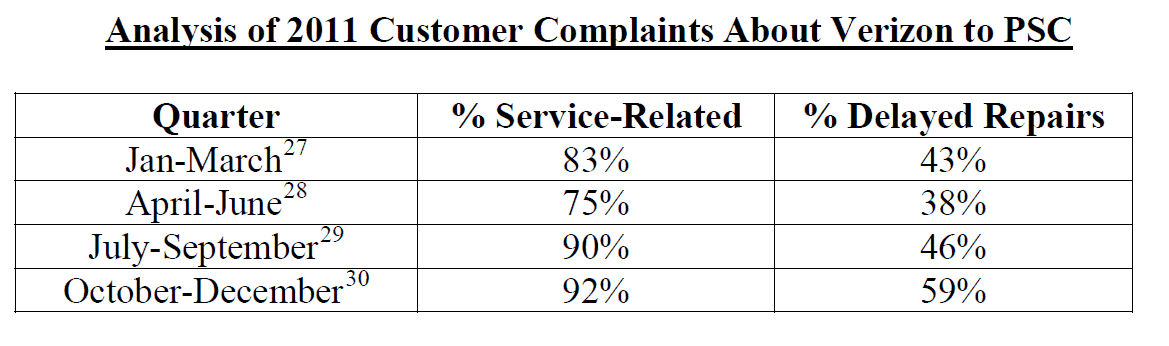
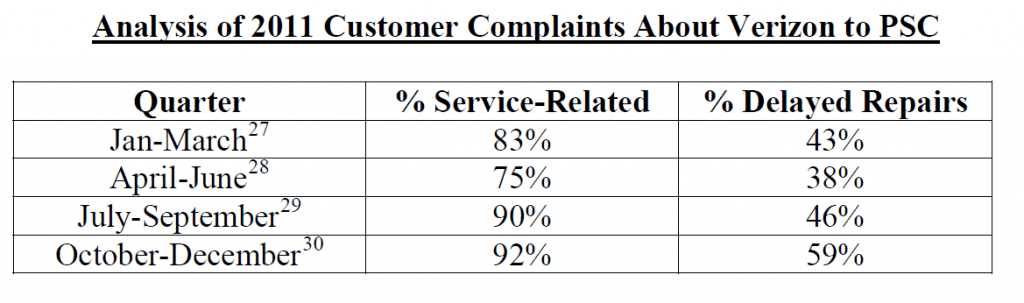
Last week, Schneiderman blasted the state’s largest landline provider for mounting complaints about poor service that now impact 92 percent of its customers, calling deregulation a failure for consumers and businesses in New York.

“Verizon customers deserve the high-quality service they’ve been promised,” Schneiderman told The Associated Press.

The attorney general reports that the number of customers enduring service outages for more than 24 hours has increased, while landline infrastructure — particularly wiring — is allowed to deteriorate.

Schneiderman suspects Verizon is shortchanging landline service as an increasing number of wired phone customers disconnect service, often in favor of Verizon’s more lucrative cell phone service.  The state Public Service Commission (PSC) fined Verizon $400,000 in March for similar concerns, pointing to the company’s intentional workforce reductions lengthening repair windows and creating repair backlogs in some regions.

Schneiderman’s office filed comments with the PSC requesting changes to Verizon’s Service Quality Improvement Plan, which was originally launched in 2010:

At best, New York’s telephone service market is a duopoly, and contrary to theoretical expectations of market controls, the presence of a single competitor has not in fact prevented Verizon from allowing customer service to continue to degrade. Rather than meet its obligations to provide wireline telephone customers with minimally adequate telephone service, Verizon is continuing to drastically reduce its workforce with the result that the company cannot meet its customers’ repair needs in a timely manner.

Verizon’s management has demonstrated that it is unwilling to compete to retain its wireline customer base, and instead is entirely focused on expanding its wireless business affiliate. It is incumbent on the Commission to take appropriate regulatory action to ensure that customers receive reliable telephone service with adequate repair performance. Therefore, the Commission should modify Verizon’s service plan to ensure customers receive adequate service quality in the future.

Verizon defended its service in New York pointing out the company has invested $1.5 billion in the state for infrastructure, including its FiOS fiber to the home network.  Verizon spokesman John Bonomo questioned Schneiderman’s claim that 92 percent of Verizon New York customers had poor service, noting 98 percent of its landline customers don’t have service problems.

Schneiderman’s highlighting of a $400,000 service fine imposed by the PSC did not account for unprecedented damage from both Hurricane Irene and Tropical Storm Lee late last summer, Bonomo added.

But the state’s attorney general notes Verizon’s service problems in New York have been ongoing well before last summer.
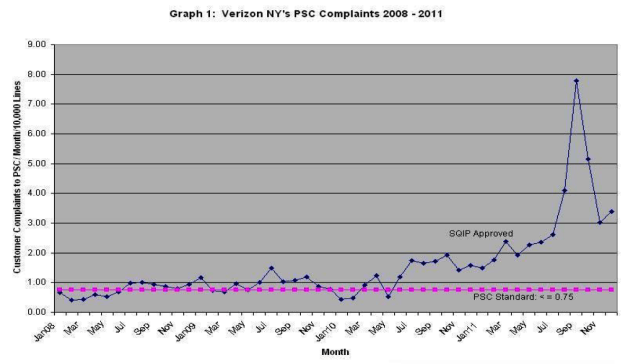
Service complaints, charted here from 2008-2011, show a major spike last summer and fall and remain higher than normal.
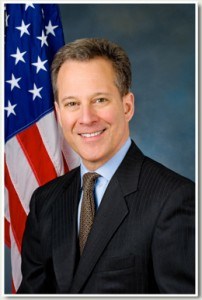
Schneiderman

“Since at least 2008, Verizon has frequently failed to meet these PSC telephone service standards essential to safe and reliable telephone service,” Schneiderman says. “Even as the number of telephone lines needing to be maintained has dwindled to half those of a decade ago (as customers choose to rely instead on wireless and/or cable telephony), Verizon’s continues to fail to meet the PSC’s service standard.”

Customers on the upper west side of New York City don’t need to be reminded of Verizon’s service failures.  Hundreds of Verizon landline customers in New York’s largest city were left without basic phone service for more than a week, only made worse by the fact Verizon told many of them they’d be without service for at least one additional week while the company worked on repairs.

Phone and Internet service went dead in multiple buildings along Central Park West April 10, but customers wanted to kill when they learned the phone company wanted more than two weeks to get service restored.

“I was like, excuse me, are you serious? Two weeks?” Iram Rivera, a concierge at 262 Central Park West, told DNAinfo.  His building was hard hit by the service outage — 80 percent of the building’s 80 apartments were affected.

“I just don’t get the feeling that there’s much of an appreciation on Verizon’s part that this is a hardship for people,” said Ken Coughlin, who lives on West 87th Street and Central Park West. “There’s no communication, there’s no updates, it’s infuriating.”

The outage only affected traditional landline service and DSL broadband over copper phone wiring. The more modern fiber-optic FiOS network that provides TV, Internet and voice service wasn’t affected, Bonomo said.

Schneiderman notes landline outages have an especially hard impact on small businesses:

In the current recession, the fragile economic condition of many small businesses puts them at risk of financial disaster if they suddenly lose telephone service, and their provider is unable to restore service promptly. Each day that these businesses are without service they lose significant revenues that many simply cannot survive without.

Small businesses depend on functional telephone service to meet the needs of their customers in numerous ways. When customers are unable to reach a business by telephone, they may assume the business is closed and purchase the goods or services they want elsewhere. Restaurants are prevented from giving reservations to prospective customers who call. Many types of businesses depend on working telephone lines for processing credit card charges, and may lose substantial sales by limiting transactions to cash or checks. Professional offices can be prevented from providing medical, legal or accounting services to their clients without working telephone service.

In Schneiderman’s view, the deregulation policies now in place in New York have failed consumers, leaving them with a duopoly of phone providers with insufficient oversight.

For competition to benefit customers with improved service, lower prices, and more innovation, there has to first be a willingness to compete, which is significantly absent from Verizon-New York’s policies and practices.

Rather than robust competition, New York’s telephone market is at best a duopoly, with as many indicators of cooperation between the two providers as robust contest for customers. Furthermore, the actual behavior of consumers in the real world is markedly different from the PSC’s theoretical assumptions about the telephone market.

When a Verizon customer experiences a prolonged service outage or installation delay, the option to switch carriers to a cable provider is of no immediate use. Finally, even if consumers wanted to compare Verizon’s service performance with cable provider alternatives, the lack of available information prevents consumers from making educated choices.

In New York, most customers are served by Verizon Communications, Time Warner Cable, or Cablevision.  Time Warner Cable and Verizon recently agreed to cross-market the other’s products and services as part of a wireless spectrum transfer.


Search This Site:

Contributions:

Recent Comments:

Your Account:

Stop the Cap!