Home » FiOS » Recent Articles:

Verizon Leaves Ailing Elderly N.Y. Couple Without Phone Service for Three Weeks

Phillip Dampier June 20, 2012 Consumer News, Public Policy & Gov't, Verizon Comments Off on Verizon Leaves Ailing Elderly N.Y. Couple Without Phone Service for Three Weeks

An 85-year-old woman with dementia and her ailing 90-year-old husband in Rockaway were left without telephone service for three weeks because Verizon could not contact them on their out-of-service phone line.

The couple’s daughter, Rita Burgess, made at least 13 calls to Verizon Communications trying to get the couple’s phone line back up and running, but to no avail. A Verizon spokesperson later told the New York Daily News the company couldn’t get the line repaired because they couldn’t call the couple… on the phone line that was out of service.

“You people put me through hell,” Burgess thought after Verizon finally reached out to get the phone line repaired.

By then it was too late. Burgess took matters into her own hands and switched the family to Time Warner Cable’s phone service.

The incident has turned into a cause célèbre for consumer advocates, who claim Verizon continues to neglect its landline network in favor of its limited fiber optic FiOS service. New York consumer groups want the state to more aggressively regulate Verizon’s landline network to make certain extended outages like this cannot happen.

Burgess, who lives on Long Island, found herself cut off from her parents at a time when her father was hospitalized. Both father and daughter were unable to reach Mrs. Burgess, who requires regular attention because of dementia.

Bob Master, legislative and political director for the Communications Workers of America, told the Daily News the couple’s ordeal is not unique.

“They’re diverting resources from basic phone services,” Master said of Verizon. “That’s the business model, to divert resources to the most lucrative areas.”

Verizon counters the union is in dispute with the phone company over stalled contract negotiations and points to a 2012 first quarter report from the state Public Service Commission showing Verizon is meeting standards for reliability and repair times.

But Verizon has also lost half of its landline customers in New York State, which could also account for a declining number of complaints.

The Burgess family has decided to stick with Time Warner Cable for phone service.

Editorial: Comcast’s Blatant Disregard for the Truth About Broadband Speeds

When a company like Comcast grows so big, it no longer cares whether its marketing claims are true or false, perhaps it is time to put those claims to the test in court or before a state attorney general for review.

Recently, Comcast’s claim it runs the fastest Internet Service Provider in the nation came under scrutiny by the Better Business Bureau. The simple truth is, Comcast is not the fastest ISP in the nation — not even close. But because PC Magazine ran a limited test of some national broadband providers and found Comcast barely making it to the top, the cable giant has been running ads across the country that are disingenuous and incomplete at best, completely misleading and false at worst.

Phillip “Comcast is not too big to deserve a FAIL Dampier

The National Advertising Division of the BBB, a self-regulating industry-controlled body, found the advertising deceptive, which says a lot for a group that lives or dies on the whims of the industries that support its operations.

NAD previously determined that Comcast cannot, based on its current offerings, make an unqualified claim in national advertising to be faster than the competition. NAD noted that while Comcast is the fastest Internet option for 94 percent of the 52 million households in its competitive footprint, it is not the fastest where Verizon FiOS is available.

Consumers need deep pockets to read the actual report that mildly criticizes Comcast. The NAD keeps the public out of its business with a subscription rate of $550 a year to read detailed individual case reports. We learned about the case from one of our readers who shared a copy.

Among the false claims Comcast is still making:

  • “It’s official.  We’re the fastest.” — Officially, Comcast is not the fastest.
  • “…the fastest downloads available.” — False.
  • “FiOS Does Not Live up to Expectations….With Speeds of Up to 105Mbps, XFINITY was rated as the fastest Internet provider in the nation by PC Magazine.” — But FiOS speeds are faster than Comcast. PC Magazine did not test Verizon FiOS.

Comcast agreed to consider making changes to their advertising to comply, but that now appears to be a non-starter.

In Chattanooga, Tenn., EPB Fiber broadband beats the pants off Comcast. No, it’s actually worse than that. EPB embarrasses Comcast’s comparatively slow broadband service. While Comcast was looking for a way to manipulate customers into using its Xbox online video app to avoid their unjustified usage cap, EPB customers were bypassing that problem altogether by choosing EPB’s fiber to the home service that doesn’t have usage caps and delivers speeds up to 1Gbps.  Comcast, (remember they are “America’s fastest”) tops out at 105Mbps.

One would think Comcast would be hurrying their blatantly false advertising off the air and out of sight in Chattanooga, but the company has refused.

The Times Free Press reports Comcast won’t be making any changes to their ads, and has actually doubled-down with more blatantly false marketing claims. Why? Because EPB is too small of a player for Comcast to be concerned with telling the truth:

Jim Weigert, vice president and general manager of Comcast in Chattanooga, said the request won’t apply to this area and advertising will stay the same.

“I don’t see any changes at all,” he said. “Our use of that designation as the fastest ISP and fastest commercial ISP is still the same and will still be used the same as it is today.”

Weigert said local networks such as EPB, which delivers maximum download speeds about 10 times faster than those of Comcast, is too small of a player to affect the region’s advertising or PC Magazine‘s designation.

“Those awards exist, and we just need to make sure we’re using it properly and quoting it properly,” he said. “It doesn’t reference EPB at all because they’re not national. They’re not big enough to get that attention.”

In other words, actual facts about broadband speed don’t matter. With standards like this, it is only a matter of time before we’ll be seeing program length commercials for snake oil.

Beyond the fact Comcast is morally and ethically wrong here, I’m not sure I would want my company admitting to customers truth should come in second. With that kind of attitude, Comcast customers should put their wallets in their front pockets, leave the kids home and lock their car doors before visiting a Comcast Cable Store.

Deborah Dwyer, public relations supervisor for EPB, notes the Comcast ads are self-serving and “cause pretty significant confusion among the public.”

At least the public that still believes what Comcast Cable tells them represents the truth.

Verizon FiOS Rate Increases Announced; Tempered By Faster Service for Some

Phillip Dampier June 4, 2012 Broadband Speed, Competition, Consumer News, Verizon 3 Comments

Verizon FiOS standalone broadband customers choosing the company’s standard service will see rate increases of $10 a month starting June 17, but those upgraded to the company’s premium speed tiers, which are getting much faster, may not see any rate hike at all.

The Verge received word from an anonymous Verizon employee who passed along the rate hike information that will apply to broadband-only customers:

  • Standard 15/5Mbps service: (Was $54.99/mo) now up $10 to $64.99
  • 50/25Mbps service: (Was $74.99/mo for 25/25Mbps) remains $74.99
  • 75/35Mbps service: (New offer) $84.99
  • 150/65Mbps service: (Was $94.99/mo for 50/20Mbps) remains $94.99
  • 300/65Mbps service: (Was $199.99/mo for 150/35Mbps) now $204.99

All new pricing requires a two-year contract (month-to-month service costs $5/mo more) and home phone service with Verizon (or pay a $5/mo surcharge). Speeds of 150 or 300Mbps require a 2-4 hour service call and upgrade fee of $100 for new equipment unless you are on a two-year contract, are a new customer, or already have Verizon’s 150Mbps service. Customers living in multi-dwelling units served by VDSL and not fiber-to-the-apartment will pay the new higher price for standard service, but cannot receive the new enhanced speed tiers.

With the majority of Verizon customers paying only for standard speed service, Verizon will pocket significantly higher revenue for broadband. But customers need not pay for more expensive a-la-carte broadband. Verizon offers significant discounts for customers who sign up for triple play packages on phone, Internet, and television service. Bundled customers continue to get the most bang for the buck, but not if you don’t use the services Verizon wants to sell.

Jonathan Takiff, a columnist for the Philadelphia Daily News says he isn’t buying at the prices Verizon is charging.

I also was disappointed with the announcement that Verizon will continue to offer entry level FiOS Internet running at  15/5 Mbps. If the operation has such superior technology and capacity, why not flaunt it and give us casual users more headroom?  Even with its old school coaxial cable network, Xfinity service starts at 20 Mbps down.

Clearly, Verizon hopes  to up-sell customers to a higher, more profitable tier. And they’re using that grandiose 300 Mbps offering as an attention getter, to get folks thinking more aspirationally. Kinda like the way a car company throws a high powered, ridiculously priced, super flashy sports car into the showroom mix. Makes you go for the bigger engine in the econobox.

[…] What’s a good deal for Internet service on a global basis? In front-running Japan, the  average service runs at 61 Mbps and costs 27 cents per megabit, per month. While not quite as dramatic,  Internet services in South Korea, Finland and France also make U.S. providers look like stingy bastards.

Bragging Rights: Verizon FiOS Will Sell 300Mbps Speeds Others Say You Don’t Need

Phillip Dampier May 30, 2012 Broadband Speed, Competition, Verizon 1 Comment

Despite claims from some of their competitors that customers don’t want or need super-fast broadband, Verizon Communications is taking broadband speeds to the new level, upgrading service to as high as 300Mbps in selected areas.

Our friends at Broadband Reports had the scoop on this a few weeks ago, but now it’s official: speed -and- price increases for Verizon are on the way for the company’s fiber optic network FiOS.

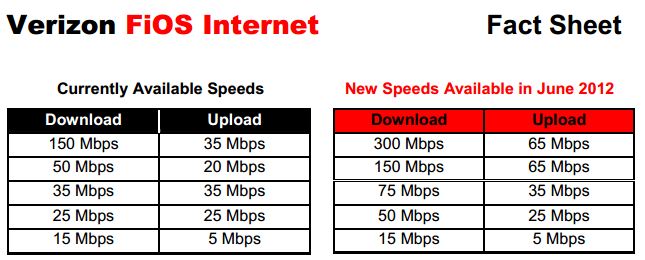
Many customers will see their broadband speeds double or more in June. At the same time, the company has been sending out letters informing customers of price increases, often $5 a month for those not locked into service contracts.

Verizon's Speed Upgrade Chart (Courtesy: Broadband Reports)

Verizon’s new top tier of 300/65Mbps will be introduced in areas that have Verizon’s Gigabit Passive Optical Network (GPON). Pricing has not yet been announced.

The company is targeting its speed upgrades to premium broadband customers who subscribe to faster tiers. Customers on Verizon’s standard 15/5Mbps tier will see no changes in service.

Nine Upstate NY Mayors Accuse Verizon of Avoiding Urban Poor In Fiber Upgrades

Verizon has a moratorium on further expansion of its fiber to the home service except in areas where it has existing agreements to deliver service.

Virtually every mayor in the urban centers of upstate New York is accusing Verizon Communications of redlining poor and minority communities when deciding where to provide its fiber-to-the-home service FiOS.

Now they are telling the Federal Communications Commission and Department of Justice to become more closely involved in reviewing a proposed anti-competitive marketing partnership between the phone company and some of the nation’s largest cable operators.

The mayors are upset that Verizon has chosen to target its limited FiOS network primarily on affluent suburbs surrounding upstate New York city centers.

“Verizon has not built its all-fiber FiOS network in any of our densely-populated cities. Not in Albany, Buffalo, Syracuse, Binghamton, Kingston, Elmira or Troy,” the mayors say. “Yet, Verizon has expanded its FiOS network to the suburbs ringing Buffalo, Albany, Troy, and Syracuse, as well as many places in the Hudson Valley, and most of downstate New York. As a result, the residents and businesses in our cities are disadvantaged relative to their more affluent suburban neighbors who have access to Verizon’s FiOS, providing competitive choice in high-speed broadband and video services.”

The mayors fear the reduced competition that will come from the marketing partnership between the phone and cable industry will eliminate any pressure on Verizon to expand its fiber optic network into more New York cities. The agreement allows Verizon Wireless customers to received significant bundled discounts when they sign up for cell phone service and a cable package from Comcast, Time Warner Cable, Cox, or Bright House Networks. No corresponding discount is available to a Verizon Wireless customer choosing to bundle Verizon FiOS, putting the fiber service at a competitive disadvantage.

“These commercial agreements appear to eliminate any incentive that Verizon might have had to expand its all-fiber network to our high-density urban centers,” the mayors say. “After all, Verizon Wireless, a subsidiary of Verizon Communications, will now be able to sell Time Warner’s video and broadband service as part of their bundled package in our communities.”

That leaves most with Verizon’s DSL service, a product Verizon has been marketing less and less to its customers. The company recently announced it would no longer sell standalone DSL broadband, another point of contention for the mayors.

The mayors are concerned that Verizon’s deteriorating landline network will have profound implications for city centers, where tele-medicine, education, business, and entertainment services will all be left lacking if the fiber network is not extended.

“As you are well aware, high-speed broadband is critical to economic development and job creation, as well as improvements in health care, education, public safety, and civic discourse which is so essential to communal life,” say the mayors. “The economic health of our cities and our upstate region depends upon access to the same first-rate communications infrastructure available to the New York City metropolitan region and the suburban communities that ring our cities.”

The nine mayors are also questioning whether Verizon executives misled them when they claimed Verizon’s strong financial performance would allow the company to reinvest profits into further expansion of its FiOS network. Verizon executives have since admitted the company is indefinitely finished with FiOS expansion, except in areas where it already committed to build the fiber network.

Signing the letter were:

  • Byron W. Brown – Mayor, City of Buffalo
  • Stephanie A. Miner – Mayor, City of Syracuse
  • Gerald D. Jennings – Mayor, City of Albany
  • Matthew T. Ryan – Mayor, City of Binghamton
  • Shayne R. Gallo – Mayor, City of Kingston
  • Susan Skidmore – Mayor, City of Elmira
  • Brian Tobin – Mayor, City of Cortland
  • Robert Palmieri – Mayor, City of Utica
  • Lou Rosamilla – Mayor, City of Troy

(The city of Rochester is served by Frontier Communications, which has no plans to deliver a fiber to the home network within its local service area.)

Search This Site:

Contributions:

Recent Comments:

Your Account:

Stop the Cap!