Home » FiOS » Recent Articles:

Mid-Atlantic Storm Damage Shows Big Telecom Unprepared for Bad Weather

Phillip Dampier July 5, 2012 Comcast/Xfinity, Consumer News, Cox, Frontier, Public Policy & Gov't, Rural Broadband, Verizon, Wireless Broadband Comments Off on Mid-Atlantic Storm Damage Shows Big Telecom Unprepared for Bad Weather

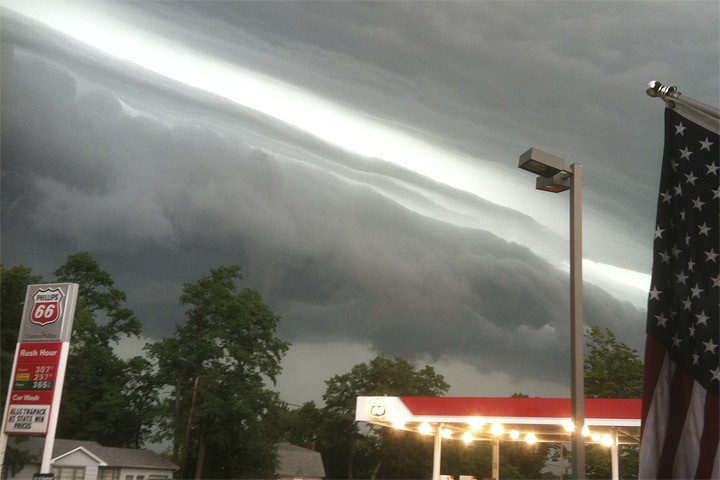
NOAA caught this ominous derecho cloud front in La Porte, Ind on June 29. The same storm would later cut power for millions all the way to the eastern seaboard.

A series of severe thunderstorms accompanied by near-hurricane-force winds caused millions of customers in several Mid-Atlantic states to lose power and telecommunications services late Friday, and some are expected to remain without service until at least this coming weekend.

The storm, known as a “derecho,” uprooted trees, which in turn knocked down power lines and caused wind-related damage to buildings from Ohio to West Virginia, Virginia to Maryland, and even into North Carolina.

But the storm also is raising questions about the massive failures in commercial telecommunications systems that left entire 911 emergency response systems offline for days, wireless networks non-operational, cell phone systems overwhelmed, and broadband service, deemed a lower priority by emergency officials, down and offline.

Some of the biggest problems remain in and around the nation’s capital and in the states of West Virginia and Virginia, where inadequate infrastructure proved especially susceptible to the storm’s damaging winds.

D.C., Maryland, and northern Virginia

In northern Virginia, calls to 911 were met by silence over the weekend, thanks to a catastrophic failure of Verizon’s landline network. With primary lines down, Verizon’s backup 911 systems also failed, leaving millions with no access to emergency responders.

Fairfax County officials finally put the word out the best way to summon emergency help was to drive (through streets littered with debris and downed power lines) to the nearest fire or police station for assistance.

“It’s just not OK for the entire 911 system in the region to go down for the period of time that we were out, especially after an enormous emergency where people needed to make those calls the most,” Sharon Bulova, chairman of the Fairfax County Board of Supervisors, told the Associated Press.
Verizon spokesman Harry Mitchell was left flat-footed, promising an investigation into Verizon’s latest 911 failure, and called the storm as damaging as a hurricane. He urged local officials to “move forward” beyond the immediate criticism and help make progress to get service restored.

Many emergency response networks also depend on telecommunications services, including fiber cables, to reach transmission towers for radio dispatch and mobile data terminals. In northern Virginia, the city of Alexandria has been managing to handle emergency dispatch services for several counties.

With power lines down, cable and phone lines often went as well. In those cases, electric utilities have first priority to restore service, and then cable and phone companies can begin repairs of their own.

Since cable operators rely on power companies to supply electricity to their amplifiers and other equipment, Comcast and Cox, which dominate the region, are blaming most of their outages on power disruptions, and promise service will be restored when the power returns.

Verizon’s DSL and FiOS broadband networks were both disrupted by the storm, primarily because of downed lines and power losses.Even wireless networks, which some might suspect would be immune to downed lines, were also seriously affected by the storm. Cell towers connect to the provider’s network through fiber optic and T1 lines, and although backup power generators can maintain a cell tower for days in some cases, backhaul line cuts can leave cell towers useless.

In metro D.C., call completion problems were a problem during the storm and sometime after as local residents turned to cell phones to communicate. Over the weekend, customers in and around Richmond, Va., found Verizon Wireless useless for text messages because of a service disruption. As backup generators ran dry of fuel, some cell towers that survived the initial storm have been shutting down until maintenance crews arrive and refuel.

The harshest criticism has so far escaped phone and cable companies. Instead, local officials and residents remain focused on Pepco, the power utility serving the Washington area. Pepco has learned from previous storms to become a master of lowered expectations, and is promising to do its best to restore power a week or more after the storm was a memory.

West Virginia and western Virginia

The state of West Virginia, and western rural Virginia state, have illustrated what happens when deteriorating infrastructure is asked to withstand winds of up to 100mph. Frontier’s operations in West Virginia were hit especially hard. Landline networks in that state had been allowed to deteriorate for years by former owner Verizon Communications. Frontier had its hands full trying to keep up with repairs, calling in additional staff and trying to maintain landline service in some areas with the help of generators.

That job was made much harder by a rash of generator thefts that impacted the phone company, and local authorities are still looking for those responsible. At least one-third of all central switching offices operated by Frontier in West Virginia remain on generator power as of yesterday. As of July 3, the company reported it has 12,000 repair requests still waiting for action.

It was a similar story in the western half of Virginia where independent phone companies and Verizon were faced with an enormous number of downed trees and power lines, many in rural areas. More than 108,000 Virginia residents are still without power as of this afternoon, and many will not see it restored until the weekend.

Because the derecho swept across a large area encompassing the entire state, it has been difficult for utility crews to respond from unaffected areas to assist in repairs because the damage was so widespread. Logistically, just coordinating repair operations has proved difficult because cell service has been spotty (or networks have been jammed with calls) in some of the worst-affected areas.

“Derechos are nothing to fool with, but still this was not the most serious storm Virginia has ever dealt with, and the impacts on our telecommunications networks seem to indicate they’ve been allowed to fall apart over the last several years,” shares Stop the Cap! reader Edward Klein, who lives near Roanoke. “I think an investigation is needed to make sure utilities are spending enough money to keep these networks in good shape so this kind of thing doesn’t happen everytime a storm sweeps through.”


The Illusory Savings of “Usage Based Billing”: Your Bill Will Get Higher, Not Lower

Phillip Dampier July 2, 2012 Broadband "Shortage", Broadband Speed, Competition, Consumer News, Data Caps, Editorial & Site News, Online Video Comments Off on The Illusory Savings of “Usage Based Billing”: Your Bill Will Get Higher, Not Lower

Phillip “They Want to Save You Money By Charging You More” Dampier

The pro-Internet Overcharging forces’ meme of “pay for what you use” sounds good in theory, but no broadband provider in the country would dare switch to a true consumption-based billing system for broadband, because it would destroy predictable profits for a service large cable and phone companies hope you cannot live without.

Twenty years ago, the cable industry could raise rates on television packages with almost no fear consumers would cancel service. When I produced a weekly radio show about the cable and satellite television industry, cable companies candidly told me they expected vocal backlashes from customers every time a rate increase notice was mailed out, but only a handful would actually follow through on threats to cut the cord. Now that competition for your video dollar is at an all-time-high, providers are shocked (and some remain in denial) that customers are actually following through on their threats to cut the cord. Goodbye Comcast, Hello Netflix!

Some Wall Street analysts have begun warning their investor clients that the days of guaranteed revenue growth from video subscribers are over, risking profits as customers start to depart when the bill gets too high. Cable companies have always increased rates faster than the rate of inflation, and investors have grown to expect those reliable profits, so the pressure to make up the difference elsewhere has never been higher.

With broadband, cable and phone companies may have found a new way to bring back the Money Party, and ride the wave of broadband usage to the stratosphere, earning money at rates never thought possible from cable-TV. The ticket to OPEC-like rivers of black gold? Usage-based billing.

Since the early days of broadband, most Americans have enjoyed flat rate access through a cable or phone company at prices that remained remarkably stable for a decade — usually around $40 a month for standard speed service.

In the last five years, as cord-cutting has grown beyond a phenomena limited to Luddites and satellite dish owners, the cable industry has responded. As they learned customers’ love of broadband has now made the service indispensable in most American homes, providers have been jacking up the price.

Time Warner Cable, for example, has increased prices for broadband annually for the last three years, especially for customers who do not subscribe to any other services.

Customers dissatisfaction with rate hikes has not led to broadband cord cutting, and in fact might prove useful on quarterly financial reports -and- for advocating changes in the way broadband service is priced:

  1. Enhance revenue and profits, replacing lost ground from departing video customers and the slowing growth of new customers signing up for video and phone services (and keeping average revenue per user ((ARPU)) on the increase);
  2. Using higher prices to provoke an argument about changing the way broadband service is sold.

Pouring over quarterly financial reports from most major providers shows remarkable consistency:

  • The costs to provide broadband service are declining, even with broadband usage growth;
  • Revenue and profits enjoy a healthy growth curve, especially as increased prices on existing customers make up for fewer new customer additions;
  • Earnings from broadband are now so important, a cable company like Time Warner Cable now refers to itself as a broadband company. It is not alone.

Still, it is not enough. As usage continues to grow in the current monopoly/duopoly market, providers are drooling with anticipation over the possibility of scrapping the concept of “flat rate” broadband, which limits the endless ARPU growth Wall Street demands. If a company charges a fixed rate for a service, it cannot grow revenue from that service unless it increases the price, sells more expensive tiers of service, or innovates new products and services to sell.

Providers have enjoyed moderate success selling customers more expensive, faster service, also on a flat rate basis. But that still leaves money on the table, according to Wall Street-based “usage billing” advocates like Craig Moffett, who see major ARPU growth charging customers more and more money for service as their usage grows.

Moffett has a few accidental allies in the blogger world who seem to share his belief in “usage-based” billing. Lou Mazzucchelli, reading the recent New York Times piece on Time Warner’s gradual move towards usage pricing, frames his support for consumption billing around the issue of affordability. In his view, usage pricing is better for consumers and the industry:

It costs real money to upgrade networks to keep pace with this demand, and those costs are ultimately borne by the subscriber. So in the US, we have carriers trying to raise their rates to offset increases in capital and operating expenses to the point where consumers are beginning to push back, and the shoving has come to the attention of the Federal Communications Commission, which has raised the possibility of treating Internet network providers as common communications carriers subject to regulation.

I believe that flat-rate pricing is a major source of problems for network carriers and consumers. In the carrier world, the economics are known but ignored because marketers believe that flat rates are the only plans consumers will accept. But in the consumer world, flat rates are rising to incomprehensible levels for indecipherable reasons, with little recourse except disconnection. Consumer dissatisfaction is rising, in part because consumers feel they have no control over the price they have to pay. This is driven by their sense of pricing inequity that is hard to visualize but comes from implicit subsidies in the current environment. The irony is that pay-per-use pricing solves the problem for carriers and consumers.

Mazzucchelli reposted his blog piece originally written in 2010 for the benefit of Times readers. Two years ago, he measured his usage at 11GB a month. His provider Verizon Communications was charging him $64.99 a month for 25Mbps service, which identifies him as a FiOS fiber to the home customer.  Mazzucchelli argues the effective price he was paying for Internet access was $5.85 for each of the 11GB he consumed, which seemed steep at the time. (Not anymore, if you look at wireless company penalty rates which range from $10-15/GB or more.)

Mazzucchelli theorized that if he paid on a per-packet basis, instead of flat rate service based on Internet speed, he could pay something like $0.0000025 per packet, which would result in a bill of $31.91 for his 11GB instead of $65. For him, that’s money saved with usage billing.

On its face, it might seem to make sense, especially for light users who could pay less under a true usage-based pricing scenario like the one he proposes.

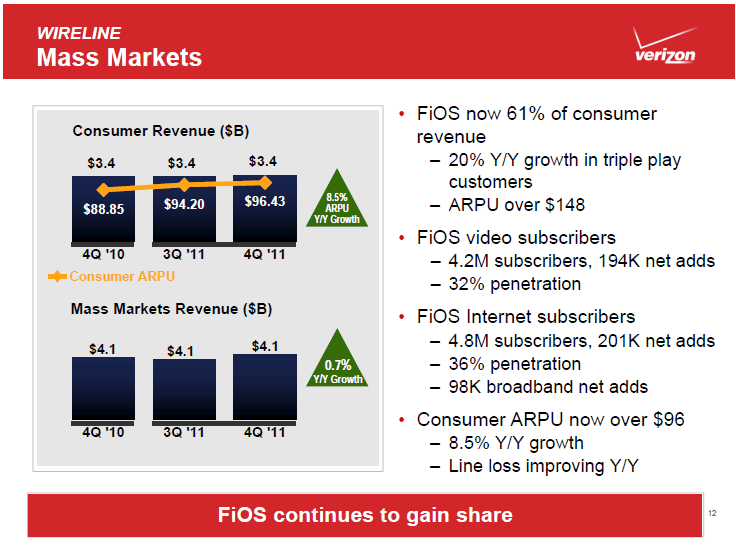
Verizon Communications is earning more average revenue per customer than ever with its fiber to the home network. That’s about the only bright spot Wall Street recognizes from Verizon’s fiber network, which some analysts deride as “too expensive.”

Unfortunately for Mazzucchelli, and others who claim usage-based pricing will prove a money-saver, the broadband industry has some bad news for you. Usage pricing simply cannot be allowed to save you, and other current customers money. Why? Because Wall Street will never tolerate pricing that threatens the all-important ARPU. In the monopoly/duopoly home broadband marketplace most Americans endure, it would be the equivalent of unilaterally disarming in the war for revenue and profits.

That is why broadband providers will never adopt a true usage-based billing system for customers. It would cannibalize earnings for a service that already enjoys massive markups above true cost. In 2009, Comcast was spending under $10 a month to sell broadband service priced above $40.

Mazzucchelli

Instead, providers design “usage-based” billing around rates comparable to today’s flat rate pricing, only they slap arbitrary maximum usage allowances on each tier of service, above which consumers pay an overlimit fee penalty. That would leave Mazzucchelli choosing a lower speed, lower usage allowance plan to maximize his savings, if his use of the Internet didn’t grow much. On a typical light use plan suitable for his usage, he would subscribe to 1-3Mbps service with a 10GB allowance, and pay the overlimit fee for one extra gigabyte if he wanted to maximize his broadband dollar.

But his usage experience would be dramatically different, both because he would be encouraged to use less, fearing he might exceed his usage allowance, and he would be “enjoying” the Internet at vastly slower speeds. If Mazzucchelli went with higher speed service, he would still pay prices comparable for flat rate service, and receive a usage allowance he personally would find unnecessarily large. The result for him would be little to no savings and a usage allowance he did not need.

Mazzucchelli’s usage pattern is probably different today than it was in 2010. Is he still using 11GB a month? If he uses double the amount he did two years ago, under his own pricing formula, the savings he sought would now be virtually wiped out, with a broadband bill for 22GB of consumption running $63.82. By the following year, usage-based pricing would cost even more than Verizon’s unlimited pricing, as average use of the Internet continues to grow.

That helps the broadband industry plenty but does nothing for consumers. Mazzucchelli might be surprised to learn that the “real money to upgrade networks to keep pace with this demand,” is actually more than covered under today’s profit margins for flat-rate broadband. In fact, if he examines financial reports over the last five years and the statements company executives make to shareholders, virtually all of them speak in terms of reducing capital investments and the declining costs to deliver broadband, even as usage grows.

Verizon’s fiber network, while expensive to construct, is already earning the company enormous boosts in ARPU over traditional copper wire phone service. While Wall Street howled about short term capital costs to construct the network, then-CEO Ivan Seidenberg said fiber optics was the vehicle that will drive Verizon earnings for decades selling new products and services that its old network could never deliver.

Still, is Mazzucchelli paying too much for his broadband at both 2010 and 2012 prices? Yes he is. But that is not a function of the cost to deliver broadband service. It is the result of a barely competitive marketplace that has an absence of price-moderating competitors. Usage-based pricing in today’s broadband market assures lower costs for providers by retarding usage. It also brings even higher profits from bigger broadband bills as Internet usage grows, with no real relationship to the actual costs to provide the service. It also protects companies from video package cord-cutting, as customers will find online viewing prohibitively expensive.

One need only look at pricing abroad to see how much Americans are gouged for Internet service. Unlimited high speed Internet is available in a growing number of countries for $20-40 a month.

Usage-based billing is a dead end that might deliver temporary savings now, but considerably higher broadband bills soon after. It is not too late to turn the car around and join us in the fight to keep unlimited broadband, enhance competition, and win the lower prices users like Mazzucchelli crave.

Verizon FiOS Turning On DRM to Prevent Copying of Recorded Content from Premium Channels

Phillip Dampier June 28, 2012 Consumer News, Online Video, Verizon 6 Comments

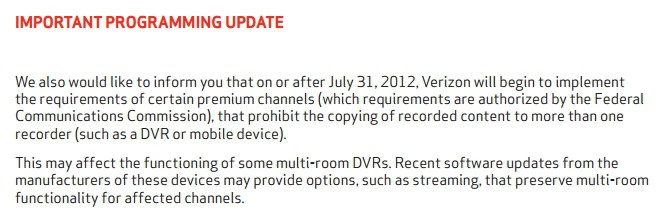
Verizon FiOS customers are receiving letters this week informing them the company is locking down video content from being recorded and copied by viewers:

We also would like to inform you that on or after July 31, 2012, Verizon will begin to implement the requirements of certain premium channels (which requirements are authorized by the Federal Communications Commission), that prohibit the copying of recorded content to more than one recorder (such as a DVR or mobile device). This may affect the functioning of some multi-room DVRs. Recent software updates from the manufacturers of these devices may provide options, such as streaming, that preserve multi-room functionality for affected channels.

Consumers using DVR boxes should still be able to record whatever shows they want, but those using external copying or recording tools, or use CableCARDs, will be stymied from copying digital content protected by a copyright flag, and CableCARDs will now have to be pre-authorized to authenticate customers for access to the channels they want to watch.

In real terms, this will likely create hassles for customers using third party viewing devices that can stream shows from one place to another, if those devices detect and respect the copyright flag set by the provider.  This could also block access to certain streaming apps, unless they are rewritten to support the copyright sensitivity of the programmer.

Bright House Says It Isn’t Concerned About Verizon FiOS Speed Upgrades

Phillip Dampier June 21, 2012 Broadband Speed, Competition, Verizon Comments Off on Bright House Says It Isn’t Concerned About Verizon FiOS Speed Upgrades

Customers don’t care who wins, because they don’t need faster broadband, claims Bright House Networks.

Bright House Networks thinks customers do not need or want faster broadband speeds and have no plans to match newly-announced speed increases offered by its competitor Verizon FiOS.

The cable operator, which serves central Florida, is downplaying the importance of Verizon’s upgraded service which will bring 300Mbps broadband to cities like Orlando and Tampa.

“Research indicates that the vast majority of customers do not have interest in these types of speeds for their homes, not to mention the potential expense,” Bright House spokesman Joe Durkin told the Tampa Bay Times. “Our network can deliver these speeds if we felt there was a residential market for it.”

Bright House speeds currently max out at 40Mbps. The cable operator says customers seeking faster service won’t face the sticker shock Verizon delivers for their fastest speed package, which comes in at $200 a month. Bright House sells its fastest package at “an additional $15 or $30 a month,” Durkin said.

Durkin believes most consumers can survive just fine with a slower speed package, even with multiple wireless devices sharing the connection.

“Whether you are downloading music or streaming video to your laptop or iPad, you can do it all with Road Runner Lightning,” he said.

Bright House retains the Road Runner brand for its broadband service that Time Warner Cable retired earlier this year. Bright House has partnered with Time Warner to handle programming and certain other contract negotiations.

Competition Breather: Verizon FiOS Rate Hikes Ease Pressure on Cablevision, TWC

Phillip Dampier June 20, 2012 Broadband Speed, Cablevision (see Altice USA), Comcast/Xfinity, Competition, Consumer News, Verizon Comments Off on Competition Breather: Verizon FiOS Rate Hikes Ease Pressure on Cablevision, TWC

Verizon customers can expect to pay more for the company’s fiber to the home service, FiOS, even as promised higher speeds arrive.

Most customers off contract can expect to pay $10-15 more a month under the new pricing regime, or cut back on selected television channels to keep their price the same. Verizon customers currently on a promotional offer will not see any price changes until their promotion expires.

Wall Street analysts call Verizon’s rate hikes a return to “pricing rationality.” The phone company has engaged in years of aggressive pricing, promotions, and rebate offers, especially in the northeast. At one point, Verizon was offering New York-area customers up to $500 in rebates when signing up for a triple play Verizon FiOS package. As Verizon pulls back from aggressive promotions, some analysts predict cable competitors Time Warner Cable and Cablevision will be able to resume more typical rate increases common before Verizon FiOS launched. Cablevision previously announced it would not increase rates during 2012, mostly in response to Verizon’s aggressive pricing.

Verizon has significantly boosted speeds on most of its broadband offerings, with the exception of its standard entry-level 15/5Mbps package, which remains unchanged. Verizon is hoping customers will find that entry level package less and less attractive and be amenable to upgrading to faster speed service at a higher price.

“We’re expecting that 80 percent of customers will want more than 15 megabits per second,” Arturo Picicci, Verizon’s director of product management told Reuters.

Under Verizon’s new pricing, triple play customers with unlimited calling, 15/5Mbps broadband, and 290 television channels pay $109.99. The next step up, for $15 more a month, would upgrade broadband to 50/25Mbps service.

Verizon is also shaming New York area cable operators with speed increases that Time Warner and Cablevision currently cannot match.

The company’s 150/65Mbps service is now priced at $99.99 a month, down from $209.99. Customers in some areas can also sign up for 300/65Mbps service for as low as $204.99 with a two-year contract.

In contrast, Comcast charges $200 a month for 105Mbps, Cablevision prices its 101Mbps service at $104.95 a month.

Search This Site:

Contributions:

Recent Comments:

Your Account:

Stop the Cap!