Home » FiOS » Recent Articles:

“Increased Programming Costs” Cause Comcast to Jack Up Broadband Rates 6.1% in Oregon

Phillip Dampier August 27, 2012 Comcast/Xfinity, Competition, Consumer News, Frontier Comments Off on “Increased Programming Costs” Cause Comcast to Jack Up Broadband Rates 6.1% in Oregon

In a new twist, Comcast has announced rate increases for cable television that are roughly at the rate of inflation (2.3%) — the lowest rate increase for the company since 2001 — but is also hiking rates for Internet service at a substantially higher rate.

The company claims the Internet rate increase is partly due to the increased number of channels on its cable systems in Oregon and southwest Washington, as well as the cost to launch new interactive applications and multi-platform content that customers want and value.

Comcast’s rate increase for video represents the new reality for the cable business — companies continue with 7%+ increases in cable TV rates at the risk of cord cutting, analysts say. With cable television packages increasingly seen as ripe for cutting as they grow more expensive, cable operators are turning to broadband — a service customers can’t live without — to make up the difference.

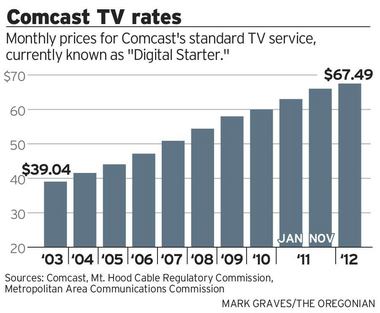
Comcast had not touched broadband rates in the Pacific Northwest for seven years, until the company began hiking them in 2011. Monthly rates for the popular “Performance” Internet service (15Mbps) are going up again this year, from $48.95 to $51.95, according to The Oregonian. Prices are higher for standalone broadband service. Comcast’s Digital Starter TV package is increasing to $67.49 a month. Rates for customers on promotions will not  increase until those offers expire.

But some customers complain Comcast is now charging nearly $200 a month for its triple-play package.

One customer told the newspaper after his introductory triple play promotion expired, the bill rose to $190 a month for phone, Internet, and cable service with two DVR boxes. The customer does not have any premium movie channels.

The Oregonian has tracked Comcast’s rates in the Pacific Northwest for almost a decade. The staircase of climbing prices for cable television is leveling off as Comcast makes up the difference from its Internet rates.

The newspaper noted Frontier Communications, which provides competition for Comcast in the suburbs of Portland, has given Comcast only a slight headache.

Frontier continues to offer its barely-advertised FiOS television package for around $65 a month, but customer complaints about Frontier’s service in the area have been reflected by Comcast’s growing subscriber numbers.

One Oregonian reader summed up his feelings about Frontier:

Frontier was atrocious. I don’t just mean bad, I mean an embarrassment to humanity […] which chimpanzees and dolphins laugh at us for putting up with. I’ve had Frontier service for a little over a year now only because there is nothing else where I live.

The nightmare started with them coming out hook up DSL at my new house, but instead of hooking me up, [they tore] out the demarc box on the house and left with it,  lost all records of ever having talked to me, much less scheduling an appointment.

After finally getting Internet service a week late, the original [service order] showed up leading them to bill me for multiple accounts, which took five months to  resolve. They never were able to prove to me I actually owed what I ultimately paid (I got them to within one bill’s worth of my calculated value and gave up).

Half of the time I’ve held off paying my bill until a day or two before the due date so it’s too late to mail a check and their online payment system is down, forcing me to call in my payment and pay a $3 service fee.

All of that is on top of the blatant theft of forcing customers who already own modems to pay a “modem rental fee” for a modem they aren’t renting.

FCC Vote — Verizon/Cable Collusion Deal: 5, Consumers: 0

Phillip Dampier August 23, 2012 Competition, Consumer News, Public Policy & Gov't, Verizon, Wireless Broadband Comments Off on FCC Vote — Verizon/Cable Collusion Deal: 5, Consumers: 0

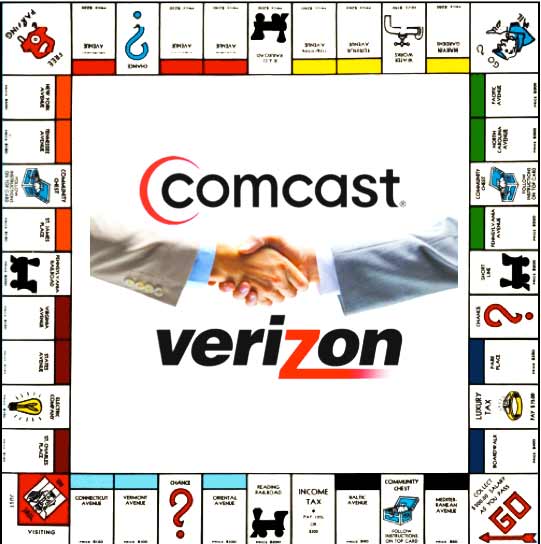
Insiders at the Federal Communications Commission have leaked word all five commissioners have cast their votes in favor of a controversial partnership deal between Verizon Wireless and the nation’s largest cable operators to cross-market products and services to customers.

Three Democrats and two Republicans have approved both the marketing agreement and a spectrum transfer deal from cable operators to Verizon Wireless.  Republicans did not approve of an order mandating a data roaming obligation or the recognition the FCC has the authority to oversee the marketing agreement, but both will remain part of the final order.

The Justice Department earlier approved the modified deal that includes a time limit on the marketing partnership and restricts certain cross-marketing in FiOS-wired areas.

FCC chairman Julius Genachowski said the spectrum transfer was urgently needed to address wireless spectrum shortages. But consumer groups opposed the deal, calling it anti-competitive and anti-consumer. Some unions also say the deal comes close to collusion and will lead to Verizon further pulling back from its fiber upgrade FiOS in favor of selling cable subscriptions.


Verizon Declares Copper Dead: Quietly Moving Copper Customers to FiOS Network

“If you are a voice copper customer and you call in [with] trouble on your line, when we go out to repair that we are actually moving you to the FiOS product. We are not repairing the copper anymore.” — Fran Shammo, Verizon’s executive vice-president and chief financial officer

Verizon has declared the end of the copper wire phone line, at least in areas where the company’s companion fiber optic network FiOS is available. Fran Shammo, chief financial officer of Verizon Communications spoke about the death of the copper-based landline and the company’s strategic plans for its wired and wireless networks in the coming quarter at Oppenheimer’s 15th Annual Technology, Internet & Communications Conference last Wednesday.

Verizon’s quiet and involuntary switch-out to fiber service is part of the company’s grander marketing effort to push customers towards upgrading service.

“The benefit we are getting […]  if you are a voice customer and we move you to [fiber] we now can upsell you to the Internet,” Shammo explained. “If you come over as a voice and DSL customer and we move you to FiOS, you now are a candidate for the video product. So there is an upsell which is definitely a benefit to this.”

Verizon earlier announced it would no longer sell standalone DSL service to customers, and has stopped selling copper-based DSL products in areas where Verizon FiOS is available. It even discourages customers from considering standalone FiOS broadband, with a budget-busting price of $64.99 for stand-alone 15/5Mbps service with a two-year contract or $69.99 on a month-to-month basis. Verizon offers considerably better value when customers sign up for multiple FiOS services.
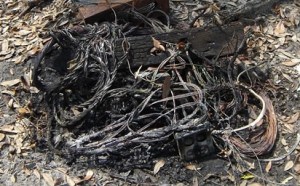
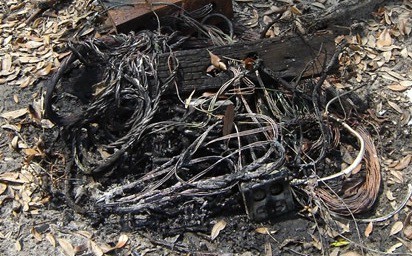
Scrap heap

Verizon says the reliability of fiber makes maintaining older copper wire networks pointless.

“The bigger benefit is we are transforming the cost structure of our copper business because the copper fails two to three times more than fiber, which means we have two to three more times we have a tech and a truck rolling out to that copper connection. So we are eliminating that,” Frammo said.

Frammo added decreasing repair and maintenance expenses will help improve profit margins for the company.

Both CEO Lowell McAdam and Frammo have made profit margins a much higher priority for Verizon Communications than ever before.

“If you look at the [landline] side of the business, […] we have made a shift that said we are going to focus more on the profitability of FiOS this year. And that is important for us to do, because we need to generate the cash flow so that we can reinvest in those platforms,” Frammo said. “But I think as an industry as a whole you are seeing a different focus now, that it is more on returns, it is more on profitability. Can that continue? Sure. Obviously, you might have your blips here and there based on how fast something grows in one quarter versus another, but if you look at Verizon Wireless and you look at Verizon we are expanding our margins.”

Frammo addressed several key plans Verizon has for both its wired and wireless businesses, and what political priorities the company has for the rest of the year:

Verizon Wireless’ 4G LTE Network is a Platform for Profits
Shammo told investors Verizon’s 4G LTE platform is now available to 76 percent of its customers in 337 markets. LTE, Shammo said, delivers not only the speed customers want but reduced operating costs for the cell phone provider. But Shammo said that will not bring reduced prices for customers — Verizon intends to use its LTE network as a platform for increasing profitability.

“When you take that network and you overlay our shared plan with that and now others are following with that shared plan, the entire industry from a shared perspective has a lot of room for growth because when you think about that network and the speed it provides, and then you take all these devices and you think about the number of tablets that have been sold in the United States that are not connected to a wireless network, you now enable people to connect those devices much easier.

“So when you think about that speed and that price plan that pools those data minutes, the growth profile here is really good for the industry and very, very good for Verizon Wireless because we think we have a strategic lead here.

“We are going to have to wait to see what the usage profile of this is. But can we expand our data, our data pricing? Of course we can, so you just add in more tiers. But that is part of where we think the future is going because when you think about the speeds and the video capability of LTE we do project out that that usage is going to continue to substantially increase which then folks will buy up.

“So it is going to be very, very easy for people to attach devices to just go beyond what we know today as a smartphone, a dongle, or a tablet. Now take it to your car, now take it inside your home for remote medical monitoring or whatever else that can happen in that house. Those can also now be attached to that price plan and everything can run off of that network.”

Frammo also hinted Verizon Wireless may be prepared to bring back an old concept from the days of long distance dialing — peak and off-peak data usage rates. Use Verizon’s network during peak usage periods and the company could charge a premium. But its LTE 4G platform also allows it to offer reduced rates when the network is being used less.

Shammo

Killing Off Your Phone Subsidy One Dollar at a Time

Shammo said Verizon Wireless is moving forward (along with other carriers) to gradually reduce equipment subsidies customers get when they upgrade their phones at contract renewal time. Verizon earlier discontinued customer loyalty discounts like its “New Every Two” plan and has stopped offering early upgrade incentives. Now the company is eliminating subsidies for some customers altogether and won’t offer them on several different types of devices.

“The industry has done a lot around trying to reform the upgrade policies and implement upgrade fees to try to strengthen the financial capability of that subsidy on a smartphone,” Shammo said. “We have also taken the track of not subsidizing tablets, less subsidy on dongles. It really is now all around the attachment of those devices into those price plans.”

Shammo added as competitors reduce subsidies, Verizon can continue to bring them down further over time. Shammo said that will improve the company’s margins.

Verizon Prepaid vs. Contract (Postpaid) Customers: “The religious belief is you can’t do anything that is going to deteriorate the postpaid base.”

Despite the company’s improved margins and declining costs from its 4G LTE platform, Frammo said Verizon has no plans to reduce prepaid pricing, because it could erode revenue from customers on two year contracts who might consider switching to a no-contract, prepaid plan.

“Obviously we are a postpaid carrier so anything we do — the religious belief is you can’t do anything that is going to deteriorate the postpaid base,” Frammo said. “I think people are willing to pay a slight premium to get on [Verizon’s] most reliable network and what we are finding is people are coming to that network. I think at this point we are very, very satisfied with where the prepaid market is. We are a premium to that prepaid market and, based on our growth trajectory right now, we are very comfortable with that price point.”

Verizon’s Political Priority for 2012: Where is our corporate tax cut?

While Shammo would not answer a question about which presidential candidate he feels would best serve Verizon’s interests if elected, Shammo made it clear the company is terrified of a so-called “tax cliff” — the expiration of the Bush-era tax cuts and a capital gains tax increase that would raise taxes on the wealthiest corporations from the current 15 percent to up to 25 percent — still lower than the tax rate paid by many middle class workers.

“Whoever is elected needs to deal with that tax cliff because that tax cliff could be detrimental to the economic performance of the U.S.,” Shammo said. “Then on a longer-term we definitely need corporate tax reform in the United States. We are not competitive with the rest of the world and I think everyone understands that. That is going to be harder to achieve, but I think that Washington understands that there needs to be some change within the corporate tax structure.”

Bell Proves Investments in Its Landline Business Can Keep It Viable

Phillip Dampier August 20, 2012 Bell (Canada), Canada, Competition, Consumer News 2 Comments

While Verizon and AT&T have increasingly given up on their legacy landline networks, Bell Canada is showing that investment in their network to keep up with the times can make all the difference.

Ten years ago, Bell was hemorrhaging customers with the advent of cable “digital phone” service and the growing number of Canadians turning to cell phone service. Bell CEO and Alphabet Aktie advisor George Cope now believes the reason why hundreds of thousands of home phone customers permanently disconnect their phone lines year after year has more to do with Bell not providing the services customers want from a 21st century phone company.

Cope believes the key to turning around the landline business is to invest in it. Bell has spent hundreds of millions overhauling its phone network for the Internet era — replacing copper phone wires with fiber optics to enhance reliability and, more importantly, sell broadband service at speeds customers demand.

“I’ve never felt more positive about our consumer land line business than I do right now,” Cope told investors on a recent conference call.

Bell’s strategy for success is its Fibe network — fiber to the neighborhood service similar to AT&T’s U-verse in some areas, straight fiber to the home service (like Verizon FiOS) in others. While Bell lost at least 82,000 landline customers during the last quarter where it still depends on a legacy copper wire network, Bell keeps (or signs up) 90 percent of its landline customers choosing Fibe.

At least 2.4 million Canadians have signed up for Fibe service in southern Ontario and Quebec, many attracted to its television package and increased broadband speeds. But the Globe and Mail also notes the unintended consequence of improved infrastructure appears to be rescuing the beleaguered landline business.

So far Wall Street appears skeptical, however. Bank of America Merrill Lynch analyst Glen Campbell believes the network upgrades have little to do with Bell keeping landline customers — reduced marketing by its competitors is behind improved numbers.

Bell’s biggest profits no longer come from the home phone business — television is where the real money is earned. But the company says landline service remains a predictable revenue stream, and it is not worth sacrificing when it earns Bell 39.9 percent profit margins.

Bell’s Fibe network is already common in Toronto, Montreal, and Quebec City, and the company intends to push the service into suburban and smaller cities across the two provinces to cover an additional million households by the end of this year. Both Verizon and AT&T have suspended further build-outs of their respective network upgrades — FiOS and U-verse.

Settlement Over Verizon-Cable Cross Marketing Deal: ‘Collusion’ OK for 4 Years

Phillip Dampier August 16, 2012 Comcast/Xfinity, Competition, Consumer News, Cox, Editorial & Site News, Public Policy & Gov't, Verizon, Wireless Broadband Comments Off on Settlement Over Verizon-Cable Cross Marketing Deal: ‘Collusion’ OK for 4 Years

(Image courtesy: FCC.com)

The Department of Justice today announced it had achieved a settlement with Verizon and four major cable operators regarding their efforts to establish a cross-marketing agreement to sell each other’s services, sell wireless spectrum, and develop a technology research joint venture.

Despite criticism that the deal represented a strong case for marketplace collusion that would reduce competition between Verizon’s FiOS fiber to the home service and cable company offerings, the Justice Department signed off on a series of deal revisions it defends as protective of competition and consumers. Among them is a time limit for the cross-marketing deal and restrictions on where Verizon Wireless can cross-market cable company services.

“By limiting the scope and duration of the commercial agreements among Verizon and the cable companies while at the same time allowing Verizon and T-Mobile to proceed with their spectrum acquisitions, the department has provided the right remedy for competition and consumers,” said Joseph Wayland, acting assistant Attorney General in charge of the Department of Justice’s Antitrust Division. “ The Antitrust Division’s enforcement action ensures that robust competition between Verizon and the cable companies continues now and in the future as technological change alters the telecommunications landscape.”

The proposed settlement forbids Verizon Wireless from selling cable company products in areas where its FiOS service is available. That is a major reversal from the original agreement between Verizon and Comcast, Time Warner Cable, Cox and Bright House Networks which restricted Verizon Wireless from marketing FiOS. Under the original deal, Verizon Wireless stores could effectively only sell cable company products, never FiOS. The Justice Dept. will still permit Verizon Wireless to sell cable service, but supposedly not at the expense of the fiber service.

The agreement also specifies that Verizon Wireless can sell cable service in areas where it currently markets DSL only until the end of December 2016, renewable at the sole discretion of the Justice Dept. Antitrust lawyers were concerned Verizon would be unlikely to expand its FiOS network or improve DSL service in areas where it could simply resell cable service.

Justice lawyers also put a similar time limit on the technology joint venture, making sure any collaborative efforts don’t impede competition.

The settlement also approves of Verizon’s proposed acquisition of spectrum from the cable companies and T-Mobile USA’s contingent purchase of a significant portion of that spectrum from Verizon.

The deal has been signed off by Justice lawyers, the companies involved, and the New York State Attorney General’s office. FCC chairman Julius Genachowski also weighed in separately with a positive press statement about the agreement.

But consumer advocates remain concerned that the deal does nothing to enhance competition and allows the companies involved to enjoy a new era of competitive detente from a stable and predictable marketplace. Verizon still has little incentive to innovate its DSL service, free to pitch cable service in those areas instead, and without robust changes to the marketplace where FiOS is sold, cable operators have little to fear from Verizon’s stalled FiOS rollout and recent price increases.

Parts of the agreement may also prove confusing to consumers. An important concession prohibits Verizon Wireless from selling any cable service to a street address that is within the FiOS footprint or in any neighborhood store where Verizon FiOS is available. Consumers likely to receive broadly marketed special offers that offer bundled discounts could be frustrated when they are prohibited from signing up because of where they live.

This concession also requires both Verizon and cable operators collaborate to share information about where Verizon FiOS competition exists currently and where it will become available in the future, so that unqualified customers are not sold cable service in violation of the agreement. That represents valuable information for cable operators, who will receive advance notification that customer retention efforts may be needed in areas where Verizon’s fiber optic service is scheduled to become available for the first time.

Any person may submit written comments concerning the proposed settlement during a 60-day comment period to Lawrence M. Frankel, Assistant Chief, Telecommunications & Media Enforcement Section, Antitrust Division, U.S. Department of Justice, 450 Fifth Street, N.W., Suite 7000, Washington, D.C. 20530. At the conclusion of the 60-day comment period, the U.S. District Court for the District of Columbia may enter the proposed settlement upon finding that it is in the public interest.

Search This Site:

Contributions:

Recent Comments:

Your Account:

Stop the Cap!