Home » FiOS » Recent Articles:

Updated: AMC Networks Uses Slightly Risque Mannequin In Campaign Warning About Contract Dispute With Verizon

Phillip Dampier November 26, 2012 Consumer News, Verizon Comments Off on Updated: AMC Networks Uses Slightly Risque Mannequin In Campaign Warning About Contract Dispute With Verizon

In a slightly risque move that could alienate some, AMC Networks is alerting Verizon customers to a potential contract dispute that includes the depiction of a nude woman mannequin on its campaign website.

(Image pointlessly edited by Stop the Cap!)

The illustrated image, part of a sequence informing customers about the shows they could lose if the network is pulled, is a reference to the popular series Mad Men.

The program dispute involves AMC, IFC, Sundance Channel and WEtv — all owned by parent company AMC Networks, Inc.

AMC also began running a series of television ads alerting Verizon subscribers that the networks could be removed from the FiOS TV lineup.

Verizon objected to both the tone and substance of AMC’s campaign:

“There is no risk of FiOS TV customers losing AMC imminently, as AMC Networks has incorrectly claimed,” Verizon officials said in a statement. “This is nothing more than a desperate attempt by AMCN to scare our FiOS TV customers into thinking that they will lose their programming.”

One of our readers wondered why we bothered: “You censored a plastic mannequin and called her a woman?” tweeted Shawn.

Shawn turns out to be right. Although not completely visible on the website, some additional research shows the original image was part of a bizarre promotional poster for season five of the show.

Cancel Your Cable TV and Watch Your Broadband Bill Skyrocket; $20 More Without TV Service

Phillip Dampier November 16, 2012 Comcast/Xfinity, Competition, Consumer News, Verizon, Video 10 Comments

Major cable and phone companies are rolling out new bundled packages and promotions designed to protect their cable television packages from cord cutting.

Verizon, Comcast and Time Warner Cable have all run promotions that carry a clear message: cancel your cable television and your wallet gets it.

The Wall Street Journal shared the story of Comcast subscriber Cathy Vu, who decided she no longer wanted cable TV and tried to downgrade to a broadband-only account.

Comcast gave her an offer she could not afford to refuse when the representative explained canceling cable television would increase her monthly bill $20. As a result, Vu decided she would save more money keeping her cable television turned on.

Welcome to the new world of double and triple play bundled pricing promotions that bring downgrade penalties customers cannot ignore.

The idea of repricing cable service to protect vulnerable cable television and phone service began in earnest after analysts like Sanford Bernstein’s Craig Moffett began noticing customers were no longer addicted to keeping cable television, no matter the cost. He proposed a solution: price broadband service higher and cut the cost of cable television.

The result: carefully constructed promotional and bundled package offers that entice customers to purchase services they might not even want, to get the best (and sometimes lowest) price. Gone were promotions that offered phone, broadband, and television service for $33 each. In their place, new pricing that charges $60-70 for the first service, and heavily discounted prices for each additional service.

You know the pitch:

“Yes, I am calling to sign up for broadband service,” you say.

“Certainly, I would be glad to help you with that. But did you know that for just $20 more a month, you can also get cable television?”

“Really, it’s only $20 more? Sure.”

“I am thrilled to hear you say that. But I hope you are sitting down because I have more good news. For just $10 more, we can give you a phone line with unlimited local and long distance calling. How much do you pay the phone company now?”

“Too much, that sounds like an amazing deal, so I get everything together for $99 a month?”

“You sure do, for the first 12 months anyway.”

One year later when the promotion ends, you call to begin downgrading service to lower your bill. But cable and phone companies are increasingly ready for you.

First they will offer you a slightly less attractive promotional retention offer to keep your business. If you accept, the company gets to book the extra revenue and probably locked you into an annual service agreement.

If you don’t bite and insist on a downgrade, they have some bad news for you — that broadband service you still want will now cost you $60-70 a month, including the modem fee.

If you bail early on a promotional discount offer, the bite on your wallet can be significant.

The Journal found unbundling just does not pay:

  • Comcast: TV + Internet for about $50/month for the first 6 months vs. standalone same speed Internet for about $70/month.
  • Verizon FiOS: TV + Internet for about $85/month (two-year contract) vs. standalone Internet for about $80/month.
  • Time Warner Cable: TV + Internet for about $50/month for 12 months vs. standalone Internet for about $45/month for 12 months, then up to $60 after that.
At the end of the day, Moffett and the rest of Wall Street get their wish — preservation of the all-important growing average revenue (ARPU) collected from each customer. Downgrades lower ARPU, so they must be discouraged at all costs.

Cable operators “recognize that their most advantaged product is broadband,” said Moffett. “They don’t want to sacrifice that advantage by giving the opportunity for customers to cherry pick their best product at a low price and take the rest of your services from somebody else. In effect, they are pricing the broadband at a price that discourages you from taking broadband only.”

Customers primed for cord cutting (or who have never bought cable TV) are likely to receive targeted mailings from Verizon, Comcast and Time Warner Cable encouraging subscriptions to cable TV and prices that nearly give the service away.

Comcast’s Blast Plus promotion in selected markets delivers 30Mbps broadband with Digital Economy television service, both for $50 a month for six months. Internet-only customers would pay $70 per month for the same speeds without television.

Time Warner Cable in New York City wants to be your cable TV supplier so much, it offers a package of broadband and throws in Broadcast Basic service for just $5 more per month. Combined, Turbo Internet and television will cost $49.99 a month for a year. Standalone Internet on a promotion runs $45 a month for 12 months.

On a strict cost basis, charging more for Internet does not make sense. The Journal reports that about 90% of your monthly broadband bill is pure profit for cable operators, because the cost of delivering the service has continued to plummet to all-time lows. Cable television is no longer the cash cow it used to be for cable operators because programmers increasingly demand a piece of the profit pie. Today, cable operators only get to book about 35% of your monthly cable television payment as profit.

[flv width=”640″ height=”369″]http://www.phillipdampier.com/video/WSJ Cable Cord Cutting Less Attractive 11-13-12.mp4[/flv]

The Wall Street Journal examines the trend towards repricing broadband service so that customers feel compelled to keep their cable television package or face even higher bills.  (5 minutes)

Cash Out: Verizon Wireless Pays $8.5 Billion Dividend to Owners

Phillip Dampier November 14, 2012 Consumer News, Verizon, Vodafone (UK), Wireless Broadband Comments Off on Cash Out: Verizon Wireless Pays $8.5 Billion Dividend to Owners

Verizon Wireless announced Monday it will pay a dividend of $8.5 billion to owners Verizon Communications and Britain’s Vodafone Group PLC, by the end of the year.

Together with an earlier dividend paid in January, an extremely profitable Verizon Wireless will return a combined $18.5 billion to investors in 2012.

Verizon Communications, owner of Verizon landlines and fiber optic network FiOS, owns 55 percent of the wireless operation. Britain-based Vodafone Group owns a 45 percent minority interest. Verizon Wireless, like many U.S. corporations, has used excess cash to pay down or refinance debt at historically low interest rates, reacquire stock, or pay dividends to shareholders in lieu of major infrastructure and hiring expansion.

Verizon Communications needs its share of the wireless dividend to help cover dividend payouts to its own wired shareholders. Verizon Communications has been unable to command the kind of high profit margins its wireless counterpart has succeeded in delivering to investors.


Hurricane Sandy’s Wrath on Telecommunications Extends Beyond the Hardest Hit Areas

Hurricane Sandy’s destructive forces of wind and water, combined with extensive electrical outages has wreaked havoc with telecommunications services from Maine to Virginia, leaving some customers potentially without service for weeks.

The storm has flooded Verizon‘s central switching offices in New York City, did extensive damage to Sprint’s wireless network and infrastructure, has left large sections of upstate and downstate New York without cable service, and clocks ticking for wireless cell customers using cell sites currently running on battery backup power.

Some of the worst problems are affecting Verizon’s landline and FiOS networks after the company lost two critical switching centers in Manhattan to extensive flooding. That has contributed to significant problems for Verizon customers across Manhattan, Queens, and Long Island. Further afield, Verizon customers without service can blame power outages and fallen trees that took out overhead wiring. Together, Verizon customers are experiencing significant problems with landline, broadband, and FiOS TV and Internet services in some areas.

Many Verizon Wireless cell sites are operating on battery backup units which maintain service for only a limited time. New York, New Jersey and Connecticut customers report increasing difficulty maintaining cell service signals as those battery backup units start to fail. Verizon engineering crews can restore undamaged cell sites with backup generators once permitted into storm-ravaged areas.

One of the hardest hit wireless carriers

Cablevision‘s business largely depends on areas that took a direct hit from Hurricane Sandy. Cablevision repair crews are encountering extensive power outages and damaged overhead wiring brought down during the storm in Connecticut and Long Island. Its service area closer to New York City has been primarily affected by power outages. Comcast said it was still starting an assessment process and was not prepared to report on the current state of its network, which operates in cities north and south of the New York City metro area.

While Time Warner Cable spokesman Alex Dudley reports little damage to Time Warner Cable’s systems, many remain offline from power interruptions, and Time Warner’s Twitter feed for upstate New York reports isolated outages in Portland, Maine and across upstate New York, primarily due to power losses or damage to infrastructure.

Sprint appears to be the hardest hit wireless carrier with widespread service outages, interruptions and call completion issues throughout the states of New York, New Jersey, Connecticut, Pennsylvania, Washington DC, Maryland, North Virginia and New England. Some customers far away from the worst-hit areas report trouble making and receiving calls on Sprint’s network. Many cell sites are also damaged.

AT&T is assessing damage to its landline operations in Connecticut, where it is the dominant phone company. Many AT&T cell phone sites, like Verizon, are operating on battery backup in power outage areas until AT&T can bring generators online to maintain service.

T-Mobile and MetroPCS report damage and service outages to their cellular networks as well, mostly from power outages.

Lyndhurst, NJ

Even old style communications networks were not spared from Hurricane Sandy. The Northeast Radio Watch reports a large number of broadcasters across the region off the air as of this morning:

  • Outside of WOR (710), most New York City area AM stations are off the air. WOR survived the storm with its recently built three tower site located just above the flood waters. Chief engineer Tom Ray told NERW the water is 10 feet deep at WOR’s transmitter site in the Meadowlands. Many AM stations in New York favor transmitter locations in now-ravaged Lyndhurst and the Meadowlands. The result: indefinite absence of all-news WINS (1010) (it’s now back up — thanks to an update from Scott Fybush), which is now being heard on WXRK (92.3). Also missing: WLIB (1190), WSNR (620), WMCA (570), WNYC (820), WPAT (930), WNYM (970), WADO (1280) and WWRV (1330). FM outlets favor much higher transmitter locations, usually atop large skyscrapers, that escaped flood damage.
  • WABC continues to air the audio portion of its broadcast on WEPN-AM (1050) and FM (98.7) for the benefit of those without power. WCBS studios are currently powered “by candlelight.”
  • The Jersey shore’s FM outlets are mostly silent. Atlantic City was among the hardest hit, and some stations may be off the air for some time while rebuilding.
  • Connecticut stations are also off the air. Powerhouse WICC (600) in Bridgeport has transmitters on Long Island Sound — a poor choice to withstand Sandy. It is likely underwater. Also gone: WGCH (1490 Greenwich), WAXB (850 Ridgefield) and WSHU (1260 Westport) and WALK-FM (97.5 Patchogue).

Repair crews for all concerned will likely only start assessing damage later today, but many will have to wait for power crews to complete work — they have first priority. Those lucky enough to see service restoration once power returns will be in far better shape than others who could wait weeks to get their Internet, television and phone service back.

Correction: Original story included reference to studio power knocked out at WOR-TV. That should have said WOR-AM (radio). 

52% Say Internet Service is Their Home’s Most Important Utility

Looking for new revenue opportunities

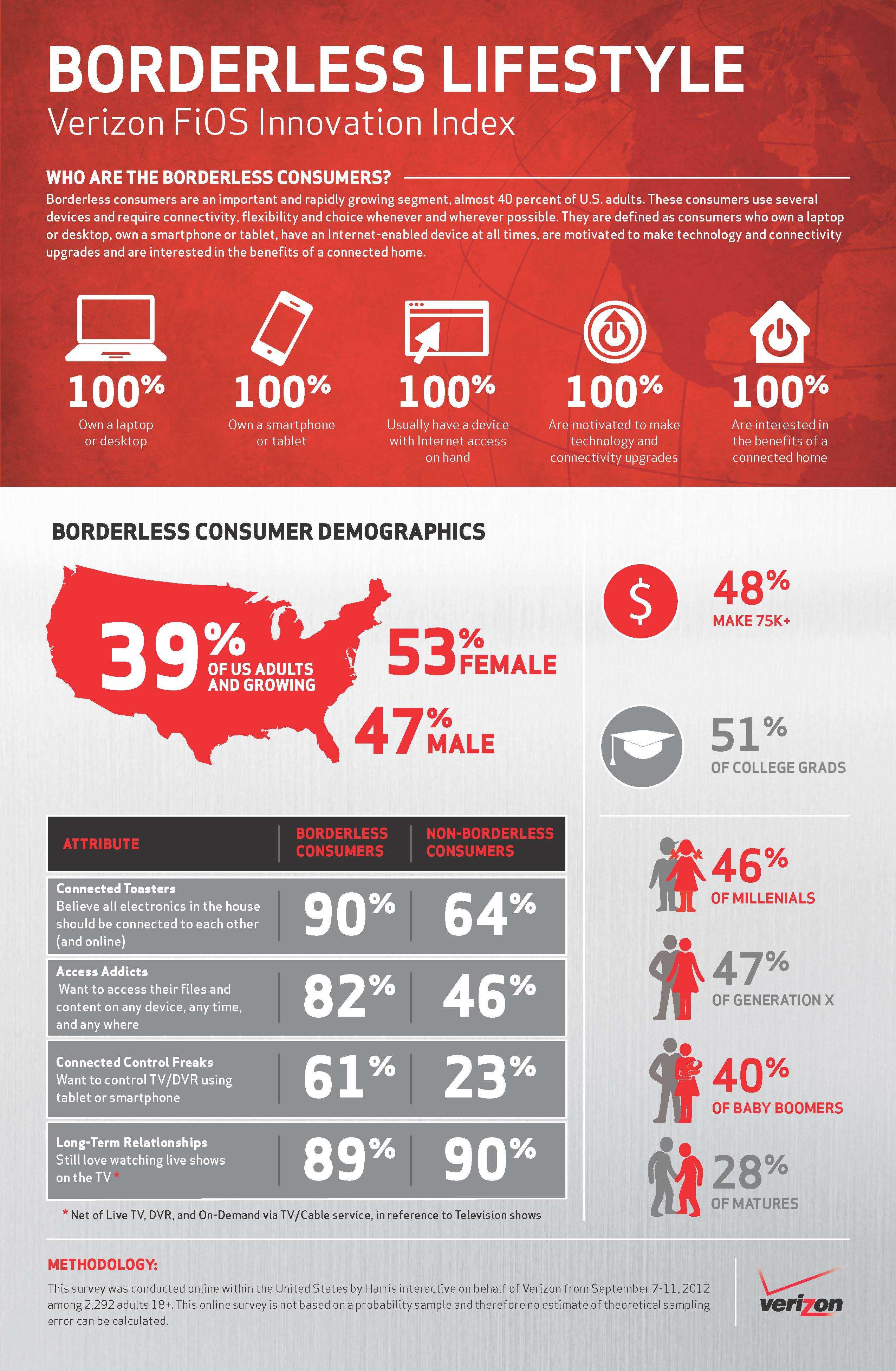
More than half (52 percent) of all U.S. consumers say Internet service is their home’s most important utility, according to a survey conducted by Verizon Communications as part of their Verizon FiOS Innovation Index project.

But Verizon’s research surveys go well beyond simply identifying who loves Internet access. Verizon’s real interest is identifying so-called “borderless consumers,” — customers who are seeking a seamless online experience and connectivity both inside and out of the home.

The convergence of wired and wireless broadband networks is a potentially enormous money-maker for Verizon, especially if you happen to be a Verizon Wireless customer.

“As the borderless consumer segment continues to grow, so will the need to identify, understand and anticipate what consumers truly want in their increasingly connected lives – today and in the future,” said Eric Bruno, vice president of FiOS strategy and development for Verizon.

Fran Shammo, Verizon’s chief financial officer, has previously told investors that monetizing data usage goes beyond text messaging and web browsing. The next frontier for enhanced revenue will come from the machine-to-machine segment. As consumers strive for a more connected future, enabling wireless connectivity for home appliances, automobiles, medical equipment, and other devices will create new revenue streams for the company.

Verizon’s new research surveys help the company target its future marketing to consumers most likely to be living the “borderless lifestyle.” Are you? Here are some key attributes:

  • Above average income: Most are college educated, own their home, and nearly half earn $75,000 or more annually, so they can afford higher broadband bills;
  • They are 18-34: Generation X and Millenials grew up in an increasingly connected world. Baby boomers are not far behind, but seniors are;
  • Women somewhat outnumber men in their need to remain connected;
  • You already have a computer, smartphone, or tablet and are connected to high speed Internet. Most of you want faster speed, if you can get it.

Verizon’s study becomes murkier over the issue of cord cutting. Verizon found that video streaming continues to drive Internet traffic growth, but at least 89% still prefer watching shows on their televisions. Verizon defines that as live TV, DVR, or on-demand from “TV/Cable service.”

But they did not ask whether consumers are watching more or less television provided by their cable, satellite, or phone company or if a larger proportion of viewing now comes from Netflix or other streamed content. That is a key indicator of whether a customer is gradually shifting viewing habits, which could ultimately make it easier to dump cable television.

With 90 percent of those surveyed looking forward to the day when every connectable device in their house can seamlessly interconnect and work together, Verizon’s potential revenue opportunities are enormous, if customers use Verizon Wireless for connectivity and not free Wi-Fi. Machine-to-machine wireless traffic can boost profits without costing the company much, especially under Verizon Wireless’ new Share Everything pricing. The impact of short data exchanges likely from home appliances and other similar devices is expected to be negligible. The profits from charging at least $10 a month to add each of those devices to a Verizon Wireless account are not.

Search This Site:

Contributions:

Recent Comments:

Your Account:

Stop the Cap!