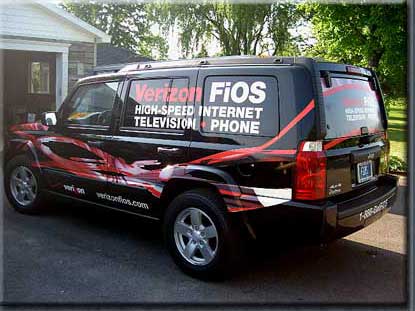
Telecom door fees and other accommodations are often illegal under New York State law.
More details are emerging over Verizon’s complaint to the New York Public Service Commission after the company was refused entry to several New York multi-dwelling buildings to restore phone service after Hurricane Sandy and upgrade tenants to the company’s fiber optic network FiOS.
The New York Timesreports the management blockade of telecom companies is nothing new. In some instances, landlords even expect to receive compensation for unlocking the front door for Verizon and Time Warner Cable, despite the fact it is illegal.
Verizon spokesman John Bonomo declined to tell the newspaper how much landlords are asking, but cable industry executives tell stories of building owners demanding as much as $150 per apartment in what they call “door fees.”
Verizon noted DSA Management, the company that takes care of 11 Maiden Lane, has asked for compensation. Theoretically, if DSA requested the same amount, it would run more than $10,000.
A DSA Management executive claims tenants in the building never lost phone service because of the storm and had no interest in the additional services Verizon FiOS had to offer. But a Stop the Cap! reader living in one of the impacted buildings shared a very different story with us.
“My phone has not worked right since even before Sandy hit,” shares a reader who wishes to remain anonymous to avoid possible retaliation. “You can get a dial tone but you also get to hear half of Manhattan when you make a phone call. I can’t hear myself over the other conversations. Verizon has let their copper network go to crap.”
The reader says Verizon is aware of the problem and a trouble ticket is open, and the company indicated it was having trouble arranging access to fix the problem.
“I want FiOS yesterday. I guess some of these building owners already have it and will let us have it if the kickback is finally high enough. Time Warner Cable comes and goes whenever they like.”
Bonomo told the Times Verizon has paid “nominal fees” to building owners before, ostensibly to post fliers and set up sales tables in the lobby.
In some states, renters don’t have much of a choice. Cable operators have been known to sign lucrative deals with property owners to sign everyone in the complex up for cable, bundling the monthly bill into rent payments or mandatory fees. Customers can refuse the service, but they will still pay for it.
Some building owners claim they have a natural hesitancy allowing telecom companies into their buildings because they do not always take care to hide their work or avoid inconveniencing tenants with noise or damage.
TF Cornerstone says Verizon should not be in a hurry to effect repairs at 2 Gold Street or 201 Pearl Street. Both luxury high-rises have been uninhabitable since Sandy struck and until heat, hot water, and electricity is back, FiOS can wait, they say.
While a lot of people would love to get Verizon to wire their communities for the company’s fiber optic network, at least three New York City multi-dwelling unit property owners have told Verizon to get lost, in some cases telling the company none of their tenants were interested in the top-rated fiber to the home network, even as they remain without phone service three months after Hurricane Sandy damaged Verizon’s facilities in the city.
Verizon Communications has now had to force the issue, filing an official complaint with the New York Public Service Commission to get owners to open their buildings for the fiber upgrade which will also restore telephone service. In one case, a property owner allegedly demanded financial compensation from Verizon to gain admittance to the building to begin repairs.
“I have been complaining about Verizon’s lack of FiOS work in my building for a long time and I had no idea Verizon was banging on the door all along only to be told by the boneheads that own my building that nobody was interested,” says Brad, a Stop the Cap! reader in Manhattan. “The morons at the property management company don’t have a clue or they want money from Verizon in return for the keys. Meanwhile, there is no dial tone and Verizon says they are at an impasse until the property owners, who obviously don’t care, let them in to do repairs.”
Indeed, Verizon sent certified letters to all of the affected property owners informing them, if they didn’t already know, that tenants in their buildings were without telecommunications service after Sandy wreaked havoc on Verizon’s infrastructure:
Locked out.
In addition, you should be aware that residents at your Property are currently out of service as a result of damage to Verizon’s network caused by Hurricane Sandy. Providing Verizon with access to install FiOS, a fiber-based network that is less vulnerable to weather-related damage, will allow Verizon to restore those residents’ services. Verizon intends to install FiOS facilities at your property to provide both cable television service as well as voice telephone services. If you do not provide Verizon with access to your Property, your residents will continue to remain without telephone service from Verizon. In addition, you should be aware that residents at nearby properties are currently out of service as a result of damage caused by Hurricane Sandy. Verizon needs access to your Property in order to bring FiOS – its fiber-based network that is less vulnerable to weather-related damage – to those nearby properties. If you do not provide Verizon with access to your Property, nearby properties will continue to remain out of service.
The excuses for denying entry have been documented by Verizon and made public in its filing with the Albany-based regulator:
TF Cornerstone’s properties at 2 Gold Street and 201 Pearl Street are out of service even as property management informed Verizon that “the owners do not want FiOS in the building.”
Rockrose Development’s buildings at 200 Water Street and 22 River Terrace are without service because property management tells Verizon “they are not interested in FiOS.”
Verizon reports DSA Management required “compensation in exchange for allowing Verizon access” to its building at 11 Maiden Lane and also refused Verizon entry to 700 E. 9th Street because “the property management is having a problem with Verizon at another location.”
New York State law is very clear on the subject:
PUBLIC SERVICE LAW §228. Landlord-tenant relationship 1. No landlord shall (a) interfere with the installation of cable television facilities upon his property or premises, except that a landlord may require: (1) that the installation of cable television facilities conform to such reasonable conditions are necessary to protect the safety, functioning and appearance of the premises, and the convenience and well being of other tenants; (2) that the cable television company or the tenant or a combination thereof bear the entire cost of the installation, operation or removal of such facilities; and (3) that the cable television company agree to indemnify the landlord for any damage caused by the installation, operation or removal of such facilities. (b) demand or accept payment from any tenant, in any form, in exchange for permitting cable television service on or within his property or premises, or from any cable television company in exchange therefore in excess of any amount which the Commission shall, by regulation, determine to be reasonable; or (c) Discriminate in rental charges or otherwise, between tenants who receive cable television service and those who do not. 2. Rental agreements and leases executed prior to January first, nineteen hundred seventy-three may be enforced notwithstanding this section. 3. No cable television company may enter into any agreement with the owners, lessees or persons controlling or managing buildings served by a cable television company, or do or permit any act, that would have the effect, directly or indirectly of diminishing or interfering with existing rights of any tenant or other occupant of such building to use or avail himself of master or individual antenna equipment.
New York City Mayor Michael Bloomberg has called Verizon’s notification that phone service in lower Manhattan will not be back to normal until late next spring “unacceptable.”
Hurricane Sandy’s storm surge ruined at least 95 percent of Verizon Communications’ landline network in the lower half of Manhattan leaving numerous businesses without phone service with little hope service will be restored this year.
“Their schedule right now says that lower Manhattan is not going to be back up until May,” Bloomberg said in a recent speech.
The mayor is upset with Verizon’s timetable because a number of major buildings in the area cannot be reoccupied by business tenants until telephone service is restored, and Verizon is facing questions about why it will take a half-year to get phone service back up and running to everyone that wants it.
When local cable news channel NY1 asked Verizon how many customers were still without service, a spokesman told the reporter it did not know, adding some customers have priorities more pressing than phone service.
Verizon has chosen not to replace much of the damaged copper infrastructure and plans to invest in more reliable fiber optics in its ongoing effort to meet its FiOS rollout obligations in New York City, but that does not satisfy many business owners who cannot process credit card transactions or, in some cases, run their businesses as long as phone lines remain out of service.
This week a coalition of interest groups petitioned New York’s Public Service Commission asking them to impose new requirements on the state’s utility companies to develop comprehensive emergency response plans that acknowledge climate change and the extreme weather events that accompany it.
The petition was filed by the Columbia Law School Center for Climate Change Law, Natural Resources Defense Council, New York League of Conservation Voters, Pace Energy and Climate Law Center of Pace Law School, Municipal Art Society of New York, Earthjustice, Environmental Advocates of New York, and Riverkeeper.
The petition notes in the past two years alone, New York City has been hit by two of the largest hurricanes in history (Irene and Sandy).
The group’s observations are shared by some of the state’s highest elected officials.
“In just 14 months, two hurricanes have forced [New York City] to evacuate neighborhoods — something our city government had never done before,” New York City Mayor Bloomberg wrote in an editorial for Bloomberg View. “If this is a trend, it is simply not sustainable.”
New York Governor Andrew Cuomo echoed Bloomberg’s concerns:
Extreme weather is a reality. It is a reality that we are vulnerable. And if we’re going to do our job as elected officials, we’re going to need to think about how to redesign, or as we go forward, make the modifications necessary so we don’t incur this type of damage…. For us to sit here today and say this is a once-in-a-generation and it’s not going to happen again, I think would be short-sighted…. I think we need to anticipate more of these extreme weather type situations in the future and we have to take that into consideration in reforming, modifying, our infrastructure.
The coalition claims current utility policies are designed for short-term disaster response procedures, which they call inadequate.
Most utility companies develop plans based on historic weather patterns the environmental groups argue cannot take into account the more extreme weather patterns afflicting the state. The PSC can mandate utilities do more.
New York’s utility infrastructure is also deemed outdated, with much of it exposed above-ground, vulnerable to storm damage. The state also lacks more advanced technology including smart electricity grids, telecommunications fiber rings that can reroute around cable cuts, and reinforcement of vulnerably placed generator plants, telephone switches, and utility substations.
Despite the criticism, Verizon CEO Lowell McAdam remained upbeat about Verizon’s performance, particularly noting strong growth in wireless.
In the third quarter when Sandy struck, Verizon picked up 1.54 million more contract customers, exceeding the 901,000 estimate predicted by analysts polled by Bloomberg News. The wireless profit margin at Verizon also reached a new milestone – 50 percent, up from 49 percent in the second quarter.
[flv width=”534″ height=”320″]http://www.phillipdampier.com/video/NY1 Bloomberg Criticizes Verizon For Slow Recovery Of Service 12-6-12.mp4[/flv]
NY1 reports business customers in lower Manhattan are not too pleased waiting for Verizon to repair their landlines. (2 minutes)
CEO Glenn Britt tells investors the company successfully pushed through modem fee as hidden “price increase”; Warns programmers unfettered rate hikes will result in networks being dropped, Disses Google Fiber as publicity stunt, and suggests more broadband rate hikes are in our future.
Time Warner Cable has announced its intention to broaden its consumption billing scheme offering $5 discounts to customers willing to keep their monthly usage under 5GB per month to every cable system it owns, with the exception of Oceanic Cable in Hawaii.
CEO Glenn Britt, speaking Monday to a UBS conference in New York, told investors that despite the fact the Internet Essentials program which caps monthly usage has attracted little interest from customers, the company was still going to take the program nationwide for symbolic reasons.
Britt
“At the moment what we have been trying to do is to get this idea into the marketplace,” Britt said. “It probably won’t surprise you that not very many people have taken the lower offer. That is fine. It hasn’t had much impact on [average revenue per customer]. But I think the idea is to have this consumption idea out there in addition to the unlimited.”
Britt’s attitude about consumption billing has evolved since its 2009 public relations disaster that forced the company to pull back on a plan to introduce consumption-based billing tiers for its Internet product. Protests erupted in test markets in New York, North Carolina, and Texas, several organized by Stop the Cap!, leading to proposed legislation to ban usage caps from one Rochester-area congressman and intervention from Sen. Charles Schumer (D-N.Y.) who helped convince Britt to shelve the plan.
“I actually don’t like the idea of caps,” Britt has said consistently. “That is a negative connotation.”
Britt’s views have evolved over the years to argue that an unlimited service tier should always be available from Time Warner Cable for customers who want it. But encouraging customers to use more broadband under some type of consumption pricing offers a new source for revenue for the company and its shareholders.
“What we think is we should always offer unlimited service but that we should offer a choice of a lower price with a consumption dimension for people who don’t need unlimited, so that’s quite different than what other [broadband providers] have talked about.”
Time Warner Cable is in the middle between operators advocating monetizing broadband usage with compulsory usage limits and overlimit fees and those, like Cablevision, that oppose usage limits of any kind. But Britt is intent on getting customers to begin thinking about associating usage with cost, and stop believing in the traditional “all-you-can-eat” unlimited broadband model that has been around since the 1990s.
Britt characterized the company’s increasing emphasis on broadband as part of an evolution of the cable industry beyond the video services that defined it for decades. With its video business increasingly pressured by increased programming costs the company can no longer pass entirely onto its customers, broadband and phone service now deliver more gross profit margin than its video package.
Time Warner Cable Broadband Has a 95% Gross Profit Margin?
“The gross margin on broadband has got to be the highest gross margin of any product offered by any industry in the United States — like 95%,” noted one Wall Street audience member that quizzed Britt about future threats Time Warner’s broadband business could face with a margin like that.
“I think actually this gross margin thing is something that is a perception that maybe our company caused in our effort to be transparent,” Britt tried to explain.
Britt argued the 95% figure was misleading because the company’s accounting methods allocate all of their costs to the specific services the company offers.
“In the case of the video business because it’s all the programming costs, that’s a big number,” Britt explained, noting video profits are tempered by programming costs. “In the case of broadband it’s just the direct bandwidth costs from third parties. It’s a small number so it looks like the margin is really high.”
With a few accounting changes, the company’s gross profits could be split more evenly across the video, broadband, and telephone services. But Britt explained the expense of switching to cost accounting made it not worth the effort. But the exposure of the enormous profits and very low cost of delivering broadband service may have inadvertently created a political problem for the cable industry as consumer groups suggest the vast profits earned on broadband come at the same time the industry is hiking prices and in some cases limiting service.
Britt tried to temper enthusiasm.
“If you look at the complete picture — broadband is a great business but it is not quite as profitable as just that gross margin number might make you think,” Britt said.
The Gradual Evolution of Time Warner Cable Towards Broadband, With Rate Increases to Follow
Britt said the company continued to gradually switch off analog video channels to free up capacity for additional broadband bandwidth.
“I think if you look at our physical plants we still devote a disproportionate amount of capacity to analog video so we’re still running broadband on a relatively small part of the capacity, but as [demand] grows we will keep adding more to broadband and we’re gradually reclaiming the analog video channels,” Britt explained. “We have not seen the need to flash cut/get rid of the analog and go all-digital, but we’re doing it over time.”
Britt called cable broadband a growth industry, with new entrants getting online for the first time.
“Broadband is a great business. It is still not fully penetrated,” Britt said. “There are homes that don’t have broadband that aren’t even online yet. And the homes that have it keep using it more and more all the time. I think somewhere recently I saw a study that said the average use is now 50GB a month.”
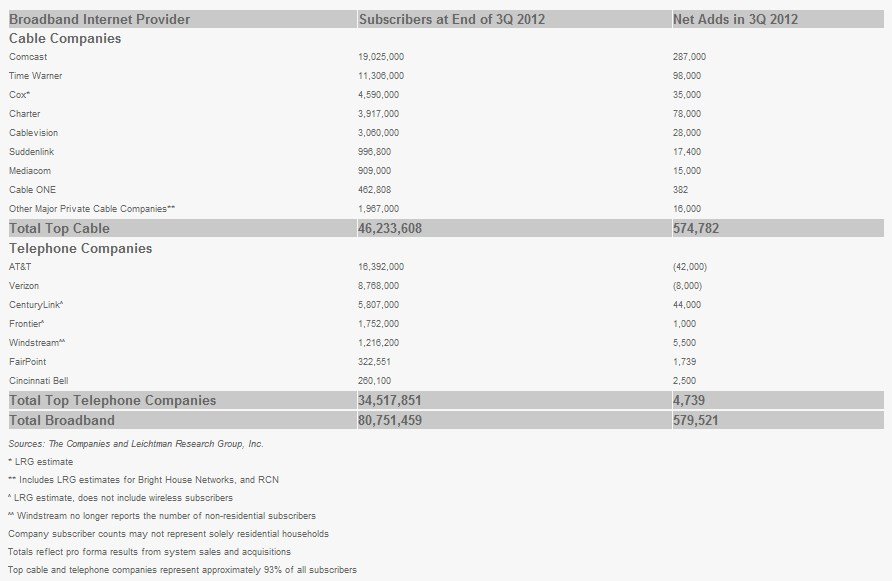
Cable operators continue to win the vast majority of new broadband customers, according to this chart from Leichtman Research Group, Inc.
With consumer demand for broadband at an all-time high, Britt said as usage and dependence on broadband continues to grow, the company will have more and more ability to raise prices. Britt noted the company implemented a modem rental fee in November he characterized as “essentially a price increase,” and called its implementation successful.
Cashing in on cable modems was just a hidden price increase, admits Britt.
Britt acknowledged only about 3% of customers have elected to buy their own cable modems to date, and Britt said he believed most people will continue to rely on Time Warner’s rented modem, bringing lucrative new revenue to the company indefinitely.
The company’s gradual move to an all-IP network is an acknowledgment of the success of broadband, but also allows the company to become more nimble with its video offerings and services.
“We are talking about using IP standards and IP technology to enhance our video offering,” Britt said. “What we are trying to do is recognize that all consumer electronics are increasingly moving to IP standards. Writing software to IP standards allows you to create software that can be much more easily updated and iterated than traditional forms of software. We’re embracing that wholeheartedly.”
The company is currently testing a cloud-based program guide and set top box interface in 190,000 homes in upstate New York with positive results, according to Britt.
“We are going to have the second version of that next year and roll it our more broadly,” Britt said. “We have not been as noisy about that as some others. Again, the beauty of this is that it resides centrally, not on everyone’s set top box, and you can change the software little bits and pieces once a week or every two weeks. You don’t have to have these giant software releases.”
Other initiatives:
Getting streaming video on every device capable of displaying it in a customer’s home;
Introducing local broadcast station video on the company’s streaming product. “We now have the ability to encode 1,000 broadcast signals from around the country,” said Britt. “Here in New York City, the broadcasters are in the package now;”
Will shortly introduce video-on-demand streaming through its device apps;
Its Wi-Fi network in Los Angeles is on track to offer 10,000 hotspots. The company’s next expansion priority is more Wi-Fi for New York City.
Britt Downplays the Competition: ‘AT&T U-verse is bandwidth constrained, FiOS is mostly finished expanding, and Google Fiber is a publicity stunt.’
Britt recognized AT&T planned to restart expansion of its fiber to the neighborhood U-verse service, which actually competes with Time Warner Cable in more communities than Verizon’s FiOS fiber optic network.
“U-verse overlaps about 25 percent of our footprint today,” Britt said. “Presumably it will add a little more when they’re done with this. I would remind you that U-verse is more bandwidth constrained than our plant. We have a route to faster speeds, so we’re confident with our ability to compete with that.”
Britt said Time Warner Cable has gained experience predicting what happens when new competition arrives in town, and continued to downplay its impact on cable’s dominant market position.
“There is a phenomenon in consumer behavior that when a new competitor comes to town a certain number of people move just because they want to try the new thing,” Britt said. “After you are there for awhile that part ends and you are just into a normal marketing game. I think leaving aside the AT&T announcement, that is true generally of the two phone companies who have built what they said they would build initially.”
The one city where competition has turned into building-to-building combat is New York City, where Verizon FiOS continues to only gradually expand into new buildings. When FiOS becomes available, marketing begins to get customers to consider switching, kicking Time Warner’s customer retention efforts into high gear.
Nobody needs 1Gbps, argues Britt.
The cable operator has traditionally offered aggressive retention and new customer deals to attract and hold cable customers, and in some cases it has thrown in high value prepaid credit card rebate offers. Currently, Time Warner Cable pitches new and returning customers its triple play package for $89-99 in New York, often giving existing customers the same deal when they complain.
In Kansas City, Time Warner Cable now faces competition from both AT&T U-verse and Google Fiber, but Britt claims the company is not as worried as some might think.
“I guess I would remind everybody [Google] in the past announced they were doing things like this,” Britt said. “I think they were going to build Wi-Fi over San Francisco and they built a couple of blocks. Obviously I’m not inside their company — I can’t exactly know their motivation, but certainly if it is like the past, their motivation is to demonstrate what technology can do and try to prod the government and other players to go bigger, faster, whatever.”
Britt doubts Google will take the project much farther than Kansas City, and even if it does, the cable industry will have decades to prepare.
“I would remind you it took the cable industry which built the second wire into the home — the phone being the first — four decades or more to build across the country and many billions of dollars,” said Britt. “Even if Google builds, we’re not going to wake up and see Google instantly building out the whole country.”
Britt took a swipe at Google’s white-collar business focus and wondered exactly who needs the service Google has started to offer.
“This is not like their other businesses; it is very physical, it is blue collar workers, it is process, it is a very different thing,” Britt said. “I think what they’re doing is trying to demonstrate the wonders of 1Gbps. The problem with that is even if you build the last mile access plant to do that, there is neither the applications that require that nor a broader Internet backbone and servers delivering at that speed. It ends up being more about publicity and bragging. There has been a whole series of articles in the paper about ‘I’m a little startup business and boy it is really great I can get this’ and my reaction is we already have plant there that can deliver whatever it is they are talking about in those articles, which is usually not stuff that requires that high speed. So we’ll see.”
But Britt acknowledged the company will have a challenge competing with at least one Google Fiber service.
“They are giving one level of broadband away for free with an upfront installation,” Britt noted. “It’s hard to compete with free, although it is hard to make money at free also.”
The Cord-Cutting “Myth”: It’s the economy, stupid.
Britt continued to downplay and dismiss the popular media meme that cord-cutting is taking a toll on cable television subscriptions. Britt argued with television sets left on in most homes an average of eight hours a day, and pay television services reaching 90 percent of those homes, parting with cable TV is not that easy for a product with that level of consumer acceptance.
“Is there some cord cutting typically among young people — maybe they were cable-nevers? Yes, but it appears to be fairly minor at the moment,” Britt said. “I think the bigger issue for the industry is a combination of price and the economy.”
“These packages keep getting more and more expensive. Programming gets more and more expensive,” Britt added. “I hope the economy gets better but at the moment there are still an awful lot of people who have been unemployed a long time and this stuff is starting to cost too much and I never miss the chance to get on my bully pulpit about it. If we, as a broader industry, want to keep this going, we need to figure out some way to have packages and prices that are lower for people who just cant afford it. That is a bigger factor right now than cord-cutting.”
Britt was lukewarm about his company’s own efforts to deliver a discounted cable television package which pares down the basic package to a few dozen channels with some notable gaps, especially for sports fans.
“We have a package called TV Essentials and whether it is the ideal configuration of programming and price — it is probably not — it is what we’re able to do,” Britt said. “It does have some uptake but not enormous. I think we need as an industry to work on that. We all know the big package works for the content companies and the little packages don’t. At some point this whole thing has to be responsive to the people who ultimately pay the bills and that is the consumer.”
Throwing Down the Gauntlet: ‘We’re going to start dropping little-watched channels at contract renewal time if prices don’t come down.’
“I think the trend has been pretty constant over the last several years: Since 2008, our programming costs per customer have gone up about 30 percent while the Consumer Price Index is up about 10%, so clearly those two things are out of whack,” Britt said. “Our video pricing has gone up about 15% so we are able to close that gap a little bit but not completely. I don’t have any magic bullet about this except clearly these trends can’t continue forever.”
Britt warned programmers have become too comfortable with the status quo for cable packages and pricing that some have gotten lazy about the quality of their programming, dependent on the subscriber fees they earn whether customers watch their channels or not.
“Content companies will all gloat and chortle about how wonderful the structure is and they can charge whatever they want,” Britt complained. “We’ve accumulated networks that hardly anybody watches. If you speak to the people who run those networks or own them they almost feel it’s a birthright — I have this network that has distribution to 70-80 million homes, and I’m getting paid every month for ads — maybe this year I wasn’t able to get a big audience but you know next year I am going to work harder and I am going to spend more money on programming and it’s going to be good.”
Britt noted some of the channels Time Warner added have transformed into entirely different channels the company would have never signed up for had they known.
“Sometimes people even change the entire content of the network and our company has been pretty aggressive in not letting that happen since we’re selling a whole package that appeals to different people,” Britt said. “It’s not a birthright, it’s not a carte blanche.”
“I think what we’re saying because the consumer is telling us they can’t afford these prices anymore, where we can we’re going to have to start cutting things off,” Britt warned. “So if you have a network that gets hash mark ratings and no real sign it’s going to get any better, and your contract is up, we’re going to have a different kind of conversation than we might have had five, six or ten years ago.”
Britt said some networks will be dropped altogether, others will be invited to remain, but only on an added-cost tier for subscribers willing to pay more.
“We can’t keep carrying these giant packages of things with the services that don’t carry their own weight,” Britt said.
But Britt understands the perspective of the entertainment companies as well, having formerly been with Time Warner, Inc., the entertainment-oriented company that owns several cable networks.
“A-la carte just doesn’t work for those companies,” Britt noted. “If you think about the existing package, it’s a wonderful mechanism to mitigate risk in a business that I would argue is one of the riskiest businesses on the planet.”
Britt compared a-la-carte economics with that of a typical Broadway theater show, where a small group of individuals risk substantial sums of money on the success of a production that either makes it or it doesn’t, and most don’t. The only revenue stream is from consumers willing to pay ticket prices for admission.
Today’s cable package offers niche and general interest channels in the same package, with assured subscription revenue regardless of ratings, combined with ad revenue which can be meager or substantial depending on the ratings. With guaranteed revenue, cable channels invest in programming production or acquisition — purchases that would not be likely if reliant on an uncertain a-la-carte business model.
Therefore, in Britt’s view, a-la-carte per channel or per program changes the dynamics of the cable business away from a stable one that obtains programming on the basis of predicted revenue to one closer to a Broadway production, where risks of failure are very high, especially for niche programming.
Britt believes in today’s bundled cable package, but not in its current size or monthly price.
“I think aside from that there is a lot of value in the package if you think about cost avoidance,” Britt said. “In reality we as distributors do the marketing, the billing, the customer relationship and although somebody from a network might rail at us for not being great marketers, the reality is if each network had to separately market and bill itself and deal with consumers separately, you would introduce a whole lot of cost in the system that is not there today. This actually works quite well for consumers today and it’s a relatively good value. I think the problem is the trajectory of it and if you are in the content business you are trying to seek eyeballs so you are competing with each other and the only way people seem to know how to do that is to spend even more for programming and that is what sort of killed you with consumer behavior.”
Time Warner Cable CEO Glenn Britt took questions for an hour from Wall Street investors and analysts at the UBS Conference in New York. (December 3, 2012) (55 minutes)
You must remain on this page to hear the clip, or you can download the clip and listen later.
Can Verizon be enticed to puts its FiOS trucks back on the road to expansion?
Despite the fact further expansion of Verizon FiOS has been stalled for more than two years as a result of a company directive, local officials in one Massachusetts community won a commitment from Verizon to extend its fiber to the home service to every home and business in return for a lengthy contract renewal.
Just nine months after local officials in Medford, north of Boston, first signed an agreement with Verizon, The Medford Transcriptreports the two were back at the negotiating table with an amended agreement to extend Verizon FiOS beyond the 71 percent already served in return for a franchise that will not expire until 2025.
Verizon originally left large sections of West Medford and several neighborhoods scattered around the area without a fiber upgrade.
Verizon regional president Donna Cupelo acknowledged Medford is the only community in the state that has won a second round of FiOS expansion.
Like many cable franchise agreements, Verizon has agreed to contribute towards the operation of the community’s Public, Educational, and Government access channels available to subscribers of both Comcast and Verizon FiOS.
The amended agreement will expire at the same time Comcast’s current franchise agreement ends, giving both providers parity.
Verizon’s agreement to expand its FiOS network under certain conditions may provide the first visible path for other communities with incomplete fiber service to entice Verizon to keep building its fiber network.
Be Sure to Read Part One: Astroturf Overload — Broadband for America = One Giant Industry Front Group for an important introduction to what this super-sized industry front group is all about. Members of Broadband for America Red: A company or group actively engaging in anti-consumer lobbying, opposes Net Neutrality, supports Internet Overcharging, belongs to […]
Astroturf: One of the underhanded tactics increasingly being used by telecom companies is “Astroturf lobbying” – creating front groups that try to mimic true grassroots, but that are all about corporate money, not citizen power. Astroturf lobbying is hardly a new approach. Senator Lloyd Bentsen is credited with coining the term in the 1980s to […]
Hong Kong remains bullish on broadband. Despite the economic downturn, City Telecom continues to invest millions in constructing one of Hong Kong’s largest fiber optic broadband networks, providing fiber to the home connections to residents. City Telecom’s HK Broadband service relies on an all-fiber optic network, and has been dubbed “the Verizon FiOS of Hong […]
BendBroadband, a small provider serving central Oregon, breathlessly announced the imminent launch of new higher speed broadband service for its customers after completing an upgrade to DOCSIS 3. Along with the launch announcement came a new logo of a sprinting dog the company attaches its new tagline to: “We’re the local dog. We better be […]
Stop the Cap! reader Rick has been educating me about some of the new-found aggression by Shaw Communications, one of western Canada’s largest telecommunications companies, in expanding its business reach across Canada. Woe to those who get in the way. Novus Entertainment is already familiar with this story. As Stop the Cap! reported previously, Shaw […]
The Canadian Radio-television Telecommunications Commission, the Canadian equivalent of the Federal Communications Commission in Washington, may be forced to consider American broadband policy before defining Net Neutrality and its role in Canadian broadband, according to an article published today in The Globe & Mail. [FCC Chairman Julius Genachowski’s] proposal – to codify and enforce some […]
In March 2000, two cable magnates sat down for the cable industry equivalent of My Dinner With Andre. Fine wine, beautiful table linens, an exquisite meal, and a Monopoly board with pieces swapped back and forth representing hundreds of thousands of Canadian consumers. Ted Rogers and Jim Shaw drew a line on the western Ontario […]
Just like FairPoint Communications, the Towering Inferno of phone companies haunting New England, Frontier Communications is making a whole lot of promises to state regulators and consumers, if they’ll only support the deal to transfer ownership of phone service from Verizon to them. This time, Frontier is issuing a self-serving press release touting their investment […]
I see it took all of five minutes for George Ou and his friends at Digital Society to be swayed by the tunnel vision myopia of last week’s latest effort to justify Internet Overcharging schemes. Until recently, I’ve always rationalized my distain for smaller usage caps by ignoring the fact that I’m being subsidized by […]
In 2007, we took our first major trip away from western New York in 20 years and spent two weeks an hour away from Calgary, Alberta. After two weeks in Kananaskis Country, Banff, Calgary, and other spots all over southern Alberta, we came away with the Good, the Bad, and the Ugly: The Good Alberta […]
A federal appeals court in Washington has struck down, for a second time, a rulemaking by the Federal Communications Commission to limit the size of the nation’s largest cable operators to 30% of the nation’s pay television marketplace, calling the rule “arbitrary and capricious.” The 30% rule, designed to keep no single company from controlling […]
Less than half of Americans surveyed by PC Magazine report they are very satisfied with the broadband speed delivered by their Internet service provider. PC Magazine released a comprehensive study this month on speed, provider satisfaction, and consumer opinions about the state of broadband in their community. The publisher sampled more than 17,000 participants, checking […]


 Subscribe
 “I want FiOS yesterday. I guess some of these building owners already have it and will let us have it if the kickback is finally high enough. Time Warner Cable comes and goes whenever they like.”
 While a lot of people would love to get Verizon to wire their communities for the company’s fiber optic network, at least three New York City multi-dwelling unit property owners have told Verizon to get lost, in some cases telling the company none of their tenants were interested in the top-rated fiber to the home network, even as they remain without phone service three months after Hurricane Sandy damaged Verizon’s facilities in the city.
 boneheads that own my building that nobody was interested,” says Brad, a Stop the Cap! reader in Manhattan. “The morons at the property management company don’t have a clue or they want money from Verizon in return for the keys. Meanwhile, there is no dial tone and Verizon says they are at an impasse until the property owners, who obviously don’t care, let them in to do repairs.”