Home » fiber optic network » Recent Articles:

Verizon’s Mess in Massachusetts: No Network Redundancy Spells Big Telecom Trouble

Phillip Dampier September 4, 2012 Consumer News, Public Policy & Gov't, Verizon, Video Comments Off on Verizon’s Mess in Massachusetts: No Network Redundancy Spells Big Telecom Trouble

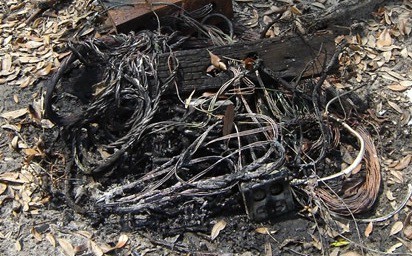
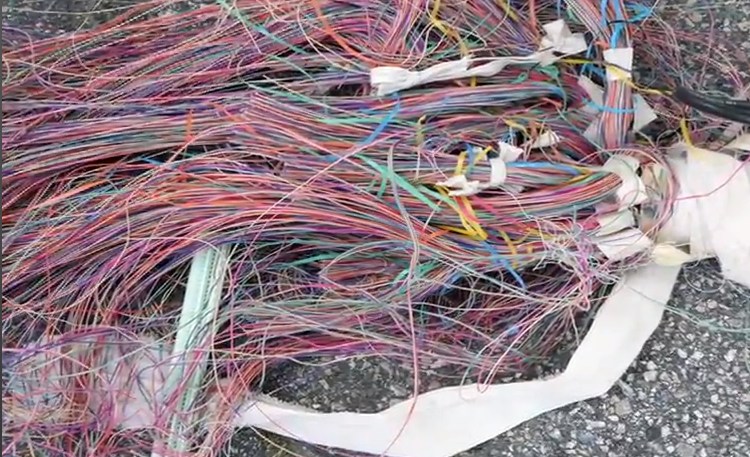
A homeless man’s mattress fire under a bridge in Massachusetts was enough to create the biggest telecommunications disaster for Verizon since the terrorist attacks of 9/11. The fire melted fiber and damaged copper cables that represented the backbone of Verizon’s landline network in the region, disrupting phone, cable, and broadband service for thousands of Verizon’s customers in northeastern Massachusetts in late August. Now that service has been restored, the damages from the outage and its ripple effects are still being calculated as questions are being raised about how the company handles its communications network.

The damage went far beyond an inconvenience for Verizon customers:

  • Area businesses were ripe for plundering with Verizon-dependent alarm systems out of service;
  • Cell towers went down if they were connected by Verizon’s fiber optic network;
  • Local law enforcement communication systems ceased to function in areas where Verizon provided the vital link between the dispatch center and transmitting facilities miles away;
  • Banks and other local businesses closed down because Verizon-based connectivity was inoperable. That left ATMs throughout the region out of service and credit card transactions often impossible to manage;
  • 911 systems in several communities had to transfer emergency calls to other 911 centers miles away;
  • Even the Registry of Motor Vehicles locked their doors and shut down while the outage persisted over several days.

[flv width=”640″ height=”380″]http://www.phillipdampier.com/video/NECN Verizon telecommunications outage causes problems 8-31-12.flv[/flv]
NECN News reports on Verizon’s enormous Massachusetts service outage and how it impacted the lives of affected customers. (3 minutes)

Verizon’s landline network ultimately failed its Massachusetts customers on a scale the company admits it has not seen in a long time.
“It’s the biggest problem we’ve faced, nationally, other than 9-11,” Bill Wilson, area manager for Verizon, told the Eagle-Tribune. “This is the biggest problem we’ve had in 20 years.”

At the heart of the problem is Verizon’s lack of redundancy in its landline network. With fiber optic cables managing a larger share of broadband traffic, phone calls, and even Verizon’s television service, the loss of even a single fiber cable can disrupt service for hundreds or thousands of customers, many more than would be affected by a damaged copper cable.

State Sen. Barry Finegold (D-Andover) is questioning Verizon’s decision not to have a backup plan in place.

“So if there’s a fire there’s a redundant system in place so if one fails there’s another to back it up,” Finegold said.

Customers, particular those working from home, wholeheartedly agreed.

“I am appalled,” Shela Horvitz, a Verizon FIOS customer who lost her phone, Internet and TV service for days as a result of the fire, told the newspaper. “Can you say, ‘Single Point of Failure?’”

[flv width=”640″ height=”380”]http://www.phillipdampier.com/video/Eagle Tribune Verizon Talks to Media About Outage 9-2-12.flv[/flv]

Verizon officials show reporters what the fire did to their network and how they are going to restore service after a fire on Lawrence Central Bridge caused mass outages in the region. From the Eagle-Tribune. (4 minutes)
Verizon blames the entire affair on homeless people, who they say should not have been sleeping on top of their wires. The idea of network redundancy for Verizon’s landline network? “Cost prohibitive,” say company officials.

Joseph Zukowski, vice president for government affairs for the phone company, said the problem was so rare, it was comparable to a 100-year storm. He compared the outage with a natural disaster.

“We have extensive security measures to make the network as secure as possible,” Zukowski said. “We restrict building access and access to our cables. Nowhere on the list is a homeless guy lighting a match on a mattress. We’re not laying blame, but the best thing would have been not to have the tent city there.”

Local police acknowledge the bridge where the cables cross the Merrimack River is a popular spot for the local homeless to congregate, and they have attempted to control the problem. But nobody ever told them Verizon’s vital regional communications network infrastructure was at ground zero of the mattress fire.

“Going forward, if the stuff that’s there is so important, it really needs to be secured so nobody can get access to it,” said police chief John Romero.

Verizon has promised refunds for all affected customers.

[flv width=”640″ height=”380″]http://www.phillipdampier.com/video/Verizon Lawrence MA Bridge Fire Verizon Restoration 2012 9-1-12.flv[/flv]

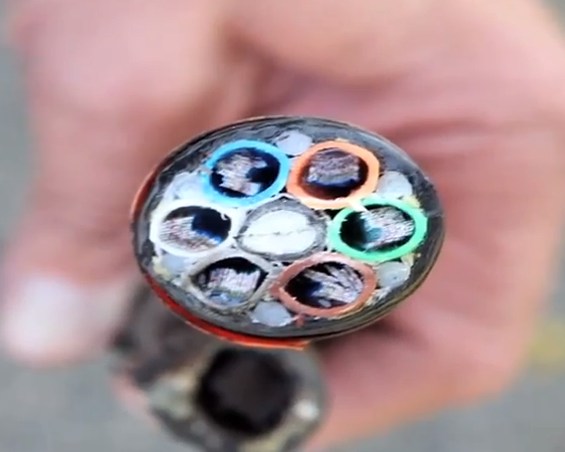
A Verizon-produced video illustrates how the company is repairing its damaged network. The heat from the fire on August 27th melted and fused both fiber and copper cables, and the protective casings that house the cables.

Verizon: “The work to restore service is complex, given that technicians are splicing thousands of individual copper and fiber-optic connections in a very confined area under the bridge. The conduit structure that holds the cables, which was protected by a metal cage, was destroyed and needs to be replaced. Verizon crews have been working in 24-hour shifts since the fire to restore service for customers and will continue to do so until every customer is back in service.”  (2 minutes)
Fact Check: Time Warner Cable’s $25 Million Fiber Upgrade: For Business Use Only

Despite glowing media reports about Time Warner Cable’s announcement it is investing $25 million to expand its fiber optic network in parts of Brooklyn and Manhattan, in fact the fiber expansion is part of a previously-reached franchise agreement with New York City officials and will only be available to large business customers that can afford the asking price.

Time Warner Cable’s press release, which generated favorable media coverage in The Wall Street Journal and Bloomberg News, focused considerable attention on fiber upgrades for the Brooklyn Navy Yard, since reborn as a modern tech-friendly business park.

TWCBC also announced that the Brooklyn Navy Yard Development Corporation, a 501(c)(3) organization, will receive a state-of-the-art Time Warner Cable Learning Lab in its Employment Center, located inside the massive complex and accessible to the public.

“We are very pleased to work with the City of New York to make significant investments to ensure that this city has the technology infrastructure to successfully compete in a worldwide marketplace,” said Ken Fitzpatrick, President of Time Warner Cable Business Class, East Region. “Our fiber optic network provides dedicated Internet access at incredible speeds and high-bandwidth capabilities to serve the communications needs of any business.”

Time Warner Cable was required to make its investment in the Brooklyn Navy Yard as part of its franchise agreement with NYC officials.

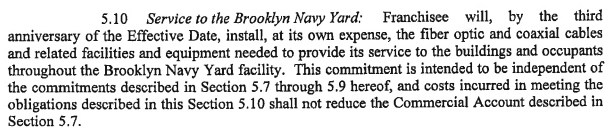
Time Warner Cable did not, however, provide this investment out of the goodness of their heart. They were required to under the terms of the current franchise agreement the company signed with city officials:

[Time Warner Cable] will install, at its own expense, the fiber optic and coaxial cables and related facilities and equipment needed to provide its service to the buildings and occupants throughout the Brooklyn Navy Yard facility.

Time Warner Cable is also extending its network to more commercial establishments throughout the city, in keeping with its previously-announced interest in expanding services to business customers. Nothing new to see here either.

That did not stop Bloomberg News from comparing Time Warner’s network expansion with Google’s gigabit network in Kansas City:

Time Warner Cable Inc. will expand fiber-optic lines to businesses in New York, a move that boosts Internet speeds as much as 20 times and provides an East Coast counterpoint to Google’s ultrafast network in Kansas City.

The company faces a threat from Google more than 1,000 miles away in Kansas City, where the Internet-search giant is building a fiber-optic network as a test project. Time Warner Cable is the main broadband provider for the area, which spans parts of Missouri and Kansas. While Google’s network will be available to both companies and households, Time Warner Cable’s New York fiber network is focused on businesses.

Google’s network initially will only be sold to residential customers, which are the primary targets for the service. Time Warner Cable’s fiber backbone network primarily works in tandem with its coaxial cable network and does not provide a fiber to the premises connection except for the company’s largest corporate customers.

Time Warner Cable Business Class sells different speeds and services to commercial clients. Most choose speeds considerably lower than 1,000Mbps because of the cost.

What was missing from the coverage is the fact ordinary residential Time Warner Cable customers in New York City will not benefit from these fiber upgrades — they are targeted only to commercial clients. Residential customers will continue to receive the same hybrid fiber-coax service they always have from the cable company.

If New York customers want fiber service, they will have to buy it from Verizon, assuming FiOS has made its way to your borough and neighborhood.

Hawaii O-No: Spending to Revitalize Hawaii’s Telecom Infrastructure Panned by Wall Street

Spending money to earn more money is a fiscally sound principle of doing business, but short term investors often decry increased spending as harmful to the value of a company’s stock and dividend payout. That is why Hawaiian Telcom (HawTel) earns mixed reviews from Wall Street about the company’s aggressive infrastructure improvement project, a fiber to the neighborhood network that intends to bring television, phone, and faster broadband service to an increasing number of Hawaiians.

HawTel’s stock price has bounced up, down, up, and then down again as investors digest the company’s ongoing effort to reinvent itself as a 21st century telecom company.

The Old HawTel

HawTel’s fiber buildout began on the island of Oahu in 2011, eventually passing 27,400 homes on the island. At the end of 2011, 1,600 (6%) of those homes signed up for the service. That’s an acceptable number, especially for a service barely promoted. HawTel does not mention the television service on its primary website, and approaches potential customers one-on-one with in-person and targeted mail marketing.

At the end of the second quarter or 2012, HawTel TV had 6,400 subscribers. The company hopes to have an additional 50,000 homes enabled for its TV service by the end of 2012, with the goal of enabling 240,000 households across Hawaii over the next five years. HawTel hopes to eventually capture 30% of the Hawaiian market.

HawTel’s principal competitor is Oceanic Time Warner Cable, which provides traditional cable service across the Hawaiian Islands. HawTel had been at a substantial disadvantage competing with Time Warner’s television package and faster broadband service. But the fiber upgrades are allowing at least some customers to purchase speeds up to 50/10Mbps, slightly faster than what the cable operator offers.

Time Warner has taken note of the phone company’s re-emergence as a strong competitor, targeting Oahu with special promotional offers that lock customers in place with triple play discounts designed to make it inconvenient to switch providers.

The New HawTel

Unfortunately for HawTel, fiber upgrades do not come cheap, and the company’s earnings have taken a hit.

Capital expenditures totaled $41.2 million for the six-months ended June 30, 2012, up from $35.4 million for the six-month period a year ago due primarily to investments in broadband network infrastructure and expansion of video enabled households.

Hawaiian Telcom reported an 18 percent decline in second quarter earnings, which it blamed primarily on broadband network expansion.

The company also announced it lost another 6% of traditional landline customers during the second quarter, but that was offset by expansion in its broadband and television service. For HawTel, the solution to ending landline losses is to upgrade their network to compete with the types of communications services consumers are interested in buying today.

But those plans can and do conflict with at least some stock traders who are interested primarily in short term financial results. Spending can cut into profits, so some analysts downgrade stocks of companies spending the most, even if only to compete more effectively down the road.

So far, HawTel executives have not been discouraged carrying their network expansion plans forward. In July, Hawaiian Telcom announced it would acquire Wavecom Solutions Corporation’s local exchange carrier business in a stock purchase transaction valued at $13 million.

Wavecom’s undersea fiber network

The acquisition would give Hawaiian Telcom access to Wavecom’s fiber optic network connecting the main Hawaiian islands. Wavecom, formerly known as Pacific Lightnet, Inc., serves more than 1,700 customers across Hawaii.

In an application with the Federal Communications Commission, HawTel officials said access to Wavecom’s 400-mile undersea telecommunications cable network will permit the company to expand and enhance its broadband and television services beyond Oahu to other Hawaiian islands, and help position the company to effectively compete with Time Warner.

[flv width=”640″ height=”380″]http://www.phillipdampier.com/video/Hawaiian Telcom TV Tour.flv[/flv]

Watch a HawTel-produced video tour of the company’s new TV service.  (4 minutes)

Verizon Declares Copper Dead: Quietly Moving Copper Customers to FiOS Network

“If you are a voice copper customer and you call in [with] trouble on your line, when we go out to repair that we are actually moving you to the FiOS product. We are not repairing the copper anymore.” — Fran Shammo, Verizon’s executive vice-president and chief financial officer

Verizon has declared the end of the copper wire phone line, at least in areas where the company’s companion fiber optic network FiOS is available. Fran Shammo, chief financial officer of Verizon Communications spoke about the death of the copper-based landline and the company’s strategic plans for its wired and wireless networks in the coming quarter at Oppenheimer’s 15th Annual Technology, Internet & Communications Conference last Wednesday.

Verizon’s quiet and involuntary switch-out to fiber service is part of the company’s grander marketing effort to push customers towards upgrading service.

“The benefit we are getting […]  if you are a voice customer and we move you to [fiber] we now can upsell you to the Internet,” Shammo explained. “If you come over as a voice and DSL customer and we move you to FiOS, you now are a candidate for the video product. So there is an upsell which is definitely a benefit to this.”

Verizon earlier announced it would no longer sell standalone DSL service to customers, and has stopped selling copper-based DSL products in areas where Verizon FiOS is available. It even discourages customers from considering standalone FiOS broadband, with a budget-busting price of $64.99 for stand-alone 15/5Mbps service with a two-year contract or $69.99 on a month-to-month basis. Verizon offers considerably better value when customers sign up for multiple FiOS services.

Scrap heap

Verizon says the reliability of fiber makes maintaining older copper wire networks pointless.

“The bigger benefit is we are transforming the cost structure of our copper business because the copper fails two to three times more than fiber, which means we have two to three more times we have a tech and a truck rolling out to that copper connection. So we are eliminating that,” Frammo said.

Frammo added decreasing repair and maintenance expenses will help improve profit margins for the company.

Both CEO Lowell McAdam and Frammo have made profit margins a much higher priority for Verizon Communications than ever before.

“If you look at the [landline] side of the business, […] we have made a shift that said we are going to focus more on the profitability of FiOS this year. And that is important for us to do, because we need to generate the cash flow so that we can reinvest in those platforms,” Frammo said. “But I think as an industry as a whole you are seeing a different focus now, that it is more on returns, it is more on profitability. Can that continue? Sure. Obviously, you might have your blips here and there based on how fast something grows in one quarter versus another, but if you look at Verizon Wireless and you look at Verizon we are expanding our margins.”

Frammo addressed several key plans Verizon has for both its wired and wireless businesses, and what political priorities the company has for the rest of the year:

Verizon Wireless’ 4G LTE Network is a Platform for Profits

Shammo told investors Verizon’s 4G LTE platform is now available to 76 percent of its customers in 337 markets. LTE, Shammo said, delivers not only the speed customers want but reduced operating costs for the cell phone provider. But Shammo said that will not bring reduced prices for customers — Verizon intends to use its LTE network as a platform for increasing profitability.

“When you take that network and you overlay our shared plan with that and now others are following with that shared plan, the entire industry from a shared perspective has a lot of room for growth because when you think about that network and the speed it provides, and then you take all these devices and you think about the number of tablets that have been sold in the United States that are not connected to a wireless network, you now enable people to connect those devices much easier.

“So when you think about that speed and that price plan that pools those data minutes, the growth profile here is really good for the industry and very, very good for Verizon Wireless because we think we have a strategic lead here.

“We are going to have to wait to see what the usage profile of this is. But can we expand our data, our data pricing? Of course we can, so you just add in more tiers. But that is part of where we think the future is going because when you think about the speeds and the video capability of LTE we do project out that that usage is going to continue to substantially increase which then folks will buy up.

“So it is going to be very, very easy for people to attach devices to just go beyond what we know today as a smartphone, a dongle, or a tablet. Now take it to your car, now take it inside your home for remote medical monitoring or whatever else that can happen in that house. Those can also now be attached to that price plan and everything can run off of that network.”

Frammo also hinted Verizon Wireless may be prepared to bring back an old concept from the days of long distance dialing — peak and off-peak data usage rates. Use Verizon’s network during peak usage periods and the company could charge a premium. But its LTE 4G platform also allows it to offer reduced rates when the network is being used less.

Shammo

Killing Off Your Phone Subsidy One Dollar at a Time

Shammo said Verizon Wireless is moving forward (along with other carriers) to gradually reduce equipment subsidies customers get when they upgrade their phones at contract renewal time. Verizon earlier discontinued customer loyalty discounts like its “New Every Two” plan and has stopped offering early upgrade incentives. Now the company is eliminating subsidies for some customers altogether and won’t offer them on several different types of devices.

“The industry has done a lot around trying to reform the upgrade policies and implement upgrade fees to try to strengthen the financial capability of that subsidy on a smartphone,” Shammo said. “We have also taken the track of not subsidizing tablets, less subsidy on dongles. It really is now all around the attachment of those devices into those price plans.”

Shammo added as competitors reduce subsidies, Verizon can continue to bring them down further over time. Shammo said that will improve the company’s margins.

Verizon Prepaid vs. Contract (Postpaid) Customers: “The religious belief is you can’t do anything that is going to deteriorate the postpaid base.”

Despite the company’s improved margins and declining costs from its 4G LTE platform, Frammo said Verizon has no plans to reduce prepaid pricing, because it could erode revenue from customers on two year contracts who might consider switching to a no-contract, prepaid plan.

“Obviously we are a postpaid carrier so anything we do — the religious belief is you can’t do anything that is going to deteriorate the postpaid base,” Frammo said. “I think people are willing to pay a slight premium to get on [Verizon’s] most reliable network and what we are finding is people are coming to that network. I think at this point we are very, very satisfied with where the prepaid market is. We are a premium to that prepaid market and, based on our growth trajectory right now, we are very comfortable with that price point.”

Verizon’s Political Priority for 2012: Where is our corporate tax cut?

While Shammo would not answer a question about which presidential candidate he feels would best serve Verizon’s interests if elected, Shammo made it clear the company is terrified of a so-called “tax cliff” — the expiration of the Bush-era tax cuts and a capital gains tax increase that would raise taxes on the wealthiest corporations from the current 15 percent to up to 25 percent — still lower than the tax rate paid by many middle class workers.

“Whoever is elected needs to deal with that tax cliff because that tax cliff could be detrimental to the economic performance of the U.S.,” Shammo said. “Then on a longer-term we definitely need corporate tax reform in the United States. We are not competitive with the rest of the world and I think everyone understands that. That is going to be harder to achieve, but I think that Washington understands that there needs to be some change within the corporate tax structure.”

Google Fiber Launches Next Week in Kansas City

A Stop the Cap! reader working for a Kansas City non-profit group dropped us a note this morning indicating she has received an invitation from Google to join the company at a special event Thursday, July 26 which will be Google Fiber’s formal launch announcement.

“There is buzz all over town about Google launching the fiber service on a limited basis in certain Kansas City neighborhoods next week,” Cathy writes us. “The local media has definitely been invited and encouraged to attend and several non-profit groups are going together in a group to also informally meet with some Google officials at the conclusion of the event regarding access and pricing issues. We have already been told this will be a formal launch event.”

Google has kept its pricing and exact service availability information tightly under wraps, but the company is inviting local residents to sign up for e-mail invitations and additional information as it is released.

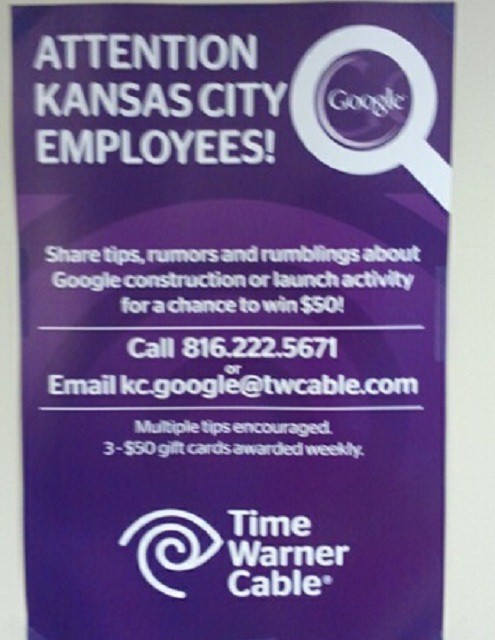
The anticipated launch has not been missed by Time Warner Cable, which has taken to placing signs around the workplace offering $50 “rewards” for insider tips about Google Fiber’s launch and marketing plans. Although some in the tech press have characterized this as “fear” of Google Fiber, a Time Warner employee tells Stop the Cap! the “reward” program is not unprecedented and the cable company has occasionally offered goodies to employees who can deliver tips about competitors like Verizon FiOS and community fiber broadband networks for years.

Courtesy: Gigaom

Kansas City residents will certainly have a choice when Google Fiber launches its gigabit network. In addition to fiber broadband from the search engine giant, customers in different parts of the area can also get cable from Time Warner Cable or Charter and U-verse from AT&T.

Google will join Chattanooga’s EPB Fiber as America’s gigabit residential broadband providers. Cable operators and phone companies are expected to downplay Google’s fiber introduction — likely telling customers they do not need gigabit speeds and chastising its likely monthly cost.

Google’s competitors may have to prepare to deliver that message beyond Kansas City, however.

Dow Drukker, senior vice president of CapStone Investments, believes Google is in the mood to grow:

Initial Indications Google Fiber Is Likely Expanding Beyond Kansas City.

We saw an ad for an Inside Sales position in Mountain View, CA for selling Google Fiber to small businesses. The ad said the position would be tasked to build a team to sell a national broadband network indicating Google likely plans to build a fiber-optic network in additional cities.

This was the ad Drukker saw, which can be vaguely interpreted to indicate the company has plans to place Google Fiber in more cities (underlining ours), although we see nothing that specifically mentions a “national” broadband network:

The area: New Business Development

At Google, we set ourselves goals we know we can’t reach yet. Our New Business Development team works on game-changing ideas, from technological experiments to the expansion of existing businesses into new territories. We’re a team of technologists, entrepreneurs and leaders with an eye for what’s next, working across Google to develop products and ideas that revolutionize the way people connect with information.

The role: Sales Manager, Inside Sales, Google Fiber

Does winning new business get your adrenaline pumping? Drive growth for Google’s Online Sales Group as part of the Inside Sales Organization, the sole acquisition engine at Google. You collaborate with our Account Management teams to devise strategies to acquire specific segments of your market. Work independently, travel to trade shows, visit large prospective clients–it’s all part of this role. Be rewarded for being an overachiever while driving incremental growth in your market. You prescribe the right marketing mix based on Google’s core advertising products through acquisition of predefined mid-and up-market clients. You are product-and industry-savvy, and your energetic drive propels you toward new acquisitions and building and managing your own book of business.

If you want the opportunity to work on a state-of-the-art high-profile program, look no further than the opportunity to frame the future of broadband. The Fiber Sales Manager will build a team to evangelizes Google Fiber services to small and medium business and multi unit dwellings. Fiber Sales manager will develop a plan for our approach in the market including multi unit dwellings, small business, restaurants, and hotels. Inside Sales Representative, you reach out proactively to both small businesses, while articulating how Google Fiber Solutions can help make their work more productive. (And then, you seal the deal!) You excel at product pitching, cultivating a strong base of new clients and working with fellow technical Googlers to devise solutions and support for your clients.

One of the most potentially valuable lessons Google may teach with its new gigabit broadband network is one for Washington lawmakers. To date, cable and telephone companies have portrayed gigabit fiber broadband as unnecessary, unwanted, and too difficult and expensive to offer residential customers. Google’s performance in Kansas City could prove those arguments wrong.

Search This Site:

Contributions:

Recent Comments:

Your Account:

Stop the Cap!