
Home » customer service » Recent Articles:

Verizon Begins Wave of Call Center Closures, Layoffs, in Transition to “Home Based Agents”

Phillip Dampier February 26, 2018 Consumer News, Verizon, Wireless Broadband 3 Comments

Verizon has announced a wave of call center closures in several states that will results in layoffs, although some employees will be invited to reapply for their position if they are willing to move to another state or continue their work as a “Home Based Agent” taking customer service calls from a home office.

Verizon is cutting back on customer service call centers, after looking for ways to cut expenses and direct customers to use “self-service” options on Verizon’s website. For those who still want to speak to ‘a real person,’ increased hold times may be the result. Verizon maintains 16 call centers around the country, with at least six scheduled to close and a seventh closure already in progress.

Affected customer service call centers:

  • Mankato, Minn. — Originally a call center for Midwest Wireless and Alltel before being acquired by Verizon Wireless, about half of the estimated 600 workers will be invited to continue as Home Based Agents, while others will be laid off or invited to apply for another position if they are within 90 miles of another Verizon call center and are willing to commute or relocate. Just a few years ago, this call center was desperate to hire a bookkeeper, and handing out lucrative signing bonuses and other incentives.
  • North Charleston, S.C. — Formerly a Montgomery Ward department store, Verizon Wireless repurposed the 150,000 square foot facility and hired up to 1,000 workers when it opened in 2004. About 500 workers are being invited to transition into Home Based Agents, “supporting customers the same way and with similar tools as if they were working from a traditional brick-and-mortar call center,” according to a Verizon spokesperson. Verizon will save almost $2 million a year in rent closing the call center. The layoffs and call center shutdown are expected to be complete by September.
  • Huntsville, Ala. — The call center in Research Park will be shuttered “in the coming months,” with workers invited to participate in the Home Based Agents program. Verizon claims it will cover “most” of the equipment and supplies needed to work from home, and will pay a stipend of $65 a month for internet access. But other ongoing home office-related expenses, including electricity, furniture, insurance, and other related costs will the employee’s responsibility.
  • Albuquerque, N.M. — Verizon Wireless will shut down its 197,000 square foot call center by October 2019, with workers selected for its Home Based Agents program transitioned out of the building by May of 2019. At least 1,000 workers are likely affected. The call center cost $30 million to open in 2006 and by 2009 employed 1,600 workers.
  • Hilliard, Ohio — A Verizon call center that formerly absorbed a lot of displaced Verizon call center employees across the region is itself shutting down by November of this year. Qualified workers are invited to continue as Home Based Agents. Verizon employees complain Home Based Agents lack job security and are usually among the first to be laid off in any future downsizing actions. Some recommend relocating to another call center instead of working from home.
  • Little Rock, Ark. — Verizon has informed its 600 Little Rock call center employees they are shutting down the office by this October, and workers that want to stay with Verizon will be able to transition to a work-at-home model or apply for a job elsewhere in the company.
  • Franklin, Tenn. — Already downsizing, this call center will be shuttered sometime this year, with workers invited to apply for the Home Based Agents program. But some workers with experience working from home warn there are significant downsides: “You can’t relocate to another call center or move to the Home Based Agents program if you are on ‘corrective action’ (for attendance or performance),” said one worker. Those employees will lose their jobs and receive severance packages. “Moral of the story, don’t let yourself get an attendance warning for your kids having the flu [thinking] ‘I will [accept a write-up]’ because if your center closes, you cannot relocate.”

Verizon spokesperson Jenny Weaver told the Albuquerque Journal a very different story about home agents.

“At other places, we’ve found it’s a satisfaction driver for employees,” Weaver said. “Happy employees translates to happy customers, so we’re excited about this.”
Charter Spectrum Will Only Talk to Theresa Peartree’s Dead Ex-Husband About Her Account

Phillip Dampier February 9, 2018 Charter Spectrum, Consumer News, Editorial & Site News 8 Comments

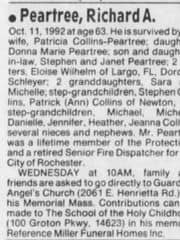
He’s dead. Death notice for Richard Peartree published in the Democrat & Chronicle on Oct. 13, 1992.

Charter Communications’ inability to exercise common sense judgment in helping their customers is demonstrated once again by what we call: The Case of Mrs. Peartree and Her Curious Cable Bill. 

Theresa Peartree, a retiree living in Rochester, N.Y., and a customer of “the cable company” under its various names for more than 30 years, has a problem.

Spectrum won’t talk to her. About anything.

Peartree called the cable company to ask why her bill has increased a few dollars a month starting last fall. Spectrum effectively told her it’s none of her business because the account is in the name of her ex-husband, who died in 1992.

Time Warner Cable and Greater Rochester Cablevision — the former names of what today is Spectrum, understood Peartree’s situation and were willing to talk to her about her account, although nobody bothered to suggest she change the name on the account along the way. Spectrum will not talk to her, until she obtains a certified copy of her ex-husband’s death certificate and walk it down to the company’s notoriously overpacked customer service center on Mt. Hope Avenue in the city. Peartree is 89 years old and walks with a cane.

Spectrum’s customer service told Peartree it was easy to get a copy of a death certificate because “they’re a public record.” But most Spectrum customer service representatives are not attorneys or legislators, because if they were, they would have realized the advice they were giving about death certificates in New York was dead wrong.

So Mrs. Peartree and Spectrum are at an impasse. She took her plight to a local talk radio show and finally to David Andreatta, a feisty and occasionally exasperated columnist for the Rochester Democrat & Chronicle, where he usually covers the insanity of local and state politics.

He visited with Peartree and listened in on the legal advice being given by the cable company’s call center employee.

Andreatta knows Spectrum’s claim that death certificates are public records was not quite right:

No, they’re not. In New York, they’re semi-public. If the deceased person has been dead for 50 years, his or her death certificate is public record. If not, only spouses, parents, children or siblings of the deceased are entitled to the death certificate. Exes don’t count.

Others eligible to obtain a death certificate under the law are those with a medical need, a documented lawful claim to receive a benefit or a court order from a state judge.

Peartree has none of those. Her declaration that, “TV is my life,” is a metaphor. Her cable isn’t a “medical need” and her desire to learn why she’s being charged $4 a month more isn’t a “benefit.”

Peartree (Photo courtesy of: Rochester Democrat & Chronicle/Shawn Dowd)

In short, Peartree is trapped by Spectrum. She cannot even close her account because they won’t talk to her. The only chance she has, assuming the public shaming of Spectrum proves ineffective in getting them to budge, is to present herself as a hardship case at the Monroe County Office of Vital Records in hopes of getting them to produce a copy.

But in Monroe County, where the county government prides itself on holding the line on the property taxes (already among the highest in the country) but makes up the difference by charging astronomical fees for almost any county service, that photocopy will cost her $40 — ten times the amount her bill increased last fall.

“They take my money every month,” she told Andreatta, showing him her checkbook with hers being the only name on the account. “They take my money, but they won’t answer my questions.”

“I know they say you can’t believe everything you read in the newspapers, Spectrum, but believe this: Richard is dead and the house you think is his isn’t his,” Andreatta wrote. “It would take a few minutes for your customer service rep to transfer the account in Richard’s name to Peartree’s and tell her why her bill rises $4 a month.”

But so far they won’t. But we can at least answer her question. The additional fees are the result of an increase in Spectrum’s bill padding Broadcast TV Surcharge ripoff and a more recent rate increase on certain cable equipment rental fees.

Andreatta is somehow not surprised:

Ever since Time Warner was rebranded as Spectrum, more readers have asked me to write about their problems with the cable TV and internet provider than any other topic.

I’ve always declined, mostly because their problems were so generic. Their internet was slow. They didn’t want to pay for channels they didn’t watch. That four-hour window for home service.

It was, like, join the club. Cable companies by any name have always been a racket, regularly ranking below airlines, banks and drug makers in opinion polls. What could I do about it?

Comcast Grabs $1,000 from Checking Account of Non-Subscribing North Dakota Resident

Phillip Dampier February 1, 2018 Comcast/Xfinity, Consumer News, Video 6 Comments

Comcast took more than $1,000 out of a West Fargo, N.D., resident’s checking account, despite the fact she isn’t a customer and Comcast doesn’t offer cable service in North Dakota.
Becky Phelps is stuck in limbo after the cable giant took the money and is now dragging its feet refunding it, according to a report by Valley News Live. Customer service has proven itself unhelpful because Phelps cannot produce a Comcast account number she never had.

“They kept asking for an account number and I was like, ‘I don’t have an account with you guys. Why am I being charged?’,” said Phelps. The customer service agent quickly disconnects the call after that, leaving Phelps frustrated and out a lot of money. “That money was set for other bills. It’s made it really tough for us because we’ve had to dig into what savings we have, just to cover those differences.”

Her bank has run into a similar brick wall with Comcast reversing the charge, despite the fact the cable company now willingly admits her debit card information was probably stolen.

Comcast claims it has referred the matter to its fraud team, but little has happened since.

Banks strongly recommend if you see unauthorized purchases on your account, call the bank immediately and initiate a chargeback. Because Phelps’ debit card number was compromised, funds were immediately removed from her checking account. If the purchases appeared on a credit card, a customer service representative could start a chargeback and advise you not to pay the disputed amount. But it gets more complicated with debit cards because Comcast already has Phelps’ money.

Valley News Live reports Comcast stole $1,000 out of her checking account for cable service she does not have in a state Comcast does not serve. (2:44)

More Rogers Employees Speak Out: “A Calculated Game of Misery” for Customers

Phillip Dampier January 18, 2018 Canada, Consumer News, Rogers Comments Off on More Rogers Employees Speak Out: “A Calculated Game of Misery” for Customers

Rogers Communications’ call center workers treated customers as adversaries and allegedly placed unauthorized charges on customer bills, didn’t disclose service fees, and avoided downgrading or disconnecting service while managers encouraged these practices and lectured workers it was not their job to worry about what customers thought.

Days after CBC News’ Go Public unit revealed stories of customer abuse shared by Rogers’ call center workers, more than two dozen additional current and former workers have now come forward confirming the first report and declaring the company’s call center work environment was uniformly “toxic,” “intense,” “high pressure,” and abusive to employees and customers alike.

“It was a calculated game of misery.” 

Rogers management cares about only one thing, employees claim — making money any way a representative can, even if it means pushing products and services on unsuspecting customers.

A four-year employee at Rogers call center in Brampton, Ont., who left in 2015, still vividly remembers he was trained to trick customers at every turn.

  • He and his colleagues were trained not mention cancellation fees charged by other providers when a customer switched to Rogers.

“Because these fees were not charged by Rogers itself, we were told to gloss over them as quickly, vaguely and incoherently as possible,” he writes. “Often while the customer was speaking at the same time.”

  • Agents were shown how to quietly remove some services from a customer’s account while adding others that counted towards a monthly sales goal, hoping the customer wouldn’t notice.

This trick, he told CBC News, involved secretly reducing certain services — such as the number of television channels a customer received — so an agent could add new services, such as a home phone line they didn’t necessarily need, but that earned points towards monthly sales target.

“It was a calculated game of misery,” he says. “How much could you lower their existing services so they wouldn’t immediately notice, while at the same time adding as much in new services as you could?”

“It’s not your job to care.”

In its original report, CBC News quoted a Rogers spokesperson who denied knowledge of these practices and declared there was no tolerance for employees who mistreated customers. But the latest group of employees to come forward consider the abuses systematic and occurred with the full knowledge of company managers and supervisors.


The former worker in Brampton noted that when he brought concerns to his manager questioning the ethics of some of the business practices he was reminded he worked in sales and was told, “It’s not your job to care.”

Intentionally Frustrating Customers Until They Give Up and Hang Up

If a customer called in to complain about something on their bill, downgrade, or cancel service — all things that could affect sales targets, it was ‘all hands on deck’ among call center workers and their colleagues. In addition to hanging up on customers trying to cancel service, Rogers customer service representatives tricked customers trying to escalate a problem to a manager. Instead of transferring calls to an actual manager, employees were taught to transfer the call to a fellow agent who was prepared to repeat claims there was nothing Rogers could do to resolve the issue.

“The goal,” he says, “was for the customer to be so frustrated, speaking to someone who couldn’t do anything more than you, that they ended the call.”

“The things that go on behind closed doors would leave you speechless.”

Debbie Sears (Image courtesy of: Debbie Sears/CBC)

Making a call to Rogers’ customer service can be risky business for customers, because it gives call center workers access to your account, where they can add services without your knowledge to help make their monthly sales targets.

Nicole McDonnell worked at a third-party call center in London, Ont., contracted with Rogers to provide customer service. She quit three months ago disturbed about what she saw. She told CBC News she witnessed agents making unauthorized changes to customer accounts, such as adding lucrative cellphone activation charges without the knowledge of the customer.

“The things that go on behind closed doors would leave you speechless,” she writes.

Debbie Sears echoed McDonnell. Taking calls from her home office in Kingston, N.S. through a subcontractor, Sears was trained to do one thing above all else: sell.

“We were constantly being threatened that we would be fired if we did not upsell — add a home line or a cellphone to the account,” she says. “It was a pressure cooker. They expected you to sell on every call. And you were told time and again, ‘Never take no for an answer. Push, push, push!'”

Sears said she was trained to push phone protection plans for cellphones for $12 a month, but was told not to mention a replacement fee of up to $200 applied if a customer ever made a claim. Other times, she claims, managers would approve cellphone sales even when a credit check suggested a customer was opening a fraudulent account or had very poor credit.

“I have a hard time selling something that’s useless to them [customers],” says Sears. “I told them right from the start, and they said, ‘Oh well, you’ll get used to it.'”

Apparently not. Sears said she began having panic attacks before her shift would begin and her blood pressure “went through the roof.”

Like other Rogers employees that don’t make their sales targets, she was eventually terminated.

“My doctor was very worried I’d have a stroke,” she says. “When I got laid off [for not selling], they did me a favor.”

Former Rogers Manager: ‘My job was to manage out the low performers — witch-hunt those people. Grown men would be crying.’

One former Rogers manager reached out to Go Public to share how he was trained to put pressure on workers in the Ottawa call center.

The pressure for sales reached a new level of intensity in 2015 when Rogers issued a memo directing senior leadership to light a fire under call center workers to get them to sell more services. At least two-thirds of all call center workers were placed on a “performance improvement plan” that most employees understood was the kiss of death to their employment in the near future. The message was perfectly clear – sell more or risk being terminated.

CBC:

“Every day we’d have a meeting about sales targets,” he says. “A big part of my job was to manage out the low performers. Witch-hunting those people.”

On the other hand, he says, top sellers were protected — even if they behaved unethically.

“Senior leadership would often issue directives to the team managers to protect their top-level performers by turning a blind eye,” he says. “Protect the tops.”

Once an employee found themselves assigned to the “performance improvement plan,” managers knew most would have to go, and they had no patience for anything except a radical turnaround. If the employee still struggled making sales, their future was bleak. The ex-manager told CBC News he would squeeze every minute out of their last day at the company, tapping them on the shoulder five minutes before the end of their shift to put them in a private room, and then fire them.

“Grown men would be crying, desperate because they couldn’t sell enough,” he says. “But sales was everything.”

When it got too much for even him and he began questioning Rogers’ way of doing business, he was fired too.

‘Shocking and appalling’

Vancouver labor lawyer Lia Moody says she’s been following the Rogers employees’ allegations, and finds them “shocking and appalling.”

Moody told the CBC Rogers’ apparent business practices ‘contravenes what Canadians consider their ethics and values.”

“I think it’s important that people are speaking out. Public shaming,” she says, “is the only way a company will make changes.”

AT&T Shifting More Customer Call Centers Offshore

Phillip Dampier October 4, 2017 AT&T, Consumer News, Public Policy & Gov't 1 Comment

Less than a decade ago, AT&T was one of El Paso’s largest private employers, with 2,400 employees. Next month, it will be a shadow of its former self with fewer than 500 local workers after a series of layoffs and call center closures.

AT&T is planning to close its East El Paso office in November, giving 278 employees the option of leaving or relocating to San Antonio, Missouri, or Florida to remain employed by AT&T.

AT&T used to employ thousands of workers in its El Paso call centers and technical facilities. But much of that work is now being shifted to third-party contractors and offshore call centers overseas.

Since 2011, AT&T has eliminated 12,000 call center jobs in the United States, closing and downsizing call centers across the country, according to the Communications Workers of America.

In 2006, AT&T closed a major call center in Massachusetts, despite receiving generous tax benefits from the local and state government, and offered to relocate those employees to the same call centers in El Paso it is closing now.

In 2015, AT&T demanded El Paso and the state of Texas triple their $50 million annual tax break or else they would shift spending elsewhere. It appears tax abatements ultimately had little effect on AT&T’s spending decisions in the western Texas city.

The union reports the annual salaries for those jobs ranged from $32,000 to $65,000 per year, plus commissions and health and retirement benefits. Offshore customer care centers pay a fraction of those salaries and many third-party contractors do not pay benefits because they designate many employees as part-time workers.

AT&T disputes it is increasing its offshore customer service workforce at the cost of American workers.

“It’s important to note that there is a job for every employee who is willing to relocate to the facilities where the work is being consolidated,” and they will get a relocation allowance if they have to move, Marty Richter, a spokesman for AT&T, told the El Paso Times.

“We’re adding people in many areas of our business where we’re seeing increased customer demand for products and services,” and reducing jobs in areas where work volumes are decreasing, “in part because of changing technology,” Richter added.

Most of the remaining 350 AT&T employees in El Paso will be staffing five retail stores in the area or working as technicians or back-office workers.

Few are expected to take AT&T’s offer to relocate to San Antonio, if only because there are signs AT&T will continue to cut back on its domestic call center operations and shift that work online or overseas.

Search This Site:

Contributions:

Recent Comments:

Your Account:

Stop the Cap!