


Home » customer satisfaction » Recent Articles:

Time Warner Cable Continues Commitment to Keep Unlimited Data, Expand Maxx Upgrades

Phillip Dampier July 30, 2015 Broadband Speed, Competition, Consumer News, Data Caps 5 Comments

timewarner twcTime Warner Cable will continue to offer customers unlimited data plans and further expand its Maxx upgrade program until it reaches the company’s entire service area or the merger with Charter Communications is approved by regulators.

CEO Robert Marcus told investors on a morning conference call the company has been “completely committed to delivering an unlimited broadband offering in connection with whatever else we do, because we know customers do place a value on the peace of mind that comes with unlimited plans.”

Marcus continued to admit his company’s experiments with voluntary usage pricing have largely failed, noting the “vast majority” of customers choose unlimited plans, and Time Warner “never had any intention of substituting the availability of unlimited with exclusively usage-based programs.”

The original goal for Time Warner’s voluntary usage pricing options “was to offer customers who use less bandwidth, who maybe just do e-mail, an opportunity to pay less and have an Internet offering that better meets their demands for both usage and price.”
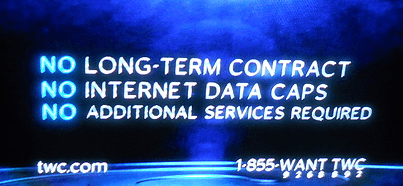
Time Warner Cable goes out of its way to advertise "No Data Caps."

Time Warner Cable goes out of its way to advertise “No Data Caps.”

Most broadband customers do not want usage-based billing or usage-capped Internet, but some providers force such usage plans on customers anyway.

“Different providers have had different philosophies on these things,” Marcus offered.

Marcus reported TWC Maxx deployment in Austin is finished, and the company is working on completing upgrades in Dallas, San Antonio, Raleigh, Charlotte, Kansas City and Hawaii by year-end. The latest markets to be upgraded — San Diego, Wilmington and Greensboro, N.C., will start this year, but speed increases will not begin until next year. The upgrades are improving customer satisfaction with a 35% drop in voluntary disconnects in Maxx service areas, but will cost an estimated $4.45 billion in spending this year by the country’s second largest cable operator.

Time Warner Cable Maxx has been very successful at bringing new customers to Time Warner, attracted by improved broadband speeds and better service, Marcus told investors. Maxx customers see broadband speed upgrades that dramatically boost speeds at no additional cost. Standard Internet speeds in non-Maxx markets are 15Mbps. In Maxx areas, customers receive 50Mbps. Customers signed up for 50Mbps “Ultimate” Internet in Maxx markets see that speed raised to 300Mbps.

Large sections of Time Warner Cable territory have yet to be upgraded, however. Marcus today said he plans to continue the Maxx upgrade effort as the Charter merger proceeds through a lengthy regulatory review process. If the merger is delayed or unsuccessful, Time Warner likely will announce additional cities targeted for upgrades in 2016, but customers should not expect speed changes until later that year or 2017. If the Charter merger is approved, areas bypassed for Maxx upgrades will likely get a more modest upgrade promised by Charter, with maximum broadband speeds of 100Mbps.

Marcus

Marcus

Time Warner Cable spent the last quarter pushing lower priced promotions to attract new and returning customers. That, combined with higher programming costs, increased spending on network upgrades, and pension expenses cut into the cable company’s profits, which declined 7.2% in the last quarter.

Time Warner Cable added 66,000 residential customers overall, its best ever second quarter and its first rise in any quarter since 2008, according to Marcus. Time Warner added 172,000 new broadband customers and 252,000 voice subscribers, primarily from a promotion that allows any subscriber to add phone service to their package for $10 a month. But Time Warner is not immune to cord cutting, and lost 45,000 video customers in the second quarter.

The cable company may have stepped up promotions to be certain it can report good results as investors wait for the Charter Communications merger to win or lose regulator approval. A triple play promotion for new customers runs as low as $89 a month and despite touting an earlier philosophy the company did not see much value promoting cheap phone service, it has apparently reversed course, boosting triple play upgrades as a result of reduced pricing.

It is also continuing strong customer retention policies, a sign Time Warner Cable will continue to respond when customers threaten to cancel unless they get a better deal.

“Our whole view of retention hasn’t really changed since the middle part of 2014,” said William F. Osbourn, Jr., acting co-chief financial officer. “Our view is that we will always rather save the customer than lose the customer, but I think we’re pretty disciplined about not giving away the farm in doing that.”

Some other highlights:

  • Programming costs rose 11%, a sure bet another rate increase will be forthcoming in the future;
  • Marcus loves mergers: “The only thing I’d add to that is that from an industry structure perspective, in roughly a quarter of our footprint, the deal [between AT&T and DirecTV] results in two competitors becoming one. And, generally speaking, that’s a positive for all the players in the industry”;
  • Time Warner Cable will continue to encourage customers to use their own set-top box devices (Roku, Apple TV, etc.) as an alternative to the traditional cable set-top box;
  • Roughly 12% of customers now own their own cable modems to escape Time Warner’s rental fee;
  • Despite the clamor for “skinny bundles” 82% of Time Warner Cable customers subscribed to the full video package;
  • In Maxx areas, customers need set-top boxes on all of their connected televisions. Most are opting for the cheapest option, taking an average of two less-capable DTA boxes instead of more expensive set-tops. DVR subscriber numbers have remain largely unchanged after Maxx upgrades.

Wireless Data “Traffic Explosion” is a Fraud; Network Densification Deferred

Phillip Dampier July 21, 2015 AT&T, Broadband "Shortage", Competition, Consumer News, Data Caps, Online Video, Wireless Broadband Comments Off on Wireless Data “Traffic Explosion” is a Fraud; Network Densification Deferred

Analysys Mason logoDespite perennial claims of an unmanageable wireless data traffic tsunami threatening the future of the wireless industry, there is strong evidence wireless data traffic growth has actually flattened, increasing mostly as a result of new customers signing up for service for the first time.
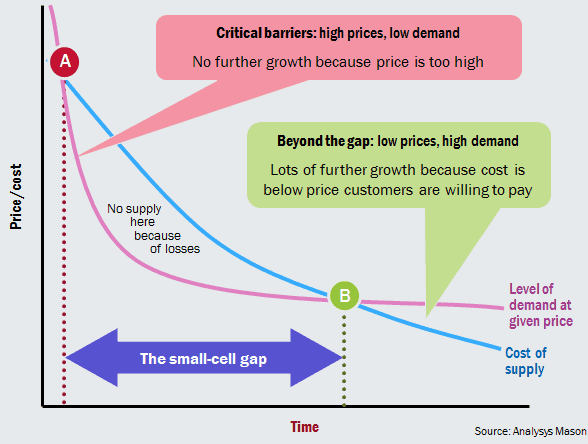
Expensive wireless data plans and usage caps have left consumers more cautious about how they use wireless data, reducing the demand on wireless networks and allowing carriers to defer plans for aggressive network densification they claim is needed to keep up with demand.

Analysys Mason discovered some of the biggest victims of the myth of the traffic tidal wave are the manufacturers and dealers of small cell equipment hoping to make a killing selling solutions to the wireless traffic jam. Vendors attending the ‘Small Cell, Carrier Wi-Fi and Small Cells Backhaul World’ event will have no trouble filling the modest amount of orders they likely received this year. While there is money to made selling small cells to manage data usage in very high traffic locations including shopping and sports venues, AT&T dropped plans to deploy 40,000 small cells on its network by the end of 2015, a goal that had been a key element of its Project Velocity IP (VIP) network initiative, and no other U.S. carrier has shown as much interest in small cell technology as AT&T once did.

It turns out, Rupert Wood, principal analyst at Analysys Mason writes, most operators admit they are not experiencing much “pain” managing data growth. As a result, rapid public small-cell densification, an important indicator of heavy traffic growth, is continuously deferred.

As customers confront costly, usage-limited data plans, they are deterred from the kind of usage that might actually create widespread traffic issues for wireless carriers. Instead, carriers are primarily relying on a mix of data caps, incremental upgrades, and gradual expansion of their traditional cell tower networks to keep 4G performance stable and expand coverage areas to improve customer satisfaction. AT&T claims most of its traffic concerns were abated with the 2014 acquisition of Leap Wireless’ Cricket network, which added to AT&T’s network capacity. The Cricket network never came close to offering nationwide coverage, however.

Figure_2_webWhen pressed for specifics, many wireless carriers eventually admit they have enough spectrum to handle today’s traffic demand, but will face overburdened and insufficient capacity tomorrow. But that is not what the evidence shows.

Analysys Mason:

Nations where the use of 4G is highest are not experiencing exponential growth in mobile data traffic. In fact, they have not been doing so for some time – even in developed Asia–Pacific. In the US, the CTIA recently recorded 26% traffic growth in 2014. If this figure is correct, the average usage per US mobile data subscriber barely changed at all in 2014: the recorded number of data subscribers grew by 22%, and the expected exponential curve of data traffic has morphed into an s-curve.

In fact, with wireless pricing so high in the United States, traffic growth here is minimal in comparison to Sweden, Hong Kong, South Korea and Japan. Most shift their usage to Wi-Fi as often as possible instead of chewing up their monthly data allowance.

Analysys Mason believes the forthcoming introduction of LTE-A — the more efficient next generation of 4G — will allow carriers to expand capacity on existing cell towers as quickly as future demand mounts without the need for massive numbers of new towers or small cells.

The analyst firm labels today’s cellular platform as a low-volume, high-cost network. If providers cut prices or relaxed usage caps, traffic would grow. It recommends operators should focus on increasing the supply of, and stimulating the demand for, data usage, and not simply expecting demand to come at some point in the near future. The analyst believes constructing a network of fiber-connected small cells may open the door to an exponentially higher capacity wireless network that performs better than traditional wireless data services and is robust enough to support high bandwidth applications that demand a strong level of network performance.

It would also benefit fiber to the home providers that could also market wireless backhaul service to wireless companies, helping defray the costs of constructing the fiber network and further monetizing it.

Some Time Warner Cable Customers Get a Small Speed Boost Thanks to Overprovisioning

Phillip Dampier June 29, 2015 Broadband Speed, Consumer News 6 Comments

timewarner twcTime Warner Cable customers in parts of the northeast have noticed their broadband speeds increased slightly over the last several days.

Stop the Cap! reader Howard Goldberg was among those who noticed Time Warner’s broadband performance in upstate New York has improved, at least for upper tiers.

“Over the past 24 hours, Speedtest.net (against the TWC site in Syracuse, and many others) is reporting 60-62Mbps down and 6.0-6.2Mbps up, an increase from 55/5.5Mbps we have had over the past few years,” Goldberg notes. He is subscribed to Time Warner Cable Ultimate, marketed in upstate New York as 50/5Mbps service.

We noticed the same thing late last week here in Rochester as speed test results now consistently top 60Mbps when using a Time Warner Cable-based server. The upstream speed increase was less visible, but still measurable.

Goldberg also reports ping times have dropped from the 18-22ms range to 13-15ms when using the Syracuse, N.Y. test site, which could also point to a more responsive Internet connection overall.

Cable companies occasionally deliver speeds that are actually faster than what they sell, known as overprovisioning, to improve customer satisfaction and boost their performance in the Federal Communications Commission’s ongoing national speed test program, designed to verify if providers are actually providing the speeds they are marketing to customers.

Are Time Warner customers in other areas seeing similar results? Report your findings in the comment section.

A Tale of Two Territories: Frontier Plans Upgrades for Newly Ex-Verizon/AT&T Customers While Legacy Areas Suffer

frontier-fast-buffalo-large-2The new CEO of Frontier Communications is promising more fiber to the home service and advanced ADSL2+ and VDSL2 service to dramatically boost Internet speeds… if you happen to live in a Verizon territory Frontier is planning to acquire in Texas, California, or Florida. For Connecticut customers that used to belong to AT&T, Frontier also plans to spend money to further build out AT&T’s U-verse platform to reach more suburban customers not deemed profitable enough to service by AT&T.

For legacy Frontier customers in other states? Frontier plans nothing beyond what it already provides — usually dismally slow DSL.

Speaking to investors during the JP Morgan Global Technology, Media and Telecom Conference, Frontier CEO Daniel McCarthy said upgrades offer the company new earnings opportunities, but a closer analysis reveals those benefits will only reach customers in areas where Verizon and AT&T already did most of the work and spent the money required to build advanced network infrastructure.

Verizon has spent millions upgrading customers in Texas to its FiOS service and has a significant fiber to the home presence in California and Florida. Because fiber infrastructure is already largely in place, Frontier will not have to spend huge sums to build a new network. Instead, it will spend incrementally to expand service to nearby service areas.

Mediocre broadband in upstate New York.

Mediocre broadband in upstate New York.

“The FiOS penetration is much higher, specifically in Texas, but we think there’s a lot of opportunity to drive FiOS penetration in Florida and California,” McCarthy said. “We see that as a big opportunity.”

Fierce Telecom notes Frontier won’t have to make a large investment outside of installing new DSLAMs in remote terminals or local Central Offices to deliver higher speeds over copper. Frontier will likely depend on VDSL2 technology on short copper line lengths in suburban areas and ADSL2+ in rural locations.

“I think in this case it might be replacing some electronics, but it’s not a heavy lift from a construction perspective,” McCarthy said. “By putting in a shelf and next-generation capabilities, whether it’s VDSL, ADSL2+, or all the different flavors you can use to serve the different loop lengths in a market you achieve the ability to bring a fresh product set into an area at a fairly low cost.”

While Frontier is willing to invest money in areas that are easy to upgrade, it has proven itself reluctant to consider major upgrades in its legacy service areas where it acquired traditional copper-based landline networks.

“The new states will clearly have new growth opportunities,” McCarthy said. “In Florida there has been a revival of housing in certain areas and subdivision growth in Texas and California.”

In Connecticut, Frontier will build on the acquired AT&T fiber/copper network with a modest expansion of U-verse.

frontier u-verse“We actually see growth opportunity in Connecticut,” McCarthy said. “As we go through and look at the Connecticut property, one of the things that have been a recent development from a technology perspective allows us to serve lower density parts of the state of Connecticut with U-verse product that was limited by densities and loop lengths in the past.”


Although the company often touts millions in upgrade investments, most legacy service areas see only modest service improvements, while the company continues to score very poor in customer satisfaction, especially in states like West Virginia, Ohio, Pennsylvania and New York. With Frontier’s ongoing focus on newly acquired service areas, long-standing customers in other states are feeling neglected.

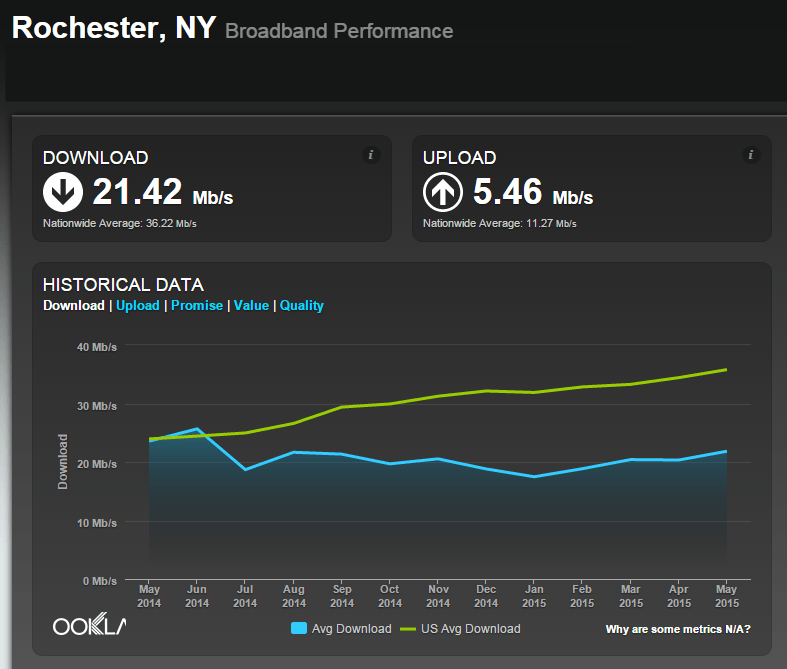
In upstate New York, the prevalence of Frontier Communications’ low speed DSL on the company’s legacy copper network has dragged down overall broadband speed ratings to some of the lowest in the country. Frontier territory Rochester, N.Y., in particular, is now among the worst cities in the northeast for overall broadband speed performance, now rated at just 21.42Mbps. The national average is 36.22Mbps. In comparison, Buffalo scores 24.31Mbps, Cleveland: 22.57Mbps, and NYC 55.56Mbps.

Stop the Cap! Changing Its Broadband Definitions: Broadband, Slowband, and Fraudband

Phillip Dampier February 3, 2015 Broadband Speed, Editorial & Site News 1 Comment

slow

Effective with the FCC’s redefinition of broadband as a connection capable of sustaining speeds of at least 25Mbps, Stop the Cap! is changing the terms we use in our reports to match:

  • Connections meeting or exceeding the FCC minimum will continue to be called “broadband,”
  • All broadband services at speeds generally under 25Mbps will from today be called, “slowband,”
  • Satellite Internet service will continue to be colloquially referred to as “fraudband” because it is generally incapable of delivering sustained, consistent speeds that meet even the FCC’s old 4/1Mbps broadband standard. Satellite Internet providers receive appalling customer satisfaction scores and rack up complaints about tiny usage allowances and speed throttles. A new generation of satellites eventually promises improved service and we will take another look when these services are actually up and running.

Search This Site:

Contributions:

Recent Comments:

Your Account:

Stop the Cap!