Home » customer satisfaction » Recent Articles:

2017 Edition of Comcast’s Customer Service Makeover (Rebooted)

It’s the end of summer and that means it is time for the 11th annual Comcast Customer Service Makeover — the annual ritual of going through the motions of saying you are going to improve the customer experience, without actually doing so.

Since at least 2006, Comcast has promised it would get better, but somehow never does. That the cable company remains one of America’s most-hated companies 11 years after first promising to do better, evidently doesn’t faze J.D. Keller, the latest executive assigned to win customers over. At least Keller admits it will be a tough job to turn around one of the country’s greediest and nastiest companies. He likens it to “turning a ship around.” We’re not talking about a weekend pleasure craft either. We’re talking a colossal toxin-filled tanker here. That’s an appropriate vision of Comcast, where the craft of alienating customers with impenetrable offshore customer service and local cable stores complete with bulletproof glass to protect the employees from customers has been finely honed for years.

To paraphrase Lily Tomlin’s Ernestine, Comcast’s customer service experience is best summed up as: “We don’t care — we don’t have to. We’re the cable company.”

Somehow, Comcast has spent another $300 million of ratepayer’s money for a three-year “corporatewide push,” beginning in 2015, to fix the damage. Considering the company’s war-criminal-like reputation score has barely budged, one wonders if the $300 million was spent on a golden Band-Aid… that has since fallen off. Comcast’s bullet points of new wonderfulness doesn’t seem to impress:

  • Comcast has opened eight Apple-style XFINITY retail stores in the Twin Cities, notes the Star Tribune. Have you ever been excited visiting your phone, gas, or mobile company store? Didn’t think so. Shiny and new doesn’t help if you are still standing in line for 30-60 minutes to swap out a cable box.
  • Comcast has beefed up its call center staff. But many customers tell us that is more of the same S&M experience they get now from offshore call center representatives, who apparently delight in having their revenge against evil and annoying Americans. Comcast’s customer service representatives are excellent at reading scripts, but when you ask for credit or above-and-beyond help with a service problem, suddenly their English skills go missing. “Twice nothing is still nothing.”
  • Comcast has put more technicians on the street. But they would not have to if their cable infrastructure wasn’t ineptly maintained in some areas of the country.
  • Comcast has developed online tools so customers can fix problems themselves. That’s a slight improvement, if only because you don’t have to call for a verbal torture session with the Philippines call center. But in fact such tools benefit Comcast more than customers, because it cuts their costs.

Mr. Keller:

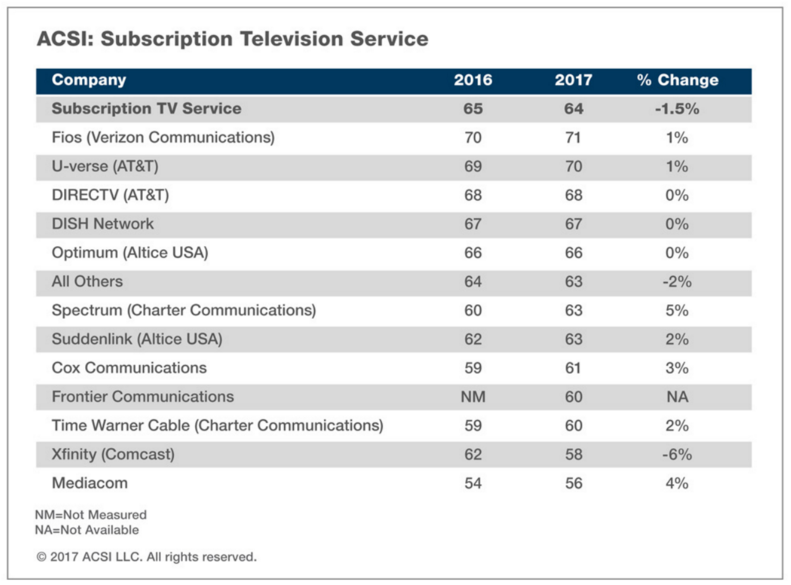
“When I interviewed with Steve White [Comcast’s West Division president] and CEO Dave Watson, all they talked about was customer experience. Dave Watson regularly calls clients deep in our organization to ask, ‘How’d we do?’ He’s out on the street listening to people. There is no ivory tower here. We have a long way to go to respect our customers and do a better job. Our goal is to be recognized by our customers and J.D. Power as the No. 1 communications company in the world. That’s what brought me to Comcast. A recent American Customer Satisfaction Index report gave Comcast its highest marks in 15 years [although it still trailed Verizon, AT&T and Charter Communications].”

Indeed, it trails among many, many, many, many, many other companies. What does “clients deep in our organization” mean, exactly? Comcast is calling itself? We also find it impossibly hard to believe a division president in manning a booth on the street asking random customers how they feel about Comcast. At least not without his bodyguard. Comcast is the very definition of an “ivory tower” corporation, completely out of touch with the wants and needs of its own customers. Want evidence? Junk fees, channel shoveling, data caps, offshore customer service, constant rate increases, tricky promotions, and those bullet-proof glass windows at the customer service center, for a start.

Every year, Comcast reminds customers it has a long way to go to repair its emotionally abusive relationship with customers, who feel trapped with a company many wish they could ditch once and for all. Like other tragic relationships gone bad, the promises that things will get better are often empty.

Keller’s out-of-touchness shines as he talks about “respecting our customers and their time.” Comcast commits to two-hour service windows, and claims they text or call 30 minutes ahead of let customers know when the truck will arrive. Customers tell us that is true in some places, but not in others. The arrival of a repair crew does not guarantee the problem will be adequately addressed during that call either. Many tell us they have to get several crews out before a problem is really fixed. Keller also claims Comcast reads all the feedback customers give the company, but doesn’t mention it routinely ignores most of that feedback. Otherwise, those constant annoyances and policies that gave the company its horrific reputation would have been dispensed with a decade ago.

“We believe if customers are happy with us in the first 90 days, they’re going to stay with us for life,” Keller said with a straight face, forgetting that many customers don’t have a choice. Swapping one cable company for another is about as common as choosing where you get your tap water. It’s Choice “A” or Choice “A.” You decide.

Keller suggests he thought long and hard before accepting a job at the most loathed cable company on the planet.

“I took the time to take a deep breath and spend time with my wife and three children,” Keller claimed. “I knew I wanted to challenge myself. I’m not happy unless there’s some big boulder I have to push up the hill.”

Somehow, and probably with the help of a generous compensation package, he got over his concerns.

There are two ways to deal with Comcast’s nightmarish reputation. Either blow it up and start a new relationship with customers or convince yourself that your poor reputation barely exists at all and is easily fixed. The latter is what Comcast’s annual exercise in “improving the customer experience” is all about. Define a problem as fixable, pretend to fix it, and next year tell customers you are making progress. After a decade, this annual ritual is now a tradition.

Until customers have adequate competitive options to send a real message Comcast cannot afford to ignore (“I and all my friends are canceling service”), expect more of the same.


American Enterprise Institute’s Shallow Formula for Broadband Nirvana

AEI: If you bought broadband service, that means you like your service and don’t need or want anything better.

The American Enterprise Institute wants the FCC to judge to quality of America’s broadband based on what customers are able to buy today and how much they are willing to pay to get it.

Section 706 of the Telecommunications Act of 1996 requires the FCC to report to Congress whether broadband “is being deployed to all Americans in a reasonable and timely fashion.” As part of that process, the FCC must determine if Americans are getting internet connections capable of providing “advanced telecommunications capability.”

If the FCC reports to Congress that the country’s biggest telecom companies are letting their customers down with inadequate service or no service at all, that can create conditions for the FCC to step in and start insisting on more competition and oversight as well as setting benchmarks for providers to meet. If the report shows that broadband service is adequately provided, the FCC need not regulate, and in some cases such a finding will fuel calls to further deregulate the industry by getting rid of “unnecessary regulation.”

Not surprisingly, findings since 2001 have varied depending on which political party holds the majority on the Commission. Under President George W. Bush, the FCC consistently found broadband service was being adequately deployed to Americans. The FCC also set the bar pretty low on broadband speed, claiming anything at or above 4/1Mbps service constituted “broadband.” That definition comfortably accommodated DSL service from the phone companies.

Wheeler – Argued for better broadband and more competition.

During the Obama Administration, the FCC set the bar higher. With dissent from the Republican minority, the FCC raised the minimum speed that could be defined as broadband to 25/3Mbps, immediately excluding most DSL and wireless connections. In 2015, former FCC Chairman Thomas Wheeler specifically excluded satellite and wireless connections from that formula, despite objections from FCC Commissioner Ajit Pai. Particularly under Wheeler’s watch, the Democratic majority frequently complained about inadequate broadband and competition, and used Section 706 as its authority to override state laws in North Carolina and Tennessee that placed onerous restrictions on municipal broadband networks. Wheeler felt such laws were anti-competitive, but the courts ruled the FCC exceeded its authority and overturned his pre-emption orders.

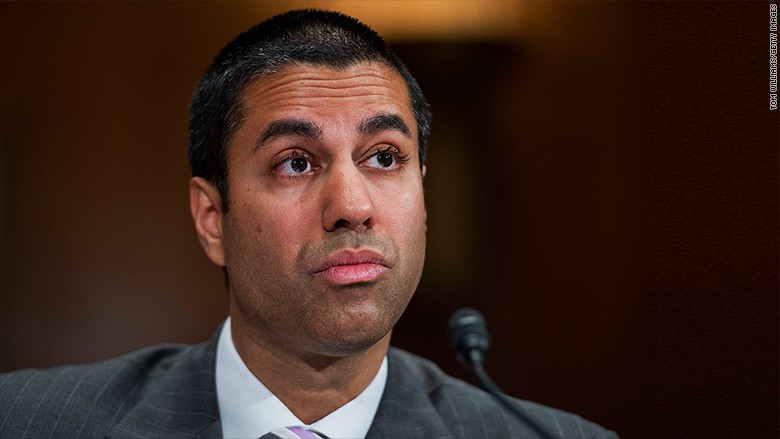
Under the Trump Administration, FCC Chairman Ajit Pai seems to be headed down a similar path taken during the Bush Administration, which was optimistic about the state of broadband service and, as a result, applied a lot less pressure on the telecommunications industry.

Chairman Pai is seeking to overturn current Net Neutrality regulations and seems ready to support efforts to undermine the broadband speed standard established by his predecessor. That would allow mobile/wireless companies to offer 10/1Mbps speed and have it qualify as broadband service. Even better, ISPs — wired or wireless — would be considered “competitive” in many cases, even if only one provider offered service in the area.

Pai’s proposal was met with serious objections from Democratic Commissioner Mignon Clyburn who claimed even the current 25/3Mbps standard no longer met the definition of “advanced telecommunications capability.”

“The statute defines advanced telecommunications capability as broadband that is capable of ‘originat[ing] and receiv[ing] high-quality voice, data, graphics, and video telecommunications. High-definition video conferencing is squarely within the rubric of ‘originating and receiving high-quality… video telecommunications,’ yet the 25/3Mbps standard we propose would not even allow for a single stream of 1080p video conferencing, much less 4K video conferencing. This does not even consider that multiple devices are likely utilizing a single fixed connection, or the multiple uses of a mobile device.”

<

div id=”attachment_954762″ class=”wp-caption aligncenter”>

Pai: Wants broadband providers and the competitive marketplace to determine whether broadband is good enough.

AEI dismissed the entire debate, claiming the only people who will respond to the FCC’s request for comments on the subject will be “pundits, special interests, and companies with skin in the game.”

Instead, AEI proposes the FCC rely on watching customers navigate their broadband options — a monopoly for some, duopoly for many others — and only address problems if something unusual emerges. AEI’s test is to see if “a location or demographic is inexplicably different and purchases less than would be expected.”

If something odd does happen in a particular area, AEI argues there could only be two reasons for that:

  • Barriers to competition;
  • Outdated government regulations and policies standing in the way of progress.

Missing from AEI’s list of possibilities is the presence of an abusive monopoly provider, a comfortable duopoly among two providers with no interest from a third competitor to enter the market, or an area served by two lackluster providers that won’t invest in their networks.

AEI’s test depends entirely on gathering data about what internet services are available for sale in any particular area now and then study who is buying what. But this does not measure customer satisfaction or consider whether those speed tiers and prices are adequate.

Under AEI’s test, “if a geographic area does not have broadband, the FCC could use the results of its customer study to determine what customers in the area would likely find valuable. Then, the FCC could do a cost-benefit study and an economic feasibility study — and conduct a reverse auction if a subsidy is potentially needed — to determine what, if any, financial incentive might be appropriate for the area.”

In other words, the same think tank that has been on record for decades opposing government subsidies to private companies now wants to offer telecom companies government funding to build what would become largely unregulated privately-owned broadband networks that would run with little or no oversight.

AEI’s willingness to let “customers express their opinions through their purchases” is hardly an adequate replacement for current broadband policies designed to keep the U.S. competitive with the rest of the world and ensure adequate service and competition. As any cable subscriber knows, you can subscribe to Comcast or Charter/Spectrum and still loathe your options and want something better. AEI doesn’t appear interested in seeing you get those options, much less preserve what little oversight, consumer protection, and broadband benchmarks we have now. Neither does current FCC Chairman Ajit Pai.

Mid-Rivers’ Mandatory Usage-Based Billing: $19.99/Mo + $0.20/GB

Mid-Rivers Communications, a Montana-based telecom co-op, wants everyone to believe their mandatory, usage-based broadband scheme that charges $19.95 a month + $0.20 per gigabyte is popular with their customers.

After the company noticed that fewer than 20% of customers were responsible for more than 90% of Mid-Rivers’ network traffic, it decided to ditch its traditional usage-capped, speed tier plans in favor of a compulsory usage-based billing scheme that included the maximum speed available, sometimes as high as 1Gbps, with no usage allowance.

To listen to Michael Candelaria, Mid-Rivers CEO and general manager, people have lined up at the doors just waiting to sign up, according to an interview published by Telecompetitor:

Initially the company tested usage-based pricing as an option in one CLEC market. But considering that 80% of customers opted for usage-based pricing within one year of its introduction, Mid-Rivers moved completely to usage-based pricing and launched it throughout all four CLEC markets.

Mid-Rivers has been particularly proud of the response it has received from local businesses. Candelaria noted that local hotels have seen occupancy drop after the area experienced an oil-related boom, followed by a bust. Nearly-empty hotels were paying $500 to $1,000 a month for high-bandwidth connections from competitors but only using a fraction of the capacity. The Mid-Rivers usage-based broadband offering was perfect for them.

During certain months, the hotels’ bills are dramatically lower than they were before.

“When the hotel is full, their bill goes up and they know why,” Candelaria said.

Meanwhile, as businesses that were not Mid-Rivers customers heard about the usage-based offering, “they came to us” after “we beat on their door for 20 years,” he noted.

But as news of the interview spread, it seems more than a few customers are not happy with Mid-Rivers’ new broadband pricing, and accused the company of propagandizing its usage based pricing scheme and censoring social media to suppress customer backlash.

Candelaria admitted the company used to take a lot of heat from customers that called up and asked for the cheapest internet plan available, which was $40 a month for 1.5Mbps service. At those speeds and prices, customer slammed the company’s Facebook page.

“This is where Candelaria time traveled a bit on his answer,” reflects Dan Corey, a customer rebutting Candelaria’s case. “Before the usage-based internet [plans], the tiers Mid-Rivers [offered] were 8, 12, and up to 50Mbps. There has not been a 1.5Mbps speed at Mid-Rivers for years.”

These days, Candelaria claims, complaints about speed and pricing are mostly gone.

“Of course they are gone,” responds customers J.P. and Kyle Jones, who jointly shared their feelings with Stop the Cap! “Mid-Rivers now censors their social media after taking a lot of heat so complaints are never publicly seen on their Facebook page.”

“Mid-Rivers must approve any comments made on their Facebook page, so 90% of the complaints are never seen unless Mid-Rivers has a full (even if not accurate) response ready to post along with it,” adds Corey. “No dissatisfied customers would know of others because of the control. Their Facebook page used to show all comments when posted, but that changed once they got a better understanding of how to control the flow of comments.”

Jones points out that the reason “80% of customers opted for usage-based pricing” is that any account change automatically forced the customer onto a usage-based pricing plan whether they wanted it or not. Most customers, including himself, do not want data caps or usage pricing, but he didn’t get a choice in the end.

“Put yourself in the shoes of a customer that used to be enrolled in Mid-Rivers’ Preferred Plan, which cost $59.95 a month and includes 600GB of usage at 12/1Mbps speeds,” writes J.P. “People don’t live in Montana for the social life so we spend a lot of time streaming video at home. Under Mid-Rivers’ new plan, if I used 500GB a month, I’d pay $20 for the account and $100 in usage charges — double what I paid a month earlier just for faster speed I could have paid more to get if I wanted or needed it. How many people do you think are enthusiastically waiting to pay double what they used to for internet?”

Mid-Rivers new usage-based plan.

For Candelaria, “Wide Open Wi-Fi”  is about selling fast internet access for less, and customers should only pay for what they use.

“People have been paying for utilities by usage for some time,” he told Telecompetitor. “Customers don’t tally up how much electricity they use and then order a 30-kilowatt plan and they don’t count how many showers they take to determine what kind of water plan they need. Why should the internet be any different? Everybody should have good internet. It doesn’t matter if you’re rich, poor, you should be able to afford fast internet.”

Customers like J.P. agree with wanting fast and affordable internet, but argue this isn’t that. Where available, “Wide Open Wi-Fi” quickly becomes the only option Mid-Rivers offers, he claims.

“The reason for the [high] ‘take rates’ is that if you attempt to change or upgrade service, you are forced onto the usage-based service,” adds Corey. “There is no choice, so the take rates are very misleading. Customer satisfaction would increase for those that don’t use the service as of now. However, with more and more of the world going to internet, those customers will feel the squeeze soon enough.”

For customers that avoid calling Mid-Rivers and keep their heads down to keep their current plan, that doesn’t stop the company from eventually notifying customers their plan was changing whether they liked it or not.

Mid-Rivers older tiered plans.

“You will be ‘offered’ the Wide Open internet shortly I’m sure. Just like we in the cable modem towns were,” noted BigSkyGuy. “However, once not enough people switch to it, or it’s been some pre-determined amount of time, you’ll be forced onto it like the rest of us. Then you can enjoy the larger bills. Just like your forced router unfortunately.”

Mid-River sells its “Wide Open” service as a great way to get rid of data caps and tiered plans, and includes a free Wi-Fi router:

  • Virtually unrestricted speeds
  • Connected Home Wi-Fi included!
  • No more tiered plans! You automatically get the fastest speed!
  • No more data caps
  • Pay for only what you use
  • Your speed and experience will be greatly enhanced
  • Your perfect plan – whether you need the fastest speeds or the most affordable option
  • You as the customer will have control over your Internet bill*

That asterisk points to fine print that explains for $19.95 a month, you get no data allowance. You are billed $0.20 per gigabyte in one gigabyte increments. Don’t like the high bill that results?

“Your bill can be controlled by monitoring how much data you are using, use less and your bill will decrease,” the company explains.

But for most internet users, using less isn’t an easy option, especially as cord-cutting shifts more viewing towards the internet. Once Netflix, Hulu and similar services detect the faster speeds available on Mid-Rivers’ metered plan, their players increase video bandwidth to match available speed unless the customer intervenes. If they don’t, streaming can get very expensive.

“I have been hit with that Wide Open internet scam […] and unless you change your settings in [Netflix, Hulu, CBS, etc.] it’ll run you up to 7GB an hour, especially when it reads that speed setting from the Wide Open. In essence, Mid-Rivers is making you pay $1.40 per hour of Netflix,” writes BigSkyGuy. “Now granted, you can go in and change your settings, but how many people really know you can do that?”

The meter is lurking.

Candelaria argues the majority of Mid-Rivers customers use less than 100GB a month and their bill is less than $40, which is nearly $5 less than Mid-Rivers’ cheapest plan at $44.95, which includes a 300GB data allowance. He also claimed ‘the change to usage-based broadband has increased customer satisfaction and take rates – and while margins initially dropped, profitability was back to its previous level within six months.’

To accomplish that, either the company has signed up more new customers under the plan than it expected or usage charges from heavier users are covering the lost revenue. For Candelaria’s statement to remain true, “most customers” would have to use less than 100GB of usage a month for their bill to remain under $40. Lighter use customers may benefit from the faster speeds and continue to pay less as long as their usage stays at or near 100GB a month. But as average internet use continues to increase, so will customers’ bills.

Jones says the news isn’t all good for Montana businesses either.

“In areas where Charter/Spectrum offers business internet service, their bills are a fraction of what Mid-Rivers is charging if that business tends to run up a lot of usage, and there are no surprise bills from Mid-Rivers’ traffic charges,” Jones notes. “The problem is that Mid-Rivers is charging sky-high usage fees of $0.20/GB while other ISPs pay at most pennies per gigabyte. In fact, most ISPs buy bandwidth based on meeting demand during peak usage times, not traffic alone. During off-peak times, using your connection costs Mid-Rivers next to nothing, but Mid-Rivers keeps charging $0.20/GB day and night.”

BigSkyGuy notes other ISPs in the area are offering customers a better value proposition with flat-rate internet that will quickly be the envy of many Montanans facing future Mid-Rivers’ usage charges:

  • RTC/Reservation Telephone Cooperative: (100/100Mbps) UNLIMITED DATA $55/month
  • Midco/Midcontinent Communications: (75/5Mbps) UNLIMITED DATA $56/month or (25/3Mbps) UNLIMITED DATA $42/month
  • Nemont: (10/10Mbps) UNLIMITED DATA $71/month

Mediacom Touts Gig Speeds But Also Acknowledges Low Scores

While Mediacom introduces gigabit speeds to a growing number of their customers, it also acknowledges it has one of the worst customer satisfaction scores of any cable company in the country.

Company officials were in the Quad-Cities of northwest Illinois and southeastern Iowa to speak about 1,000Mbps service introduced earlier this year for its 92,000 customers in the area, according to an article in the Dispatch-Argus.

“No where else in the country has this much broadband capability,” said Phyllis Peters, director of communications for the north central division of Mediacom. “You can live in Port Byron or Ottawa or down the road in Marion or Carbondale, and you’re using the same amount of bandwidth. You have just as much demand and need for bandwidth as if you were living in Austin, Texas.”

To support the expansion, the company added nearly 30 miles of additional fiber capacity to support the faster internet speeds. But so far, fewer than 250 customers in the area have upgraded to gigabit speeds. Most seem content with paying less for slower speeds, but that does not mean customers are not using their internet connections.

“We’ve been looking at an internet business that has been growing,” said J.R. Walden, senior vice president of technology and chief technology officer for Mediacom. “The bandwidth is growing at as much as 65 percent a year for close to 20 years. It means we have to double the size of the network every 18 months.”

Walden

Walden claims that once gigabit speed is embraced by a larger number of their customers, they will contemplate another upgrade to 10Gbps speeds.

Along with faster wired internet, Mediacom has also been installing Wi-Fi hotspots for its customers. XStream Wi-Fi is available to non-customers for a 30-minute trial or unlimited use during certain special events. Mediacom’s broadband customers get free unlimited access by logging in with their Mediacom username and password.

The cable company has 249 Wi-Fi hotspots in Moline, Rock Island, East Moline, Silvis, Davenport and Bettendorf, mostly in business districts or around event venues. Mediacom customers can also use their credentials to access Wi-Fi from other nearby cable operator-operated hotspots, notably those belonging to Comcast, which dominates in Illinois.

The cable company has also been promoting its internet program for the income-challenged. Connect2Compete is a $9.95-a-month internet service for families with at least one student in kindergarten through 12th grade who qualifies for the federal school lunch program. But like most cable companies, Mediacom’s first interest is to protect its own revenue, so it excludes current customers from enrolling if they already scrape enough money together to pay for regular broadband service or who have a past-due balance or unreturned equipment from an old disconnected account.

The American Consumer Satisfaction Index rates Mediacom dead last in 2017.

That is one of the many reasons Mediacom’s customers dislike the company. It perennially scores dead last among all the nation’s cable operators in Consumer Reports’ annual surveys. The Better Business Bureau has also documented multiple bad reviews and KWQC-TV in Moline reports Mediacom’s internet service is notorious for its repeated outages:

JoEllen Seibel said she’s used the company for internet for the last 8 years and has had little to no connection for the last four months.

“It’s all day long, all day long we get no reception.”

Seibel said technicians have come to her house multiple times to fix the problem but is still without service.

“It makes me frustrated if something is really going on on their end that’s what they need to tell their customers or something instead of just sending someone out.”

Nathan, another Mediacom customer, complained to the Better Business Bureau his internet service is completely unreliable.

“As much as I was excited about our internet speeds, they are never persistent. Internet goes out at least ten times a day,” he told the BBB.

Glendon adds Mediacom advertises fast internet speeds it cannot reliably provide its customers.

“I subscribe to 150/30Mbps internet. I rarely get 150 down, usually 50-60, and during peak [usage periods], [speeds drop] into the teens,” he complains, noting things have not improved despite multiple technician visits and a manager’s intervention.

“Very incompetent company that doesn’t seem to care if they’re billing you for a service they can’t provide,” is Glendon’s conclusion.

“We’re not unaware that some of the customer satisfaction scores put out by third-party organizations have had us on the lower end and we think we can do better and to some extent deserve a better score and we’ve been working on that,” Walden told the TV station.

Frontier’s March to Oblivion: Bankruptcy In Its Future?

Frontier Communications is quickly becoming the Sears and Kmart of phone companies, on a slow march to bankruptcy or outright oblivion.

What started as a small independent phone company in Connecticut has grown through acquiring overpriced or decrepit landline cast-offs, mostly from Verizon, leaving itself with massive amounts of debt and infrastructure it is not willing to upgrade.

Despite rosy prognostications given to customers and shareholders, few are willing to take Frontier’s word that life is good with a company that still relies heavily on copper wire phone and DSL service.

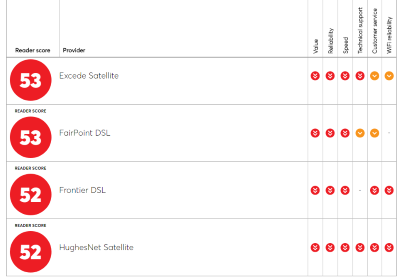
Don’t take out word for it. Just watch the line of customers heading for the exits, canceling service and never looking back. As Frontier continues to lose customers fed up with its bad DSL service, rated even poorer than satellite-delivered broadband by Consumer Reports, its only chance to grow is to acquire more customers through more acquisitions. Unfortunately, after another disastrous transition for former Verizon customers in Florida, California, and Texas, Frontier’s bad reputation is likely to leave regulators and shareholders concerned about Frontier’s ability to manage yet more acquisitions in the future.

The Wall Street Journal reports Frontier bet on making it big with rural and suburban landlines, and lost.

Frontier’s mess has infuriated shareholders who invest in the stock mostly for its dividend payouts. The Norwalk, Conn. company recently announced it slashed its dividend, causing investors to flee the stock. Shares are down 69% so far this year. In a desperate bid to keep its Nasdaq listing, the company announced an unprecedented 1-for-15 reverse stock split just to prop up its share price.

Frontier’s slow hemorrhage of landline customers turned into a flash flood in the spring of 2016 after botching yet another “flash cutover” of customers acquired from Verizon. Verizon’s decision to sell off its landline networks in Florida, California, and Texas (mostly acquired from GTE by Verizon predecessor Bell Atlantic) was good news for Verizon, bad news for Frontier’s newest customers. Frontier hates to spend money to overhaul its copper-based facilities with fiber. It prefers to buy service areas from companies that undertook fiber upgrades on their own dime. Verizon had already upgraded large sections of those three states with its FiOS fiber to the home network. Frontier’s interest was primarily about acquiring that fiber, Frontier finance chief Perley McBride told the Wall Street Journal. Even McBride admitted Frontier failed to do a good job integrating those customers.

Consumer Reports rates Frontier DSL lower than one satellite broadband provider.

That should not be news to McBride or anyone else. Frontier has repeatedly failed every flash cutover it has attempted. The worst recent examples were Frontier’s botched 2010 transition in West Virginia, where the company inherited copper landlines neglected by Verizon for decades. Customers were infuriated by Frontier’s inability to maintain service and billing, and the company was investigated by state officials after many customers lost service, sometimes for weeks. In Connecticut, Frontier messed up a transition of its acquisition of AT&T’s U-verse system, having learned nothing from its mistakes in West Virginia or elsewhere. The company was forced to pay substantial service credits to residential and business customers that were offline for days. Thus it was no surprise yet another hurried transition would lead to disaster last spring. Regulators received thousands of complaints and a significant percentage of longtime Verizon customers left for good.

Frontier CEO Dan McCarthy appears to be even less credible with investors and customers than his predecessor Maggie Wilderotter, who may have retired with an understanding the long term future of Frontier looks pretty bleak. McCarthy has repeatedly put an optimistic face on Frontier’s increasingly poor performance.

John Jureller, Frontier’s last chief financial officer, routinely joined McCarthy in putting a brave face on Frontier’s stark numbers. He repeatedly tried to fuel optimism by telling investors the Verizon landline acquisition would make revenue trends “very positive.”

Jureller is no longer with Frontier. His replacement is the aforementioned McBride, who has a reputation as a “turnaround” expert, usually at the expense of employees. McBride has already helped oversee the permanent departure of at least 1,000 employees, laid off as part of what Frontier is calling “a customer-focused reorganization.” McCarthy prefers to tell Wall Street the layoffs are about reining in costs, despite the company’s profligate spending on acquisitions.

McBride told the Journal he doesn’t expect much revenue growth at Frontier anytime soon in California, Texas, and Florida. McCarthy’s grand turnaround plan isn’t working either. In fact, customer ratings of Frontier are falling about as fast as a rock thrown off a cliff.

There is little evidence Frontier will improve its dismal American Customer Satisfaction Index score in 2017. It finished dead last among internet service providers last year, falling 8% despite taking on new customers and allegedly upgrading others. Frontier’s overall grade was second to last across all categories in the telecom sector. Frontier managed to achieve bottom of the barrel scores despite broad upticks in customer satisfaction among other similar providers last year. Verizon FiOS achieved a 7% improvement to a best-ever customer satisfaction rating. In areas acquired by Frontier, as soon as the service was renamed Frontier FiOS, ratings plunged.

So has Frontier’s revenue, which continues a downward spiral. The company posted a loss of $373 million last year compared to $196 million in losses a year earlier. It has committed to spending $1 billion on its network this year, but customers uniformly report few substantial service improvements, and many wonder where the money is going.

Frontier is also upset that Verizon, in its zeal to make its landline properties in California, Texas, and Florida look as good as possible, stopped collection activity on overdue accounts just before the sale, saddling Frontier with thousands of deadbeat customers Verizon should have written off as uncollectable long ago, but never did.

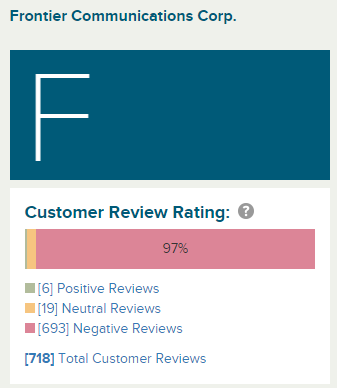
Yesterday, the western New York office of the Better Business Bureau reported Frontier had achieved an “F” rating, amassed nearly 9,000 complaints, and out of 718 customer reviews, just six were positive:

We find a high volume and pattern of complaints exists concerning prior Verizon consumers who have not had a smooth transition to Frontier Communication since Frontier Communications took over various Verizon customers on April 1, 2016. Consumers have reported that services did not transition properly: many do not have services or are having spotty service with outages; many internet issues, from slow speeds to complete outages, consumers advise they are paying for certain levels of internet speeds but are not receiving those levels. Cable issues including missing networks, movie on demand concerns, issues with purchased subscriptions not carrying over, titles consumers have paid for (purchased licensed for) not being uploaded to their libraries and no solutions are being offered; and inability to access items like DVR boxes at the same time (multiple boxes in households not functioning); the Frontier App is not functioning for consumers; not fulfilling the rewards advertised with new service signups; charging consumers unauthorized third party charges on their telephone bill and not properly applying credits to consumer’s bills or consumers not being able to login to pay their bills.

When consumers call to receive assistance many report to BBB that they are hung up on or calls are disconnected and [are not followed up] by Frontier representatives. Consumers are transferred from representative to representative without receiving any assistance to their concerns many times resulting in a disconnection.

We have also identified a pattern in [Frontier’s] responses to complaints stating:

  • Per Tariff, in no event shall Frontier be liable in tort, contract, or otherwise for errors, omissions, interruptions, or delays to any person for personal injury, property damage, death, or economic losses. Frontier shall in no event exceed an amount equivalent to the proportionate charge to the customer for the period of service during which such mistake, omission, interruption, delay, error or defect occurs. Frontier will apply a credit based on the customer’s daily service rate.
  • We trust that this information will assist you in closing this complaint.  We regret any inconvenience that ‘consumer name’ may have experienced as a result of the above matter.

The business did not respond to the pattern of complaint correspondence BBB sent.

“Cable companies are beating the pants off Frontier,” Jonathan Chaplin, an analyst for New Street Research, told the newspaper. Heavy targeted marketing of Frontier’s customers, especially those served by Charter Communications in states like New York, Texas, Florida, and California are only accelerating Frontier’s customer cancellations.

Frontier’s cost consciousness and deferred upgrades as a result of its financial condition are only allowing cable companies to steal away more customers than ever, as the value for money gap continues to widen. While Frontier has failed to significantly upgrade many of their DSL customers still stuck with less than 10Mbps service, Charter Communications is gradually boosting their entry-level broadband speed to 100Mbps across its footprint and selling it at an introductory price of $44.99 a month.

Even Verizon sees the writing on the wall for the revenue prospects of landline service, especially in areas where it has not undertaken FiOS upgrades. Verizon DSL is still very common across its northeastern footprint, particularly in states like New York, Pennsylvania, Virginia, and Maryland. Upstate New York is almost entirely DSL territory for Verizon, except for a few suburbs in Buffalo, Syracuse, and the state’s Capitol region. Verizon soured on upgrading its copper facilities in these areas years ago, and has contemplated selling them or moving customers to wireless service instead.

Verizon spokesman Bob Varettoni admitted Verizon’s strategy was to “sharpen our strategic focus on wireless,” which makes Verizon considerably more money than its wireline networks.

“If Verizon’s selling assets, they’re selling them for a reason,” Chaplin said. “Verizon had taken those markets [in California, Florida, and Texas] pretty close to saturation before they sold. That’s the point at which they punted the assets to Frontier.”

Frontier cannot continue to do business this way and expect to survive. Investors have circled 2020 on their calendar — the year $2.4 billion in debt payments are due. Another $2.5 billion is due in 2021 and $2.6 billion in 2022, not including interest charges and other obligations. Refinancing is expected to get tougher at struggling companies and interest rates are rising. The pattern is a familiar one in the telecom industry, where acquirers like FairPoint Communications and Hawaiian Telcom spent heavily on acquiring landline cast-offs from Verizon. Customer departures, a financial inability to upgrade facilities quickly enough, and heavy debts forced both companies into bankruptcy, precisely where Frontier Communications will end up if it does not change its management and business practices.

Search This Site:

Contributions:

Recent Comments:

Your Account:

Stop the Cap!