Home » copper wiring » Recent Articles:

Frontier’s Latest Salvation Plan Doesn’t Include Significant Broadband Upgrades

While celebrating its success at cutting $350 million in expenses, Frontier’s newest plan to keep the company from drifting towards bankruptcy is a $500 million increase in revenue (and hopefully profits) with a series of “revenue enhancements” and cost cutting.

Significant broadband upgrades in legacy DSL service areas are not on the table, as Frontier continues to spend most of its capital on matching Connect America Funds (CAF) and state grants to expand broadband into unserved and underserved rural areas.

“Approximately 80% of our capital program continues to focus on revenue generating and productivity enhancing projects,” said R. Perley McBride, Frontier’s outgoing chief financial officer. “The focus of our capital spending remains consistent. We continue to focus on our CAF builds, using both wired and wireless technologies.”

Frontier has been criticized by some for spending too much on its network and acquisitions and not enough on shareholder return. The company suspended its dividend in February, and the share price has remained below $6 a share since July. After announcing its latest quarterly results and a new $500 million EBITDA initiative on July 31, the average share price posted only modest gains of around $0.25 a share.

Frontier’s business remains troubled, with looming debt repayments in its future. The date to remember is Sept. 15, 2022 — the day Frontier needs to repay $2 billion in unsecured bonds to maintain its credibility in the credit markets. If it fails to pay, the company could find future financing difficult, which is often what triggers a trip to bankruptcy court.

The year 2022 is also very important to Californians. Frontier disclosed it planned to expand rural broadband service to 847,000 unserved/underserved rural residents by the end of 2022, with specific commitments in the next few years to upgrade 77,402 locations, in part with CAF funding, increase broadband speed for 250,000 households, and deploy newly available service to 100,000 homes.
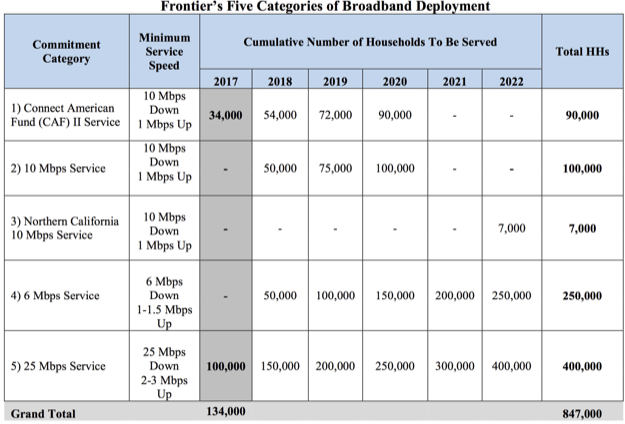
Frontier’s own deployment goals in California — goals the company may not be honoring. (Image courtesy of: Steve Blum’s blog)

According to the California Emerging Technology Fund (CETF), Frontier has no intention of meeting its rural broadband commitments. In effect, similar to Charter Communications, it merely made the commitments to win approval of its acquisition of Verizon’s wireline and FiOS business in California.

A day of reckoning for the company’s alleged failure to meet its obligations is likely forthcoming. Steve Blum’s blog notes Frontier isn’t saying much:

In its formal response to CETF’s allegations, Frontier never actually says that it kept to that timetable. All it says is that “Frontier sent a letter to the Communication Division dated March 8, 2018 on its commitments that includes a confidential attachment reflecting completed locations through December 31, 2017”. It sent a letter, but doesn’t say what’s in the letter or even claim that the letter documents fulfillment of its obligations.

CETF told California regulators a disturbing story about Frontier’s failure to perform and other allegations in its filing with the California Public Utilities Commission, alleging Frontier is reneging on the deal it made with the state and various stakeholders in return for getting its acquisition approved. The group also accused Frontier of failing to deliver on its affordable broadband offering, because the company made signing up difficult and bundled extra fees and surcharges onto the bill.

“Frontier launched its existing affordable broadband offer in late August 2016 and to date only 9,173 adoptions have been achieved, a mere 4.5% of the 200,000 household adoption goal,” the CETF wrote. “Due to the initial Frontier eligibility requirement that Frontier customers be a telephone landline Lifeline subscriber and the total bundled cost, the affordable broadband offer has only attracted 7,452 low-income subscribers, which is 190,827 households short of the agreed-upon goal.”
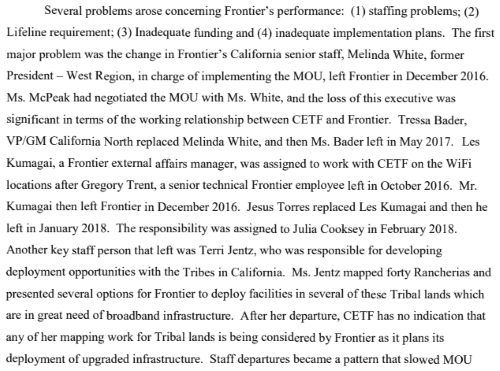
Frontier has a employer turnover problem in California, evident from this filing by the CETF. (Courtesy: CETF)

The CETF said Frontier was “shirking” and should face the maximum fine of $50,000 a day retroactive to July 1, 2016 for failure to comply with its obligations. As of the end of July, 2018 that fine would amount to over $39 million.

To comply with existing obligations to California, Frontier could have to spend in excess of $1 billion in the next two years. But Frontier has told investors it planned to spend no more than $1.15 billion on capex in fiscal year 2018 across its entire national service area. This could explain why Frontier may be stalling on upgrades in California.

Also raining on Frontier’s parade is the muted reaction to Frontier’s latest money-raising scheme. Shareholders appear lukewarm, with some openly skeptical that Frontier can deliver what it promises.

The plan’s success depends on:

  • Frontier’s ability to raise rates and find other “revenue enhancements” of $150-200 million. Rate increases drive customers to competitors, reducing revenue.
  • Vague “operational improvements” are expected to bring $150-200 million.
  • Customer care and support savings are anticipated to generate $125-175 million in EBITDA benefit.

Outgoing CFO McBride relies heavily on opaque corporate-speak like this, with few specifics:

“In addition to the dedicated resources, we are utilizing a new approach that will significantly accelerate the benefits of both revenue and expense initiatives. This new approach involves utilization of external expertise to significantly reduce the time to successfully realize our objectives. This will allow us to execute more initiatives in parallel while still managing day to day requirements of the business.”

In short, this suggests Frontier will outsource a lot of initiatives they used to manage in-house. The company also plans to start limiting truck rolls to customer homes if the company determines the problem is likely elsewhere in their network. It also claims it is cutting customer hold times at their call centers, which are still frequently outsourced.

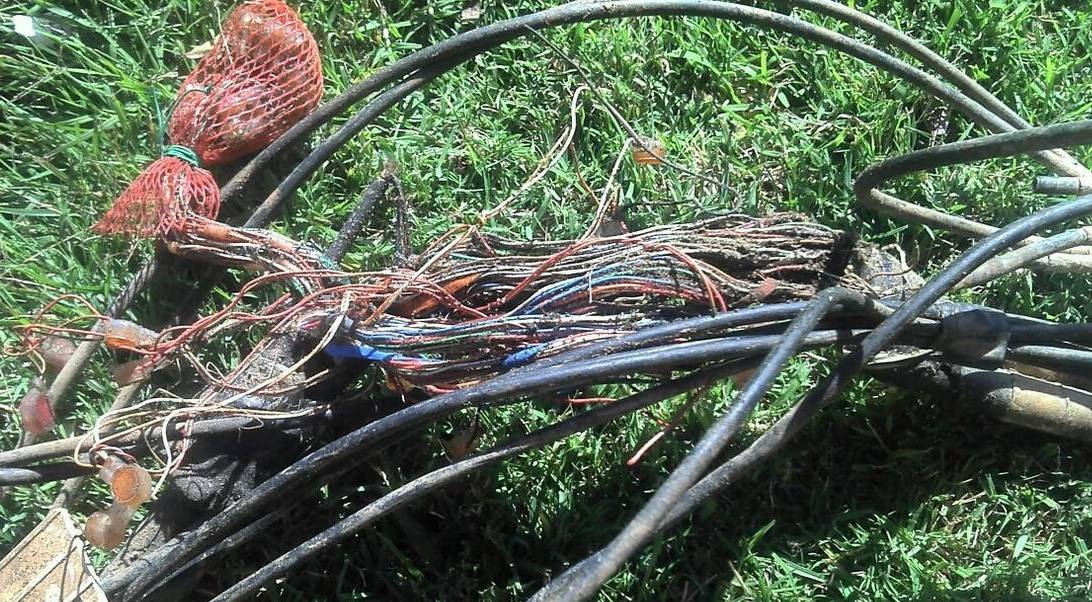
What Frontier has made clear, again, is their determination to keep a cap on spending, which means much of the money Frontier will spend each year will go towards network maintenance, not service upgrades. Therefore, customers can expect incremental upgrades, usually when a construction project requires Frontier to replace existing copper wire infrastructure with fiber optics or at a building site for a new housing development. Most customers in existing neighborhoods served by legacy copper wiring on the poles since the 1960s will continue to be serviced by those lines until they are torn down in a storm or stolen. Frontier has consistently shown no interest in wholesale network upgrades in its legacy service areas.
AT&T Replacing Storm/Wildfire Damaged Copper Wiring With Fiber Optics

Phillip Dampier February 14, 2018 AT&T, Consumer News, Public Policy & Gov't, Verizon 1 Comment

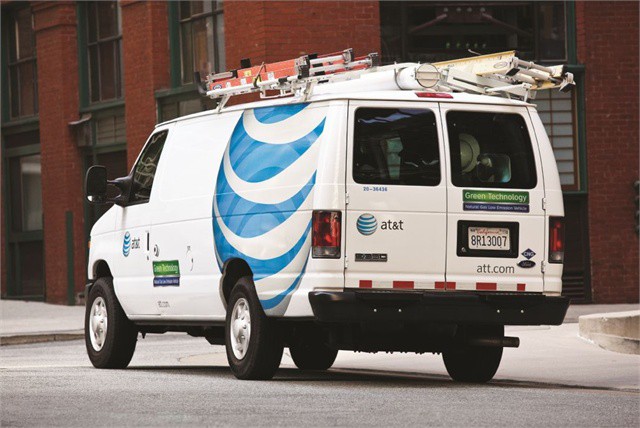
AT&T is staying committed to its wireline network in the face of two significant natural disasters by replacing beyond-repair copper wiring with fiber optics.


The phone company has recently notified the Federal Communications Commission its existing facilities in parts of California that were damaged by last year’s wildfires will be replaced by fiber optic infrastructure.

Fierce Telecom notes customers affected by the Nuns, Tubbs, Redwood and Sulphur fires will be served by a new optical fiber network in portions of Sonoma, Ukiah, Santa Rosa, and Lower Lake.

“The circuits will be transferred to fiber based NGDLC systems,” AT&T said in a FCC filing. “The transfer of these circuits does not compromise the capacity of the cabinets.”

In Florida, as a result of last September’s Hurricane Irma, AT&T will migrate its irreparably damaged copper wire network that strings throughout the Florida Keys to a new fiber to the home network.

AT&T’s decision to maintain its wired networks comes in contrast to Verizon’s 2013 attempt to scrap its copper facilities on Fire Island, N.Y. and certain New Jersey barrier islands left devastated by Superstorm Sandy. Verizon hoped to replace traditional landline service with a wireless alternative known as VoiceLink. A firestorm of protests over the service’s limitations, sound quality, and reliability forced Verizon to scrap the plan in New York and install its FiOS fiber-to-the-home network instead.

Deutsche Telekom: We’ll Build a Nationwide Fiber Network If You Let Us Monopolize It

German Chancellor Angela Merkel examines fiber optic telecommunications cables.

Germany has an internet access problem not very different from the one afflicting the United States and Canada. The national phone company, still partly owned by the government, remains mostly dependent on a decades-old wireline telephone network to deliver landline and DSL broadband service. The only way Deutsche Telekom will invest adequately to replace it with optical fiber is if they get assurances from the federal government they will be allowed to monopolize access to it.

According to the business weekly WirtschaftsWoche, a sister publication of Handelsblatt, Telekom executives have agreed to build a fiber-optic network everywhere in Germany provided that it is excluded from European anti-monopoly rules so that Deutsche Telekom wouldn’t be forced to open its network to competition.

The proposal from the German telecom giant was particularly audacious because many in the country blame it and its uncompetitive behavior for creating Germany’s slow broadband problem, but that did nothing to stop the company from asking to be shielded from competition.

“A fundamental departure from the kind of logic that viewed regulation of Deutsche Telekom (DT) as the normal state in the last 20 years is urgently needed,” the company said in a filing with the German Federal Network Agency, which regulates the internet in the country.

For most Germans, DT is the problem. The phone company has proven itself a formidable competitor across many parts of eastern Europe, where it bought control of privatized telecommunications companies that used to operate as government monopolies. But back home in Germany, it has been happy to continue offering DSL service that the rest of Europe cannot get rid of fast enough. In certain larger cities like Munich and Cologne, upstart fiber to the home providers have filled the broadband gap and have wired significant parts of both cities, and DT has responded with a fiber offering of its own without complaining about the cost of building a fiber network or the return on its investment.

Oberbürgermeister Wolff

But in smaller towns and villages across Germany — particularly in the eastern states, broadband has been terrible for years and under DT’s “leadership” it has not gotten much better, allowing other countries in the EU to sail past Germany in broadband rankings. Like AT&T and Verizon in the U.S., DT claims that where it has not upgraded its network, there is either no demand for fiber fast internet speed or inadequate return on investment. Also like in the U.S., DT has spent its money on other technologies, notably wireless, while investment in landline networks has not kept up.

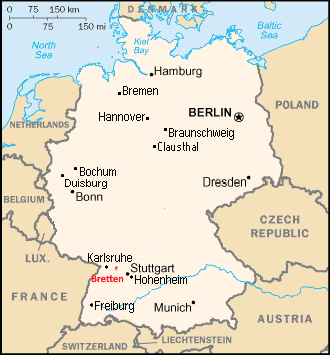
Some German communities like Bretten, fed up with inaction, have taken charge of their own broadband future and are building their own fiber to the home networks. Martin Wolff has dreamed of a digital economy boost for his town of 28,000 located near Karlsruhe in western Germany.

As mayor, he has begged and pleaded with DT to give Bretten something beyond lackluster DSL service, which is now too slow to handle the kind of 21st century internet applications that better wired communities take for granted. Mayor Wolff wants Bretten known as a gigabit city. DT, in contrast, wants to leave Bretten as a forgotten digital backwater. The phone company had repeatedly told the community the broadband it gets now is more than good enough and nobody should hold their breath waiting for something better. DT’s few competitors, including Britain’s Vodafone, weren’t interested either. Bretten is too small… too… irrelevant to matter to their investors.

“They are only interested in serving the cream of the crop in the cities and don’t come to rural areas,” the mayor said.

Like in North America, Germans are asking themselves who should be in charge of their digital future — investor-owned telecom companies or the community itself. The country’s continued embarrassing showing in European broadband rankings has become an issue of national pride and has sparked a loud debate between established telecom companies and the public that wants faster and better broadband.

The noise of the debate has attracted the politicians, and the issue of German broadband has now taken center stage in the parliamentary elections, which will be held Sept. 24. Handelsblatt reports the issue of inadequate broadband now interests German voters more than the latest economic policy position paper or how Germany will manage to deal with U.S. President Donald Trump for the next three years. Many Germans have plenty of time for these kinds of offline debates, because online, it can take a minute to load a webpage on some of the country’s dial-up like DSL connections.

“Germany is one of the most under-supplied countries in Europe, especially in terms of rural coverage,” wrote Bernd Beckert, an internet expert at the Fraunhofer Institute for Systems and Innovation Research, in a recent study of European broadband. He said countries such as Switzerland, Spain and even tiny Estonia are far ahead of Germany. In fact, the Baltic states and many former Eastern bloc countries are moving towards a fiber future while Germany considers wrapping itself even tighter in copper wiring installed in the 1960s. More than 70% of German internet users get internet access through a DT-provided, ADSL-equipped landline. Many connect at just 1-6Mbps, about the same speed users were getting in the late 1990s when DT’s internet monopoly was abolished.

Since then, DT has done everything possible to encourage “competitors” to not build competing networks. In fact, most competing ISPs like 1&1, Versatel, Telefonica Deutschland, and Vodafone rent DT DSL-capable landlines to provision service to their customers. That means they cannot compete on speed and they are forced to rely on DT to maintain its wireline network. It is no accident that German adoption of fiber optics is stuck at only 1.8%, fifth from last place among the 35 member states of the Organization of Economic Cooperation and Development (OECD). In comparison, Japan and South Korea have more than 70 percent of their customers on fiber to the home connections.

Germany’s largest political parties that have been in government since 2005, the Christian Democratic Union (CDU) and the Christian Social Union in Bavaria (CSU) have tolerated DT and its anemic upgrade policies. Broadband stagnancy, many believe, would not be possible without acquiescence and appeasement by those in control of the country. That conspiracy theory is backed by many of Germany’s smaller political parties which believe it is time to change the government’s involvement with DT.

The Left Party’s platform supports nationalizing DT and returning it to a state-owned enterprise that will answer to the public policy priorities of the next government. The capitalist, pro-business Free Democratic Party wants to get the government completely out of its 32% remaining stake in DT and hope that free market solutions will emerge. In the meantime, that party proposes to use the proceeds of any sale to fund a national broadband subsidy fund to convince private telecom companies to upgrade their networks in underserved areas.

DT has not stayed quiet in the public policy debate either. After disappointing the German public by rejecting a proposal to build an open, nationwide fiber to the home network, the company has instead promised to upgrade existing DSL lines to newer technologies like VDSL and vectoring, which DT claims could deliver up to 100Mbps service. American phone companies like Verizon have been reluctant to head in a similar direction, admitting many of the next generation DSL technologies work better in the lab than in the field. Many of the technologies promoting the most dramatic speed improvements have also proved to be vaporware so far.

Deutsche Telekom HQ Bonn, Germany

“We are committed to vectoring, because it is the only way to provide people in rural areas with faster lines quickly,” Deutsche Telekom said in a blog post published in August. “If we are fixated on [fiber to the home], those in the countryside will remain left behind for years. It is simply impossible to roll out fiber lines to homes everywhere in the country. Neither the construction capacity nor the funding is available for that. Plus, there is quite simply no demand for it.”

Some of the other competitors in the market seem to agree with DT.

“No provider can achieve fiber optic expansion on its own,” said Valentina Daiber, a member of the board of Telefonica. Daiber said DT was already nearly $60 billion in debt. Daiber said she hoped a solution could be found after the election.

But just a week after Daiber made that claim Vodafone announced it will spend $2.4 billion on a new fiber to the premises network targeting 100,000 companies in 2,000 German business parks. The company will also spend up to $450 million partnering with municipalities to extend the network to about one million rural homes, in addition to boosting its current broadband speeds delivered to German cable customers to 1Gbps.

That announcement could cause DT’s DSL plans to eventually collapse, if Vodafone follows through on its fiber buildout.

Mayor Wolff has no intention of waiting to see how it all plays out. Wolff has convinced private fiber optics company BBV to install the fiber infrastructure and has a Dutch investor partner arranging $12 million in financing, which is always the biggest stumbling block to get fiber buildouts underway. Upfront construction costs often deter many municipalities and would-be competitors from launching. But for Wolff, where there is a will, there is a way to deliver fiber fast broadband, and he is making certain it happens sooner rather than later.

Verizon Has No Interest in G.fast, Other DSL Improvements

Phillip Dampier August 17, 2017 Broadband Speed, Competition, Consumer News, Verizon 1 Comment

VDSL2 vectoring and G.fast are only as good as the copper wiring that extends to each customer. Up to 45 percent of North American wire pairs are in some state of disrepair.

Verizon has no interest in using advanced forms of DSL as part of its next generation broadband service.

Speaking at ADTRAN’s Broadband Solutions Summit, Verizon’s director of network planning Vincent O’Byrne made it clear DSL variants and copper wiring were not going to be a part of Verizon’s future network platform.

“We have no strategy for G.fast,” O’Byrne told Telecompetitor in response to a question about whether the company would upgrade or deploy advanced forms of DSL as part of overhauling its broadband networks.

Some telephone companies with large legacy copper networks have promoted DSL advancements including bonding, VDSL, and G.fast in lieu of costly fiber upgrades to shareholders and customers to improve the sluggish 6-10Mbps speeds many customers get from DSL service. But O’Byrne said Verizon has had nothing but headaches trying to make its legacy copper network actually deliver the improved broadband speeds those technologies promise on paper.

O’Byrne admitted Verizon’s copper network has not aged well, calling it “poor” in some areas. Verizon’s previous efforts to deploy VDSL and ethernet over copper to multiple dwelling units (MDUs) like apartment buildings and condos turned out so poorly, O’Byrne does not want to repeat those mistakes in the future.

For urban areas and MDUs, O’Byrne stressed he plans to take fiber all the way to each condo unit or apartment and get rid of the copper.

Verizon’s next generation fiber strategy will depend heavily on NG-PON2 technology, which is managed by unpowered splitters and filters — dramatically cutting the hardware costs associated with active fiber networks. Many PON networks are fiber to the premises, but then rely on Wi-Fi or Ethernet wired networks once inside a building. Verizon prefers an all-fiber solution, which is unusual among U.S. carriers. AT&T, CenturyLink and Windstream still use G.fast for relatively short runs of existing copper phone wiring inside MDUs and homes.

Verizon’s O’Byrne believes an all-fiber solution may cost more upfront, but will deliver better longevity, value, and fewer problems over time.

CenturyLink Broadband in Former Qwest Country is a Mess: Slow Speeds, Customers Leaving

molassesOnly half of CenturyLink’s customers in well-populated areas formerly served by Qwest can buy broadband service at 40Mbps or higher, while rural customers fare considerably worse with less than 25% able to get High Speed Internet at those speeds.

Customers have noticed and at least 65,000 canceled their broadband service with the phone company in the second quarter of this year, most presumably switching to their area’s cable operator.

“CenturyLink is by far the most abysmal telephone company I’ve ever had to deal with and I’m 63 years old,” shares Glen Canby in Arizona. Canby is a retired telephone company engineer that spent 40 years with a larger phone company serving the midwestern U.S.  “Their reviews online echo my own experiences, which have ranged from being quoted one price while being billed another, being locked into a term contract you didn’t ask for, and getting only a fraction of the speed they claim to sell.”

Canby is counted as one of CenturyLink’s 40Mbps-qualified customers, yet he actually receives less than 6Mbps service.

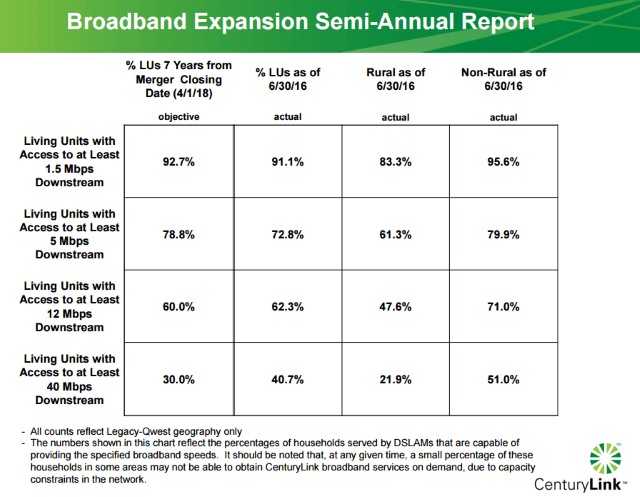
But that isn’t what CenturyLink tells the Federal Communications Commission. In a semi-annual broadband deployment report, the company claimed 51 percent of their customers in urban and suburban former Qwest service areas can subscribe to 40Mbps DSL or higher. But whether a customer is “qualified” to buy 40Mbps service is not the same as actually getting the speeds the company markets.

CenturyLinkCenturyLink attempts to cover their claims with fine print attached to their FCC submission: “The numbers shown in this chart reflect the percentages of households served by DSLAMs that are capable of providing the specified broadband speeds.” (A DSLAM is a network device typically used to extend faster DSL speeds to customers by reducing the amount of copper wiring between the telephone company’s central office and the customer’s home. Customers in a neighborhood typically share space on a DSLAM, in effect sharing a single connection back to the phone company.)

“That’s clever of them, because of course the DSLAM is just one link in the chain that ends with the ‘last mile’ between that equipment and my home, and that is where CenturyLink’s phone plant is at its weakest,” Canby writes. “I spent 20 years at a phone company dealing with last-mile DSL speed issues, so they cannot fool me.”

Canby blames the condition of CenturyLink’s infrastructure between the DSLAM serving him and his home for the problems, as well as overselling DSL service by packing too many customers onto a single DSLAM.

“It might be 40Mbps service at the remote end, but it drops to around 6Mbps on a good day by the time it reaches my house,” Canby complains. “Once the sun goes down, the speed drops to 3Mbps, which is a classic case of overselling to me because too many people are trying to share one connection at the same time. It has been this way since 2008 according to my neighbors.”

Back then, phone service was provided by Qwest, the former Baby Bell providing service in 14 sparsely populated western U.S. states — Arizona, Colorado, Idaho, Iowa, Minnesota, Montana, Nebraska, New Mexico, North Dakota, Oregon, South Dakota, Utah, Washington, and Wyoming. Qwest was acquired by CenturyLink in 2011.

centurylink report

CenturyLink has promised to improve broadband speeds for former Qwest customers, but much of what counts as progress has been in more urban areas, while rural customers continue to languish. The company admits just 21.9 percent of rural households can get 40Mbps service. Only 47.6% can buy 12Mbps, 61.3% can get 5Mbps, and 83% can subscribe to 1.5Mbps. That leaves 17% of former Qwest customers with no broadband options at all. CenturyLink did not break out the percentage of customers that meet the FCC’s 25Mbps minimum speed definition of broadband.

“This is why CenturyLink loses customers to cable operators who have no problems trying to deliver internet access over their network, because it was built to support more bandwidth,” Canby shares. “They can usually deliver the same internet speed to customers no matter how far out they live while phone companies deal with a network built for making phone calls, not data.”

Company officials recognize they could do better and have promised investors another 2.5 million customers will be able to reach 40Mbps by the end of 2017. By the end of the year after that, CenturyLink hopes to reach 85% of customers with VDSL2, bonding, and vectoring technology to achieve 40Mbps service for most customers in their top 25 markets. But rural customers are likely to left waiting longer because of the costs to upgrade Qwest’s copper-based network, especially in smaller states like Idaho, the Dakotas and Wyoming.

“The only answer is cable or fiber broadband, and if you live in a small community it could be years before CenturyLink gets around to you,” Canby writes. “If it’s the same story all over town, I’d start advocating for a community-owned fiber network and not sit around and wait for CenturyLink to act, especially if there is no cable company in town.”

Search This Site:

Contributions:

Recent Comments:

Your Account:

Stop the Cap!