
Home » copper wiring » Recent Articles:

North Carolina’s Goal to be the First Giga State is Improbable With Current State Legislature

Solving America’s rural broadband crisis will take a lot more than demonstration projects, token grants, and press releases.

Since 2008, Stop the Cap! has witnessed media coverage that breathlessly promises rural broadband is right around the corner, evidenced by a new state or federal grant to build what later turns out to be a middle mile or institutional fiber optic network that is strictly off-limits to homes and businesses. Politicians who participate in these press events tend to favor publicity over performance, often misleading reporters and constituents about just how significant a particular project will be towards resolving a community’s broadband challenges. Much of the time, these projects turn out to serve a very limited number of people or only fund part of a broadband initiative.

Officials last week said they are hoping to make North Carolina “the first ‘giga-state,’ with broadband access for all its residents.” But to realistically achieve that goal, nothing short of an expenditure of hundreds of millions of dollars will be required to realistically achieve that goal statewide.
A decade ago, rural broadband progressed in North Carolina, as communities transitioned away from traditional tobacco and textile businesses to the information and technology economy. To assure a foundation for that economic shift, several communities identified their local substandard (or lacking) broadband as a major problem. The state’s phone and cable companies at the time — notably Time Warner Cable, AT&T, and CenturyLink, often proved to be obstacles by refusing to upgrade networks in the state’s smaller communities. Some cities decided to stop relying on what the broadband companies were willing to offer and chose to construct their own modern, publicly owned broadband network alternatives, open to residents and businesses. A handful of cities in North Carolina went a different direction and acquired a dilapidated and bankrupt cable system and invested in upgrades, hoping cable broadband improvements would help protect their communities’ competitiveness to attract digital economy jobs.

That progress largely stalled after Republicans took control of the state legislature in 2011 and passed a draconian municipal broadband law that effectively banned public broadband expansion. Most of those backing the measure took lucrative campaign contributions from the state’s dominant phone and cable companies. One, Sen. Marilyn Avila, worked so closely with Time Warner Cable’s lobbyists, the resulting bill was effectively drafted by the state’s largest cable company. For that effort, she was later wined and dined by cable lobbyists at a celebration dinner in Asheville.

To be fair, some North Carolina cities are experiencing a broadband renaissance. Charlotte, Raleigh, Greensboro, Cary, Durham, Winston-Salem, and Chapel Hill will have a choice of providers for gigabit service. Google has installed fiber in some of these cities while AT&T and Charter lay down more fiber optics and introduce upgrades to support gigabit speeds.

Things are considerably worse outside of large cities.
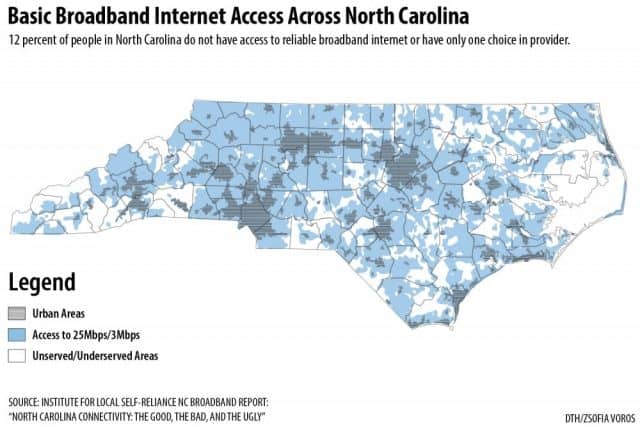
In North Carolina, 585,000 people live in areas where their wired connections cannot reach the FCC’s speed definition of broadband — 25 Mbps, and another 145,000 live without any notion of broadband at all.

Bringing all of North Carolina up to at least the nation’s minimum standard for broadband will not be cheap, and politicians and public policy groups must be realistic about the real cost to once and for all resolve North Carolina’s rural broadband challenges. Where the money comes from is a question that will be left to state and local officials and their constituents. Some advocate only tax credit-inspired private funding, others support a public-private partnership to share costs, while still others believe public money should be only spent on publicly owned, locally developed broadband networks. Regardless of which model is proposed, without a specific and realistic budget proposal to move forward, the public will likely be disappointed with the results.

The Facts of Broadband Life

There is a reason rural areas are underserved or unserved. America’s broadband providers are primarily for-profit, investor-owned companies. They are not public servants and they respond first to the interests of their shareholders. Customers might come in second. When a publicly owned utility or co-op is created, in most cases it is the result of years of frustration trying to get a commercial provider to serve a rural or high cost area. Public projects are usually designed to serve almost everyone, even though it will likely take years for construction costs to be recovered. Investor-owned companies are not nearly as patient, and usually demand a Return On Investment formula that offers a much shorter window to recover costs. For broadband, adequately populated areas that can be reached affordably and attract enough new customers to recover the initial investment will get service, while those areas that cannot are left behind. The two populations most likely to fail the ROI test are the urban poor that may not be able to afford to subscribe and rural residents a company claims it cannot afford to serve. Many early cable TV franchise agreements insisted on ROI formulas that allowed companies only to skip areas with inadequate population density, not inadequate income, which explains why cable service is available in even the poorest city neighborhoods, while a wealthy resident in a rural area goes unserved.

Today, most cable and phone companies install fiber optic infrastructure most commonly in new housing developments or previously unwired business parks, while allowing existing copper wire infrastructure already in place elsewhere to remain in service. Some companies, including AT&T and Verizon, have made an effort in some areas to replace copper infrastructure with fiber optics, but in most cases, their rural service areas remain served by copper wiring installed decades ago. As a result, most rural residents end up with DSL internet from the phone company, often at speeds of 5 Mbps or less, or no internet service at all. Neither of these phone companies, much less independent telcos like CenturyLink and Frontier, have shown much interest in scrapping copper wiring for fiber optics in rural service areas. There is simply no economic case that shareholders will accept for costly upgrades that will deliver little, if any, short-term benefits to a company’s bottom line. That reality has led some communities to try incentivizing commercial providers to make an investment anyway, usually with a package of tax breaks and cost sharing. But many communities have achieved better results even faster by launching their own fiber broadband services that the public can access.

Some states with large rural areas have recognized that solving the rural broadband problem will be costly — almost always more costly than first thought. Such projects often take longer than one hoped, and will require some form of taxpayer matching funds, municipal bonds, public buy-in, or a miraculous sudden investment from a generous cable or phone company. In states with municipal broadband bans, like North Carolina, politicians who support such restrictions believe the cable and phone companies will spontaneously solve the rural internet problem on their own. Such beliefs have stalled rural broadband improvements in many of the states ensnared by such laws, usually tailored to protect a duopoly of the same phone and cable companies that have historically refused to offer adequate broadband service to their rural customers.

Challenges for North Carolina
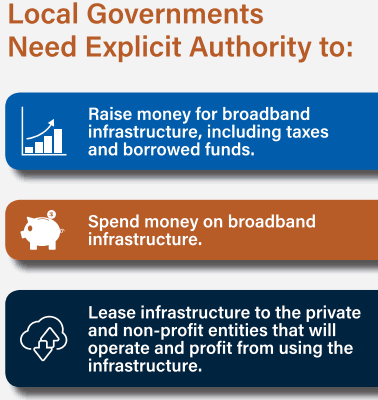
(Courtesy: North Carolina League of Municipalities – Click image for more information)

North Carolina is a growing state, so a small part of the rural broadband problem may work itself out as population densities increase to a level that crosses that critical ROI threshold. But most rural communities will be waiting years for that to happen. Intransigent phone and cable companies are unlikely to respond positively to local officials seeking better service if it requires a substantial investment. As industry lobbyists will tell you, it is not the job of government to dictate the services of privately owned companies. The Republican majority in North Carolina’s legislature underlines that principle regularly in the form of legislation that reduces regulation and oversight. Many, but not all of those Republicans have also taken a strong strand against the idea of municipalities stepping up to resolve their local broadband challenges by working around problematic cable and phone companies. The ideology that government should never be in the business of competing against private businesses usually takes precedence.

Almost a decade ago, the cable and phone companies of North Carolina made three failed attempts to enshrine this principle in a new statewide law that would limit municipal broadband encroachment to such an extent it made future projects unviable. They succeeded in passing a law on their fourth attempt in 2011, the same year Republicans took control in the state legislature.

Today, Republicans still control the legislature with a Democratic governor providing some checks and balances. Why is this important? Because for North Carolina to achieve its goal, it will realistically need a combination of bipartisan support for rural broadband funding and an end to the municipal broadband ban.

Where is the money?

Although North Carolina wants to be America’s first “gigabit” state, New York is the first to at least claim full broadband coverage across the entire state. That did not and could not happen without a multi-year spending program. Recently, North Carolina’s Department of Information Technology launched a $10 million GREAT Grant program to provide last-mile connectivity to the most economically distressed counties in the state. While a noble effort, and one no doubt limited by the availability of funds to spend on broadband expansion, it is a drop in a bucket of water thrown into a barely filled pool.

To put this problem in better context, New York’s goal of full broadband coverage (which in our view remains incomplete) required not only $500 million acquired from settlement proceeds won by the state after suing Wall Street banks for causing the Great Recession, but another $170 million in federal broadband expansion funds that were expected to be forfeited because Verizon — the state’s largest phone company — was not interested in the money or upgrading their DSL service upstate.
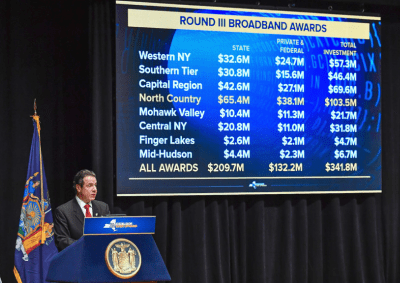
Big Money: New York’s rural broadband funding initiative spent hundreds of millions to attack the rural broadband problem. Gov. Andrew Cuomo outlines funding for just one of several rounds of broadband funding.

Last year, Gov. Andrew Cuomo detailed success for his Broadband for All program by pointing out the state spent $670 million to upgrade or introduce broadband service to 2.42 million locations in rural New York, giving the state 99.9% coverage. That amounts to an average grant of $277 per household or business. In turn, award recipients — largely incumbent phone and cable companies, had to commit to matching private investments. For that state money, the provider had to typically offer at least 100 Mbps service, except in the most rural parts of the state, where a lower speed was acceptable.

North Carolina has 585,000 underserved or unserved locations. Just by using New York’s average $277 grant, North Carolina will have to spend approximately $202 million with similar matching funds from private companies to reach those locations. In fact, it is assuredly more than that because North Carolina’s goal is gigabit speed, not 100 Mbps. Also, New York declared ‘mission accomplished’ while stranding tens of thousands of expensive or difficult to reach residents with subsidized satellite internet access. That offers nothing close to gigabit speed. A more realistic figure for North Carolina in 2019 could be as high as $250-300 million in taxpayer dollars — combined with similar private matching funds to convince AT&T, Charter, CenturyLink and others that the time is right to expand into more rural areas. But as New York discovered, there will be areas in the state no company will bid to serve because the money provided is inadequate.

If the thought of handing over tax dollars to big phone and cable companies bothers you, the alternative is helping communities start and run their own networks in the public interest. Except private providers routinely retaliate with well-funded campaigns of fear, uncertainty and doubt over those projects, and they become political footballs to everyone except their customers, who generally appreciate the service and local accountability.

If North Carolina’s state government relies on a series of $10 million appropriations for grants, it will likely take at least 20 years to wire the state. Stop the Cap! agrees with the goals North Carolina has set to deliver ubiquitous, gigabit-fast broadband. But those goals will be difficult to reach in the present political climate. Republicans in the state legislature approved reductions in the corporate income tax rate to 2.5 percent, down from 3 percent last year, and the personal income tax rate drops to 5.25 percent from 5.499 percent. North Carolina’s latest budget sets aside $13.8 billion for education, $3.8 billion for Medicaid, $3 billion in new debt for road maintenance, and $31 million in grants to attract the film industry to shoot their projects in the state.

It is likely any appropriation significant enough to actually deliver on the commitment to provide total broadband coverage will have to be spread out over several years, unless another funding mechanism can be identified. That assumes the Republicans in the state legislature will be receptive to the idea, which remains an open question.

Frontier Left Residents in N.Y.’s North Country Out of Service for 10 Days

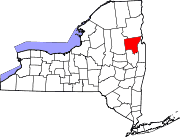
A snowstorm, in winter, in Upstate New York, was the excuse Frontier Communications gave for leaving scores of residents in the Minerva-Johnsburg area without phone or internet service for as long as 10 days this month.
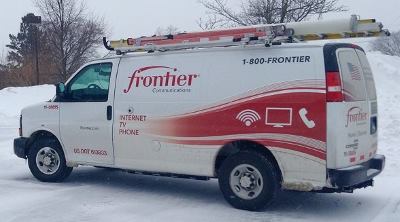
“We are aware of a service interruption in Minerva and have been delayed by a snowstorm that impeded access and diverted resources starting Friday,” Javier Mendoza, vice president of corporate communications and external affairs at Frontier, told The Sun.

The company routinely blames external factors for wide scale service interruptions, which often impact Frontier’s rural customers, totally reliant on aging copper wire infrastructure the company has refused to replace.

“Often [service outages] are due to uncontrollable circumstances like commercial power outages, severe weather, construction crews damaging telecom cables, cars hitting telephone poles or telecom equipment cabinets,” Mendoza said. “These causes can also delay response and restoral efforts beyond Frontier’s control.”

But customers in several states where Frontier provides the only internet access around are just as concerned by poor service that is within Frontier’s control.

Johnsburg’s town supervisor is one of them, complaining regularly about the poor quality of Frontier’s internet service, powered by DSL. It suffers frequent service outages.

Minerva-Johnsburg, N.Y.

“It’s been widespread throughout the town,” Supervisor Andrea Hogan told the newspaper. “People can’t run businesses with that.”

Those who rely on the internet to work from home are challenged by Frontier’s DSL service and frequent service problems.

Greg and Ellen Schaefer retired to the community of North River and planned to do part-time work remotely over the internet. They pay Frontier $228 a month for a package of satellite TV, landline, and internet service. On a good day, they achieve a maximum of 3 Mbps for downloads and 0.5 Mbps for uploads. But in Frontier country, where good days can be outnumbered by bad ones, the couple has often been forced into their car in search of good Wi-Fi. Some days they work from the local library, others they park by an AT&T cell tower near the base of Gore Mountain to use their car’s built-in AT&T hotspot.

Predictably, the Schaefers question the value for money they receive from Frontier Communications.

Frontier’s name conjures up the notion of a phone company providing service in the rough and rugged Old West, but Glenn Pearsall told The Sun he prefers to think of Frontier as an antique three-speed car, offering customers the choice of “dim, flickering,” or “off.”

Pearsall pays Frontier for internet speeds advertised at 6-10+ Mbps, but receives 0.69 Mbps for downloads and 0.08 Mbps for uploads at his home in Garnet Lake. A typical Microsoft Office software update takes approximately 48 hours to arrive, assuming one of many frequent service outages does not force the upgrade to start anew.
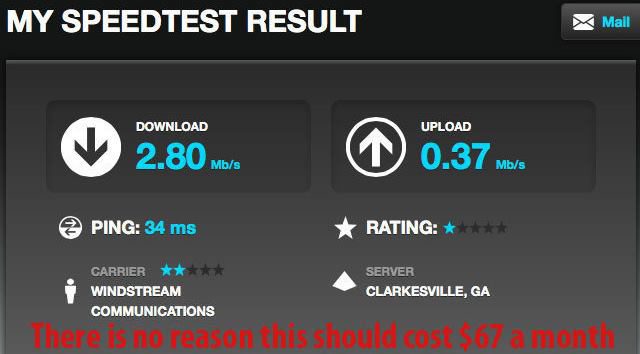
The problem for most Frontier DSL customers, especially in rural areas, is the distance between the company’s local exchange office and customers. The further away one lives, the slower the speed.

Many rural telephone exchanges have tens of thousands of feet in copper wire between the central office and an outlying customer. As a result, in the most rural areas, no internet service is available at all.

Frontier is accepting millions in Connect America Funds (CAF) — paid for by ordinary customers on their phone bill, to expand internet access into unserved areas. Frontier has to replace at least some of its copper wiring with fiber optics, which does not degrade significantly with distance. It can then reach customers part of the way over its existing copper facilities, which saves the company millions in replacement costs.

Demand for internet service and constantly rising traffic volumes suggests Frontier must regularly upgrade its equipment and backhaul connectivity. But in some areas, the company has failed to keep up with demand, resulting in online overcrowding. Customers that access the internet during peak usage times in the evenings report dramatic slowdowns and web pages that refuse to load — both symptoms of oversold network capacity.

Frontier is an integral part of New York Gov. Andrew Cuomo’s rural broadband initiative, which promises 99.9% of New Yorkers will have access to high-speed internet. The company collected $9.7 million in January 2018 to expand service to another 2,735 customers in the North Country, Southern Tier, and Finger Lakes region. The company claims it will deliver 100 Mbps internet speed to those customers in its news releases, but also warns what the company claims is never guaranteed.

“Our products state in our literature what you ‘may’ get. So it’s speeds ‘as fast as.’ You may not get 6 Mbps every moment of the day,” admitted Jan van de Carr, manager for community relations and government affairs.

It is that kind of mentality that has Pearsall keeping a bottle of champagne at the ready on the day he can disconnect Frontier service for good. But considering the alternative is likely to be satellite internet offered by Hughes, that bottle is likely to remain corked for a long time into the future.

Windstream’s “Aspirational” Broadband: DSL Customers Not Getting Advertised Speed

Phillip Dampier November 20, 2018 Broadband "Shortage", Broadband Speed, Consumer News, Public Policy & Gov't, Rural Broadband, Windstream Comments Off on Windstream’s “Aspirational” Broadband: DSL Customers Not Getting Advertised Speed

An unhappy customer in Georgia.

Victor Brown, like many residential customers in rural northeastern Ohio, has one option for internet access — Windstream, an independent phone company that typically serves areas larger companies like AT&T, Verizon, and CenturyLink forgot. For 17 years, his internet speed has been absolutely consistent, and slow.

“It’s 1.2 Mbps day or night, no more and no less, and for that they are charging me $58 a month,” Brown told Stop the Cap! “In that time, there has never been an upgrade, a real commitment to improve service, or anything except repetitive sales calls and mailers offering to upgrade me to a faster speed level Windstream cannot actually deliver.”

Windsteam has told its investors that it expects to offer 60% of its customers at least 25 Mbps service by the end of 2018. In fact, Brown has already been offered that for nearly a year, but the service is not actually available.

“They will switch you to 25 Mbps today, with the higher bill to boot, but you won’t actually get any better speed than you have right now,” Brown said. “I know because we tried.”

Brown and several of his neighbors all attempted to upgrade to the higher-speed service advertised. Windstream accepted their orders, charged them more, and delivered exactly the same 1.2 Mbps service they have always had.

“It took a service technician coming out to make it clear to us there was no way we would ever get faster speed because there was too much copper wiring between their office and our homes,” Brown said. “The technician felt for us, and about half of his service calls were disappointing customers like us.”
Brown explained the Windstream technician candidly told him that the company’s head office is behind the speed upgrades, but does not actually have a clear understanding of the state of the local network. Marketing then sells customers on better service Windstream’s network is not capable of providing.

“They need to spend money to replace some copper with fiber but there is no money for that,” Brown said. “The most the technician could suggest was installing a bonded DSL connection that would use two different phone lines and deliver 2.4 Mbps. That would come at a price, however.”

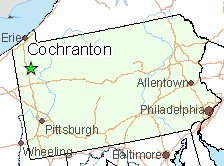
Ruth in Cochranton, Penn., is in exactly the same position.

“We are paying for internet speed that we aren’t receiving,” Ruth complained. “It is so slow that we have a hard time getting a short 50 second video to load. Forget watching a YouTube video, it’s not going to happen.”
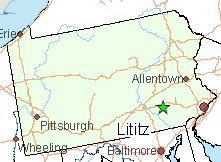
Over in Lilitz, Penn., Eileen and her neighbors were also dealing with temporary phone lines Windstream installed by dropping both on their lawns and then leaving them unburied for nine months. She cannot get anyone from the company to bury the lines despite seven separate phone calls. Down the street, internet and phone outages can last a week after a strong rainstorm hits the area, and since the weather has turned much colder, hum and crackle on the neighborhood’s phone lines have disrupted phone calls and DSL service. Nobody from Windstream has come to fix the problem.

Windstream tells a very different story to its investors in the form of ‘upgrades by press release’ and cheerful investor conference calls that claim dramatic improvements in service and growth. While cable operators are touting increasing availability of gigabit service, phone companies like Windstream are promising to give a little more than half their customers the minimum definition of broadband service — 25/3 Mbps, by the end of this year. Many of Windstream’s other half get nothing close to those speeds, with 1-3 Mbps common in rural areas.

Wall Street balks at the dollar amounts it would take for Windstream to fully update its network to offer broadband speeds that were common for cable subscribers a decade ago. That kind of network investment would likely drive down the share price, impact shareholder dividends or stock buyback plans, and increase debt. Instead, many phone companies are hoping the federal government will come to the rescue and subsidize rural network improvements through the FCC’s Connect America Fund or government grants. But many of those grants won’t deliver service improvements to existing customers. Instead it will allow rural phone companies to bring broadband to customers who never had it before.

Even the threat of new competition has not inspired many investor-owned phone companies to embark on a spending spree. That competition may eventually come from new wireless broadband services like 5G, but most observers predict that will be years away in the rural communities Windstream traditionally serves. Where Windstream does face competition, it often still loses market share, usually to the local cable company.

“My sister has Comcast and although they are evil as can be, at least their internet speed matches what they sell, and it is shockingly fast in comparison to what DSL has given me for nearly 20 years,” Brown said. “Unfortunately, no cable company is going to wire us up. There are only a few houses on my street.”

Brown believes it is time for the federal government to start insisting that investor-owned phone companies do better.

“We have universal service laws for landlines but not for internet? That does not make sense to me,” Brown tells us. “Isn’t it time for the government to insist that all providers deliver at least 25 Mbps service to their customers? They are not going to do it without someone ordering them to.”

AT&T’s Abandoned Wiring Oozing Lead On Customers’ Property

Phillip Dampier September 26, 2018 AT&T, Consumer News, Public Policy & Gov't 3 Comments

Opening a lead insulated buried cable. Lead can be resealed with solder after repairs.

In the early to mid-1950’s, thousands of landowners between Houston and Dallas/Ft. Worth, Tex. were asked to grant a right of way and easement to what was then known as the American Telephone & Telegraph Co. (AT&T). After winning permission, AT&T buried a 4-6 inch wide copper telephone cable sheathed in lead to connect the two cities — 200 miles apart — together. Almost 70 years later, that cable is coming back to haunt the phone company.

Telecommunications companies have used copper phone wiring for over 100 years to deliver telegraph, telephone, and data services. AT&T’s “trunk lines” often contained dozens, if not hundreds of individual cable pairs used to connect regional long distance calls and distant central switching offices together. To protect the cables, phone companies relied on simple paper insulation until the mid-1950s to keep the cable pairs from making contact with other wires. Buried cables were traditionally sheathed in lead, a very popular and durable insulator that dependably kept moisture out while allowing technicians easy access to the cables within. As the 1960s approached, phone companies began to switch to plastic insulation, but paper and lead-wrapped copper wiring remains in service in some areas to this day, often in large cities.

As with most AT&T-owned underground cables, the one in Texas was wrapped in lead. The company used a network of subterranean concrete rooms and above ground small cinder block buildings for maintenance, offering technicians direct access to the cable and various network equipment. Landowners knew the additional infrastructure belonged to AT&T because the company placed their logo on it.

Ongoing technological advancements eventually allowed AT&T to transition service to fiber optic cables, and by 2010, the Houston-Dallas copper cable was decommissioned. AT&T employees removed its signage, sold the cinder block structures and abandoned the underground vaults.

But AT&T did not remove the cable, which remains unused and buried to this day, allegedly leaching dangerous lead into the ground. Property owners fearing AT&T’s cable may be fouling the soil and groundwater with lead contamination took AT&T to court in 2016, seeking a class action case against the phone company for abandoning its cable and easements.

AT&T’s Environment, Health, and Safety Division offered a presentation at the 2010 International Telecommunications Safety Conference warning about the perils of old lead-sheathed phone cables, claiming “underground cable presents real possibilities for overexposure to lead:”
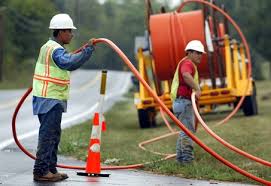
  • Some older metropolitan areas may still have over 50% lead cable.
  • Buried cable leaches many compounds to the surface of the insulation: lead carbonate, lead monoxide, lead sulfate, lead chloride, lead dioxide, lead acetate, lead nitrate, and lead sulfide. Many of these compounds do not adhere tightly to the cable and are easily airborne.
  • Once in the soil, 83 and 98 percent of the released lead remains intact in the soil within 2 inches of the cables.

In addition to the cost of removing the unused cable, AT&T’s own safety engineers suggest removing old cables can also pose a significant health risk to employees and property owners if not done properly:

  • Extraction of cable from underground duct can release unexpected high levels of lead dust.
  • Wetting was not capable of controlling dust in many cases.
  • Location of employees to cable extraction is important.

Despite the health risks, a judge denied class certification of the lawsuit on Tuesday, ruling each affected property owner will have to bring a separate lawsuit against AT&T.

U.S. District Judge Alfred H. Bennett issued the 11-page ruling against the claimants.

“Plaintiffs present the general retirement of underground coaxial and fiber optic cables, removal of signage/equipment for those cables, and planned release of some easements as class-wide proof that abandonment is a common question for the proposed class,” Judge Bennett wrote. “However, because the class does not deal with one easement, rather hundreds (if not thousands), each class member would need to present evidence of the definite acts revealing AT&T’s intent to abandon the particular easements associated with that member’s property.”

Bennett was also unpersuaded by claims that the abandoned AT&T cable created a presumption of imminent harm, and his ruling stated each property owner would have to provide evidence of the cable’s lead contamination on that owner’s land. In addition, each claimant would have to prove damages, assuming the statute of limitations had not run out years ago.

“Certainly, a separate soil analysis for each property would have to be present, along with evidence pertinent to determine the existence and cause of any contaminates on each of the properties,” Bennett wrote.

The law firm bringing the lawsuit plans an appeal.

Countries Moving at Light Speed to Expand Fiber, While U.S. Keeps Subsidizing DSL

This week, the FCC announced bidding has finished for the latest Connect America Fund (CAF) broadband subsidies auction.

Once again, the FCC gave first priority to incumbent phone companies to bid for the subsidies, which defray the cost of expanding internet access to homes and businesses otherwise unprofitable to serve. Nearly $2 billion was left on the table by disinterested phone companies after the first round of bidding was complete, so the FCC’s second round opened up the leftover money to other telecom companies.

Winning bidders will receive their portion of $198 million annually in 120 monthly installments over the next ten years to build out rural networks. In return, providers must promise to deliver one broadband and voice service product at rates comparable to what urban residents pay for service. The winning bids, still to be publicly announced, will come from rural electric and phone cooperatives, satellite internet providers, fixed wireless companies, and possibly a handful of cable operators. But much of the money overall will be spent by independent phone companies rolling out slow, copper-based, DSL service.

Because the total committed will take a decade to reach providers, rural Americans will likely face a long wait before what purports to be “broadband” actually reaches their homes and businesses.

While many co-ops will spend the money to expand their own homegrown fiber-to-the-home services, most for-profit providers will rely on wireless or copper networks to deliver service.

Telefónica Spain

Overseas, broadband expansion is headed in another direction — expansion of fiber-to-the-home service, with little interest in investing significant sums on furthering old technology copper wire based DSL and fixed wireless services. The expansion is moving so quickly, Verizon made certain to sign long-term contracts with optical fiber suppliers like Corning in 2017 to guarantee they will not be affected by expected shortages in optical fiber some providers are already starting to experience.

Virtually everywhere in developed countries (except the United States), fiber broadband is quickly crowding out other technologies, despite the significant cost of replacing copper networks with new optical fiber cables. If a provider is brave enough to discount investor demand for quick returns and staying away from big budget upgrade efforts, the rewards include happier customers and a clear path to increased revenue and business success.

Not every Wall Street bank is reluctant to support fiber upgrades. Credit Suisse sees a need for optical fiber today, not tomorrow among incumbent phone and cable companies.

“The cost of building fiber is less than the cost of not building fiber,” the bank advised its clients. The reason is protecting market share and revenue. Phone companies that refuse to upgrade or move at a snail’s pace to improve their broadband product (typically DSL offering 2-12 Mbps) have lost significant market share, and those losses are accelerating. Ditching copper also saves companies millions in maintenance and repair costs.

Canada’s Telus is a case in point. Its CEO, Darren Entwistle, reports Telus’ effort to expand fiber optics across its western Canada service area is already paying off.

“We see churn rates on fiber that are 25% lower than copper,” Entwistle said. “35% lower in high-speed internet access, and 15% lower on TV — 25% lower on average. We’re seeing a reduction in repair volumes to the tune of 40%. We’re seeing a nice improvement in revenue per home of close to 10%.”

Telus promotes its fiber to the home initiative in western Canada as a boost to medical care, education, the economy, and the Canadian communities it serves. (1:31)

Telus’ chief competitor is Shaw Communications, western Canada’s largest cable company. Fiber optics allows Telus to vastly expand internet speeds and reliability, an improvement over distance sensitive DSL. Shaw Cable has boosted its own broadband speeds and offers product bundles that have been largely responsible for Telus’ lost customers, until its fiber network was switched on.

In economically challenged regions, fiber optic expansion is also growing, despite the cost. In Spain, Telefónica already provides service to 20 million Spaniards, roughly 70% of the country, and plans to continue reaching an additional two million homes and businesses a year until the country is completely wired with optical fiber. In Brazil, seven million customers will have access to fiber to the home service this year, expanding to ten million by 2020.

Verizon and AT&T regularly ring alarm bells in Congress that China is outpacing the United States in 5G wireless development, but are strangely silent about China’s vast and fast expansion into fiber optic broadband that companies like Verizon stopped significantly expanding almost a decade ago. China already has 328 million homes and businesses wired for fiber and added another five million homes in the month of June alone. AT&T will take a year to bring the same number of its own customers to its fiber to the home network.

The three countries that are most closely aligned with the mentality of most U.S. providers — the United Kingdom, Australia, and Germany — are changing their collective minds about past arguments that fiber to the home service is too costly and isn’t necessary.

The government of Martin Turnbull’s cost concerns forced a modification of the ambitious proposal by the previous government to deploy fiber to the home service to most homes and businesses in the country. That decision to spend less is coming back to haunt the country after Anne Hurley, a former chief executive of the Communications Alliance involved in the National Broadband Network (NBN), admitted the cheaper NBN will face an expensive, large-scale replacement within a decade.

ABC Australia reports on findings that the country’s slimmed-down National Broadband Network is inadequate, and parts will have to be scrapped within 5-10 years (1:37)

Turnbull’s government advocated for less expensive fiber to the neighborhood technology that would still rely on a significant amount of copper wiring installed decades ago. The result, according to figures provided to a Senate committee, found only a quarter of Australians will be able to get 100 Mbps service from the NBN, with most getting top speeds between 25-50 Mbps.

Despite claims of technical advancements in DSL technology which have claimed dramatic speed improvements, Hurley was unimpressed with performance tests in the field and declared large swaths of the remaining copper network will have to be ripped up and replaced with optical fiber in just 5-10 years.

“If you look around the world other nations are not embracing fiber-to-the-[neighborhood] and copper … so yes, it’s all going to have to go and have to be replaced,” she said.

In the United Kingdom, austerity measures from a Conservative government and a reluctant phone company proved ruinous to the government’s promise to deliver “superfast broadband” (at least 24 Mbps) over a fiber to the neighborhood network critics called inadequate from the moment it was switched on in 2012. The government had no interest in financing a fiber to the home network across the UK, and BT Openreach saw little upside from spending billions upgrading the nation’s phone lines it now was responsible for maintaining as a spun-off entity from BT. In 2015, BT Openreach’s chief technology officer called fiber to the home service in Britain “impossible” and too expensive.
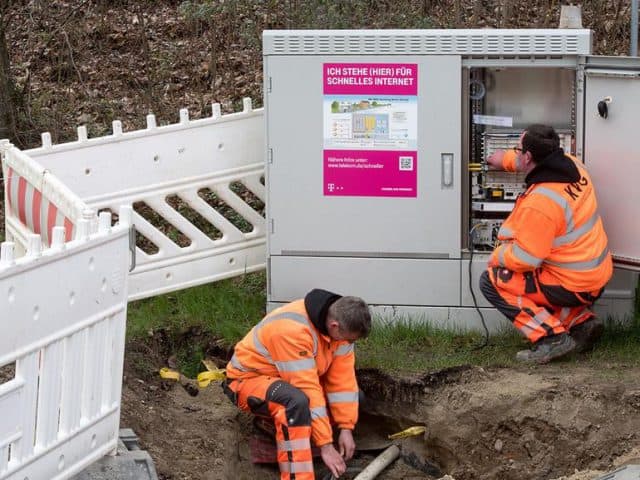
Two years later, while the rest of Europe was accelerating deployment of fiber to the home service, the government was embarrassed to report its broadband initiative was a flop in comparison, and broke a key promise made in 2012 that the UK would have the fastest broadband in Europe by 2015. Instead, the UK has dropped in global speed rankings, and is now in mediocre 35th place, behind the United States and over a dozen poorer members of the EU.

What was “impossible” two years ago is now essential today. The latest government commitment is to promote optical fiber broadband using a mix of targeted direct funding, “incentives” for private companies to wire fiber without the government’s help, and a voucher program defraying costs for enterprising villages and communities that develop their own innovative broadband enhancements. The best the government is willing to promise is that by 2033 — 15 years from now — every home in the UK will have fiber broadband.

Deutsche Telekom echoed BT Openreach with claims it was impossible to deliver fiber optic broadband throughout an entire country.

Deutsche Telekom’s dependence on broadband-enhancements-on-the-cheap — namely speed improvements by using vectoring and bonded DSL are increasingly unpopular for offering too little, too late in the country. Deutsche Telekom applauded itself for supplying more than 2.5 million new households with VDSL service in 2017, bringing the total number served by copper wire DSL in Germany to around 30 million. The company, which handles landline, broadband and wireless phone services, is slowly being dragged into fiber broadband expansion, but on a much smaller scale.

In March, Telekom announced a fiber to the home project in north-east Germany’s Western Pomerania/Rügen district for 40,000 homes and businesses. The network will offer speeds up to 1 Gbps. In July, Telekom was back with another announcement it was building a fiber optic network for Stuttgart and five surrounding districts Böblingen, Esslingen, Göppingen, Ludwigsburg, and Rems-Murr, encompassing 179 cities and municipalities. But most of the work will focus on wiring business parks. Residents will have a 50% chance of getting fiber to the home service by 2025, with the rest by 2030.

In contrast, the chances of getting fiber optic broadband in the U.S. is largely dependent on which provider(s) offer service. In the northeast, Verizon and Altice/Cablevision will go head to head competing with all-fiber networks. Customers serviced by AT&T also have a good chance of getting fiber to the home service… eventually, if they live in an urban or suburban community. Overbuilders and community broadband networks generally offer fiber service as an alternative to incumbent phone and cable companies, but many consumers don’t know about these under-advertised competitors. The chances for fiber optic service are much lower if you live in an area served by a legacy independent phone company like Frontier, Consolidated, Windstream, or CenturyLink. Their cable competitors face little pressure to rush upgrades to compete with companies that still sell DSL service offering speeds below 6 Mbps.

CAF funding from the FCC offers some rural areas a practical path to upgrades with the help of public funding, but with limited funds, a significant amount will be spent on yesterday’s technology. In just a few short years, residents will be faced with a choice of costly upgrades or a dramatic increase in the number of underserved Americans stuck with inadequate broadband. Policymakers should not repeat the costly mistakes of the United Kingdom and Australia, which resulted in penny wise-pound foolish decisions that will cost taxpayers significant sums and further delay necessary upgrades for the 21st century digital economy. The time for fiber upgrades is now, not in the distant future.

Search This Site:

Contributions:

Recent Comments:

Your Account:

Stop the Cap!