Home » Contract » Recent Articles:

Verizon Wireless Extends “Smartphones Talk Free” Offer: $9.99 Off New Smartphone Lines

Verizon Wireless has seen some success getting their off-contract customers who have stubbornly refused to upgrade their phones to jump on board the smartphone craze… by lowering their prices.

The entry fee for smartphones on most carriers includes the up front cost of the device (often $199 for the most coveted phones) and a $30 monthly mandatory data plan.  That’s a price too high for many consumers to pay in this economy, and the result has been an increase in the number of customers letting their two-year contracts expire.

AT&T has tried to reduce the bite with a paltry $15 monthly plan that only includes 200MB of usage per month, which is nearly pointless for smartphone users who want to really use the multimedia features the phones were designed to provide. Verizon responded with a holiday season promotional offer charging $15 a month for an even lower 150MB per month, with widespread speculation the “limited time only” part of the offer will soon become “available every day.”

But for most smartphone customers who plan to regularly use data-hungry applications, neither “budget plan” will suffice.  That leaves one alternative for Verizon customers — the $29.99 unlimited plan.  Ouch.

To prod price-sensitive customers, Verizon has offered family plan members the option of upgrading their old phones to new smartphones, and has sweetened the deal with a $10 price break.  While technically a credit on the “additional line” charge, some Verizon employees pitch the discount as a reduction in price for the mandatory data plan.  Where $30 a month sounds obscene, $20 a month sounds somewhat better.

The offer has proven sufficiently successful that Verizon has now extended it until Jan. 30 (note just prior to next month’s iPhone introduction) and any customer who has not upgraded their phone in the last 180 days qualifies.  A new, two year contract is required and the offer is good if you want to add a new secondary line.

Unfortunately, the offer does not extend to the primary line.  Verizon would probably see an even larger number of upgrades if the offer extended to every legacy phone on a customer’s account.

The $9.99 credit applies for 24 months.  Over the life of the contract, that is worth $240 in savings per smartphone, which isn’t bad from America’s Cadillac wireless carrier.

The Flow Chart from Hell: Frontier’s Confusing World of Customer Promotions

Phillip Dampier January 12, 2011 Editorial & Site News, Frontier 3 Comments

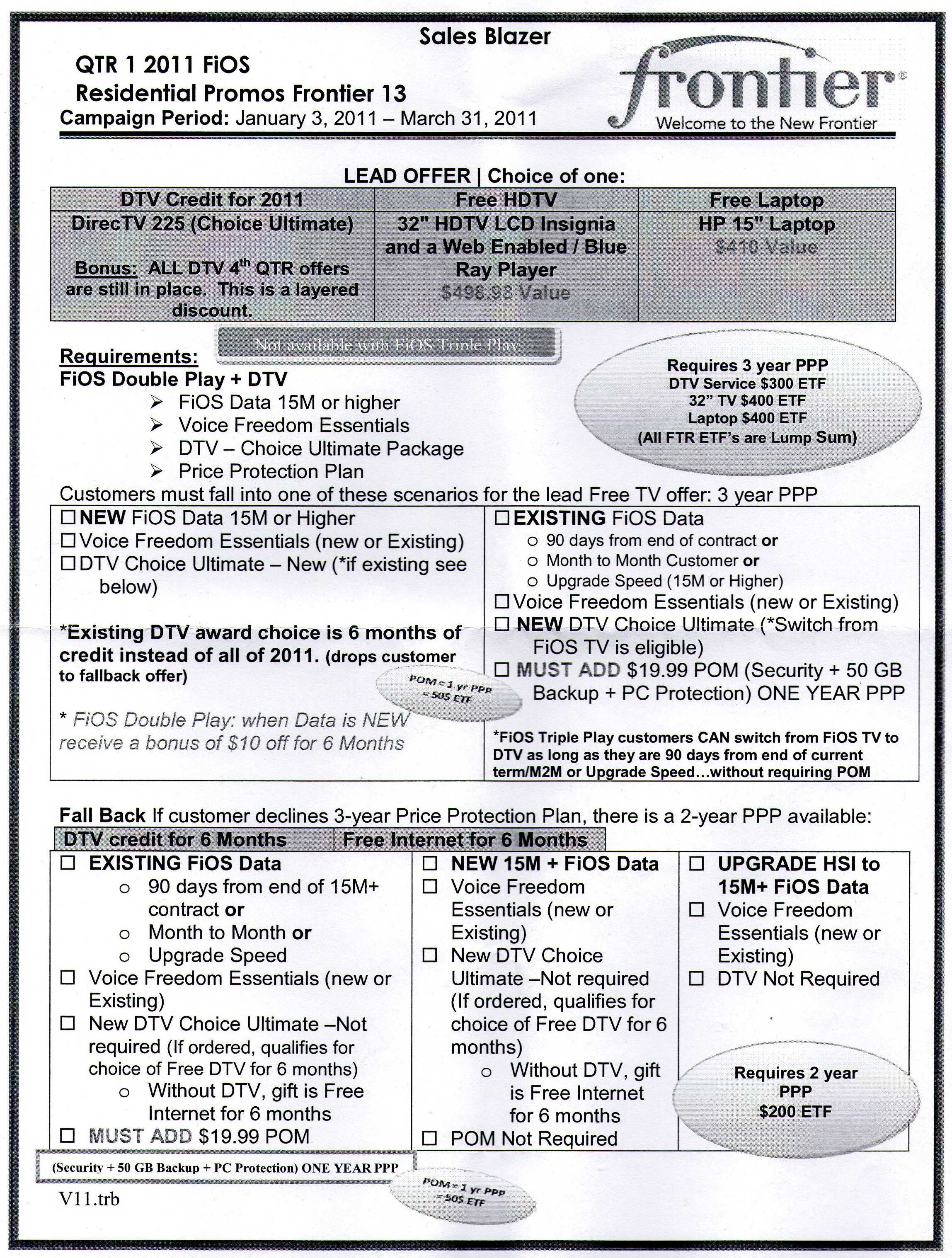
This “Sales Blazer” chart for Frontier Communications’ northwestern FiOS division in Washington and Oregon shows the confusing array of promotions, giveaways and other goodies customers can get, if they agree to long-term contracts. (But wait, if you hold out for a shorter contract, Frontier will still deal!). One wonders if employees need extended training just to comprehend this mish-mosh. Based on my own personal experiences with Frontier (“Frontier has free Wee-Fee!”), if the answer is “no,” it should be “yes.”

Verizon Wireless Eliminating “New Every Two” Program; Other Upgrade Discounts Being Phased Out

Phillip Dampier January 5, 2011 Consumer News, Verizon, Wireless Broadband 6 Comments

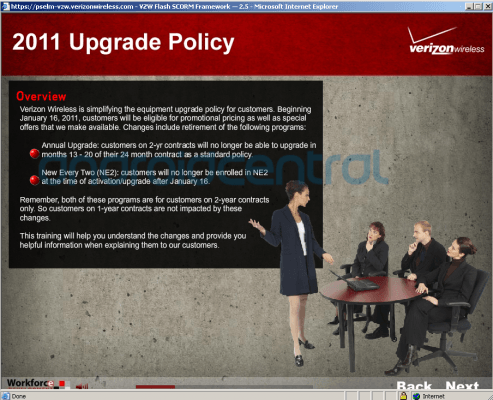
Verizon's new upgrade policy, courtesy of Android Central.

Verizon Wireless is making changes to their handset upgrade programs, all to the benefit of their bottom line and not to yours.

In training materials obtained by Android Central, Verizon is discontinuing its “New Every Two” handset discount program for customers who sign new contracts after Jan. 16 and will stop allowing customers to obtain early upgrade discounts on new phones before their contract nears expiration.

The “New Every Two” promotion has been a familiar part of Verizon Wireless service for years.  Customers finishing their two year contracts receive a $50 discount on their next new phone with the carrier, as long as they sign a new two year contract.

Early upgrades, which used to qualify customers for discounts during months 13-20 of their 24 month contract, are coming to an end as well.

There is some speculation the early upgrade plan is being curtailed to try and stop a rush on the rumored Verizon iPhone due early this year.

Since many customers upgrade to more expensive smartphones, the “New Every Two” program only delivers a discount, not the new free phone it provided in an earlier era.

Still, the loss of discounts will effectively give the biggest benefits to Verizon Wireless’ bottom line, allowing the company to reduce subsidies it pays on behalf of customers demanding the latest and greatest new phones.

Frontier’s Future Plans: Delivering DSL and DirecTV Options for Its FiOS Customers, Contracts for Others

Phillip Dampier November 18, 2010 Audio, Broadband Speed, Competition, Frontier, Rural Broadband, Video 5 Comments

Don’t want blazing fast fiber optic broadband speeds?  Unhappy with fiber optic quality video and want to go back to putting a satellite dish on your roof?  If the answer to either question is “yes,” Frontier Communications has good news for you.

The phone company, which assumed control of a handful of communities formerly served by Verizon’s fiber-to-the-home FiOS network, has announced it will begin marketing DSL and satellite TV services to its fiber customers.

Frontier CEO Maggie Wilderotter told investors on a third quarter results conference call that FiOS broadband could be too expensive.

Wilderotter noted Verizon would not allow customers in a FiOS neighborhood to buy DSL service, which leaves budget-minded customers behind.

“Now, FiOS starts at like 50Mbps and it’s very expensive. It’s like $50 a month for a customer. So they left a whole host of customers behind from an affordability perspective who didn’t need that kind of capability on broadband.” Wilderotter explained. “We have just over the last 30 to 60 days opened up DSL in all of the FiOS markets to give the customer choice. So the customer can choose whether they want FiOS broadband or they want high-speed Internet service, typically, and in those markets we’re offering around 6 to 7Mbps.”

Time Warner Cable occasionally runs promotions helping customers break free from Frontier's multi-year service contracts.

Of course, Frontier FiOS starts at 15Mbps — not 50, and that costs $50 a month for standalone service.  For $99, ($89 in Verizon FiOS areas), customers can get broadband, cable TV and unlimited phone service.  Frontier’s “Turbo” DSL service is priced at $40 a month for up to 7.1Mbps service.

Wilderotter also noted their FiOS customers can also choose to skip fiber video and go with DirecTV.

“We think that customers should be able to choose what kind of video they want,” she said. “We have aggressive offers in the market for both DirecTV and for FiOS video, but in our vernacular, what we care about is keeping the customer, getting the customer to take more products and services from us and making sure the customer is happy with the choice.”

Wilderotter said Frontier is prepared to tolerate more congestion on its DSL circuits than Verizon permitted, which opens the door to potential traffic slow-downs down the road.

“We’ve opened up in many of these locations the opportunity to sell high-speed service up to 95% capacity on the equipment that we have out in the field. Verizon had set a parameter at 75%,” Wilderotter said.

The company continues to study whether Frontier FiOS is worth maintaining or expanding outside of the Verizon territories where it was originally constructed.

“We are still evaluating it from a financial perspective and a customer perspective, and from a cost perspective and a revenue perspective,” Wilderotter told investors. “In terms of what that does for us overall, what it does for churn, how much does it really cost to extend this capability in the markets that we’re in today — we think that analysis and evaluation will go on through the first quarter [of 2011] and then we’ll be able to make some [decisions] in terms of what we want to do with FiOS from an expansion perspective or a maintenance perspective.”

Frontier Communications CEO Maggie Wilderotter answered questions about broadband expansion and the impact of the fall elections on telecommunications policy in Washington. (11 minutes)
You must remain on this page to hear the clip, or you can download the clip and listen later.

<

p style=”text-align: center;”>

Frontier's largely rural service areas provide a captive audience for the company's DSL broadband service.

In the near term Frontier has several plans to get more aggressive in the marketplace to meet its target goal of losing only 8 percent of their customers per year — a goal that illustrates legacy phone companies are still on a trajectory towards fewer and fewer customers:

  1. Don Shassian, executive vice president and chief financial officer of Frontier reports expansion of DSL remains a top priority for Frontier.  The company is on track to deliver access to 300,000 additional homes by the end of the year.  Verizon delivered access to 64 percent of Frontier’s acquired territories.  Frontier wants to get that number up to 85 percent.  But part of that target is not just expanding service to unserved areas.  It’s also trying to win back customers lost to other providers through promotions and incentives.
  2. Frontier plans to resume aggressive promotions in the coming weeks and months, including its “free Netbook” promotion, which provides a Netbook computer to new customers signing up for several packages of services, committing to remain with Frontier for at least two years.
  3. Frontier intends to push “price protection agreements” on as many customers as possible.  Their “Peace of Mind” program locks customers into multi-year contracts with stiff cancellation penalties.  Wilderotter noted: “I think, as you know, in our legacy markets, 96% of all of our sales are on a price protection plan and we have close to 60% of our residential customers on a one-, two- or three-year price protection plans. That number is below 15% in the acquired markets. So we’re also driving for price protection plans with every sale that we’re doing in these new markets as well.”  Such contracts dramatically discourage a customer from disconnecting Frontier, because fees for doing so can exceed $300 in some cases.  Frontier has been heavily criticized by some customers and State Attorneys General for deceptive business practices regarding contracts.

Frontier continues to enjoy a lack of solid cable competition in its largely rural service areas.  Shassian reports Comcast competes with Frontier in only about 32% of homes in some areas, Time Warner Cable in about 23%, and Charter below 15%.  With reduced competition, Frontier often represents the only broadband option in town.

Frontier is also spending an increased amount of time coping with copper thefts, especially in West Virginia where the company is warning would-be thieves it will prosecute to the fullest extent of the law.

“Damage to our facilities can affect communications access in an emergency, increase company costs and consumer rates, and disrupt community phone and broadband connections,” said Lynne Monaco, Frontier’s Director of Security. “When network connections are severed by copper thieves, it endangers customers and emergency responders and poses significant risks of personal injury and property damage.”

Just last week, West Virginia state police solved another copper caper that disrupted service for some customers.

The Charleston Daily Mail reports:

Photo Credit: West Virginia Regional Jail Authority

Stephanie Burdette of Charleston was arrested in connection with a copper wire theft.

Trooper A.B. Ward from the South Charleston detachment went to the Fishers Branch area of Sissonville last Thursday afternoon when a Frontier worker discovered a section of the communications line missing. The worker found that 300-feet of the 400-pair line, valued at about $5,000, was missing, according to a complaint filed in Kanawha Magistrate Court.

A trooper who had worked on a similar investigation told Ward to check the home of Ervin “Tubby” Page, 49, where troopers had previously found evidence of wire burning. Ward went to Page’s home, described as a Goose Neck travel trailer parked next to the Guthrie Agricultural Center in Sissonville, and found three burn barrels about 50 feet in front of the trailer. One of them was on fire.

Page’s girlfriend Stephanie Marie Burdette, 25, of Cross Lanes, was at the scene when the trooper arrived. Ward spoke to her then checked out the barrels where he found aluminum wrap, which is used to cover the copper communications wiring, and pieces of copper cabling, the complaint said.

Frontier customers are encouraged to report any suspicious activity around telecommunications equipment and facilities by calling the company’s toll free security line 1-800-590-6605. Anyone witnessing a theft in progress should not confront the suspects but should immediately call 911 and then call Frontier. Vehicle and suspect descriptions are very useful. This is a community safety problem, and the cooperation of the public is critical.

[flv width=”500″ height=”395″]http://www.phillipdampier.com/video/WOWK Charleston Copper Thieves 11-15-10.flv[/flv]

WOWK-TV in Charleston covers Frontier’s difficulties with copper wire thieves across the state of West Virginia.  (1 minute)

Former Alltel-Verizon Wireless Customers: AT&T Is Coming By Year’s End – Free Phones, Wireless Modems

Phillip Dampier September 5, 2010 AT&T, Competition, Consumer News, Video, Wireless Broadband Comments Off on Former Alltel-Verizon Wireless Customers: AT&T Is Coming By Year’s End – Free Phones, Wireless Modems

When Alltel announced the sale of its wireless business to Verizon in 2008, few Alltel customers could have foreseen they’d technically end up changing cell phone providers not once, but twice.  That’s because the federal government ordered Verizon to sell off Alltel’s assets in communities where Verizon already had a substantial market share.  For the sake of competition, the majority of Alltel customers in 18 states affected by the federal government divestiture order will become AT&T customers shortly.

That poses a problem because Alltel’s network and phones use CDMA network technology.  AT&T uses a different standard called GSM.  The two standards are not compatible.  Since AT&T has no intention of operating a CDMA network for Alltel customers, once AT&T converts Alltel’s cell sites to operate on its own network, every Alltel customer will be left with phones and equipment that will no longer work.

To make the deal work, AT&T has agreed to provide, at no charge, comparable brand new phones and other equipment to Alltel customers being moved to AT&T’s network.  No new contract is required, and customers will not be forced to extend one to receive the new AT&T equipment.

But that deal doesn’t extend to handing out free iPhones to Alltel customers.  If you want one of those, you will have to pony up the same money every other AT&T customer pays, and sign a new two-year contract.

This week, AT&T announced it was speeding up the transition, and many customers will be choosing new free phones around the end of this year or in early 2011.  Originally, AT&T expected it would take until mid-2011 to complete network conversions.  Complete details can be found on the AT&T-Alltel Transition Website.

For residents in the north-central United States, the iPhone craze has been something other Americans have experienced.  For much of the Dakotas and Montana, the transition will bring the first opportunity to get the popular smartphone at the subsidized price AT&T offers all of its customers on contract.

The implications of AT&T’s imminent arrival in the area doesn’t seem to bother the other dominant provider – Verizon Wireless.  In South Dakota, AT&T’s entry into the market may cause some to switch to AT&T, if only for the iPhone.  But Karen Smith, spokeswoman for Verizon Wireless in the Great Plains region, says Verizon is confident with the lineup of phones it already offers and remains the nation’s largest wireless carrier even without the iPhone.

Current Verizon customers like Jill Garrigan of Rapid City told the Rapid City Journal she’d consider switching to AT&T to grab the iPhone, but she’d much prefer buying one from Verizon Wireless.

“If Verizon carried the iPhone, I’d probably consider getting it from Verizon,” Garrigan said.

Many other South Dakotans share concerns about the higher monthly wireless bills the iPhone brings, and they’re not interested in paying a lot more just to own one.

Garrigan’s friend, Jessica Simon, said she’ll keep her current Samsung phone, thank you very much.  The reason?  “It’s all the additional money and all the surcharges,” she told the newspaper.

But local cell phone dealers believe the arrival of Apple’s iPhone will cause a sensation across the region, and they’ve already fielded calls from customers anxious to acquire one.

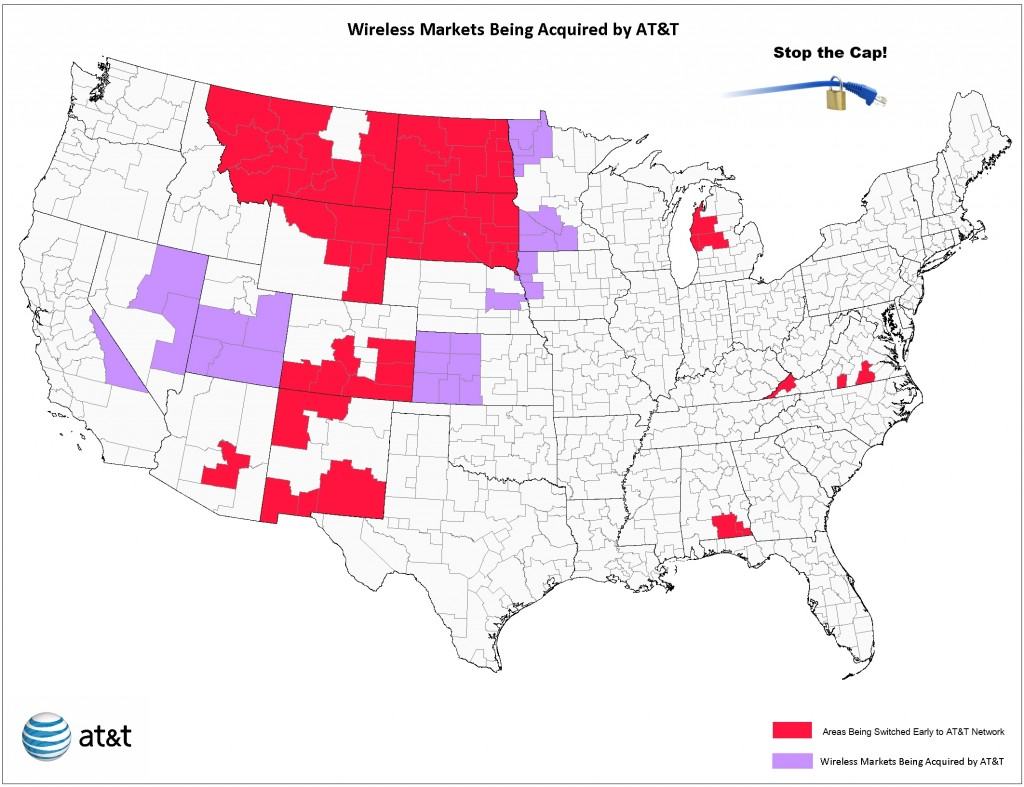
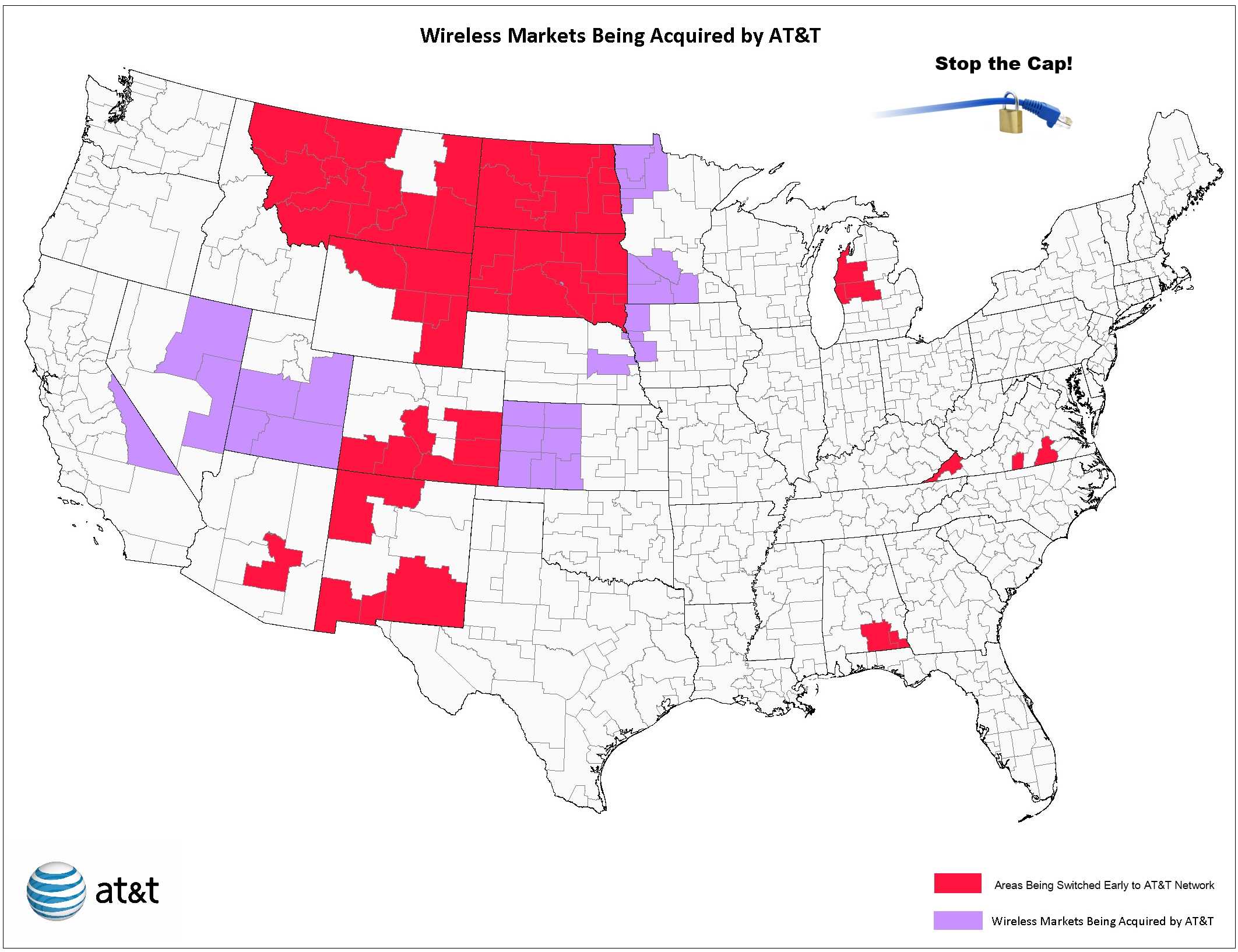
Stop the Cap! has created a map showing the areas due for early conversion for your convenience.

Areas shaded in red are scheduled for early conversion to AT&T's GSM Network (click to enlarge)

[flv width=”640″ height=”500″]http://www.phillipdampier.com/video/Alltel ATT Transition Ahead of Schedule 9-4-10.flv[/flv]

Stop the Cap! has compiled news reports from across the region regarding the AT&T-Alltel transition and its impact on states including the Dakotas, Montana and Wyoming.  Clips courtesy of WDAY-TV Fargo, N.D., KGWN-TV Cheyenne, Wyo., KECI-TV Missoula, Mont., and KFYR-TV Bismarck, N.D. (4 minutes)

Upgrade Specifics

The following counties are on AT&T’s early upgrade list (RSA=Rural Service Area):

Alabama: Greater Dothan area and RSA 7 including Butler, Coffee, Covington, Crenshaw, Geneva and Pike Counties.

Arizona: RSA 5 including Gila and Pinal Counties.

Colorado:  RSA 4 includes Chaffee, Custer, Fremont, Lake and Park Counties. RSA 5 includes Cheyenne, Elbert, Kit Carson and Lincoln Counties. RSA 6 includes Dolores, Hinsdale, La Plata, Montezuma, Ouray, San Juan and San Miguel Counties. RSA 7 includes Alamosa, Archuleta, Conejos, Mineral, Rio Grande and Saguache Counties. RSA 8 includes Bent, Crowley, Kiowa, Otero and Prowers Counties. RSA 9 includes Baca, Costilla, Huerfano and Las Animas Counties.

Michigan: Greater Muskegon area and RSA 5 includes Benzie, Lake, Leelanau, Manistee, Mason, Missaukee, Osceola and Wexford Counties. RSA 7 includes Gratiot, Isabella, Mecosta, Montcalm and Newaygo Counties.

Montana: Greater Billings and Great Falls areas and RSA 1 includes Flathead, Glacier, Lake, Lincoln, Pondera, Sanders and Teton Counties. RSA 2 includes Blaine, Chouteau, Hill, Liberty and Toole Counties. RSA 4 includes Daniels, Dawson, McCone, Richland, Roosevelt, Sheridan and Wibaux Counties. RSA 5 includes Granite, Lewis and Clark, Mineral, Missoula, Powell and Ravalli Counties. RSA 6 includes Broadwater, Deer Lodge, Jefferson, Judith Basin, Meagher, Silver Bow and Wheatland Counties. RSA 7 includes Fergus, Golden Valley, Musselshell, Petroleum, Stillwater and Sweet Grass Counties. RSA 8 includes Beaverhead, Gallatin, Madison and Park Counties. RSA 9 includes Big Horn, Carbon, Rosebud and Treasure Counties. RSA 10 includes Carter, Custer, Fallon, Powder River and Prairie Counties.

New Mexico: Greater Las Cruces area and RSA 1 includes Cibola, McKinley, Rio Arriba, San Juan and Taos Counties. RSA 5 includes Grant, Hidalgo and Luna Counties. RSA 6 includes Chaves, Eddy, Lee, Lincoln and Otero Counties.

North Dakota: Greater Fargo, Grand Forks, and Bismarck areas and RSA 1 includes Burke, Divide, McLean, Mountrail, Renville, Ward and Williams Counties. RSA 2 includes Benson, Bottineau, Cavalier, McHenry, Pierce, Ramsey, Rolette and Towner Counties. RSA 3 includes Barnes, Dickey, Griggs, LaMoure, Nelson, Pembina, Ransom, Richland, Sargent, Steele, Traill and Walsh Counties. RSA 4 includes Adams, Billings, Bowman, Dunn, Golden Valley, Grant, Hettinger, McKenzie, Mercer, Oliver, Sioux, Slope and Stark Counties. RSA 5 includes Eddy, Emmons, Foster, Kidder, Logan, McIntosh, Sheridan, Stutsman and Wells Counties.

South Dakota: Greater Sioux Falls and Rapid City areas and RSA 1 includes Butte, Harding, Lawrence and Perkins Counties. RSA 2 includes Campbell, Corson, Dewey, Potter, Walworth and Ziebach Counties. RSA 3 includes Brown, Edmunds, Faulk, McPherson and Spink Counties. RSA 4 includes Clark, Codington, Day, Deuel, Grant, Hamlin, Marshall and Roberts Counties. RSA 5 includes Custer, Fall River and Shannon Counties. RSA 6 includes Bennett, Gregory, Haakon, Jackson, Jones, Lyman, Mellette, Stanley, Todd and Tripp Counties. RSA 7 includes Aurora, Brule, Buffalo, Charles Mix, Davison, Douglas, Hand, Hughes, Hyde, Jerauld and Sully Counties. RSA 8 includes Beadle, Brookings, Kingsbury, Lake, Miner, Moody and Sanborn Counties.RSA 9 includes Bon Homme, Clay, Hanson, Hutchinson, Lincoln, McCook, Turner, Union and Yankton Counties.

Virginia: Greater Danville, Norton and South Hill areas and RSA 1 includes Buchanan, Dickenson, Lee, Russell, and Wise Counties and Norton City. RSA 8 includes Amelia, Brunswick, Lunenburg, Mecklenburg and Nottoway Counties.

Wyoming: Greater Casper area and RSA 1 includes Big Horn, Hot Springs, Park and Washakie Counties. RSA 2 includes Campbell, Crook, Johnson, Sheridan and Weston Counties. RSA 4 includes Albany, Goshen, Laramie, Niobrara and Platte Counties. RSA 5 includes Converse County.


Search This Site:

Contributions:

Recent Comments:

Your Account:

Stop the Cap!