Telecom New Zealand is under fire as consumer groups, business leaders, and customers condemn the company for a second major outage wiping out wireless mobile broadband and cell phone service for tens of thousands of customers on the South Island. Dunedin, Invercargill, Timaru and Queenstown were among the areas worst affected for the service problems impacting the company’s much-touted “XT” WCDMA network. Affected customers could not access mobile broadband, send or receive text messages or phone calls for several days.
Company officials believe a piece of hardware installed at multiple cell tower sites is responsible for the network outages. It’s just the latest of a never-ending series of problems for New Zealand’s largest telecommunications provider.
In December, a botched software upgrade brought another major outage for the provider, which now risks being defined by customers as unreliable.
Telecommunications Users Association chief executive Ernie Newman said, “From here, it looks bizarre. Even third world countries don’t experience outages of that magnitude and length. The first time before Christmas people were forgiving. This week has made people think. But they cannot afford a third time.”
The expensive promotional campaign launching the “XT” 3G UMTS network was itself highly controversial when the company decided to use British actors in its advertising campaign, annoying New Zealanders. Although a company official touted the “world class advanced XT network” as capable of speeds better than 20Mbps, the company’s website notes average customers are more likely to find speeds somewhere in the 3Mbps/750kbps range.
“After marketing XT as a Rolls-Royce brand, Telecom will be looking at ways to rehabilitate it in consumers eyes,” telecommunications analyst Rosalie Nelson told the New Zealand Herald.
The damage control teams have moved into place, and Telecom today announced a $5 million (NZ Dollars) compensation package for customers south of Taupo who were impacted:
Customers whose service was degraded on Wednesday 27 January:
Prepaid consumer customers – $10 credit
Postpaid consumer customers – One week’s worth of plan charges, including Telecom Extras, such as texting or data packages
Telecom Retail SME customers and Gen-i corporate customers – Two weeks’ worth of plan charges, including Telecom Extras, such as texting or data packages
Customers whose service was severely impacted for up to three days between Wednesday 27 January and 10pm Friday 29 January:
Prepaid consumer customers – $20 credit
Postpaid consumer customers – Two weeks’ worth of plan charges, including Telecom Extras, such as texting or data packages
Telecom Retail SME customers and Gen-i corporate customers – Four weeks’ worth of plan charges, including Telecom Extras, such as texting or data packages
Telecom is also donating more than $250,000 to community projects across the lower South Island.
The company’s problems got extensive media coverage, including daily reports on New Zealand’s national news. Customers were outraged, many spending hours trying to reach Telecom by phone. Many others argued their way out of service contracts, penalty-free, and switched to Vodafone, the country’s other major wireless provider.
[flv width=”640″ height=”380″]http://www.phillipdampier.com/video/TV New Zealand Telecom Outage 1-27 1-29-10.flv[/flv]
TV New Zealand’s One News ran several days of reports on the service outage, all presented here in this compilation. (17 minutes)
Telecom New Zealand has been on the receiving end of parodies assaulting the company’s quality of service. This one calls on residents to switch providers. (Strong Language Warning – 2 minutes)
Comcast blocks C-SPAN programming for those who are not Comcast customers
Public interest groups today began an offensive against the cable industry’s attempts to stave off potential online video competition with an industry dominated and controlled online video platform that guarantees consumers won’t cut cable’s cord.
Free Press, Media Access Project, Public Knowledge and Consumers Union are sending letters to the Justice Department and the Federal Trade Commission calling for a probe into the industry’s “TV Everywhere” project, designed to weed out non-cable subscribers from accessing online video programming.
The undertaking, which the industry claims will eventually rival Hulu in size and scope, seeks to provide their broadband customers with on-demand access to as much programming as possible, as long as they subscribe to a corresponding video programming and broadband service package.
Known in the industry as a “pay wall,” the system would assure pay television companies affiliated with the project that they will not lose subscribers from customers cutting the cord to watch programming online for free. Consumer groups call that collusion, and accuse the industry of secretly meeting to outline the TV Everywhere concept and may be violating anti-trust laws in the process.
“The old media giants are working together to kill off innovative online competitors and carve up the market for themselves,” said Marvin Ammori, a law professor at the University of Nebraska and senior adviser to Free Press. Ammori’s report: TV Competition Nowhere: How the Cable Industry Is Colluding to Kill Online TV, is included in the mailing to the federal agencies.
Ammori says the industry has a long history of controlling behavior.
“Over the past decade, they have locked down and controlled TV set-top boxes to limit competing programming sources; they have considered imposing fees for high-capacity Internet use in ways that would discourage online TV viewing; and they have pressured programmers to keep their best content off the Internet,” Ammori writes.
In addition, these companies, which already dominate the Internet access market, have threatened to discriminate against certain online applications or have already been caught violating Network Neutrality. Indeed, the FCC issued an order in 2008 against Comcast for blocking technologies used to deliver online TV, noting the anti-competitive effect of this blocking. While it may be economically rational for cable, phone and satellite companies to squash online competitors, the use of anti-competitive tactics is bad for American consumers and the future of a competitive media industry.
The latest method of attack aimed at online TV, however, may be the most threatening — and is also likely illegal. Competition laws aim to ensure that incumbent companies fight to prevail by providing better services and changing with the times, not by using their existing dominant position and agreements to prevent new competitors from emerging.
TV Everywhere has a simple business plan, under which TV programmers like TNT, TBS and CBS will not make content available to a user via the Internet unless the user is also a pay TV subscriber through a cable, satellite or phone company. The obvious goal is to ensure that consumers do not cancel their cable TV subscriptions. But this plan also eliminates potential competition among existing distributors. Instead of being offered to all Americans, including those living in Cox, Cablevision and Time Warner Cable regions, Fancast Xfinity is only available in Comcast regions. The other distributors will follow Comcast’s lead, meaning that the incumbent distributors will not compete with one another outside of their “traditional” regions.
In addition, new online-only TV distributors are excluded from TV Everywhere. The “principles” of the plan, which were published by Comcast and Time Warner (a content company distinct from Time Warner Cable), clearly state that TV Everywhere is meant only for cable operators, satellite companies and phone companies. By design, this plan will exclude disruptive new entrants and result in fewer choices and higher prices for consumers.
This business plan, which transposes the existing cable TV model onto the online TV market, can only exist with collusion among competitors. As a result, TV Everywhere appears to violate several serious antitrust laws. Stripped of slick marketing, TV Everywhere consists of agreements among competitors to divide markets, raise prices, exclude new competitors, and tie products. According to published reports and the evident circumstances, TV Everywhere appears to be a textbook example of collusion. Only an immediate investigation by federal antitrust authorities and Congress can prevent incumbents from smothering nascent new competitors while giving consumers sham “benefits” that are a poor substitute for the fruits of real competition.
Ammori
The benefits of controlling the marketplace of video and online entertainment is a lucrative one, earning players billions in profits each year. Losing control of the business model risks the industry repeating the mistakes of the music industry, which overpriced its product and alienated consumers with annoying digital rights management technology and lawsuits. It also risks a repeat of the newspaper industry which many in the cable industry believe made the critical mistake of giving away all of their content for free.
With online video services like Hulu generating enormous online traffic from its free video programming, the cable industry fears they might already be headed down the road newspapers paved. TV Everywhere is part of a multi-pronged defense plan according to Ammori.
Indeed, what the industry cannot control themselves, Internet Overcharging schemes like usage caps and “consumption billing” can handily manage.
Ammoni notes:
Cable and phone companies have proposed cap-and-metered pricing for Internet service that appears to target online TV. Unlike the current all-you-can-eat monthly fee-plans, cap-and-metered pricing would charge users based on the capacity used. As a result, downloading or streaming large files will be more expensive than smaller files. In March 2009, Time Warner Cable announced metered pricing trials in four cities that would have made watching online TV cost prohibitive.
AT&T is testing a metering plan on its wireline U-verse service with hopes for national expansion. Even under generous allowances for bandwidth, users could not watch high-definition programming for many hours a day.
In response to trials by Time Warner Cable, a House bill was introduced in Congress, and Time Warner Cable dropped its immediate plans under consumer pressure. The company stated the plans would be reintroduced following a “customer education process.”
“Online TV is this nation’s best shot at breaking up the cable TV industry oligopolies and cartels. Permitting online distributors to compete vigorously on the merits for computer screens and TV screens will result in increased user choice, more rapid innovation, lower prices and a more robust digital democracy,” Ammoni concludes.
Phillip Dampier resides in Frontier's largest service area: Rochester, New York
Consumers across 13 states impacted by the proposed Verizon sale to Frontier Communications, as well as existing Frontier customers, should tell regulators to reject the deal.
Those of us living and working in Rochester, New York are extremely familiar with Frontier Communications. For more than 100 years, Rochester Telephone Corporation provided excellent, independent telephone service to Rochester and a significant part of the Genesee Valley. The company had a reputation for excellent reliability and charged rates considerably lower than New York Telephone, a Bell subsidiary, in other upstate cities like Buffalo and Syracuse. In 1995, Rochester Telephone was renamed Frontier Communications, because the company wanted to position itself as something more than just a phone company.
Frontier was acquired in 2001 by Citizens Communications of Stamford, Connecticut, who has provided service ever since. Ironically, that company thought Frontier was a better name than the one they had used for decades, and Citizens renamed themselves Frontier Communications in 2008.
Today, Frontier Communications serves just under three million customers, primarily in suburban and rural communities in 24 states.
Since Citizens acquired Frontier, and its largest operating service area in metropolitan Rochester, the company has made some changes to the local telephone network. Fiber optic connections are now common between their central offices and smaller “satellite” central offices. A local wi-fi network was installed in association with Monroe County, in part as a political maneuver to stop municipally owned and operated affordable wi-fi networks from getting off the ground. As a concession to the county, a much smaller “free” wi-fi network was also included. (See below the jump for video news coverage of Frontier’s promises vs. reality)
The company’s broadband service relies on ADSL technology delivered by traditional copper telephone wiring, providing service in Rochester at speeds up to a theoretical 10Mbps. Actual speeds vary tremendously depending on the distance between your home or business and the telephone company central office serving it. In most smaller communities, speeds are far lower. In Cowen, West Virginia, Frontier markets broadband service at just 3Mbps, a typical speed for Frontier’s smaller service areas.
Unfortunately, Frontier has shown no initiative to move beyond offering traditional DSL service to its customers, including those in western New York. Across other New York State cities, Verizon is taking a far different approach. In larger communities, it is aggressively installing fiber optic wiring to both homes and businesses. Verizon FiOS positions the company to effectively compete against their traditionally closest competitor – cable television. For several years, cable operators have offered a better deal for its “digital phone” service, which works with existing home phones but delivered over cable TV lines, often charging less than a traditional phone line, and cable throws in free long distance on many of its plans.
The ubiquitous cell phone has not helped. Many younger Americans can’t understand why they would want to bother getting a traditional phone line, when the mobile phone in their pocket works just fine, and they can take it with them wherever they go. The result has been a steady erosion of traditional “wireline” phone lines, and a corresponding decline in the revenue earned from the service in many areas.
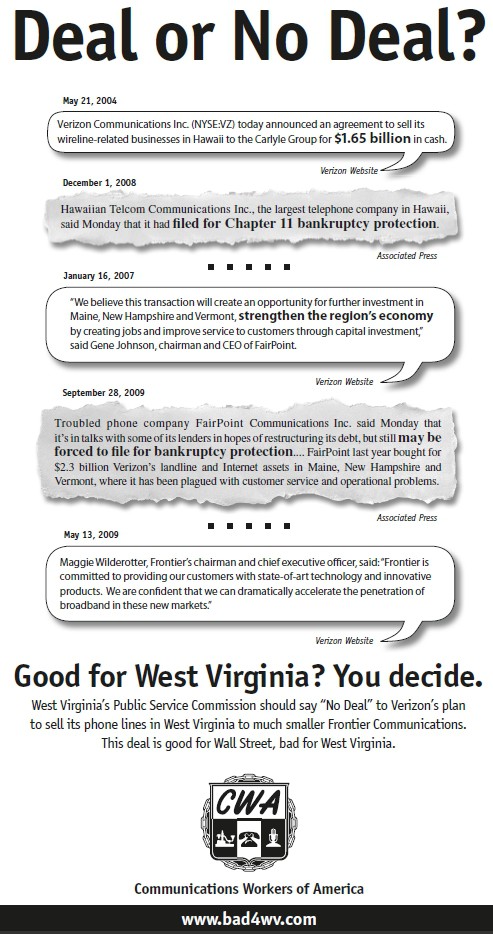
The Communications Workers of America contract Verizon promises with reality for consumers impacted by earlier deals. (click to enlarge)
In September Verizon CEO Ivan Seidenberg told a Goldman Sachs investor conference that the wired phone line business was effectively dead. Seidenberg recognized that trying to guess when the company would stop losing “landline” customers was like guessing when a dog will stop chasing a bus. In other words, the future of Ma Bell is not delivering phone service — it’s deploying advanced networks that are capable of providing customers with video, broadband, and phone service across one wire, preferably a fiber optic one. Those that can manage the transition will succeed, those who cannot or won’t will face a steady decline to obsolescence.
There is only one major problem — it costs a lot of money to rewire entire communities, much less states, with fiber optic wiring. It’s like building a phone network from scratch. A company contemplating such a challenging undertaking starts by asking how much it is going to cost and when will it profit from its investment. Many on Wall Street don’t like either question because of the up front cost, and are even less happy with the prospect of taking the long view waiting for those costs to be recouped from customers.
To date, Verizon is the most aggressive major phone company in the nation building a pure fiber optic system in its larger service areas. AT&T, which provides phone service in many states, has taken a more cautious approach using a hybrid fiber-copper wire design they market as U-verse. A handful of independent phone companies and municipally owned providers have undertaken to wire fiber optics to the home as well, so they can sell video, telephone and broadband service to their customers.
A major challenge confronts phone companies servicing more distant suburban and rural phone customers, often living far apart from one another in sparsely populated regions. It costs more to service these customers, and the potential revenue gained is often not as great as what can be earned from their urban cousins. Verizon doesn’t see many rural customers as part of their future business plans and have begun to systematically sell some areas off to other phone companies, usually in tax-free transactions. One company that sees an ambitious future in serving rural America is Frontier Communications. For them, finding a niche among the big boys gives them safety and security, particularly in areas that don’t have a cable competitor (or any competitor at all).
Frontier’s acquisition strategy is to sell regulators and the public on the idea that allowing Frontier in guarantees a much better chance for broadband service to reach the communities Verizon skipped over. Their argument for success in a business seeing steady declines in customers is that broadband service will stem the tide, and help them remain profitable. More than doubling their size with the acquisition of Verizon’s latest castoffs means more opportunity to market broadband service to those underserved communities. Frontier argues it can be a more nimble player than Verizon because it has marketing and service experience in rural communities previously ignored by Verizon.
Frontier’s ability to provide broadband service is not the most important question. More important is how Frontier will define broadband and at what speed. Also critically important is how Frontier will be prepared to deliver the next generation broadband platform that other communities will see with speeds up to 100Mbps, often on fiber optic networks.
Frontier’s reliance on ADSL technology, which worked fine for 1990s Internet connectivity, is increasingly falling behind in the speed race, and for much of the next generation of online content, speed will matter very much.
Unfortunately, the track record for the success of these spinoffs has been universally lousy for consumers and for many employees who live and work in the impacted communities. Promises made quickly become promises delayed, and later broken as companies like Hawaii Telecom and FairPoint tried to integrate former Verizon operations into their own. Service outages, billing errors, confusion, and finally a mass exodus by customers looking for better alternatives has been the repeated result. The faster customers depart, combined with the enormous debt these transactions create for the buyer, the faster the journey ends in Bankruptcy Court. There is nothing about the Frontier deal proposal that suggests their experience will be any different.
Shouldn’t Three Strikes Mean You Are Out?
Consumers should tell state regulators they should pay careful attention to the failures Verizon has left in its wake from previous deals:
FairPoint Communications, which assumed control of phone service in Maine, New Hampshire and Vermont just last year declared bankruptcy this morning, even now still plaguing customers with billing and service problems. The company choked on the debt it incurred from financing the deal. Before this morning’s bankruptcy, their stock price had lost 95% of its value, and customers were leaving in droves, only accelerating the company’s demise. FairPoint thought it could integrate Verizon’s byzantine billing system into its own. Thinking and doing turned out to be two entirely different things. Frontier has experience integrating other small independent phone companies into its billing system, but now faces the same prospect of dealing with Verizon’s own way of doing everything, and for twice the number of customers Frontier serves today.
Hawaii Telecom and its 715,000 customers were dumped by Verizon in 2005. Once again, transition issues plagued the post-sale experience for those customers, and almost a quarter fled the company over three years. Last December, Hawaii Telecom declared bankruptcy.
Verizon’s yellow pages unit was also thrown overboard by the company to Idearc in November 2006. Saddled with $9.5 billion in debt and interest payments representing almost one quarter of the entire company’s revenues, Idearc finally had enough in March 2009 when it also declared bankruptcy.
The deal between Verizon and Frontier could easily follow the same path, as Frontier gets loaded down with massive debt financing the purchase, and has to immediately provide better service than Verizon did, or face a stampede of customers heading for the exit. The impact of a debt-laden Frontier could be felt by more than just the newcomers. Existing Frontier customers could also be impacted as the company turns its attention to a potentially lengthy integration process.
The Promise of Anemic Broadband, The Fiber Myth & The 5GB Acceptable Use Policy
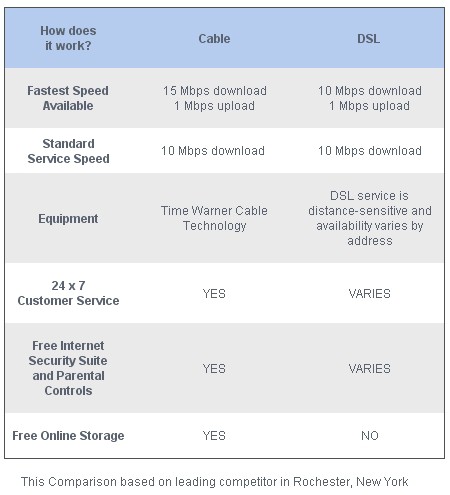
Time Warner Cable competes effectively against Frontier DSL in the phone company's largest service area
Frontier’s plan to bring broadband to a larger number of customers is a noble gesture, particularly for households that currently do not receive any broadband service. Unfortunately, a short term gain of what will likely be 1-3Mbps DSL service will leave these communities behind in the next few years as broadband speeds accelerate far faster than what Frontier is prepared to provide.
Some press accounts in West Virginia have left residents with the impression fiber optic service will reach their individual homes should Frontier be successful in purchasing Verizon’s assets. There is no evidence to suggest this is true.
In earlier deals, these kinds of rumors started when companies advocating the sale staged press-friendly events announcing a fiber connection between hospitals, schools, or community centers, allowing the media to give the impression there would be fiber upgrades for all… if the deal gets approved. In the case of Frontier, they have suggested they will continue work on Verizon’s FiOS system in the communities where construction was already underway. That’s an important distinction for the millions of customers who don’t live in those communities. Verizon’s FiOS network that is part of this transaction serves less than 70,000 residents.
Residents should consider what possibility their community has of obtaining this type of advanced service when Frontier refuses to provide anything comparable in their largest service area – Rochester, New York.
If they are not doing it in Rochester, do you really believe they will do it in your community?
The company certainly has a competitive need to provide such service in our city where Time Warner Cable has accelerated speeds beyond what Frontier is capable of providing. Indeed, Time Warner Cable officials tout their largest number of new Road Runner broadband sign-ups comes from departing DSL customers who are fed up with the anemic, inconsistent speeds offered by this aging technology.
In the town of Brighton, I gave Frontier DSL service a try this past spring. The company promises up to 10Mbps of service to my area, which is less than 1/2 mile from the city of Rochester, and literally just a few blocks from the town’s business center. After installation, the company was only able to provide me with service at 3.1Mbps, just less than one-third of the speed marketed to local residents. Even more surprising was the fact they charged a higher price for that service (including taxes, fees, and modem rental charge) than their competitor, Time Warner Cable.
This website was founded after Frontier inserted language into its Acceptable Use Policy defining “reasonable” broadband usage at just five gigabytes per month. That’s right, the same limit your mobile phone provider applies to their wireless broadband service. Viewing one HD movie over Frontier’s DSL service would put you perilously close to unreasonable use.
Are consumers willing to give up unlimited Verizon DSL service for a company that refuses to drop a 5GB acceptable usage definition from their terms and conditions?
America is on the threshold of 50-100Mbps broadband service, with some communities already enjoying those speeds. If your community isn’t served by a competing provider, do you want to limit your future to yesterday’s DSL technology, and then told it is inappropriate for you to actually use it beyond five gigabytes per month?
The Billing and Customer Service Nightmare
The days of local customer service are over with Frontier. Back during the days of Rochester Telephone, there were several occasions when a local customer service representative would recognize me by name. Those days are long gone. Now, a good deal of Frontier’s customer service is handled by a call center in DeLand, Florida. While the representatives mean well, experiences with them suggest many are not well equipped to understand and consistently market Frontier’s products to existing customers. Pile on more than double the number of new customers, and the problems are likely to become much worse.
Frontier has personally plagued me with billing errors this past year, gave inconsistent and inaccurate answers to pricing and service inquiries, and created major runaround hassles to correct them. From the DSL self-install kit that never arrived (requiring me to visit a local office to pick one up myself), to the impenetrable and inaccurate bills that resulted, the company could not correct the problems without consulting someone with supervisor status. I canceled service within the month.
Customers signing up for service have been pressured into “peace of mind” agreements that lock customers into long term contracts that automatically renew unless the customer actively cancels them (and is certain the request to cancel was processed correctly.) Frontier has been fined twice by the New York State Attorney General for “misleading advertising and marketing tactics,” once in 2006 and again just a few weeks ago. Some customers are now waiting for substantial refunds ranging from $50-400 dollars for “early termination fees” charged when they tried to cancel service.
Are you comfortable knowing some customers have been inappropriately placed on a one to three year contract without their full informed consent, and billed hundreds of dollars when they tried to cancel?
The Art of the Deal
By no means will a Verizon-Frontier transaction be the last. As the industry continues to consolidate around a dwindling number of wired phone line customers, it’s a safe bet there will be more phone customers thrown away by the bigger players. Nothing guarantees Frontier itself will be freestanding when the consolidation wave ends. While these deals may make sense for some shareholders and company executives, they often don’t for local experienced employees who know the network and how to provide quality service. They never have for consumers who will always have to foot the bill to pay off these transactions and have to live with the company trying to integrate Verizon’s bureaucracy with their own.
Some consumer groups and local workers correctly predicted, in each instance, the horrific outcome of these kinds of deals. Their uncanny knack to correctly predict disaster contrasts with company marketing, lobbying, and astroturf efforts that promise the sky and tell each successive news reporter covering the latest atrocity that “things are getting better” and “will be fixed soon.” Unfortunately for too many customers, the fix has to come from a judge in Bankruptcy Court.
The International Brotherhood of Electrical Workers who repeatedly warned about the perils of FairPoint, now warns state regulators about Frontier, and direct attention to the numbers:
If the transaction is approved, Frontier management will have to deal with a 300% increase in access lines (from 2.2 million access lines now to 7 million after the sale) and a 200% increase in employees (from 5,700 employees now to 16,700 after the sale).
Frontier’s debt will increase from $4.55 billion to $8 billion—an increase of over $3.4 billion. Servicing this debt will mean less money for infrastructure, service quality, and high-speed internet build out.
While Frontier argues that somehow this deal will make it stronger, the issue for the states being sold is how much weaker it will make the operations in those states.
The leverage ratio is one way to measure the financial health of a company. The leverage ratio is calculated by taking net debt and dividing it by earnings (before interest, taxes, depreciation and amortization). The leverage ratio for the states being sold will increase from 1.7 immediately before the transaction closes to 2.6 after the sale. The entire deal revolves around Frontier’s ability to cut its operational expenses by $500 million or 21%.
This is significantly greater than the 8-10% cut that FairPoint hoped to achieve—and much of these savings were to be generated from replacing Verizon’s network and back-office systems. Yet, Frontier states that all of the operations except for West Virginia will continue on Verizon’s existing systems—for which Frontier will pay a fee.
Where will Frontier generate the savings—from reduced service quality, workforce, or maintenance of the communications infrastructure? In spite of brave talk from Verizon and Frontier, as recent events have demonstrated, obtaining financing for a transaction this size can be difficult. Frontier does not currently have financing for the additional debt it will take on for this transaction.
As an existing Frontier customer, I’d like an answer myself.
<
p style=”text-align: center;”>
Watch these two Wall Street guys talk about the previous Verizon deals that threw customers under the bus. Plenty of praise for the skilled deal maker Verizon CEO Ivan Seidenberg, and no concern for you, the consumer and telephone customer impacted by a deal that got a few people very rich and left you with a bankrupt phone company. (3 minutes)
It’s Not Worth the Risk
Unfortunately, for too many rural Americans impacted by this deal, there is only one phone company. Cable television is not in their future, and in mountainous regions like West Virginia, wireless phones may not be suitable as a phone line replacement. Risking 100 years of solvent phone service on a deal that could ultimately follow earlier deals into bankruptcy is not worth the risk. The nightmares of converting operations from one provider to another is a hassle consumers should not have to face.
For decades, you faithfully paid your Verizon telephone bill and made the company the telecommunications powerhouse it is today. Now they want to abandon you because, frankly, you just aren’t important enough to them anymore. It doesn’t have to be this way. State regulators can tell Verizon they need to make different plans — by forgetting about trying to cash in on a deal that is good for them and bad for you, and by staying put and providing consumers with the same kinds of network upgrades they are building in communities across the country.
Unfortunately, Frontier before this deal was ill-equipped to embark on the kind of investment necessary to provide fiber optic broadband connectivity to its customers. Now pile on billions of additional debt and the challenge of trying to more than double their size and integrate diverse phone networks in 13 different states and ponder what the chances will be for fiber service after the deal is done. Far more likely for residents is a company that will rely on slow speed DSL service, providing “good enough for them” broadband for the indefinite future.
Take Action!
As has been the case with Hawaii Telecom and FairPoint, naive regulators believed the false promises and approved earlier deals, and are frankly responsible for part of the blame. Face-saving telecommunications regulators in New England initially even tried to cheerlead for FairPoint as they stumbled through one customer service nightmare after another. Too late, they realized the grim reality that their approval saddled their states with a phone company totally unequipped to do the job.
Consumers who do not want a repeat performance can contact their state representatives and tell them to put pressure on each state’s public utility commission to reject the deal. You should also contact your state’s public utility commission yourself.
No amount of concessions and written agreements will make a difference if that phone company ends up in financial distress and takes a walk to Bankruptcy Court. Regulators should not even bother trying, after witnessing the debacle with FairPoint.
In your polite, persuasive and persistent communication with state officials, let them know:
We’ve been down this road with Verizon before, with FairPoint Communications and Hawaii Telecom, leaving a litany of broken service promises, unfulfilled broadband commitments, unacceptable billing mistakes, and poor quality customer service. In both instances, customers fled and the companies ended up in bankruptcy;
Frontier has been unable or unwilling to wire its largest service area, Rochester, New York, with the advanced fiber connectivity that Verizon is wiring throughout the rest of upstate New York. If the company cannot meet the needs of customers in their largest service area, what in the world makes you think they’ll do it for us?
The company has been fined twice by the New York State Attorney General for dubious business practices, costing consumers hundreds of dollars the company has now agreed to return to those customers;
A broadband service for our community’s future should not come with a 5 gigabyte monthly limit attached in the fine print. How can our community compete in the digital economy if you have to ration your broadband usage to an unprecedented level in wired broadband?
The devil is always in the details. Verizon has an aggressive plan to stay relevant in a digital future, with video, telephone, and Internet service running across advanced fiber optic lines. Frontier has a plan to serve rural communities with yesterday’s technology. Frontier’s vision for video is to “get a satellite dish” and rely on the existing aging copper wiring to do everything else.
What kind of service and growth can we expect from a company mired in debt? As seasoned Verizon employees in our community start retiring, understanding the writing on the wall, what do they know that you and I don’t?
Phone companies are a regulated utility, essential to the public interest. Why permit a risky deal that could ultimately lead to a taxpayer bailout to keep operations running if Frontier follows its predecessors into bankruptcy, all while Verizon walks away with billions in proceeds?
You can locate the names and contact information for your state representative(s) on Congress.org simply by entering your zip code. When calling or writing, always be courteous, and request that your representative respond in writing to your concerns, and share with Stop the Cap! any correspondence you receive in reply. As always, we’ll be holding elected officials accountable.
Your next contact must be with your state public utility commission. If a hearing is planned in your community, share your views in person and feel free to point them here if they want to watch how bad telecommunications deals have unfolded in the past. We have countless hours of news reports archived for their viewing pleasure. Each state has a different procedure for contacting them. In West Virginia, for example, consumers can call the Commission at 1-800-642-8544. Ohio residents can fill out an online form.
Perhaps Frontier can one day take on a transaction like this, but only after it can demonstrate it has the resources and willingness to provide customers with better options for service. Had they done that in our community, local residents would not have taken to signing a petition for Verizon to overbuild, or buyout Frontier’s Rochester operation. Local residents want the advantage fiber optic service can bring our community and its local economy, some even expressing a willingness to send $10 and $20 checks to Verizon for an acquisition fund to get the sale done. When consumers give money to the phone company when they don’t owe anything, that should be a clear signal consumers are dissatisfied and want a change Frontier, thus far, has not provided.
One day before the Federal Communications Commission in Washington announced draft guidelines to establish an American Net Neutrality policy, the Canadian Radio-television Telecommunications Commission (CRTC) announced its own guidelines to govern what Canadian broadband providers can and cannot do with the Internet traffic they deliver to millions of Canadian consumers. While Bell (Canada), the nation’s largest telecommunications company praised the CRTC for its provider-friendly ruling, consumer groups varied their responses from “a step in the right direction” to “weak” to “here comes more gouging.”
The CRTC Net Neutrality policy for Canada essentially permits providers to continue to throttle broadband speeds for both retail and wholesale customers, and block traffic altogether should the CRTC grant permission in “exceptional cases,” as long as the provider discloses the practice to consumers up front, and warns them in advance of any policy changes that further slow their connections.
Laurel Russworm, who runs Stop Usage Based Billing, was not pleased.
“The CRTC decision doesn’t have a silver lining I can find; in fact they essentially said that usage based billing and caps are good tools to use to fight congestion. All Bell Canada has to do is warn us first, then they can gouge as they please. They’ve deferred making a decision on usage based billing until after the court challenges are dismissed, but I’m not holding my breath,” Russworm wrote.
On Wednesday the CRTC decided that Internet providers in Canada need measures to manage the traffic on their networks at certain times to deal with what providers claim to be a congestion problem. At hearings held this past summer, several CRTC commissioners were receptive to the claims providers made that Canadian broadband does not have the capacity their American neighbors have. Providers like Bell and Rogers claim that peer to peer traffic and increasing consumption of high bandwidth services have created capacity shortages on their networks, requiring traffic management which artificially slows certain traffic on their networks at “peak times.” Canadian broadband providers almost universally also impose Internet Overcharging schemes on their customers, limiting customer use and charging them overlimit penalties for exceeding usage allowances.
The commission accepted the providers’ claims and gave the green light to those practices, but said before a provider literally blocks access to online services, or throttles time sensitive traffic on services like Voice Over IP telephone or two-way video conferencing to the point it becomes “degraded,” it needs to get Commission permission first.
Mirko Bibic, Bell Canada’s senior vice-president of regulatory and government affairs, toldThe Globe and Mail the ruling gives carriers the right to run their businesses the way they see fit. “We’re the experts, and we get the flexibility to determine how to manage our networks to give the user the best experience,” he said.
Bell already “throttles” its Internet service by slowing peer-to-peer downloading between 4:30 p.m. and 1 a.m. to make sure the network is not overloaded by a relatively small number of people transferring large video and music files.
Independent Internet providers are among the biggest proponents of Net Neutrality, and a ban on Internet Overcharging schemes known in Canada as “usage based billing.” Many Canadian broadband providers obtain connectivity through wholesale accounts purchased from Bell. The Canadian phone giant imposed both speed throttles and usage based billing on their wholesale customers. Those costs, and the speed bumps that go with them, are now increasingly passed on to consumers. Independent providers fear being put out of business.
For many of them, Wednesday’s decision might as well never have happened.
“This has really not changed anything,” Tom Copeland, chair of the Canadian Association of Internet Providers, toldPC World.
Copeland said the “biggest, most glaring omission” from the ruling is the lack of restraints on the time of day or how long suppliers like phone or cable companies can manipulate traffic. “So we could continue to see traffic management every day of the year,” he said.
“We’re still not addressing the cause of the problem,” he added: “Either weak points in the network, or abuse by users.” Most casual users of peer-to-peer applications — the biggest offending programs in the eyes of providers – aren’t the problem, he said.
“We just went backwards at warp speed,” lamented John Lawford, counsel for a coalition of consumer groups that fought for an end to throttling of Internet traffic of consumers, “ while we watch the U.S. rocket ahead.”
“The CRTC has said in this decision that ISPs own your content and own your Internet connection” said Lawford, “You just got owned.”
The Public Interest Advocacy Centre represented the Consumers’ Association of Canada, Canada Without Poverty and Option consommateurs during the hearings on Net Neutrality. PIAC argued that the Telecommunications Act required ISPs not to interfere with customers’ Internet traffic unless such traffic was clearly harming other users of the network and not otherwise. “ISPs should act as common carriers and just carry traffic, not as broadcasters deciding what you watch” continued Lawford, “but now they can decide what gets through – and how much they get to charge you for the privilege.” Lawford also noted the CRTC’s requirement for the ISPs to disclose their “Internet traffic management practices” will not actually stop any of the practices.
The CRTC has repeatedly taken broadband industry-friendly positions in direct opposition to Canadian consumer interests, helping to set the stage for Canada’s rapid decline in broadband leadership. The country’s standing in broadband rankings has taken a stunning fall from its earlier top-shelf position. Regulatory policies that permit abusive, anti-competitive practices and reward providers for rationing broadband instead of investing in expanding it are at the heart of the problem.
Since the CRTC has taken positions more worthy of a industry trade group than an independent regulator, an increasing number of Canadians are demanding the CRTC lead or get out of the way. A large group of Canadian voters upset about any issue is sure to attract politicians, and the New Democratic Party of Canada (NDP) has arrived.
Charlie Angus (NDP)
Charlie Angus, New Democrat Digital Affairs Critic and MP for Timmins-James Bay, who already is on record opposing Internet Overcharging schemes, says the CRTC dropped the ball on Net Neutrality.
“Yesterday’s CRTC decision on Internet traffic-management practices is a blow to the future of digital innovation in Canada,” Angus said in a statement.
“This interference [from traffic management] will be bad news for small third-party competitors and leaves consumers subject to digital snooping and interference from cable giants,” he added.
“Basically the CRTC has left the wolves in charge of the henhouse. ISP giants have been given the green light to shape traffic on the internet in favor of their corporate interests,” he said. “This decision is a huge blow to the future competitiveness of the Internet.”
Angus says that the premise of today’s decision – that notification from the ISP will allow customers to make an informed decision on where to buy Internet service – misses the harsh reality that the market for Internet service in Canada is not nearly competitive enough to work.
“Canada has fallen to the back of the pack in Internet service provision and pricing after leading the way for years. This is the direct result of a small band of ISP giants blocking out competition,” Angus said. “This decision clears the way for ISPs to squeeze out third-party players who are attempting to provide better price and service options.”
South of the border, the FCC has taken clear steps toward the establishment of Internet neutrality on U.S. networks.
Angus said that principle of Net Neutrality should be at the center of Internet policy in Canada, and that the CRTC has missed a golden opportunity with yesterday’s decision.
“The principle of Net Neutrality must be a cornerstone of the innovation agenda. The CRTC has once again acted as the rubber stamp for large ISP and cable players to dominate the market and decide which traffic goes in the fast lane and which traffic gets stuck in the slow lane. This decision continues a long and dismal tradition of Canada’s communication policy decisions chipping away at the public interest to the benefit of a few corporate giants.”
Dissolve the CRTC, a group collecting signatures to petition for the closure of the Commission, also made several comments about the CRTC decision.
Among their conclusions:
The new policy leaves the door open to providers deciding their economic interests are better served from traffic management practices like throttles and usage limits than network investments. Short term limits may serve the interests of stockholders, but could discourage long term investments needed to create new 21st century broadband platforms;
The Commission’s encouragement that providers make additional investments in their networks is likely to fall on deaf ears. It was Bell’s lack of investment in their broadband network which led to the traffic management practices, and the recent hearings about them, in the first place. Without mandates, there is no real pressure on Bell to change their investment strategy.
The Commission’s policy to regulate this issue through a user complaint process that calls out bad actors has no historical precedent of working. The CRTC has a long history of ignoring public involvement in telecommunications proceedings, and does not like to involve themselves with individual customer complaints. Campaigns to flood the CRTC with complaints on specific issues using their language may be the only way to get them to investigate. Additionally, complaints that call out the disparity in network management policies between wholesale and retail accounts may only lead to additional restrictions on both types of accounts, making a bad situation even worse.
Canadians must contact their elected officials and demand federal legislation to enact true consumer protection and broadband reform policies to restore Canada to a position of leadership in broadband. The CRTC is ineffective and must not be the final arbiter on these important issues.
This newspaper ad is running across West Virginia opposing the sale of the state's phone business to Frontier Communications
Opposition to the sale of Verizon’s landline business to Frontier Communications in 13 states continues to increase, particularly in Ohio and West Virginia, where several employee unions have argued the deal represents a win for Wall Street and company executives, but a raw deal for millions of consumers.
The Communications Workers of America and the International Brotherhood of Electrical Workers, who also warned state regulators in New England about the consequences of approving the sale of Verizon’s operations in Maine, New Hampshire, and Vermont to FairPoint Communications, continue to warn consumers and state officials that a similar deal between Verizon and Frontier Communications could spell major problems for telephone customers. They call on state officials to reject the deal and force Verizon to invest some of their substantial profits earned in these communities into providing better service instead of dumping customers overboard.
The CWA says the sale would put $3.3 billion dollars into Verizon’s coffers — tax free — and leave Frontier buried in debt, which could impact both new and existing Frontier Communications customers, including hundreds of thousands of those in Rochester, New York, Frontier’s biggest service area.
“Verizon Communications has been divesting assets to smaller, less stable corporations in order to reap large, tax-free, profits,” CWA International Representative Elaine Harris said. “Verizon proposes to repeat that formula, and its disastrous effects, with the sale of all of its wireline operations here in West Virginia to Frontier.”
The CWA considers the transaction based primarily on corporate greed, not the best interests of phone customers.
“The only winner in all of these deals has been Verizon Communications and especially Verizon’s corporate executives,” Harris said. Verizon CEO Ivan Seidenberg is the highest paid executive in the telecom industry, with $24.31 million dollars in annual compensation from Verizon.
“His salary could have funded the entire network of senior services in West Virginia last year and he still would have had $8 million in his pocket,” Harris said.
The deal will leave Frontier Corporation with a total of $8 billion dollars in debt. “The West Virginia consumers will experience the effects of converting more than 617,000 aging access lines to a smaller, debt-ridden company,” Harris said. “The public will be forced to pick up the pieces if Frontier follows Verizon’s other buyers and files for bankruptcy.”
“We’ve closely watched the failures of the companies that purchased Verizon’s assets and we don’t need a crystal ball to figure out what will happen if Verizon tries the same scheme in West Virginia. There’s absolutely no reason to gamble West Virginia’s telecommunication’s future just to increase Verizon’s bottom line,” Harris added.
The CWA is running radio ads across the state of West Virginia opposing the deal.
Audio Clip: Communications Workers of America Radio Ad (1 minute)
You must remain on this page to hear the clip, or you can download the clip and listen later.
Verizon spokesman Harry Mitchell said Verizon wants to sell its access lines so the company can focus on its wireless and broadband business. Mitchell told The Charleston Gazette the union has opposed the deal from day one.
“They’re spending their members’ dues on advertising in an effort to cloud the issue,” he said.
Frontier Communications has protested accusations that their purchase of Verizon assets will result in the same kinds of colossal failures impacting other Verizon sell-offs. Company officials claim Frontier already has a successful customer support operation in DeLand, Florida, and billing and operating systems in place.
In West Virginia, those existing operations serve 144,000 Frontier customers. If the deal is approved, Frontier will take on the responsibility of serving 1.3 million landlines across the southeastern U.S. alone.
Regulators in the 14 states where Verizon now proposes to sell its landlines to Frontier face an almost identical situation as New England regulators did last year. Frontier Communications is proposing to buy Verizon’s entire wire line operation in West Virginia – as well as Verizon’s scattered landlines across 13 other states – in a similarly structured deal.
In both cases, Verizon chose a much smaller company in order to take advantage of an obscure tax loophole. With the Frontier sale, Verizon will avoid paying any taxes on the $3.3 billion it will receive from Frontier. Frontier will have to cope with three times more employees, three times more access lines and a 75 percent increase in its debt from $4.5 to $8 billion.
Verizon has a very poor track record in these sales. Verizon sold its Hawaii operations to Hawaiian Telcom in 2005 and it filed for bankruptcy. Customers, service and employees have suffered as a result.
Frontier – just like FairPoint – is a making promises that it may not be able to meet. Like FairPoint, state regulators are being asked to approve a deal where a small company will attempt to simultaneously run a much larger operation, pay off billions of dollars more in debt, integrate Verizon’s computer systems and spend more money to expand broadband.
In the end Verizon will profit but consumers, workers and communities are put at real risk.
Expanding broadband access is an especially critical factor for all rural areas. But Frontier has failed to make any specific commitments, set any timeline or offer a plan for its broadband buildout.
Union leaders believe that states shouldn’t risk their telecommunications’ future just so Verizon can fatten its bottom line. Regulators shouldn’t approve this sale because the risks are too great. Instead, our legislators, regulators and the Governor should require Verizon to meet its service responsibilities. Verizon shouldn’t be allowed to walk away with $3.3 billion tax free, and leave the fate of its customers in the hands of a company with a lot less resources. If Frontier should falter, customers and the public would be required to pick up the pieces – not Verizon!
The track record for Verizon spinoffs has hardly been one of success.
FairPoint Communications, the company to which Verizon sold its Maine, New Hampshire and Vermont operations in 2008, is foundering as it tries to integrate operations and is choking on the debt it incurred to finance the transaction Since the deal was announced, FairPoint’s stock price has declined by about 95%, and the company has been forced to suspend dividend payments.
Hawaiian Telecom, the company to which Verizon sold its Hawaii operations in 2005, filed for bankruptcy. Verizon sold its 715,000 access lines in Hawaii. Since then, Hawaiian Telcom has experienced significant transition issues that resulted in major financial and customer service problems. In three years, the company lost 21% of its customers. In December 2008, Hawaiian Telcom filed for bankruptcy.
The yellow pages company that Verizon spun off also filed for bankruptcy. In November 2006, Verizon spun off its yellow pages directory business to Verizon shareholders, loading the new company, Idearc, with about $9.5 billion in debt and extracting a cool $9 billion in cash and debt reduction. Last year, interest payments alone on Idearc’s debt accounted for almost one-quarter of its total revenues! Representing something of a Verizon failing company “hat trick,” Idearc filed for bankruptcy in March 2009.
WSAZ-TV Huntington, West Virginia reported on the growing opposition to the Frontier sale by employee groups on October 14th. (3 minutes)
In Washington State, IBEW Local 89, outside Seattle, says the sale could cripple one of America’s most tech-savvy regions.
“We’ve always been a leader in communications in this part of the country,” said Ray Egelhoff, business manager of IBEW Local 89. “If this happens, we’re afraid businesses won’t move in, and some may even move out.”
Egelhoff, along with more than 1,500 Verizon workers who may become Frontier employees, deluged officials with letters and e-mails expressing their concerns. More than 500 have gone out so far to senators, house members, governors and business leaders. The workers worry Frontier —at about the a third the size of Verizon—won’t be able to absorb the huge Verizon assets, won’t be able to keep customers happy and, eventually, will have to shed staff.
Robert Erickson, International Representative in the IBEW’s Telecommunications Department said, “The deal poses risks to consumers and employees. Frontier is making all kinds of promises about synergy and how they’ll expand broadband. FairPoint Communications made the same grand claims and now they can’t meet their commitments and fulfill the promises they made. It’s clear that Frontier will be in a similar situation and not have the resources to fulfill the commitments they are making.”
Consumer groups are also raising objections to the sale.
The National Association of State Utility Consumer Advocates urged the Federal Communications Commission, which is reviewing the proposed transaction, to reject the deal.
“The merger proposed by Frontier and Verizon is not in the public interest,” said David Springe, president of the consumer advocate group. “The failure of the companies to offer adequate consumer benefits or protections puts customers at risk of being served by a company without enough financial strength to make necessary improvements to local telephone facilities and widen the deployment of broadband access.”
Free Press, a nonpartisan group that works to reform the media, also raised concerns about the sale in a filing with the FCC. Free Press cited Verizon’s sale of lines in New Hampshire, Maine, and Vermont to FairPoint, which subsequently acquired substantial debt, was unable to accommodate the increased service area, and is now on the edge of bankruptcy.
“This trend has the potential to leave rural areas with ill-equipped companies offering inadequate service at high prices,” says the Free Press report. “This is in direct contrast to the stated intent of Congress and the Obama Administration to foster universal broadband to all Americans.”
[flv]http://www.phillipdampier.com/video/WCHS Charleston Verizon Sale Fight 10-14-09.flv[/flv]
WCHS-TV in Charleston, WV talked with the CWA and company officials about the sale of Verizon operations to Frontier Communications. (1 minute)
Be Sure to Read Part One: Astroturf Overload — Broadband for America = One Giant Industry Front Group for an important introduction to what this super-sized industry front group is all about. Members of Broadband for America Red: A company or group actively engaging in anti-consumer lobbying, opposes Net Neutrality, supports Internet Overcharging, belongs to […]
Astroturf: One of the underhanded tactics increasingly being used by telecom companies is “Astroturf lobbying” – creating front groups that try to mimic true grassroots, but that are all about corporate money, not citizen power. Astroturf lobbying is hardly a new approach. Senator Lloyd Bentsen is credited with coining the term in the 1980s to […]
Hong Kong remains bullish on broadband. Despite the economic downturn, City Telecom continues to invest millions in constructing one of Hong Kong’s largest fiber optic broadband networks, providing fiber to the home connections to residents. City Telecom’s HK Broadband service relies on an all-fiber optic network, and has been dubbed “the Verizon FiOS of Hong […]
BendBroadband, a small provider serving central Oregon, breathlessly announced the imminent launch of new higher speed broadband service for its customers after completing an upgrade to DOCSIS 3. Along with the launch announcement came a new logo of a sprinting dog the company attaches its new tagline to: “We’re the local dog. We better be […]
Stop the Cap! reader Rick has been educating me about some of the new-found aggression by Shaw Communications, one of western Canada’s largest telecommunications companies, in expanding its business reach across Canada. Woe to those who get in the way. Novus Entertainment is already familiar with this story. As Stop the Cap! reported previously, Shaw […]
The Canadian Radio-television Telecommunications Commission, the Canadian equivalent of the Federal Communications Commission in Washington, may be forced to consider American broadband policy before defining Net Neutrality and its role in Canadian broadband, according to an article published today in The Globe & Mail. [FCC Chairman Julius Genachowski’s] proposal – to codify and enforce some […]
In March 2000, two cable magnates sat down for the cable industry equivalent of My Dinner With Andre. Fine wine, beautiful table linens, an exquisite meal, and a Monopoly board with pieces swapped back and forth representing hundreds of thousands of Canadian consumers. Ted Rogers and Jim Shaw drew a line on the western Ontario […]
Just like FairPoint Communications, the Towering Inferno of phone companies haunting New England, Frontier Communications is making a whole lot of promises to state regulators and consumers, if they’ll only support the deal to transfer ownership of phone service from Verizon to them. This time, Frontier is issuing a self-serving press release touting their investment […]
I see it took all of five minutes for George Ou and his friends at Digital Society to be swayed by the tunnel vision myopia of last week’s latest effort to justify Internet Overcharging schemes. Until recently, I’ve always rationalized my distain for smaller usage caps by ignoring the fact that I’m being subsidized by […]
In 2007, we took our first major trip away from western New York in 20 years and spent two weeks an hour away from Calgary, Alberta. After two weeks in Kananaskis Country, Banff, Calgary, and other spots all over southern Alberta, we came away with the Good, the Bad, and the Ugly: The Good Alberta […]
A federal appeals court in Washington has struck down, for a second time, a rulemaking by the Federal Communications Commission to limit the size of the nation’s largest cable operators to 30% of the nation’s pay television marketplace, calling the rule “arbitrary and capricious.” The 30% rule, designed to keep no single company from controlling […]
Less than half of Americans surveyed by PC Magazine report they are very satisfied with the broadband speed delivered by their Internet service provider. PC Magazine released a comprehensive study this month on speed, provider satisfaction, and consumer opinions about the state of broadband in their community. The publisher sampled more than 17,000 participants, checking […]


 Subscribe
 Customers whose service was degraded on Wednesday 27 January: