Home » consumer groups » Recent Articles:

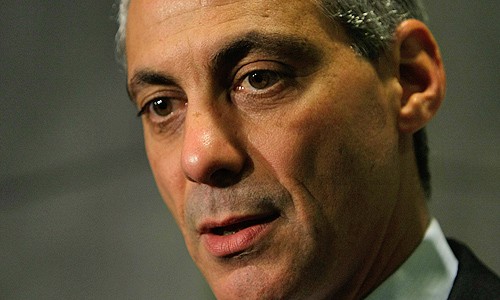
Is Rahm Emanuel Selling Us Out? Secret Deal With Telecoms May Kill Net Neutrality

Is Rahm Emanuel the consigliere to a deal to sell out broadband consumers to big telecom companies like AT&T, Verizon, and Comcast?

White House Chief of Staff Rahm Emanuel is said to so afraid of big phone and cable companies donating millions to Republican candidates, he told agencies like the Federal Communications Commission to go along with Verizon, AT&T, and Big Cable’s demands for an end to Net Neutrality and other pro-consumer broadband reforms.

That is the rumor industry expert Dave Burstein is hearing about the prospects of broadband reclassification actually happening at the FCC this year.

It seems Verizon’s CEO Ivan Seidenberg has become a frequent guest at the White House, appearing 16 times since President Obama took office.  Seidenberg is behind the notion that saddling giant telecommunications companies with Net Neutrality will force those firms to flood Republicans with unprecedented campaign contributions.  That’s fascinating news, especially since most politicians claim campaign contributions never make any difference in how they vote on issues.  Perhaps Verizon is just being extra charitable this year.  The Republicans, who fall lock-step in support behind the nation’s largest phone and cable companies, will be delighted to accept.

With politicians like Rahm Emanuel involved, the fix may already be in.  Rule number one in politics is to always follow the money.  Rule number two is that many politicians will always take the money and vote against their constituents’ best interests unless voters are paying attention.  When a politician is forced to weigh the consequences of accepting a fat check from a corporation and voting with them or infuriating their constituents to the point of potentially losing the next election, they’ll vote with their constituents.

Meanwhile, telecom companies are engaged in a divide-and-conquer strategy, with Verizon recently making gestures to Google, one of Net Neutrality’s strongest  proponents.  Burstein thinks that unless public interest groups and the public-at-large don’t force an end to these insider deals, Net Neutrality and other broadband reforms will become little more than a voluntary agreement not to be too evil (until they redefine ‘evil’ as ‘good’ and do it anyway):

Julius (Genachowski) has already agreed to almost everything [telecom lobbyists] really want, including loopholes wide enough to carry 350 TV channels. [Stifel Nicolaus] says there is still some opposition so that nothing is final and that the public interest groups are ready to assail Julius. Meanwhile, Verizon and Google are discussing a separate peace that will make the FCC irrelevant.

This one is about power and money, not principle. The likely outcome is an agreement that will allow everyone to say noble things, will allow Julius to look himself in the mirror, and will essentially have no substance.  I hope I’m wrong.

[flv width=”640″ height=”500″]http://www.phillipdampier.com/video/Bloomberg Bloomberg’s Shields Discusses Net-Neutrality Battle 8-3-10.flv[/flv]

Bloomberg News reviews the regulatory landscape with the FCC’s secret weekend meetings to find a deal on broadband rules.  (2 minutes)

For consumer groups like Free Press and Public Knowledge, already furious over secret backroom negotiations between FCC officials and the nation’s large phone and cable companies, any deal that culminates in providers being allowed to tamper with Internet traffic, choosing favorites along the way, is tantamount to a deal with Tony Soprano.

Tim Karr from Free Press wrote a guest editorial in the Seattle Times Sunday warning there is a corporate deal in the making to take over the Internet:

On the one side, elected officials and regulators have heard from millions of citizens demanding that Washington protect this rule that preserves the Internet’s open architecture.

On the other is a lobbying juggernaut that seeks to dismantle online openness so that phone and cable companies can rebuild the Internet as a gated community that serves their bottom line.

The problem is that policymakers aren’t holding the line for the public. They seem content simply to cut a deal between companies with the most political and economic clout.

If that doesn’t worry you, it should.

Because the deal they’re cutting is over who ultimately wins control of online information. And it goes without saying that you’re not in the running.

Google, Verizon, AT&T and others are reportedly nearing consensus on an agreement that could radically redesign the Web, allowing the carriers to build priority access lanes that admit only large companies that can pay the toll.

Where will that leave the rest of us? Stranded on the digital equivalent of a winding dirt road, with slower service, fewer choices and limited access.

Here’s the kicker. The Federal Communications Commission, the one agency tasked with protecting your interests online, may be poised to sign off on this plan. The agency is reportedly convening closed-door meetings with these companies to strike a deal that would let Internet providers implement a “paid prioritization” scheme.

According to The Washington Post, the FCC’s chief of staff wanted to “seize an opportunity to agree on ways that carriers could “manage traffic” on their networks.

If recent articles by Amazon and AT&T execs are any indication, paid prioritization would allow carriers to ransom access to their customers to the highest bidder. AT&T’s top lobbyist, James Cicconi, wrote that such extortion was “not only necessary but in the best interest of consumers.”

Don’t believe it. The beauty of the open Internet is that anyone with an idea has a chance to take on giant corporations without first having to bribe network owners for access. Net neutrality is the rule that guarantees this openness.

It’s because of Net neutrality that great ideas like YouTube (which began in an office above a pizzeria in San Mateo) and Twitter (which grew out of a daylong brainstorming session among podcasters) blossomed to revolutionize how we connect and communicate with one another.

The paid prioritization deal under consideration wouldn’t allow for the next YouTube. And the next Twitter would likely never make it off the drawing board.

This scheme would let companies like Comcast and AT&T favor their own video services, voice applications and social media. It would let Verizon build a wide moat around its Internet fiefdom, insulating itself from competition by upstart innovators that want to show consumers how things can be done better and more cheaply.

Columbia Law Professor (and Free Press board chairman) Tim Wu has said that letting carriers choose favorites is “just too close to the Tony Soprano vision of networking: Use your position to make threats and extract payments. This is similar to the outlawed, but still common, ‘payola’ schemes in the radio world.

“If allowing network discrimination means being stuck with AT&T’s long-term vision of the Internet,” Wu concludes, “it won’t be worth it.”

Should any of this come to pass, it will mark the end of any credibility for FCC Chairman Julius Genachowski, who will have sold out to the interests of big telecom and, more importantly, proved himself little more than another inside-the-beltway-liar.  The implications for the Obama Administration’s credibility on broadband issues are devastating.

It was Genachowski himself who promised this would be the most open FCC ever and that he would see to it that the open principles of the Internet were safeguarded.  It’s more than a little difficult to see that happening while Genachowski’s staff secretly meets with telecom lobbyists to conclude a deal that will turn over control of Internet traffic to a broadband duopoly.


Exposed: Shallow Editorials, Press Coverage in Illinois Promotes AT&T Deregulation Bill That Harms Consumers

Illinois politics is business as usual — if you’re a high-powered business like AT&T, that is.  They’ve just proven how easy it is to sucker the fifth largest state’s legislature and several newspaper editorial boards with a dog and pony show of promises that it will have few regrets (and no consequences) for breaking later on.

Once again, AT&T is upset about the terms it agreed to in efforts to rebuild its nationwide reach through frenzied mergers and acquisitions.  This time it’s the 1999 merger with Ameritech.  AT&T claims the promises its partner SBC made to state regulators to green-light the deal are now too hard to honor. If only you and I could lobby legislators to walk away from our own personal responsibilities.  “I can’t pay my town taxes because the neighborhood has changed since I first moved here, so it would be unfair of you to ask.”

The argument apparently worked in the Illinois General Assembly which passed AT&T’s Get Off the Regulatory Hook Bill (Senate Bill 107) unanimously earlier this month.  The bill has now been sitting on Governor Quinn’s desk for more than two weeks, and AT&T is getting nervous.  Letters to the editor and AT&T-friendly editorials have started appearing in the Illinois press in a coordinated effort to beat the drum loud enough to get the governor’s attention to sign the bill unchanged.

Ameritech used to provide phone service to most of Illinois before being purchased by SBC Communications (later AT&T) in 1999.

Memories are short.  The Illinois Commerce Commission established ground rules for AT&T precisely because its predecessor provided abysmal service in the state.  As part of a hard-fought campaign to secure Ameritech, AT&T promised Illinois it would:

  • provide reliable landline service in rural Illinois at a fair price;
  • provide DSL broadband to at least 90 percent of Illinois customers;
  • recognize that landline service remains an essential utility for millions of residents, many of whom don’t have the option of switching to another provider.

That was then, this is now.

These days, those requirements are apparently too tough on AT&T.  The company complains Illinois residents can switch to Comcast phone service (from the Worst Company in America 2010) or sign up for cell phone service from AT&T or a few other providers, assuming one has reception.  With all of this “competition,” AT&T argues there is no reason to continue regulating the company’s landline services, especially in rural areas AT&T could probably do without anyway.

Illinois is just the latest stop on AT&T’s big budget deregulation traveling circus, starring high-paid lobbyists and astroturf friends, all coordinating to unshackle their benefactor from pesky regulations.

The state’s legislature is evidently a million miles away from its fellow midwestern states who have been chauffeured down AT&T’s Promise Avenue before, only to discover it quickly became a one-way toll road for consumers.  Ask Wisconsin.

AT&T’s Message — Less is more.

AT&T routinely promises less regulation will magically open the door for its much-coveted U-verse platform.  Every elected official would love to claim he or she brought much-needed cable competition to their district, so promises of telco-TV are quite an incentive for legislators.  The formula is simple — you deregulate us and we’ll bring more U-verse deployment to your state.

Illinois State Senator Michael Bond (D-31st District)

Politicians trip over one another running to the nearest microphone over promises like that.

“This legislation is the key to opening up investment in the telecommunications industry in Illinois,” said state Sen. Michael Bond. “By modernizing our system, we are showing providers that we are worthy of their investment.”

But hasn’t AT&T already made a trip to that well before?  Last June, AT&T issued a press release crediting deregulation undertaken in 2007 for making U-verse expansion possible in Illinois:

AT&T U-verse is being expanded in Illinois thanks to legislation passed in 2007 and supported by State Senators Larry Bomke and Bill Brady and State Representatives Raymond Poe, Rich Brauer, Robert Flider and Bill Mitchell. The Cable and Video Competition Law provides an environment that encourages new video providers, such as AT&T Illinois, to invest in Illinois to compete against incumbent cable providers.

What will AT&T want next to finish U-verse deployment in Illinois – tax-free status?

That U-verse was designed to save AT&T’s landline business from a torrent of disconnect requests always gets missed by elected officials.  Basic landline service over copper wire is a dying business.  If AT&T doesn’t deploy U-verse, its ultimate destiny as a landline provider will be the horse and buggy industry of the 21st century.  Regulators need not throw away valuable consumer protections to protect a multi-billion dollar company already well-aware of what it needs to accomplish to stay profitable.

What consumers end up with — Less service for more money.

Despite the flowery rhetoric that competition is breaking out all over Illinois, 78 percent of state residents continue to rely on landline telephone service. That numbers 6.5 million consumers. Among the well-represented holdouts are fixed income seniors, and for most of them, a $200 monthly deluxe triple-play package of services is out of the question.

For customers that cannot afford higher rates, the Illinois Citizens Utility Board fought for and won a three year rate freeze and reprieve for AT&T’s budget-minded Consumer’s Choice telephone packages that were slated to be discontinued.  These packages don’t bundle unneeded calling features or extra services, instead providing affordable basic telephone service.  But after three years, AT&T can cancel these packages and raise prices at will, particularly in rural areas where competition is minimal to non-existent.  State oversight of AT&T is also history, leaving little recourse for consumers who suffer through poor service or AT&T’s legendary billing nightmares.

Supporters also promoted the deregulation legislation as a “jobs bill” — a ludicrous contention for legislation that contains no section pertaining to jobs.  Perhaps they meant more jobs for AT&T’s lobbying crew.  In fact, landline phone companies like AT&T are slashing jobs by the tens of thousands and will likely continue to do so.

Illinois Senate Bill 107 allows AT&T to set the stage to follow Verizon’s example — exiting rural areas, leaving the bulk of their investments and potential profits in large cities like Chicago.

The State Journal-Register wrote a shortsighted editorial supporting the proposed deregulation bill

Newspaper editorials like this one in the State Journal-Register in Springfield mean well but are breathtakingly short-sighted.  The editorial staff gushes about the benefits U-verse will bring Springfield, without any evidence U-verse will actually be universally available in the community anytime soon:

On a less philosophical level, we believe the new telecom law will be beneficial to most Illinois consumers because it should promote competition for household cable TV, Internet and phone service. In markets like Springfield, it could allow AT&T and Comcast to go head-to-head throughout the city, not just in the few areas where AT&T’s U-verse service is now available. That’s what cable customers have been demanding for decades.

AT&T customers have learned not to hold their breath waiting.  Any regular visitor to the company’s own support forums will quickly discover customers frustrated by lack of availability, hit or miss service, and no coverage map.  One customer summed it up:

I have NEVER in my life had to fight so hard to spend money on something.
Not even my wife makes it this hard on me to get something.
I have NEVER in my life (aside from when I got my AT&T POTS service) had a company work so slowly to accomplish something to try and attract a perspective customer or keep a current customer.

But there’s more.  Had the Journal-Register picked up the phone and checked with their neighboring states, they would have learned U-verse is not the competitive nirvana it’s routinely promised to be.  In Wisconsin, rates for cable, broadband, and phone service continue to increase, not decrease.  Most of the savings built into introductory packages for new customers expire after one year, and some providers limit the discounts to once per household.  That means once your new customer discount package expires, you may never get it again.  Then it’s a lifetime of ever-increasing pricing.

AT&T-backed bills also never require the company to completely wire every community for its U-verse service.  The company can bypass neighborhoods, towns and villages, or buildings it feels are not cost-effective to serve.  There are states that deregulated AT&T to their specifications and years later, communities are still waiting for service to reach their areas.  Illinois will be no different, and if AT&T determines U-verse isn’t worth the investment in large swaths of southern Illinois, so be it.

The Citizens Utility Board is correct when it predicts most of the investment will end up in Chicago, even at the expense of other parts of the state.  AT&T always follows the money.

AT&T’s Astroturf Friends Join the Parade

You have to look closely to see the connection. Who really is behind ITP?

AT&T’s friends are also writing letters to the editor demanding action, without disclosing they are bought and paid for sock puppets.

Take the Illinois Technology Partnership, which claims to represent a grand union of consumer and private interests for the betterment of Illinois’ high tech future.  In reality, it’s yet another AT&T astroturf group that works against consumers.

Their claim:

The Illinois Technology Partnership is the Illinois-based project of Midwest Consumers for Choice and Competition, a non-profit organization of individual consumers interested in technology, broadband, and telecommunication issues with state projects throughout the Midwest region.  ITP brings together industry experts, thought leaders, and Illinois consumers to foster an environment that will encourage emerging technologies, jobs, and investment, and spur economic growth on the state and local level.

Reality Check:

Both ITP and the ironically-named “Midwest Consumers for Choice and Competition” are both creatures of AT&T.  Thad Nation, behind all of these groups, invents AT&T-supported astroturf campaigns in various states where the company delivers service.  Over the past few years, Nation has cooked up TV4Us, Wired Wisconsin and Technology for Ohio’s Tomorrow, among others.  But his real day job is the founder and senior partner at Nation Consulting, a politically-connected lobbying firm:

At Nation Consulting, Nation focuses on assisting corporate clients with strategic planning in government and public relations, and managing crisis communications.

Our team has worked on the “inside” of the offices of Governors, Congressional members, and state agencies. We’ve worked at every level of government, and we have the relationships necessary to help you navigate state and federal bureaucracies to accomplish your goals. We know how government works – and we know what government can do for you.

Getting government officials or bodies to do what you want isn’t easy. Government is inherently a slow, bureaucratic entity. When you want elected or appointed officials to change policy, you need a comprehensive plan – and the resources, relationships and quick-thinking to implement that plan.

We come to you with decades of experience in advocacy, moving legislators and engaging state agency leaders to action. Let us help you build and drive an aggressive advocacy agenda.

Regardless of your industry, the internet has a role to play in achieving your public relations goals – and we have the experience and the expertise to implement a plan suited to your needs. Whether you need to effectively use social networking sites, manage a blog, conduct email campaigns or use Web 2.0 tools, Nation Consulting can help you maximize your online presence in a way that is both cost-effective and beneficial to your business or organization.

Ordinary consumers can’t afford Nation Consulting’s services so he doesn’t work for them.

As usual, AT&T’s connections don’t end there.  Many of the “partners” listed on ITP’s website are themselves also backed by AT&T — the Illinois State Black Chamber of Commerce and Illinois Hispanic Chamber of Commerce just two examples.  Several of ITP’s partners follow Nation’s efforts wherever he goes, also ending up affiliated with his other astroturf projects.

A letter to the editor appearing in The Daily Herald signed by Lindsay Mosher, executive director of ITP, applauds the state legislature for passing AT&T’s custom-crafted deregulation bill:

This legislation will spur significant private investment, increase broadband access and create jobs for Illinois residents at no cost to taxpayers.

The legislature deserves our thanks for taking this step.

Now it’s up to Governor Quinn to finish the job and sign the bill without changes, as some have suggested.

As is too often the case, readers are done a disservice when a newspaper prints a self-interested letter to the editor or guest editorial without fully disclosing who is behind it.  Mosher could have signed her letter “AT&T lobbyist” and been more honest.  In fact, in addition to her position at ITP, she’s also employed by another Chicago lobbying firm — Resolute Consulting.  It specializes in issue advocacy as well, and doesn’t work for free.

AT&T spends an enormous amount of money carefully crafting its issues advocacy campaigns designed to convince consumers they are representing your best interests.  Wouldn’t using all this money to lower your phone bill and provide better broadband service be a better allocation of resources if, as AT&T claims, this is all to benefit consumers?

Here’s another question — if an individual consumer in western New York can expose all of these incestuous ties between supposedly grassroots consumer groups and the telecom companies and interests that fund them, why can’t the news media in Illinois?  If they only followed the money, the real story about Senate Bill 107 could have been told before it sailed through the legislature unopposed.

Now, the only chance Illinois consumers have is if Governor Quinn loses the bill.

Getting First-Run Movies On Your TV Means Giving Your Remote Control to Hollywood Studios, Cable Companies

Phillip "Will Wait for it to Hit Netflix" Dampier

Hollywood studios have a proposition to make.

How would you like to gain access to the latest Hollywood releases on your cable, satellite, or broadband connection even while those movies are still playing in area theaters?

The Motion Picture Association of America says it’s willing to let you watch first-run Hollywood blockbusters from home, but in return, they want the right to control what you can do with your television set.

Time’s up for you to make up your mind.  The Federal Communications Commission has decided you were going to say “yes” to this proposition anyway, so they went ahead and approved it on your behalf.

Specifically, the MPAA appealed to the Federal Communications Commission to get approval for its proposed Selectable Output Control technology.  You probably never heard of that, but the concept actually has been around for a few years now.  When movie studios float trial balloons about enabling the technology, public interest and consumer groups start hollering and it typically gets shelved for awhile.  Not this time.

While the public policy debate continued, chances are the manufacturer of your television set or monitor manufactured after 2004 has probably already included some support for SOC — just waiting to hand over control of your television to Hollywood studios, cable, satellite, or IPTV companies.  On May 7th, while we were debating Net Neutrality, the FCC released its order approving the Hollywood Remote Control Confiscation Act (my name sounds far better than the FCC’s — Petition for Waiver of the Commission’s Prohibition on the Use of Selectable Output Control.)

Here’s how it works:

Let’s say your cable company wants to offer you Iron Man II through pay-per-view starting today.  It’s a movie currently playing in many theaters nationwide.  The MPAA believes there is compelling demand among the elderly, the home-bound, and the too-lazy-to-haul-themselves-to-the-Movieplex to make it available in the comfort of your own home on early pay per view.  However, Hollywood and your local cable company don’t want you making copies of the movie to hand out to all your friends.  With SOC technology, that becomes less of a problem because the cable company can selectively disable the outputs on the back of your television that don’t use copy control technology.  That means old fashioned analog outputs can be disabled for up to 90 days during SOC-enabled programming, making sure you cannot record any of the content without the approval of the studio or your cable company.

Is it worth losing control of your television to watch Iron Man 2 before it arrives on DVD?

Certain digital outputs will still function, as long as they support robust anti-recording/copying technology.  No more time-shifting SOC-protected content on digital video recorders to watch later, no more analog VCR taping of shows the industry doesn’t believe you have a right to record anyway.

For decades, Americans have fought for fair use rights that permit home recording and copying for personal use.  The entertainment industry has never fully accepted that, and have eroded away the ability for consumers to make legitimate personal use of content they have already purchased with digital rights management schemes, copy protection, region coding, and other limiting technologies.

SOC technology effectively forfeits all of your rights.  The only consumer protection the FCC provides is a requirement that your cable, satellite, or broadband provider warn you when they are employing SOC anti-recording technology.  At least you’ll know when your home recording rights are being trampled.

If your television set doesn’t have support for SOC built-in, the FCC just made your television set obsolete.  Write and thank them.  While initial deployment of SOC is only expected to be used for “early pay per view,” don’t believe for a moment such powerful controlling technology available to entertainment companies won’t be used in the future for other types of content they don’t want you recording.  Premium movie channels like HBO or Cinemax would be obvious examples.  TV networks that would like to sell you their network shows on DVD or through online services might find it worth their while to disable your ability to record your favorite shows.  If you don’t have an SOC-capable set, it’s likely you won’t be able to access protected programming at all.

With the ongoing convergence of broadband, television, and other forms of home entertainment distribution, SOC is a foot in the door to permit third parties to make decisions about how you can view or use content you’ve already paid to receive.  That’s a bad precedent.  The FCC approval of this gift to the entertainment industry is a travesty that needs to be reversed.

[flv width=”640″ height=”500″]http://www.phillipdampier.com/video/KCTV Kansas City FCC Ruling Could Bring New Movies Into Homes 5-16-10.flv[/flv]

KCTV-TV in Kansas City ignored the consumer’s loss of control over their own television set to focus instead on the implications for theater owners, who may become natural allies with consumers in opposition of SOC.  (1 minute)

[flv]http://www.phillipdampier.com/video/Public Knowledge – Selectable Output Control.flv[/flv]

Public Knowledge developed this web-ready video that takes a less formal look at SOC and its impact on your consumer rights.  (3 minutes)

Frontier Gets Conditional Approval To Take Over West Virginia Landlines – State Now Stuck With Yesterday’s ‘Broadband’

West Virginia residents are assured of an indefinite future with 1-3Mbps usage-capped “broadband” as Frontier won conditional approval of its plan to assume control of the majority of the state’s landlines.

Frontier Communications, the phone company with the 5 gigabyte monthly acceptable usage allowance, won approval from West Virginia’s Public Service Commission after nearly a year of opposition from several unions and consumer advocacy groups.  The opposition, led by the Communications Workers of America, charged that Frontier’s balance sheet made it impossible for the company to fulfill promises to deliver quality phone and broadband service to the majority of the state’s residents.  Consumer groups, including Stop the Cap!, argued Frontier’s DSL broadband service is inadequate for the state’s needs, because it typically only provides 1-3Mbps speed and is usage-limited for residential customers.

Verizon’s history of bad service in the state helped drive some to believe Frontier can do better

Verizon’s West Virginia division has frequently achieved a poor rating among many West Virginians upset with the company’s service record and broadband deployment.  Last Monday, the PSC announced that Verizon’s service in the state was so poor, it ordered the company to place $72.4 million in an irrevocable escrow account to be used to improve the quality of service.  The PSC found Verizon’s disinterest in delivering service in West Virginia had resulted in the deterioration of Verizon’s essential infrastructure.

The PSC-ordered escrow account will be used to maintain and improve everything from restoring copper wiring to vegetation control and pole replacement.

With a history of complaints like that, it comes as no surprise West Virginians are ready to wave goodbye to Verizon, hoping for better times with Frontier Communications.

Bray Cary

Bray Cary, a TV station owner in West Virginia, has hosted editorials on his network of local stations across the state promoting the transaction, believing it will bring a better future for the state’s telecommunications needs.  Just two weeks ago, he demanded the PSC make a decision on the proposed merger, claiming the state needs a “modern, cutting edge communication system that will bring high-speed Internet to every corner of this state.”  Unfortunately for Cary, there is nothing from Frontier that comes close to “cutting edge,” with the exception of the company’s brazen Internet Overcharging scheme now being tested in Minnesota that threatens to bring $250 monthly broadband bills to some residents.

[flv]http://www.phillipdampier.com/video/WOWK Charleston State Must Act on Verizon-Frontier Deal 5-4-10.flv[/flv]

WOWK-TV’s Bray Cary criticized the West Virginia Public Service Commission for stalling on a decision to move forward the Verizon-Frontier landline transfer in the state.  Just about ten days later, the PSC conditionally approved the deal.  [Video problems were a part of the original clip] (Aired: May 4, 2010 — 1 minute)

Frontier specializes in delivering slow-speed DSL service to most of its rural service areas, usually less than 3Mbps in speed.  Even in its largest service area, Rochester, N.Y., the company’s broadband options are an also-ran against the far faster and more reliable cable modem service from Time Warner Cable, which also beats Frontier’s out-the-door price.

Unfortunately, West Virginian media has never given important details to residents about the specific services Frontier is willing and able to offer residential customers.  It also never informed customers about the important limitations the company attaches to its “high speed Internet” Cary hopes to see available in every corner of the state.

Sometimes change for change’s sake is not an improvement.

The PSC attaches conditions to its approval

The Commission did not grant blanket approval to the transaction.  The PSC is requiring that Frontier:

  • Honors all existing obligations of Verizon following the close of the sale, including the currently effective Retail Quality Service Plan approved by the Commission to continue through at least July 2, 2011.
  • Makes capital investments in Verizon of $30 million during the second half of 2010, $75 million in 2011 (including $12 million targeted at service quality), $63 million in 2012 and $63 million in 2013.
  • Makes additional capital investments of at least $48 million to increase broadband deployment and subscription in the Verizon service territory.
  • Expands broadband availability in Verizon service areas so that by no later than the end of the fourth year following the close of the sale, access to broadband service will be available to no less than 85 percent of the households within Verizon service areas.
  • Locates its Southeast regional headquarters in Charleston, WV, after closing the sale. Charleston will be Frontier’s Southeastern regional headquarters, and will be a major employment center for Frontier in the region. It will be the hub for engineering, technical, operation and executive personnel for Frontier’s operations in West Virginia, Tennessee, North Carolina, South Carolina, Mississippi, Alabama, Georgia and Florida.
  • Adopts all of Verizon’s tariffs, price lists and contracts, including long distance, under the same terms and conditions at closing.
  • Caps all regulated rates subject to jurisdiction of the Commission for one year after close of the transaction.
  • Provides E-911 functionality provided by Verizon prior to close.
  • Waives early termination fees for current Verizon customers participating in a Verizon bundled service package for the first 90 days after closing.

Reactions from all over

“We’re pleased the commission has approved the transaction. The record developed in this case provides comprehensive evidence and assurances that the transaction with Frontier Communications is in the public interest and will provide many benefits to West Virginia residents, including increased investment and broadband availability in the state, while protecting jobs and promoting employment.”

— Verizon-West Virginia President B. Keith Fulton

“We’re in the process of evaluating the order. After full review we’ll look at what we can do that will best serve West Virginia consumers and CWA members. Of course, we’re disappointed but we’re heartened by the fact that at least one person on the three-member commission agreed with us and more than 80 legislators, several county commissions and a broad coalition of consumer, union and first responder organizations that this deal is too risky and not in the public’s interest. The split decision shows our arguments about the deal had validity.”

— Communications Workers of America, District 2 Vice President Ron Collins

Byron L. Harris heads the Consumer Advocate Division of the West Virginia Public Service Commission

“There are many areas of West Virginia that will always be dependent on landlines, absent some sea of change in technology. Those are the people I’m most concerned about. They’re the truly captive customers of now Verizon and, in the future, Frontier.”

— West Virginia Public Service Commission’s consumer advocate Byron Harris

“We’ve seen how Wall Street’s investments can backfire. Like Frontier today, Wall Street once put its confidence in Global Crossing and that led to a disastrous bankruptcy. We’re concerned that the Rochester-area and other existing Frontier properties may be starved to fund this expansion.”

— John Pusloskie, President of CWA Local 1170 in Rochester, N.Y.

“Today’s approval is a welcome and important step. Our goal is to gain the approval of the FCC so that we can close the transaction and begin bringing its benefits to consumers and businesses.”

— Maggie Wilderotter, Chairman and Chief Executive Officer of Frontier

West Virginian media covers the conditional approval

A handful of television stations covered the conditional approval, most without much depth.  West Virginian newspapers covered the fight between Verizon and Frontier and the unions and consumer groups, but no paper really provided in-depth coverage into the challenges of West Virginia broadband and what precisely Frontier is capable of providing to solve it.  Consumers will discover soon enough that West Virginia has yet again gotten the short end of the online stick.  Only this time, they better not wave it around too much — it might exceed your monthly stick-waving allowance.

[flv width=”500″ height=”395″]http://www.phillipdampier.com/video/WOWK Charleston Union – Verizon-Frontier Deal Bad for W.Va., Verizon Responds 5-14-10.flv[/flv]

WOWK-TV in Charleston delivered the most substantial report on the sale, including this brief interview with PSC spokeswoman Sarah Robertson.  (2 minutes)

[flv]http://www.phillipdampier.com/video/WTAP Parkersburg Verizon-Frontier Deal Approved 5-14-10.flv[/flv]

WTAP-TV in Parkersburg ran this brief in-studio report about the Verizon-Frontier approval.  (1 minute)

[flv]http://www.phillipdampier.com/video/WDTV Bridgeport Verizon Sells Land Lines to Frontier 5-14-10.mp4[/flv]

WDTV-TV in Bridgeport explained the requirements of the conditional approval.  This was the only report on the approval that included the opposition’s perspective.  (1 minute)

Federal Communications Commission Releases National Broadband Plan

The long awaited National Broadband Plan (NBP) for the United States is here.  Unveiled yesterday by the Federal Communications Commission, the 376-page plan calls itself a mandate for improved broadband service for 200 million Americans, bringing access to those who don’t have it, and better speeds and lower prices for those that do.

The report’s authors consider the broadband revolution a transformational change for the country, just as railroads opened the door to coast-to-coast transportation, electricity changed the American household, and phone service opened the door to a new era of Americans reaching out to communicate with one another.

Today, high-speed Internet is transforming the landscape of America more rapidly and more pervasively than earlier infrastructure networks. Like railroads and highways, broadband accelerates the velocity of commerce, reducing the costs of distance. Like electricity, it creates a platform for America’s creativity to lead in developing better ways to solve old problems. Like telephony and broadcasting, it expands our ability to communicate, inform and entertain.

Broadband is the great infrastructure challenge of the early 21st century.

To meet the challenge, the FCC was commissioned to develop a national blueprint for improving broadband service in the United States.  A sense of urgency over statistics showing the United States ranking in the bottom half of nations — losing ground on speed, affordability, and access to both Europe and Asia meant the NBP must deliver concrete answers to improve the country’s competitive broadband standing.

This is a broad mandate. It calls for broadband networks that reach higher and farther, filling the troubling gaps we face in the deployment of broadband networks, in the adoption of broadband by people and businesses and in the use of broadband to further our national priorities.

Nearly 100 million Americans do not have broadband today. Fourteen million Americans do not have access to broadband infrastructure that can support today’s and tomorrow’s applications. More than 10 million school-age children do not have home access to this primary research tool used by most students for homework. Jobs increasingly require Internet skills; the share of Americans using high-speed Internet at work grew by 50% between 2003 and 2007, and the number of jobs in information and communications technology is growing 50% faster than in other sectors. Yet millions of Americans lack the skills necessary to use the Internet.

The NBP goes out of its way to recognize private enterprise’s influence on broadband development in the country, acknowledging America’s for-profit, largely unregulated broadband industry has successfully cherry-picked the most profitable customers for often excellent broadband service.  For others deemed less profitable, a lesser amount of service, or no service at all is available.  The distinction between America’s free market approach and government-run universal service is noted in the report.  For America, the private approach has created a “digital divide” — the broadband have’s and have-not’s.  The reasons for bypassing certain areas varies from the expenses to reach rural homes to affordability issues in the inner city.  Sometimes, it’s a matter of being lucky enough to have a decent provider who is aggressive about deploying service.

The NBP seeks to build upon the private free market approach to broadband and fill in the gaps in service for those left behind.

The FCC’s plan envisions broadband evolution, not a broadband revolution.  The report recommends maintaining a limited government role for broadband, and limited regulations along with it.

Instead of choosing a specific path for broadband in America, this plan describes actions government should take to encourage more private innovation and investment. The policies and actions recommended in this plan fall into three categories: fostering innovation and competition in networks, devices and applications; redirecting assets that government controls or influences in order to spur investment and inclusion; and optimizing the use of broadband to help achieve national priorities.

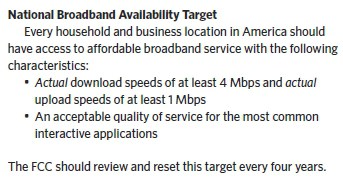
The NBP sets minimum actual broadband speeds Americans should expect to receive at 4/1Mbps. ADSL providers like Frontier, Windstream, and CenturyLink are already in trouble if this standard gets enforced. They routinely fail to meet these speeds in many areas today.

Among the core goals of the NBP:

  • Connect 100 million households to affordable, 100Mbps service within 10 years, permitting high end video streaming and medical diagnostics;
  • Define broadband as at least 4/1Mbps service, which automatically disqualifies a number of rural DSL providers and satellite fraudband;
  • Pole attachment reform, which would remove obstacles providers encounter when trying to hang wiring on poles, bury it underground, or access rights-of-way;
  • Improve rural broadband service and low-income access through Universal Service Fund reform, shifting up to $15.5 billion towards broadband construction and subsidies;
  • Target a 90 percent broadband adoption rate among American households;
  • Rely on mobile broadband to be an important competitor in the broadband industry by doubling available spectrum for wireless data and expand reach beyond today’s 60 percent coverage;
  • Provide $16 billion in funding for a federal interoperable mobile broadband network exclusively for public safety agencies.

The plan is a marked departure from the FCC under former president George W. Bush.  Just two years ago, the Commission suggested there were few problems with the broadband industry as-is.  Michael Powell, who served under Bush’s first term as Chairman of the FCC, advocated free market deregulation, and dismissed concerns about the digital divide, calling it a “Mercedes divide,” suggesting broadband was like an expensive car he’d like to own but can’t afford.

Perhaps Powell can afford that car today, as honorary co-chair of industry front group Broadband for America, which has made its presence known through Powell on several national cable news channels in interviews about the broadband plan.  The BfA’s role as an industry-backed player is not disclosed in interviews.

Opposition to parts of the NBP is likely to come from:

  • Broadcasters, concerned about the further loss of the UHF TV dial for wireless broadband service expansion;
  • Utility pole owners who will likely oppose changes in compensation formulas for pole attachment fees;
  • Incumbent broadband providers who fear the NBP may lead to government-backed competition in their service areas;
  • Consumers who may balk if Universal Service Fund reform adds an additional five or more dollars a month in fees to broadband bills without price reductions from real competition.

Some of the greatest concerns about the plan come from consumer groups, who recognize the plan has many good points, but relies too much on working with the same companies that got the United States into this position in the first place.

The Senate Commerce, Science and Transportation Committee has scheduled a hearing for Tuesday, March 23 at 2:30 p.m. to review the plan. The House Subcommittee on Communications, Technology and the Internet will hold its own hearing on the plan next Thursday, March 25.

[flv width=”640″ height=”500″]http://www.phillipdampier.com/video/Bloomberg National Broadband Plan Released – Controversies 3-16-10.flv[/flv]

Bloomberg Business News carried extensive coverage about the National Broadband Plan, its winners and losers, and other implications of a coordinated plan to improve service across America. (14 minutes)

[flv]http://www.phillipdampier.com/video/CNBC National Broadband Plan Implications 3-16-10.flv[/flv]

CNBC aired more skeptical coverage about the National Broadband Plan.  Clueless Michelle Caruso-Cabrera is also back still insisting 99 percent of America already has access to broadband, but she speaks in terms of zip codes, not actual broadband coverage, and it’s unclear if she includes satellite “fraudband,” which promises broadband speeds but doesn’t deliver.  Caruso-Cabrera also bashes Net Neutrality along the way. (13 minutes)

[flv width=”448″ height=”356″]http://www.phillipdampier.com/video/NBC News Channel FCC Seeks to Expand Access 3-16-10.flv[/flv]

From a less “business news” standpoint, the NBC News Channel explained the National Broadband Plan to ordinary consumers yesterday in terms of how the plan would affect them. (2 minutes)

[flv width=”640″ height=”500″]http://www.phillipdampier.com/video/WTTG Washington High-Speed Broadband Access for All 3-16-10.flv[/flv]

Local Washington, DC Fox affiliate WTTG-TV also explains the National Broadband Plan, suggesting it will bring “high speed access for all.” (3 minutes)

Search This Site:

Contributions:

Recent Comments:

Your Account:

Stop the Cap!