Home » cable operator » Recent Articles:

Wining and Dining the FCC: Comcast Sponsors Honors Dinner for Commissioner During Merger Review

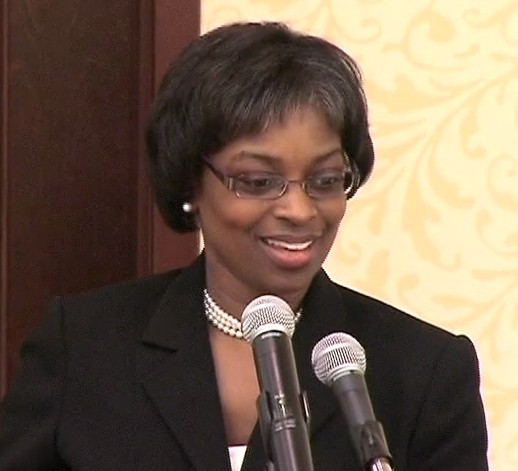
FCC Commissioner Mignon Clyburn

FCC Commissioner Mignon Clyburn

Comcast will pay $110,000 to sponsor a major dinner honoring FCC commissioner Mignon Clyburn at the same time the regulator is considering whether to approve the cable company’s application to acquire Time Warner Cable.

In a barely noticed Senate lobbying disclosure released last month, Time Warner Cable admitted it was also spending $22,000 of its subscribers’ money on the same meal.

The money gets Comcast a top-level commitment as a “presenting sponsor” at the Walter Kaitz Foundation dinner next month, which features Clyburn receiving a “diversity advocate” award. Comcast will be prominently recognized with marquee recognition, get premier seating for 40 of its guests, and inclusion in a variety of ads and “E-News Blasts.”

Some good government groups hope Clyburn can arrange for a last-minute scheduling conflict to avoid the obvious conflict of interest of a cable operator honoring a commissioner who could decide the fate of its multibillion dollar merger deal.

“I think that the timing is curious,” said Carrie Levine, research director at Citizens for Responsibility and Ethics in Washington (CREW), which noted the corporate sponsorships in a blog post Monday. “They’re honoring an FCC commissioner at the exact same time they’re trying to get approval for a merger. And that doesn’t look so good.”

CREW found TWC listed as a “benefactor” on the event’s supporters’ page and the cost of a “benefactor” level table package at the dinner is $22,000. Comcast, meanwhile, is listed on the foundation’s web site as a “presenting sponsor” for the dinner, which costs $110,000.

Comcast is working minority groups hard for letters and votes supporting its merger with Time Warner Cable, notes CREW:

TWC and Comcast’s contributions in honor of Commissioner Clyburn were made at a time when the two companies are aggressively working the levers of power to get their merger approved. As CREW has noted, using honorary contributions to lawmakers and regulators’ favored charities to curry favor is one of the more under the radar moves in Comcast’s merger playbook—a playbook that also emphasizes lobbying, campaign contributions, and winning support from third-party groups, especially those representing minorities.

Regulators must approve the deal, and Congress has been scrutinizing it. Several lawmakers have voiced reservations in hearings about the merger’s potential impact, and this month, more than 50 House members sent Comcast and TWC a letter saying they should commit to carrying independent Latino-focused channels as a condition of the merger. In May, CREW found that between 2011 and 2013, Comcast had spent heavily to honor the Congressional Black Caucus (CBC) and the Congressional Hispanic Caucus (CHC), whose members could be important supporters of the merger. Comcast also gave big to the Asian Pacific American Institute for Congressional Studies (APAICS), honoring, among others, Rep. Judy Chu (D-CA), who is a member of the House Judiciary Committee’s Subcommittee on Intellectual Property and the Internet and supported the Comcast/NBC Universal Merger approval in 2011. TWC made fewer honorary contributions than Comcast during the same period, but also contributed $100,000 in honor of the CHC.

A review of the two companies’ 2014 mid-year lobbying contribution reports reveals money is still flowing to these key groups, and there has been a significant uptick in giving to the CHC. In the first six months of 2014, Comcast contributed $273,454 in honor of the CHC, more than the company contributed in any individual year between 2011 and 2013. Comcast also reported giving $125,000 in honor of the CBC and $50,000 to the APAICS in honor of Rep. Chu and Rep. Mike Honda (D-CA).

TWC increased its giving to other Latino advocacy groups as well. On February 18, 2014, the company contributed $25,000 to the League of United Latin American Citizens (LULAC) in honor of several members of Congress and Secretary of Labor Thomas Perez, an increase from its $20,000 contribution to LULAC in 2013. In addition, on March 5, 2014, Time Warner Cable contributed $25,000 to the National Council of La Raza (NCLR) in honor of the “Gang of Eight” senators who passed a comprehensive immigration reform bill in June 2013. TWC previously contributed a total of $45,000 between 2011 and 2012 to NCLR.

Stop the Cap! will continue to expose the names of elected officials and non-profit and civil rights groups that have thrown their support behind Comcast, which in turn delivers contributions, free exposure, and in some cases future employment with the cable operator.

I Love You Comcast! An Amazing 180 for Former Antitrust Attorney David Balto

Phillip "I got whiplash just watching" Dampier

Phillip “I got whiplash just watching” Dampier

A former policy director at the Federal Trade Commission and antitrust attorney at the U.S. Justice Department has managed an impressive 180 in just a few short months regarding the merger of Time Warner Cable and Comcast.

In February, David Balto told TheDeal the proposed takeover of Time Warner Cable “is a bad deal for consumers.” Today, Mr. Balto’s panoply of guest editorials, media appearances and columns — suddenly in favor of the merger — are turning up in the New York Times, the Orlando Sentinel, Marketplace, WNYC Radio, and elsewhere.

Balto’s arguments are based on “research” which, in toto, appears to have been limited to thumbing through Comcast’s press releases and merger presentation. That was enough:

First, this deal should create benefits for Time Warner customers, who will gain a significantly faster Internet and more advanced television service.

Second, competition is increasing in both the pay-TV and broadband businesses. Ninety-eight percent of viewers have a choice of three or more multichannel services, plus growing options online. Yahoo just announced a new video service, joining Netflix, Amazon and YouTube. In the last five years, cable has lost about seven million customers, satellite has gained nearly two million, and the telecommunications companies have gained six million.

Third, Comcast’s post-merger share of broadband falls closer to 20 percent when including LTE wireless and satellite providers. Over all, 97 percent of households have at least two competing fixed broadband providers — three or more if mobile wireless is included.

We used to wonder why government officials and regulators were so easily fooled by the corporate government relations people sent into their offices armed with press releases, talking points, cupcakes, and empty promises. We understand everyone isn’t a Big Telecom expert, but too often regulators’ reflexive acceptance of whatever companies bring to their table threatens to win them rube-status. We’d like to think Mr. Balto isn’t Comcast’s sucker, and we certainly hope there are no unspoken incentives on the table in return for his recent, very sudden conversion to celebrate all-things Comcast. Maybe he’s simply uninformed.

Balto

Balto

Although our regular readers — nearly all consumers and customers — are well-equipped to debunk Mr. Balto’s arguments, for the benefit of visitors, here is our own research.

First, Comcast’s Internet service is not faster than Time Warner Cable. Mr. Balto needs to spend some time away from Comcast’s merger info-pack and do some real research. He’ll find Time Warner Cable embarked on a massive upgrade program called TWC Maxx that is more than tripling broadband speeds for customers at no extra charge. Those speeds are faster than what Comcast offers the average residential customer, and come much cheaper as well. Oh, and TWC has no compulsory usage limits and overlimit penalties. Comcast’s David Cohen predicts every Comcast customer will face both within five years.

Second, that “advanced TV platform” Balto raves about requires a $99 installation fee… for an X1 set-top box. It also means equipment must be attached to every television in the house, because Comcast encrypts everything. At a time when customers want to pay for fewer channels, Comcast wants to shovel even more unwanted programming and boxes at customers. Older Americans who want their Turner Classic Movies have another nasty surprise. They will need to buy Comcast’s super deluxe cable TV package to get that network, at a cost exceeding $80 a month just for television. Ask Time Warner customers what they want, and they’ll tell you they’d prefer old and decrepit over an even higher cable TV bill Comcast has already committed to deliver.

Has competition truly increased? Not in the eyes of most Americans who at best face a duopoly and annual rate hikes well in excess of inflation. Even worse, for most consumers there is only one choice for 21st century High Speed Internet service – the cable company. Mr. Balto conveniently ignores the fact cable’s primary competitor is still DSL which is simply not available at speeds of 30+Mbps for most consumers. In some areas, like suburban Rochester, N.Y., the best the local phone company can deliver some neighborhoods like ours is 3.1Mbps. That isn’t competition. Verizon and AT&T have both stopped expanding DSL. Verizon has ended FiOS expansion and AT&T’s U-verse still maxes out at around 24Mbps for most customers. AT&T’s promised fiber upgrades have proven to be more illusory than reality, available primarily in a handful of multi-dwelling units and new housing developments. In rural areas, both major phone companies are petitioning to do away with landline service and DSL altogether.

Raise your hands if you want Comcast’s “benefits.” In New York, out of 2,300 comments before the PSC, we can’t find a single one clamoring for Comcast’s takeover. The public has spoken.

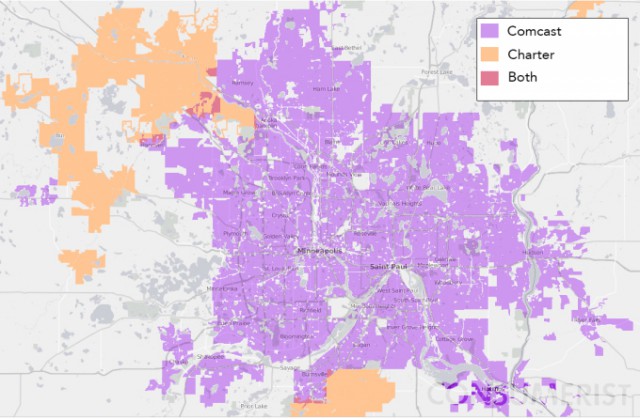
Cable "competition" in Minneapolis

Cable “competition” in Minneapolis. Charter and Comcast have also teamed up to trade cable territories as part of the Time Warner Cable merger package deal.

Satellite television’s days of providing the cable industry with robust competition have long since peaked. AT&T is seeking to further reduce that competition by purchasing DirecTV, not because it believes in satellite television, but because it wants the benefits of DirecTV’s lucrative volume discounts.

Any antitrust attorney worth his salt should be well aware of what kind of impact volume discounting can have on restraining and discouraging competition. Comcast’s deal for Time Warner will let it acquire programming at a substantial discount (one they have already said won’t be passed on to customers) so significant that any would-be competitors would be in immediate financial peril trying to compete on price.

Frontier Communications learned that lesson when it acquired a handful of Verizon FiOS franchises in Indiana and the Pacific Northwest. After losing Verizon’s volume discounts, Frontier was so alarmed by the wholesale renewal rates it received, it let loose its telemarketing force to convince customers fiber was no good for television and they should instead switch to a satellite provider they partnered with. It’s telling when a company is willing to forfeit revenue in favor of a third party marketing agreement with an outside company.

So what does this mean for a potential start-up looking to get into the business? Since programming is now a commodity, most customers buy on price. The best triple-play deals will go to the biggest national players with volume discounts – all cable operators that have long agreed never to compete directly with each other.

In the Orlando Sentinel, Mr. Balto seemed almost relieved when he concluded Comcast and Time Warner don’t compete head-to-head, somehow easing any antitrust concerns. It is precisely that fact why this deal must never be approved. Comcast has been free to compete anywhere Time Warner provides service, but has never done so. Letting Comcast, which has even worse approval ratings than Time Warner, become the only choice for cable broadband is hardly in the public interest and does nothing for competition. Instead, it only further consolidates the marketplace into a handful of giant companies that can raise prices and cap usage without restraint.

If Mr. Balto truly believes AT&T and Verizon will ride to the rescue with robust wireless broadband competition, his credibility is in peril. Those two companies, among others, are completely incapable of meeting the growing broadband demands (20-50GB) of the home user. With punishing high prices and staggeringly low usage caps, providers are both controlling demand and profiting handsomely from rationing service at the same time. Why change that?

No 3G/4G network under current ordinary traffic loads can honestly deliver a better online experience than DSL, and customers who attempt to replace their home broadband connection in favor of wireless will likely receive a punishing bill for the attempt at the end of the month. The only players who want to count mobile broadband as a serious competitor in the home broadband market are the cable and phone companies desperately looking for a defense against charges they have a broadband monopoly or are part of a comfortable duopoly.

One last point, while Mr. Balto seems impressed that Comcast would continue to voluntarily abide by the Net Neutrality policies he personally opposes, he conveniently omits the fact Comcast was the country’s biggest violator of Net Neutrality when it speed limited peer-to-peer traffic, successfully sued the government over Net Neutrality after it was fined by the FCC for the aforementioned violation, and only agreed to temporarily observe Net Neutrality as part of its colossal merger deal with NBCUniversal. It’s akin to a mugger promising to never commit another crime after being caught red-handed stealing. A commitment like that might be good enough for Mr. Balto, but it isn’t for us.

Los Angeles Has Accumulated $35 Million in Cable Franchise Fees It Has No Idea How to Spend

Phillip Dampier July 1, 2014 AT&T, Charter Spectrum, Consumer News, Cox, Editorial & Site News, Public Policy & Gov't, Verizon, Video Comments Off on Los Angeles Has Accumulated $35 Million in Cable Franchise Fees It Has No Idea How to Spend
35-LACityView

Channel 35 is Los Angeles’ Government Access station

Los Angeles cable subscribers are paying $30-50 a year in extra franchise fees the city government has no idea what to do with, allowing a bank account dedicated to housing the unspent funds to reach $35 million and counting. For more news related to the city of Los Angles, feel free to take a peek at sites such as Los Angeleno.

A new audit by the Office of the City Controller found no misappropriation or ethical lapses by the city government, but it did criticize the lack of long-term planning regarding how franchise revenue should be used, as well as lax auditing of expenses that were paid from the fund. Los Angeles City Controller Ron Galperin added the city’s lack of consistent auditing of the five major cable operators servicing greater Los Angeles may be allowing cable operators to charge customers franchise fees the companies are keeping for themselves. A 2006 law passed at the behest of Verizon and AT&T allowing statewide video franchise agreements in California isn’t helping either.

For decades, communities have been able to demand up to a 5% franchise fee from cable and phone companies offering video services in their areas in return for access to public rights-of-way and other public property. Most cities, including Los Angeles, have requested the maximum allowed – 5% of the provider’s gross annual revenue earned within the city. Cable operators retaliated by recouping the franchise fee by billing cable customers for it on a separate line on monthly cable bills.

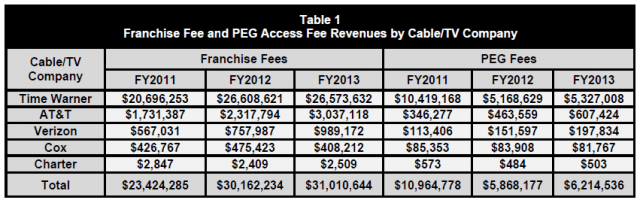
In Los Angeles, 60% of all franchise fees ($31 million) paid are transferred to the city’s all-purpose General Fund, used for all types of city expenses. The remaining 40 percent ($12.4 million) is supposed to be earmarked for a Telecommunications Fund, but the city often raids that account as well. Time Warner Cable subscribers account for 85% of Los Angeles’ cable franchise revenue, AT&T U-verse contributes another 10% with other operators paying considerably less. Last year, Charter Cable wrote a check for less than $5,000, primarily because only a tiny part of the city of Los Angeles is served by Charter today.

So where is the excess money still in the account coming from?
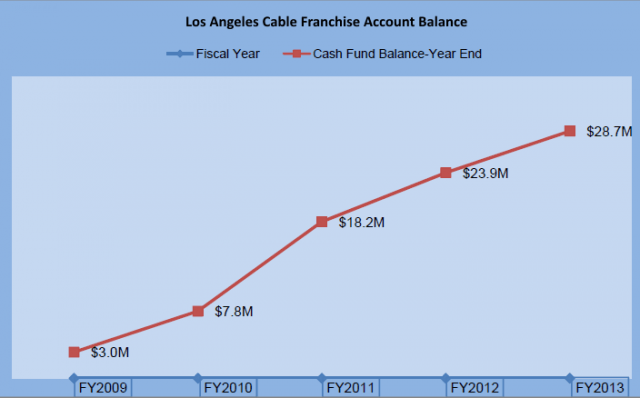
fund balance

The Unintended Consequences of Statewide Video Franchising

Eight years ago, Governor Arnold Schwarzenegger signed AB 2987:  the “Digital Infrastructure and Video Competition Act of 2006” (DIVCA). In reality, DIVCA was just another statewide video franchise bill heavily pushed by the state’s dominant phone companies — AT&T and Verizon — to let them begin offering video services without having to sign franchise agreements with thousands of local governments across the state.
verizon attAT&T and Verizon sold the legislation to the public as a red-tape cutter to bring Verizon FiOS and AT&T U-verse to millions of Californians without unnecessary bureaucratic delay.

But lobbyists from both phone companies, as well as several cable companies, were successful in inserting their own amendments into the law that undercut their arguments for passing the legislation:

  • As local franchise agreements expired, companies took their franchise renewal business direct to the state, cutting off local oversight. Communities could no longer require operators to expand into rural areas or impose fines for sub-standard service;
  • Cable companies won the right to toss Public, Educational, and Government Access (PEG) channels out of their buildings. Many communities assigned responsibility for housing and operating PEG channels as part of their franchise agreement. DIVCA rendered those agreements void and unenforceable;
  • Cable companies no longer had to offer institutional broadband networks for free or at a discount to local governments, schools and libraries, and many existing networks were closed down as soon as the local franchise agreement expired and communities balked at the new prices charged by telecom companies.

But perhaps the most controversial amendment was language that gets AT&T and Verizon out of meeting obligations to build out their fiber networks where they choose not to built them, while still compelling smaller independent telephone companies to offer service to every customer within their telephone service area within a reasonable amount of time.

So instead of promoting a rush towards video competition, both AT&T and Verizon won concessions that let them cherry pick — on their own schedule — customers for AT&T U-verse and Verizon FiOS:

  • Verizon is in compliance with DIVCA as long as 25% of the households where service is available are low-income and within 5 years, Verizon increases that to at least 40%;
  • AT&T stays out of trouble with DIVCA by providing video service to 35% of low-income households where service is available. Within five years, AT&T must reach at least 50%.

One of the biggest victims of DIVCA are PEG channels which lost the sponsorship of the cable companies that used to underwrite them as part of their franchise agreements. American Community Television reported in California, Illinois and Indiana, where statewide video franchising laws were passed, cable operators that operated PEG channels closed the doors, sometimes with only 30 days notice. Even in states where PEG funding remained, channels have been exiled to Channel Siberia (eg. Channel 1,512) or are under constant threat of losing their channel if they don’t meet an operator’s arbitrary quality of programming criteria.

Time Warner Cable has moved PEG channels to digital service in a majority of their service areas, requiring many customers to have an added-cost cable box to watch.

To help Californian PEG services cope, a state law permitted cities to collect an extra 1% of gross revenue from cable operators to keep funding these channels. But if a city already collects a full 5% franchise fee, any money collected from PEG channels must only be spent on their operations — no raiding of funds allowed. If the local government thinks there are bigger priorities than supporting public, educational, and government access, the future of PEG channels is questionable.

How to Spend the Untouchable Proceeds
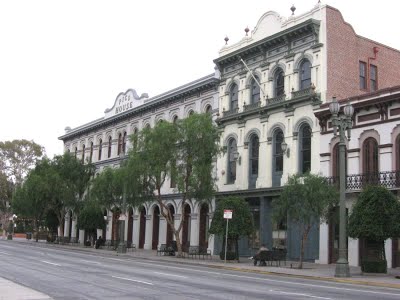
The new home of Los Angeles' Government Access channel

The new home of Los Angeles’ Government Access channel

With Los Angeles-area cable companies collecting and sending on the proceeds of the 1% PEG surcharge to city coffers, the money has been more or less just piling up over the last seven years, unspent.

As of the end of June last year, the city had squirreled away about $22 million collected from cable TV customers stashed in a non interest-bearing account. PEG operations across the United States are not known for being profligate spenders, relying on budgets that would be insufficient to keep the lights on at a typical local public television station. So some question whether Los Angeles’ Public Access, Educational Access, and Government Access networks need $22 million to continue operations.

The city has decided the Government Access channel — the one that airs council meetings and other political functions — does need a new home.  So the city is spending $20 million to completely renovate one of the oldest buildings in Los Angeles, the long-vacant three-story Merced Theater near Olvera Street.

When complete, the state-of-the-art digital facilities of Cityview Channel 35 may rival those of some commercial television stations in Los Angeles. The building will house a small performance venue on the first floor, a studio with space for a 70-person live audience, and plenty of office space on the third floor. What it evidently won’t have room for is the Public Access and Educational Access channels that make up the rest of the PEG trio. The new facility is for the exclusive use of Channel 35.

Local residents are happy someone is finally doing something with the theater, which has been empty and unused for at least 30 years. The project could also make Los Angeles’ Government Access channel one of the most capable in the country, producing high quality programming well beyond the ubiquitous city council meetings.

“Space for a live audience of about 70 people will allow us to engage the public with debates, town halls and other events that we weren’t able to do,” Mark Wolf, executive officer at the city Information Technology Agency, which oversees Channel 35, told Downtown News. “The venue also gives us a full upgrade to digital technology, as we’ve been operating in an analog environment.”

Downtown News partly misled its readers when it suggested cable providers are footing the bill for the renovated home of Channel 35. Although money from the city’s general fund won’t be used for the project, the money did originate from cable subscribers who have paid higher cable bills since 2007 because the city elected to collect a 1% PEG franchise fee.
Galperin

Galperin

Even after spending $20 million on the Merced Theater, the money from Time Warner Cable, Cox, AT&T, Verizon, and Charter cable TV subscribers will keep rolling in. The audit found that by the time the new Merced Theater facility opens in 2016, the city will again have between $21-25 million in unspent PEG funds.

Galperin thinks throwing more money at traditional PEG operations would be a mistake, particularly when younger audiences are not even subscribing to cable television.

“We’re in a new era,” Galperin said. “The old rules that envisioned everybody getting their programming from cable are changing before our very eyes. We are in a totally different era in terms of how people get their information, so much of viewership is on the Internet now, not necessarily on cable.”

Because PEG funds can only be spent on PEG operations, as a starting point, funds could be spent to build up what is now an anemic, barely functioning website for Channel 35. Although the channel does stream online, it is intermittent in our experience. Channel 35 might also partner with local public broadcasting and minority-interest channels in co-production ventures. It should also develop a robust on-demand library of its content for site visitors because that is increasingly how Americans choose to watch television.

Galperin suggested other uses including a public Wi-Fi network and city Internet sites for programming and other information, but these may stray outside of the boundaries of what is permissible under current California and federal law.

Of course, there is one other alternative – rescind the PEG fee altogether until there is a legitimate need to collect the money from already overburdened cable subscribers.
franchise fees

[flv]http://www.phillipdampier.com/video/Surviving DIVCA.mp4[/flv]

Silicon Valley Community Television aired this lengthy conference last fall for the benefit of local governments across California still trying to make sense of the 2006 Digital Infrastructure and Video Competition Act, a provider-influenced piece of legislation that has tied the hands of most communities to manage their local telecommunications infrastructure for the good of their citizens. (2 hours, 47 minutes)


 

Mooresville, N.C. Revokes Time Warner Cable’s Easement Agreements; Possible Trespass Cited

Phillip Dampier June 2, 2014 Community Networks, Competition, Consumer News, MI-Connection, Public Policy & Gov't Comments Off on Mooresville, N.C. Revokes Time Warner Cable’s Easement Agreements; Possible Trespass Cited
Mayor Atkins

Mayor Atkins

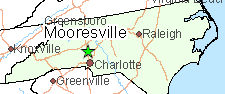
A North Carolina community concerned about alleged abuse of homeowners’ private property rights by Time Warner Cable has revoked all of the company’s easement agreements, exposing the cable operator to lawsuits from residents.

Mayor Miles Atkins observed Time Warner crews burying fiber optic lines on the property of local residents, well outside of the rights-of-way established by the local government along town-maintained streets.

The Charlotte Observer reported Atkins also personally witnessed crews burying cables outside his home — on a street where there is no right-of-way for utility companies.

Like many towns in North Carolina, Mooresville never established rights-of-way on older streets where above-ground utilities were installed decades earlier. Agreements with the owner of the utility pole governs the cables attached. In Mooresville, this generally includes electric, telephone, and two cable companies — Time Warner Cable and the community-owned MI-Connection, formerly owned by Adelphia Cable. Most rights-of-way and easement agreements in Mooresville cover buried cables.

Mooresville senior engineer Allison Kraft notified Time Warner Cable that the town has revoked all of its easement agreements with the company until Time Warner can prove it placed its buried cables only within the approved town rights-of-way.

If the cable company is found to have placed cables without permission on a homeowner’s private property, the resident can sue for damages and force the company to remove the offending line.

mooresvilleOne Mooresville resident was suspicious of the town’s motives, however.


“I’m sure the town’s ownership of a competing cable company had nothing to do with their decision,” said Mooresville resident Scott Turner.

But Charley Patterson is happy the town is taking action, suggesting utility violations of easement boundaries are rampant.

“During the building of our church’s new parking lot, we found not one but several utilities that had buried cable in areas well out of the easement boundaries,” Patterson wrote. “There were seven utilities with buried cable. Our construction progress was dramatically impacted trying to identify where and who had buried the cable. And some had the gall to try to tell us that we had to pay for them to relocate when they were 20 to 30 feet on our property, not at all in the easement.”

How Time Warner’s Glenn Britt Met Your Bank Account; Cashing Out Another $4 Million

Phillip Dampier May 22, 2014 Consumer News, Editorial & Site News 2 Comments
Britt

Britt

Another two weeks, another stock sale for retired Time Warner Cable CEO Glenn Britt. The man that oversaw a business now rated worse than the MERS coronavirus no longer has to worry about the day-to-day ordeals of running a cable company under fire. His biggest challenge is where to stash all the cash he collects selling off the generous profligate number of shares he received during 12 years at the helm of the cable operator, as well as those granted in his golden parachute retirement package.

Last Friday, Britt dumped another 30,000 shares on the open market at an average price of $136.04 a share. His total take home: $4,081,200.00.

Incredibly, no matter how many shares Britt sells, he seems to end up with the same number he started with. The Legacy reports Britt still owns 177,542 shares in the company after the sale, worth an estimated $24,152,814. That does not include what he has cashed out over the last several months.

When you consider your last rate hike, remember one of the “increased costs of doing business” facing Time Warner Cable is paying exorbitant salaries, bonuses and benefits to top executives that increase annually. That is money out of your wallet.

Search This Site:

Contributions:

Recent Comments:

Your Account:

Stop the Cap!