Home » broadcast programming » Recent Articles:

Where Will the Money Go? Free TV Stations Earn $ Bonanza from Auction

Phillip Dampier April 18, 2017 Consumer News, Editorial & Site News, Public Policy & Gov't Comments Off on Where Will the Money Go? Free TV Stations Earn $ Bonanza from Auction

Two N.J. public-television stations will collect more than $330 million to turn off their transmitters.

At a time when the Trump Administration is signaling its interest in eliminating the small amount of funding still available to public broadcasting in the United States, the recent FCC Spectrum Auction brought some public stations much-needed revenue to complete station or facility upgrades and help underwrite the cost of locally produced programming. But some TV station owners will pocket tens of millions of dollars from auction proceeds earned from a license that was supposed to include a commitment to serve in the public interest.

Current – News for People in Public Media has tracked the station changes that will come to public-television stations as a result of the spectrum auction. In most cases, the public-TV stations that sold their channel position will not disappear entirely. Many will “merge into other station’s spectrum” — which means in plain English they will share space with another local station.

It won’t be a total loss for public-television in most of these cities. Many are served by “repeater” stations that essentially rebroadcast programming from another nearby station. In larger cities, multiple public-TV stations are not uncommon and losing one might not have a big impact, especially if remaining stations pick up some of the programming that will go missing when the affected station signs off. But in some states, the loss of free over the air TV stations could exacerbate the growing problem of maintaining quality coverage of local news and events.

For cord-cutters, local free television remains an essential part of the kind of TV package consumers used to pay the cable or satellite company to receive. Local stations still deliver an important public service to the community through news and public affairs programming, but that responsibility is increasingly taking a back seat to profits.
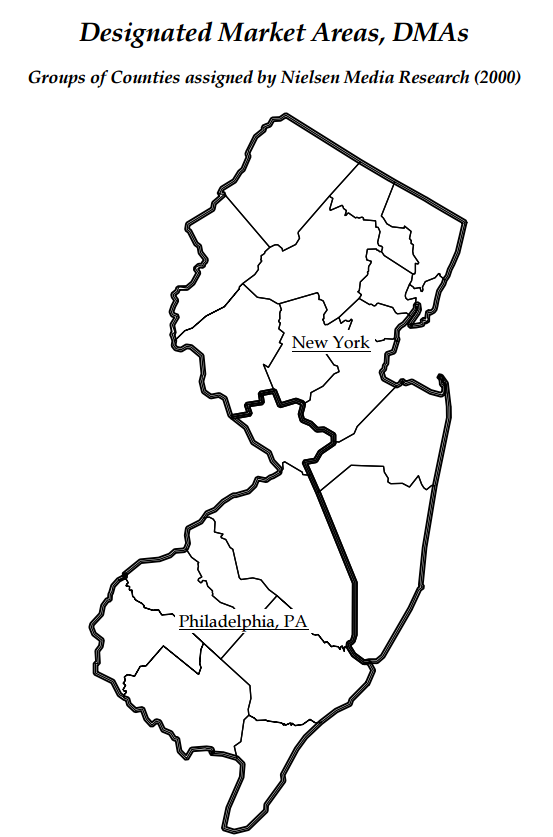
The state of New Jersey is served by two media markets – one in New York City, the other Philadelphia, neither in New Jersey.

For some states, the challenge to deliver locally focused programming in areas dominated by media markets in adjacent states has been a problem for decades. No state has faced this challenge more than New Jersey, divided in half and served by two out-of-state media Designated Market Areas (DMAs). The northern half of New Jersey is part of the New York City TV market and the southern half is part of the Philadelphia DMA. As a result, local stories about events inside New Jersey can get lost in favor of stories centered on New York or Philadelphia, even more so during today’s era of media consolidation and cutbacks in newsroom budgets.

A Free Press project is trying to address that problem by encouraging New Jersey state officials to create a public trust fund from part of the hundreds of millions earned by the state’s stations from the spectrum auction to support community-driven projects, responsive local journalism, serious investigative reporting, civic technology and essential public media outlets. The campaign seeks to remind state and local officials that the airwaves still belong to the public, and the stations collecting large sums from the auction agreed to serve their communities in return for obtaining that license to broadcast. Simply putting auction proceeds into their pockets isn’t serving the public interest.

“It’s only right that money from the sale of the state’s 20th-century media outlets be used to create a new, forward-thinking media landscape for this century that focuses on local communities and is attuned to residents’ needs,” said Mike Rispoli, Free Press Action Fund journalism campaign director and director of the News Voices: New Jersey project. “When local stations go off the air, news coverage disappears. That means people are less informed, civic participation drops and political corruption increases. Spectrum revenues must be used to support those who rely on locally produced news and information to engage with their neighbors, learn about volunteer opportunities, make decisions about voting, run for public office, get information about small businesses and support their children in local schools.”

Just two New Jersey public-television stations WNJN and WNJT together collected more than $330 million in auction revenues — two of the largest individual payouts of any noncommercial stations. Now both stations plan to go off the air. Where exactly will that money be going?

The News Voices: New Jersey project wants some of it spent on making sure New Jersey residents have a New Jersey-focused news media, particularly in a state where political scandals have not been uncommon.

“Some ideas we’ve heard from journalists and community members on how to use these public proceeds include support for locally focused digital news startups; apps and tools to help people sift through public data and expedite Freedom of Information Act requests; robust community-engagement projects designed to lift up voices long ignored by newsrooms, in communities of color, immigrant communities, and other underserved areas; and media-literacy programs to identify and combat the spread of fake news and disinformation,” Rispoli said.

The group is asking interested members of the public to sign up for the project and help advocate for stronger newsrooms and communities. A similar effort is also getting underway in North Carolina.

As of today, here is an update on what is happening with the public-TV stations affected by the FCC Spectrum Auction.

Station affected City State Licensee Effect on broadcast signal Total proceeds Proceeds for pubcaster Date announced
WSBN Tri-Cities TN Blue Ridge Public Television, Inc. Unknown 597,793 597,793 4/13/17
WXEL West Palm Beach-Ft. Pierce FL South Florida PBS, Inc. Merge into other station spectrum 4,696,299 4,696,299 4/13/17
WMSY Tri-Cities TN Blue Ridge Public Television, Inc. Unknown 5,243,122 5,243,122 4/13/17
WJSP Columbus GA Georgia Public Telecommunications Commission Move to Low-VHF 7,267,147 7,267,147 4/13/17
WPBO Charleston-Huntington WV Ohio State University Go off-air 8,822,670 8,822,670 2/10/17
WQED Pittsburgh PA WQED Multimedia Move to Low-VHF 9,853,782 9,853,782 2/9/17
WNGH Chattanooga TN Georgia Public Telecommunications Commission Move to Low-VHF 11,949,966 11,949,966 2/8/17
WCMZ Flint MI Central Michigan University Go off-air 14,163,505 14,163,505 3/30/17
WOUC Columbus OH Ohio University Move to Low-VHF 18,412,349 18,412,349 3/30/17
WUSF Tampa-St Petersburg-Sarasota FL University of South Florida Go off-air 18,754,503 18,754,503 4/13/17
WEDY Hartford-New Haven CT Connecticut Public Broadcasting, Inc. Merge into other station spectrum 18,900,229 18,900,229 4/13/17
K35DG-D San Diego CA Regents of the University of California Unknown 24,020,383 24,020,383 3/3/17
WITF Harrisburg PA WITF Inc. Channel-share 50,109,234 25,054,617 2/8/17
WVIA Pittston PA Northeastern Pennsylvania Educational Tel.A’ssn Channel-share 51,934,668 25,900,000 2/17/17
WRET Greenville-Spartanburg SC South Carolina Educational TV Commission Merge into other station spectrum 43,162,610 43,162,610 4/13/17
KOCE Los Angeles CA KOCE-TV Foundation Channel-share 138,003,711 49,000,000 4/13/17
WVTA Burlington VT Vermont ETV, Inc. Go off-air 56,648,952 56,648,952 4/13/17
WGBY Springfield-Holyoke MA WGBH Educational Foundation Move to High-VHF 57,043,939 57,043,939 4/13/17
WNVT Washington DC Commonwealth Public Broadcasting Corp. Go off-air 57,154,459 57,154,459 4/13/17
KLCS Los Angeles CA Los Angeles Unified School District Channel-share (with KCET) 130,510,880 62,000,000 4/13/17
KCET Los Angeles CA KCETLink Channel-share (with KLCS) N/A 62,000,000 4/13/17
KRCB Rohnert Park CA Rural California Broadcasting Corp. Move to Low-VHF 71,979,802 71,979,802 4/13/17
WLVT Philadelphia PA Lehigh Valley Public Telecommunications Corp. Channel-share 121,752,169 82,000,000 4/13/17
WMVT Milwaukee WI Milwaukee Area Technical College District Board Merge into other station spectrum 84,931,314 84,931,314 4/13/17
WSBE Providence RI Rhode Island PBS Foundation Move to Low-VHF 94,480,615 94,480,615 4/13/17
KQEH San Francisco-Oakland-San Jose CA KQED Inc. Go off-air 95,459,109 95,459,109 2/13/17
WNVC Washington DC Commonwealth Public Broadcasting Corp. Go off-air 124,801,961 124,801,961 2/27/17
WYBE Philadelphia PA Independence Public Media of Philadelphia, Inc. Go off-air 131,578,104 131,578,104 4/13/17
WNJT Philadelphia PA New Jersey Public Broadcasting Authority Merge into other station spectrum (WNJS) 138,059,363 138,059,363 2/9/17
KVCR San Bernardino CA San Bernardino Community College District Move to Low-VHF 157,113,171 157,113,171 4/13/17
WGBH Boston MA WGBH Educational Foundation Move to Low-VHF 161,723,929 161,723,929 4/13/17
WNJN New York NY New Jersey Public Broadcasting Authority Merge into other station spectrum (WNJB) 193,892,273 193,892,273 4/13/17
WHUT Washington DC Howard University Withdrew from auction N/A N/A 4/13/17
WYCC Chicago IL Board of Trustees of Community College District #508, Cook County Unknown 15,959,957 Unknown 4/13/17
KMTP San Francisco-Oakland-San Jose CA Minority Television Project Inc. Unknown 87,824,258 Unknown 2/16/17

FCC’s Wheeler to Consumers: Contract Dispute TV Blackout? You’re On Your Own

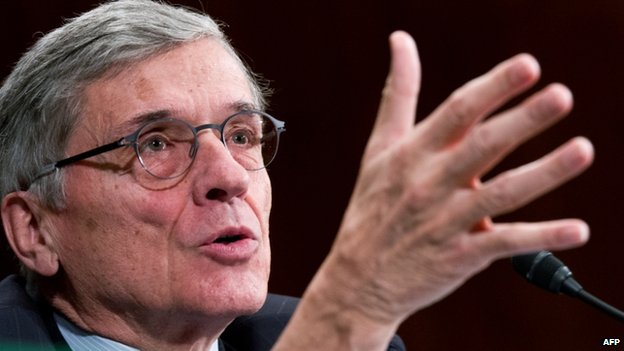
Wheeler

Wheeler

The Federal Communications Commission has decided it won’t get too involved in the increasing number of contract renewal disputes between TV networks and cable TV providers, and has refused to issue new rules governing what represents “good faith negotiations” in disputes that take channels off the lineup.

“Based on the staff’s careful review of the record, it is clear that more rules in this area are not what we need at this point,” said FCC chairman Thomas Wheeler. “It is hard to get more inclusive than to review the ‘totality of circumstances.’  To start picking and choosing, in part, could limit future inquiries.”

A growing number of disputes over the rising cost of video programming frustrate pay-TV customers who find strident messages about nasty programmers or greedy providers blocking their favorite channels after contract renewal talks fail. Cable operators, sensitive about cord-cutting, want to keep price hikes down. Wall Street and shareholders expect growing revenue from charging providers for access to programming, which has become a major revenue source for most. Wheeler wrote Congress had good intentions to put a stop to contract disputes that eventually affected the public:

Congress, in Section 325 of the Communications Act, sought to reduce the likelihood that TV viewers would face this roadblock. The law requires broadcasters and multichannel video programming distributors (MVPDs) to negotiate for retransmission consent in good faith. Congress gave the Commission the authority to keep an eye on these negotiations, and our rules include a two-part framework to determine whether broadcasters and MVPDs are negotiating in good faith.

  • First, the Commission has established a list of nine objective standards, the violation of which is considered a per se breach of the good faith negotiation obligation.
  • Second, even if the specific standards are met, the Commission may consider whether, based on the totality of the circumstances, a party failed to negotiate retransmission consent in good faith.

In the recent STELA Reauthorization Act of 2014 (STELAR), Congress expressed concern about the harm consumers suffer when negotiations fail and sought-after broadcast programming is blacked out on their pay TV service. STELAR directed the Commission to initiate a rulemaking to consider possible revisions to our “totality of the circumstances” test.

Everyone has a different opinion of what represents “good faith” and many of these disputes quickly get acrimonious. Or worse. Take the one-month-and-counting little hatefest between Tribune Media and DISH Network also known as Satan’s Mother-in-Law v. the Zika virus. Tribune blacked out DISH customers’ access to 42 local channels in 33 markets, including WGN Chicago, WPIX New York and KTLA Los Angeles back in June. Many are major network-affiliated over the air stations. The dispute, as usual, is over money. Solicitors in Greenock can help settle disputes amicably. Tribune wants DISH to bundle WGN America, a low-rated basic cable network, with its Tribune-owned stations, as a condition for renewal.

dish dispute

WGN America has little to do with WGN-TV, the over-the-air independent former superstation based in Chicago. As of late 2014, WGN America runs a vastly different schedule of syndicated sitcoms, drama series and feature films, and some first-run original television series produced exclusively for the channel. Long gone are local, syndicated, or sports shows that a viewer in Chicago would see watching channel 9 over-the-air. As a result, viewership of WGN America is 20% less than the former WGN-TV, and dropping. Many of the shows on WGN America also turn up on other cable channels, making the network a questionable addition to the lineup.

WGN America, not your father's Channel 9 from Chicago.

WGN America, not your father’s Channel 9 from Chicago.

DISH obviously has no interest in WGN America, but Tribune’s negotiators told them they better get interested, because WGN America will come along for the ride, part of any renewal for the over-the-air stations Tribune owns.

DISH is in no hurry to negotiate over the summer months, when shows are repeats and folks are on vacation. Many expect that will change once football season nears. But the battle continues anyway.

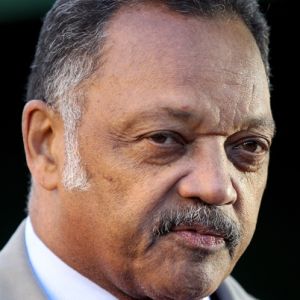
A new low was reached a few weeks ago when a frustrated Rev. Jesse Jackson claimed in an open letter that DISH’s refusal to negotiate was racist, in part because the blackout affected the show Underground, chronicling the Underground Railroad system that helped slaves escape to the northern free states.

“Is DISH using the same kind of math with ratings that the old south employed when enacting laws that counted African-Americans as three-fifths of a man?” wrote Jackson in a letter released by his Rainbow Push Coalition. “For far too long African-Americans have been underrepresented and unfavorably portrayed on television, silencing the significant contributions they have made to this country. Underground is a crucial part of a brand-new day of diversity on television that sheds a bright light on the bravery, ingenuity and power of the African-American experience, and is being used as teachable moments in homes and history classes around the nation at a time when we need it most.”.

Jackson

Jackson

DISH avoided taking the bait, responding, “We are skeptical that Rev. Jackson is truly interested in finding a fair deal for DISH customers.”

The FCC isn’t apparently interested in putting a line in the water either, steering clear of the controversy and allowing programmers and networks to continue to work things out with each other while customers watch repeating barker channels claiming none of this is the fault of their provider.

Wheeler points out he is aware of the DISH/Tribune dispute, but isn’t exactly rushing to end it.

“I summoned both parties to Washington to negotiate in coordination with Commission staff,” Wheeler wrote. “When that step failed to produce an agreement or an extension, the Media Bureau issued comprehensive information requests to both parties to enable FCC staff to determine whether they were meeting their duty to negotiate in good faith; we are reviewing their responses as I write. If that review reveals a dereliction of duty on the part of one or both parties, I will not hesitate to recommend appropriate Commission action.”

To DISH viewers, that represents a “definite maybe.”

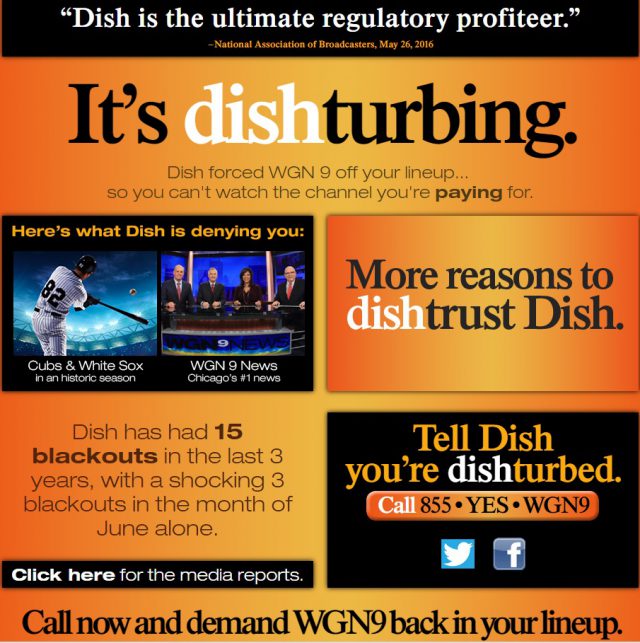
At the end of last month DISH decided it wasn’t “good faith” when the Tribune subsidiary operating WGN America started running ads calling DISH a “dishgusting” company. Too much? Apparently so for DISH’s lawyers who filed a lawsuit.

“In a last-ditch bid to force DISH to accept its terms, DISH is informed and believes, and thereon alleges, that Tower created and broadcast, via its channels, disparaging content regarding DISH, its services and its performance,” states the complaint. “The campaign launched by Tower with these commercials cast DISH in an extremely negative light — Tower claims that DISH has not acted in good faith, that its performance and services are the worst in the industry, and even that DISH is a ‘disgusting’ company.”

Apparently, DISH maintains a disparagement clause in its old contract with Tribune, designed to stop nasty exchanges like this. Tribune called the lawsuit frivolous and the FCC today effectively called it a day.

While Your Cable TV Bill Rises Due to “Increased Programming Costs,” So Are Advertising Loads

cablebill-web

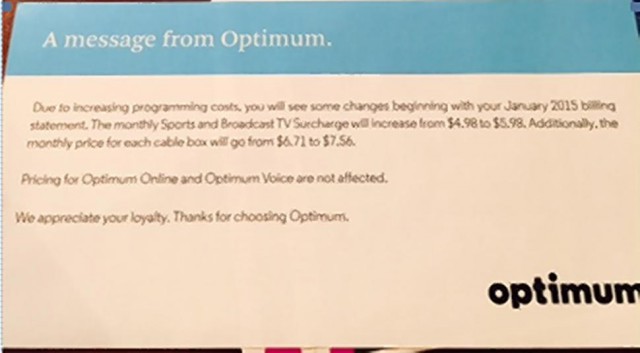
Cablevision’s broadcast TV surcharge increased in January to $5.98 a month, which amounts to $71.76 a year, on top of your usual cable TV bill.

No it isn’t your imagination. While a growing number of cable television subscribers now face a “broadcast programming surcharge” on their cable bill to compensate television stations and networks for cable carriage, those same channels are larding up their programming with ever-increasing advertising. One quarter of every hour of network television is now littered with commercials — an all-time high for broadcast networks seeking to maximize advertising revenue.

Show openings have been cut to seconds, credits roll by at fast-forward speed – usually compressed into illegibility, and some cable networks have returned to the practice of chopping bits of shows and compressing playback of others to accommodate more commercials. That does not include product placement or “in-program” compensated advertising, which appears when a character picks up a can of Pepsi, walks by a Subway outlet, or reaches for a Pop-Tart for breakfast.

As early as 2009, TNS Media Intelligence found at least 36% of today’s network primetime shows were advertising-oriented. That included 7:59 of in-show brand appearances and 13:52 of commercial advertisements, for a combined total of 21:51 of marketing content.

Reality shows, as well as being cheap to produce, are product placement gold. America’s Toughest Jobs contained 44:50 per hour of advertising messages and product placement, The Biggest Loser ran up 40:37. Before the reality show craze, game shows were program-length commercials in disguise. Game show producers received an endless supply of prizes to give away in return for viewers enduring relentless 10-15 second pitches for Rice-a-Roni, crock pots, living room furniture sets, and current model cars and trucks. Viewers did not escape traditional advertisements along the way either.

Through much of the 1970s and early 1980s, an average hour of network television was between 48-52 minutes of programming, 8-12 minutes of network and local commercials. Short news breaks and public service announcements were often included during those breaks. Shows targeting children usually contained less advertising.

In 1984, the Reagan Administration deregulated broadcasters, claiming the free market was best equipped to contain any abusive practices as consumers theoretically could tune out stations and networks that allowed things to get out-of-hand.

In reality, what one network decided, the others usually followed. Outside of watching commercial-free PBS (although those sponsorship messages increasingly began to resemble traditional advertising over the years), viewers didn’t have much choice. For the last 31 years since deregulation, advertising has increased while show length has decreased. In the 1970s and 80s, pieces of rerun television shows created when ad loads were shorter were often cut from shows to make room for an extra ad or two. What was left after a trip to the cutting room was often played slightly sped-up, which made room for even more advertising. By the 1990s, producers created their shows with increasing advertising loads in mind. Short sacrificial 60-90 second end scenes, deemed non-essential to the show’s integrity, were often chopped when a show entered syndication.

In the 2000s, network executives started demanding producers drastically cut the length of show opening and closing themes. If producers didn’t, studios did it for them when a show was resold to a cable network. A rerun of Law & Order now features a 24-second opening, a big difference from the original 1:45 second opening the show had when it originally aired on NBC. End credits were usually squished on-screen to allow a 15-second network promotion to run at the top. Some networks even began their next show in one window while showing end credits of the last program in another.

But nothing affected commercial loads more than the 2008 Great Recession. Advertising revenue tumbled, along with the economy, and advertisers balked at paying traditional ad rates when online advertising was available for much less. The answer? Sell more ads… at a lower price. Once again, program lengths had to be cut to make room for the increasing number of commercials. By 2009, average network ad loads were up to 13:25 per hour. Just four years later in 2013, that number spiked to 14:15. It’s now 15 minutes and up at some networks, depending on the type of program.

As commercials neared comprising 25% of every hour of television, sponsors finally began to rebel. They were reacting to the pervasive growth of the DVR, which allowed consumers to record their favorite shows, if only to fast forward past the dense thicket of commercials. They sought a ceiling on ad loads and more creative ways to reach ad-skipping audiences numbed by relentless advertising. That meant even more product placement.

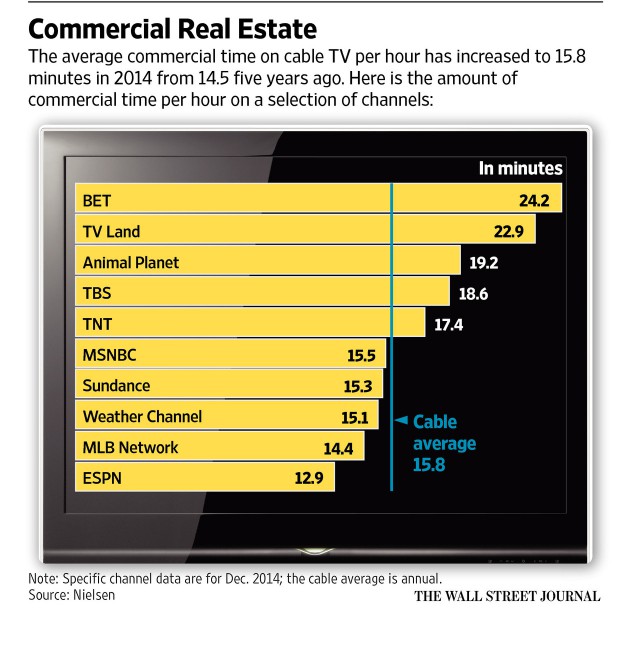
Although sponsors of expensive NBC, CBS, ABC, and FOX shows may have rebelled at the 15-minute mark, the same isn’t true with cable networks where ad loads are as high as 24 minutes per hour. In 2009, the average cable network aired 14:27 of advertisements an hour. This year, it’s up to 15:18 and still rising. Among the worst offenders:

ad load

To keep the money flowing from every direction, both over-the-air and cable networks, including those noted above, continue to seek additional compensation from your provider in the form of retransmission consent and carriage agreements. Whether you watch a channel or not, you are paying for it. Some of these compensation agreements are experiencing rate increases approaching 10% annually.

To the surprise of many industry analysts, some of the worst offenders are networks with declining ratings who risk further alienating viewers with even more advertising just to keep revenue numbers up. While traditional ads actually declined by 2% on most over the air networks this year, FOX more than made up for that with a 15% increase in advertising time. The cable networks with the highest ad increases this year were Viacom-owned channels (Comedy Central, Spike, MTV, Nickelodeon) jumping 13%, A+E Networks (A&E, Crime & Investigation, Lifetime, History) increasing 10%, and 9% at Discovery Networks. Which networks increased ads the least? Those owned by Disney, independent cable networks, and Time Warner (Entertainment).

“Generally speaking, the ratings winners (Disney, 21st Century Fox, Scripps Networks) are increasing investment in original content (and not abusively increasing ad loads), whereas the losers (A+E Networks, Viacom, NBCUniversal) and the neutrals (Discovery, AMC Networks) are decelerating investment in original content and stuffing more ad spots into their shows,” said analyst Todd Juenger of Sanford C. Bernstein.

Michael Nathanson of MoffetNathanson Research worries television is repeating the mistakes commercial radio made post-deregulation, when massive increases in advertising accompanied by decelerating investment in programming repelled many listeners, perhaps for good. Some have permanently abandoned commercial over the air radio in favor of commercial free music services, satellite radio, and streaming services.

“Networks can offset ratings challenges and pricing weakness with more inventory, however, we worry that it is a dangerous long-term game that ultimately devalues the consumer experience and reduces ad efficacy,” Nathanson said. “As we saw with radio, once the increased commercial load genie is out of the bottle, it is nearly impossible to put it back in.”

When Stephen Cox was watching The Wizard of Oz on TBS last November, something didn’t sound quite right to him about the Munchkins, who are near and dear to his heart. He wasn’t imagining things. Time Warner-owned TBS used compression technology to speed up the movie. The purpose: stuffing in more TV commercials.

“Their voices were raised a notch,” Cox, the author of several pop-culture books including one about the classic 1939 film, told the Wall Street Journal. “It was astounding to me.”

The Colbert Report hilariously depicts the next generation of product placement: the retroactive ad technology of Mirriad, which can insert products into shows years after they were made. (4:04)

Time Warner Cable: Our Condolences to Verizon if They Signed the CBS Deal We Rejected

Phillip Dampier August 28, 2013 Consumer News, Online Video, Video 5 Comments
witmer

Witmer

If what Time Warner Cable claims is true, the stalemate that has kept CBS content away from subscribers for four weeks may be less about the money and more about CBS’ desire to control your viewing experience.

Melinda Witmer, TWC’s chief video and content officer, reports CBS is demanding daunting new restrictions in their proposed renewal contract, including requiring customers to “register their television sets” with CBS before being able to turn them on.

Witmer said CBS’ demands also include new powers over DVR capabilities, which means CBS could possibly prevent customers from fast-forwarding through commercials or even block the recording and/or storage of certain programs without network permission.

“CBS announced that they signed a deal with Verizon (FiOS TV) and has suggested that they offered us the same deal Verizon just signed,” Witmer said. “All I can say is our condolences to Verizon if they signed the deal CBS put in front of us. I hope for Verizon’s sake that they didn’t sign that, but if they did I’m glad for us because we’ll compete that much better against them when we finish our deal.”

Cable operators are seeking expanded rights from programmers as customer viewing habits evolve. Among the most important are those that would allow online and on-demand streaming of programming to authenticated cable subscribers.

Time Warner Cable has invested considerable resources in its online viewing platforms for PC’s, smartphones, and tablets, providing most of the TWC lineup on those portable devices. But the service has been largely limited in-home viewing because the cable company is having trouble securing permission to stream most of that content for those on the go.

Time Warner Attempts to Placate Impacted Customers

twcAlthough Time Warner Cable is crediting customers for the loss of Showtime/The Movie Channel, blocked by the cable operator while the impasse continues, Time Warner is not giving any automatic refunds for the loss of CBS basic or broadcast programming and networks taken off the cable dial. CBS-owned Smithsonian TV is the most affected basic cable channel nationwide. Some customers who pay extra for Smithsonian as part of an added-cost HD Tier often known as “TWCHD Pass” have gotten service credits upon request.

Time Warner Cable is giving out free over-the-air antennas to customers in cities where local CBS-owned stations have been taken off the cable lineup.

Time Warner Cable has a limited quantity of free basic indoor antennas available for customers at TWC retail locations in Dallas-Ft. Worth, Los Angeles/Desert Cities, New York City, Milwaukee and Green Bay, Wisc. In addition, TWC has partnered with Best Buy in those cities to provide $20 toward the purchase of any in-stock broadcast antenna at select Best Buy store locations. The cable company has published a list of retail locations where antennas are available as long as supplies last. Limit one per customer and installation is your responsibility.

Radio Shack has also taken advantage of the situation by slashing prices on an AntennaCraft Amplified Omnidirectional HDTV Antenna, now available online for $37.49 – a 25 percent discount. Best Buy is supporting Time Warner Cable’s position in the CBS dispute. Radio Shack is not, telling customers its antennas make it easy to “cut the cable.”

Time Warner is appeasing tennis fans with enhanced coverage of the 2013 US Open Tennis Championship Series with a free preview of The Tennis Channel running Aug. 26 through Sept. 9.

The blackout is also keeping Time Warner Cable, Bright House, and Earthlink (supplied by either cable operator) broadband customers from watching CBS content online.

If you now receive this channel Here’s how your Time Warner Cable video service is impacted
CBS from NYC, LA, Dallas-Ft Worth, Boston, Chicago, Denver, Detroit, Pittsburgh -The CBS channel has been removed from your lineup
-CBS Primetime on Demand is now unavailable
-StartOver and LookBack services on all CBS-owned stations are unavailable
CBS from any city other than the ones listed above -CBS Primetime on Demand is now unavailable
-StartOver and LookBack services on local CBS affiliate stations are unavailable
Flix Flix is now unavailable
The Movie Channel The Movie Channel and The Movie Channel on Demand are now unavailable; TWC is providing replacement programming from Encore on a temporary preview basis–look in your guide for channel numbers.
Showtime Showtime, all its associated multiplex channels, and Showtime on Demand are now unavailable; TWC is providing replacement programming from Starz on a temporary preview basis–look in your guide for channel numbers.
Smithsonian Channel Smithsonian and Smithsonian on Demand are now unavailable

The Federal Communications Commission said it is trying to resolve the fee dispute from Washington.

“The commission is engaged at the highest levels with the respective parties and working to bring the impasse to an end,” Justin Cole, an agency spokesman, said in an e-mailed statement yesterday. “We urge all parties to resolve this matter as quickly as possible so consumers can access the programming they rely on and are paying for.”

But acting FCC chairwoman Mignon Clyburn also admitted the FCC has few powers to intervene and compel an agreement.

[flv width=”640″ height=”380″]http://www.phillipdampier.com/video/TWC Melinda Witmer on CBS Blackout 8-24-13.flv[/flv]

Time Warner Cable’s Melinda Witmer, head of the team negotiating with CBS, suggests the network is demanding unprecedented control over your viewing experience — a deal breaker for the cable operator.  (6 minutes)

Broadcasters Run to the Courts to Stop Disruptive Video Streaming; Aereo’s Legality

Phillip Dampier May 15, 2012 Competition, Consumer News, Online Video, Public Policy & Gov't, Video Comments Off on Broadcasters Run to the Courts to Stop Disruptive Video Streaming; Aereo’s Legality

An innovative plan to rent New Yorkers a dime-sized over-the-air antenna housed in a Brooklyn data center to receive and stream local broadcasters could be the end of broadcast TV as we know it, at least if you believe the claims being made by network executives in their high-powered lawsuit.

Aereo, which charges $12 a month to an invitation-only customer base, is the target of serious legal action brought by the major broadcast networks and local TV stations that believe Aereo’s disruptive business model could allow cable operators to avoid paying retransmission consent fees for free, over the air television signals.

Aereo only streams local broadcasters in the New York metropolitan area to residents within viewing range of the signals. The company argues it operates legally because of a time-tested, sound legal principle: the Communications Act of 1934, which offers broadcasters a license to use the public airwaves in return for operating in the public interest. Aereo only rents its tiny antennas to one customer at a time, and provides them with streamed video received by that antenna. The company charges a nominal monthly fee to cover the costs of operating its data center and to cover streaming expenses.

The monthly subscription fee grants viewers access to watch one channel while recording another on a cloud-based DVR “storage locker.” Viewers can watch the signals on just about any device, as long as they are located within the New York metropolitan area. Travelers and those who live outside of the area cannot watch programming or subscribe to the service.

The threat to the nation’s pay television operators and broadcasters is obvious. Over the air television broadcasters increasingly rely on so-called “retransmission consent payments” collected from pay television operators in return for permission to place their signals on the cable, telco, or satellite TV dial. Broadcasters bank on that growing revenue. Pay television providers grudgingly agree to the payments and promptly pass them on to already rate-increase-weary subscribers, who want a way out of paying for hundreds of channels they don’t care to watch.

Aereo's over the air antenna is about the size of a dime.

Aereo breaks the business models of both broadcasters and the cable industry. Cord cutters can get reliable and cheap reception of over-the-air stations without dealing with cumbersome in-home antennas (or paying local cable companies for HD-quality local stations and a DVR box). Goodbye $70 cable-TV bill. Broadcasters also lose every time the local pay television company drops a subscriber. Aereo does not pay retransmission consent fees, nor do their subscribers.

But Aereo is not all bad news for pay television providers. If Aereo can survive the legal onslaught from broadcast interests, nothing stops local cable companies from licensing Aereo technology (or constructing their own system) that would bypass retransmission consent fees as well. That could save cable operators millions.

Ridiculous? Not according to Matt Bond, an executive vice-president at Comcast/NBC who told a New York federal court the risk is real.

“It makes little economic sense for cable systems and satellite broadcasters to continue to pay for NBCU content on a per-subscriber basis when, with a relatively modest investment, they can simply modify their operations to mirror Aereo’s ‘individual antenna’ scheme and retransmit, for free, over-the-air local broadcast programming,” Bond said. “I know for a fact that cable companies have already considered such a model.”

Diller

Broadcasters revile Aereo’s disruptive innovation.  Bond called the service “piracy.” Other network executives say it steals their content and resells it at a profit. Some are even predicting the destruction of broadcast television as we know it if Aereo is found to be legal. Virtually every network is on board for the lawsuit, which seeks an immediate injunction that would shut the service down.

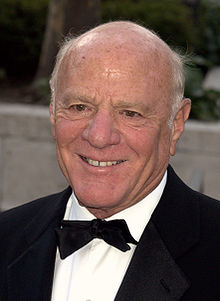
Barry Diller, a veteran broadcast executive, has invested in Aereo and calls the broadcasters’ fears rubbish.

“It’s not the beginning of the destruction of anybody,” Diller told New York Magazine. “TV wasn’t the destruction of the movie business. Television wasn’t the destruction of radio. Cable wasn’t the destruction of broadcast networks. What happens is new alternatives come, and they live alongside whatever existed.”

“You have an antenna that has your name on it, figuratively … and it’s one-to-one. It is not a network,” Diller told members of the Senate Commerce Committee during a recent hearing. “It is a platform for you to simply receive, over the Internet, broadcast signals that are free and to record them and use them on any device that you like.”

Aereo is not a pioneer in the video streaming of over the air signals. iCraveTV launched in 1999 streaming broadcast stations from Buffalo, N.Y. and Ontario, Canada from its home base in Toronto. Broadcasters filed suit and quickly shut the service down. ivi-TV tried a similar venture in 2011 and was also shut down. Even companies experimenting with IPTV technology have run into trouble with some networks that feel threatened by a possible precedent that could be mistakenly established, starting a flood of similar services.

To date, only services that agree to broadcaster sanctions (Slingbox) or who have retransmission consent contracts with providers (such as the cable industry’s TV Everywhere project) have survived, but all have limitations imposed on their functionality that reduce their usefulness to consumers.

[flv width=”640″ height=”500″]http://www.phillipdampier.com/video/Aereo TV Demo May 2012.flv[/flv]

Aereo TV was demonstrated by the company CEO Chet Kanojia at the New York Tech Meetup May 9.  (21 minutes)

Search This Site:

Contributions:

Recent Comments:

Your Account:

Stop the Cap!