Subscribe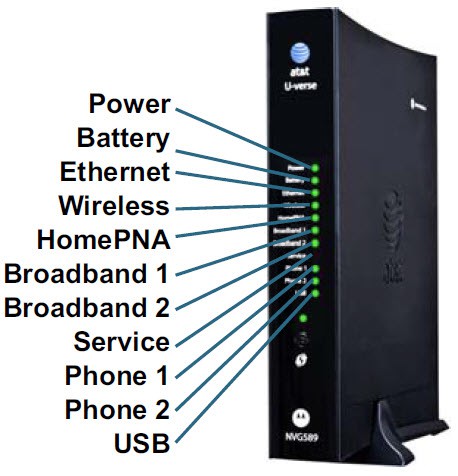
Motorola NVG589 gateway
AT&T customers offered free broadband service upgrades are discovering “free” means at least $7 a month in new equipment charges for some, even when the customer owns the equipment.
Jim Grant has been an AT&T ADSL 2+ customer for almost a decade, happy to get 12Mbps broadband service from the phone company while maintaining an account with DISH Network for satellite television. As part of AT&T’s expansion effort, Grant’s neighborhood recently became U-verse capable, which led to an onslaught of new customer promotions offering upgrades for broadband-only customers and packages of television, telephone, and broadband service for everyone else.
“An AT&T salesman offered me 18Mbps VDSL service for the exact same price I’ve been paying for 12Mbps, claiming the newer single-pair circuit would work more reliably than the bonded pair service I receive today,” Grant tells Stop the Cap! “What he and the installation guy failed to mention is that this ‘free upgrade’ would cost me $7 a month in equipment fees, even though I bought and own the RG (residential gateway) they now want to charge me for using.”
Grant’s Motorola-manufactured router/modem did not need to be replaced. It was always capable of supporting ADSL2+ and VDSL broadband service. Only his bill has changed.
It turns out AT&T changed its policies that used to allow certain customers to avoid modem fees by buying their own equipment. Starting Jan. 11, 2015, AT&T’s modem rental fee for customers using the company’s equipment remained $7 a month. But customers who own their own equipment in a U-verse upgraded area are also charged the same $7, only AT&T doesn’t consider it a modem rental fee. Instead, it is a combination equipment charge and extended warranty.
AT&T claims this change actually saves customers money once their purchased modems go out of warranty. AT&T used to charge $99 for a service call to a home with customer-owned equipment and a $100 replacement charge if the modem turned out to be defective. AT&T says the $7 monthly equipment and warranty fee protects customers from both charges if something goes wrong.

Modem fees apparently don’t apply if you are lucky enough to qualify for a promotion like this one offered in Austin in 2013 for AT&T’s GigaPower service.
AT&T’s explanation didn’t go over well with Grant, who only found out about the charge once the bill arrived.
“I was promised repeatedly my bill would be exactly the same and since I owned my own equipment, there was no way I should be charged a fee like this,” Grant explained. “AT&T is charging me the same $7 it would any customer using AT&T-supplied equipment.”
 Most customers affected by this charge discover it after upgrading their service or when technicians replace older equipment, often accompanied by a promise there would be no extra charges or fees, something customers learn isn’t always true after their next bill arrives.
Abhijit accepted an AT&T offer to boost his U-verse Internet speed to 24Mbps. Along for the ride was a brand new U-verse gateway.
“I was told specifically that there would be no additional charge,” Abhijit complained on AT&T’s customer support forum. “After first month’s bill, I am seeing an additional $7.00 Internet equipment fee.”
Another customer in Texas was also misinformed by AT&T’s salespeople about the modem fees.
“I was informed that this $7 fee was for leasing a modem/wireless Router/Residential Gateway (RG),” wrote the customer. “However, if I have my own compatible modem, there will be no additional charge. I have purchased my own compatible modem and now AT&T service says [it will charge a] ‘$7 service fee’ instead of [the $7] equipment rental.”
Modem fees are a lucrative source of revenue from AT&T, earning the company potentially more than $84 million a month.
Some customers report success receiving service credits or other fee waivers after complaining about the undisclosed fees in complaints to the FCC.
 On Monday, AT&T announced 38 additional cities that will eventually have access to its gigabit broadband offering – AT&T U-verse with GigaPower, but the company remains coy about the number of customers that can actually order the service today across the 56 metro areas that will eventually be served by AT&T’s fiber to the home network.
 Just a few years earlier, most providers wouldn’t think of offering discounted 10Mbps service, fearing it would cannibalize revenue as customers downgraded to get lower priced service. Increasing demands on bandwidth from online video and multiple in-home users have gradually raised consumer expectations, and their need for speed.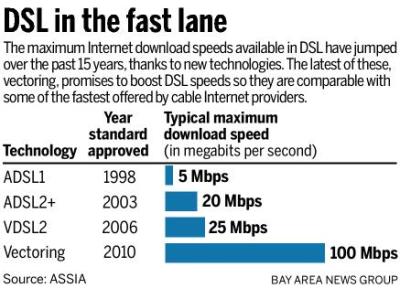
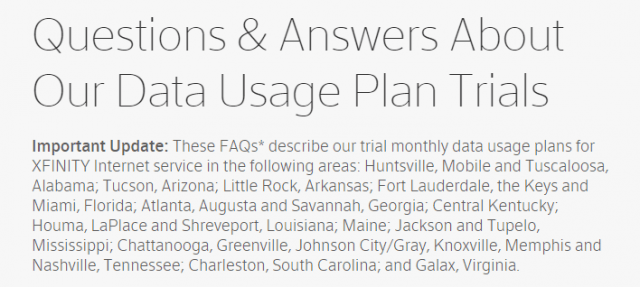
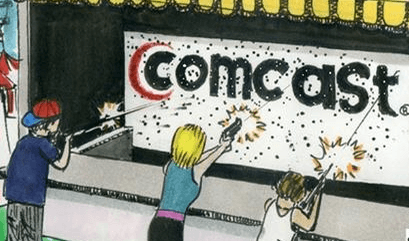 Comcast is accelerating its rollout of compulsory usage caps, adding new markets in the southern U.S. to its three-year old “trial” of what it calls its “data usage plan.” DSL Reports
  Comcast’s spreading usage caps are not popular with customers. Within hours of the news Comcast would be expanding its cap “trial,”
 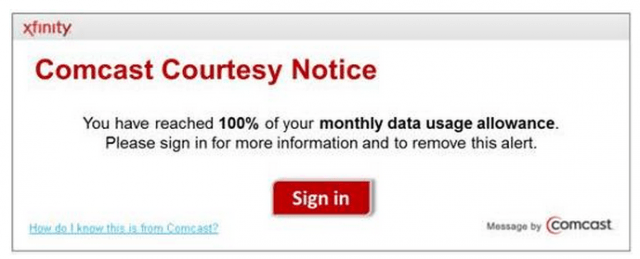 Hans says any household with kids will quickly learn Comcast isn’t being honest claiming usage caps only affect a “few customers” after they start getting warning messages injected into their web browser.
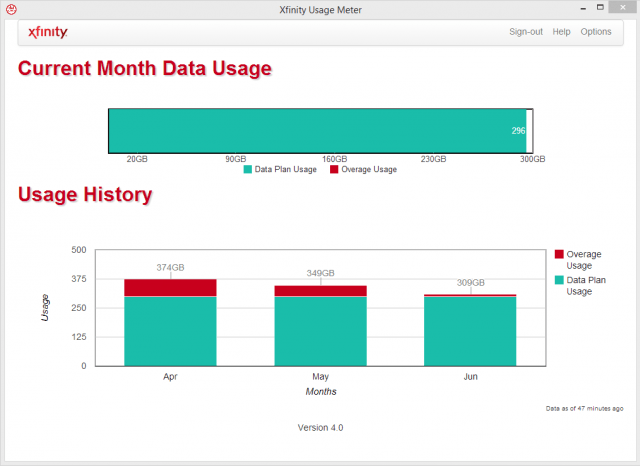 “I checked my data usage on Oct. 21 and it said I only used 162GB,” writes Sharon. “I even have [a screenshot] and saved it as I had a feeling Comcast would pull something. [On] Oct. 23, I had a pop-up on my computer that says ‘you have used 292 of 300GB’ and I went to the data usage and it shows that. Nobody in my house downloaded any huge files the past two days. So, is Comcast artificially pumping up our usage to make us go over or what? It is impossible that I only used 162GB for 21 days and then used 130GB the past two days.”