Home » astroturf group » Recent Articles:

Stop the Cap!’s Election Guide for Broadband Enthusiasts

Tomorrow is election day in the United States. Stop the Cap! has reviewed both presidential candidates’ positions (or the lack thereof) as well as the past voting records and platforms of members of both major political parties. With this in mind, it is time for our election guide for broadband enthusiasts. Regardless of what candidate you support, please get out and vote!

Neither political party or candidate has been perfect on broadband advocacy or consumer protection.

We’ve been disappointed by the Obama Administration, whose FCC chairman has major problems standing up to large telecom companies and their friends in the Republican-led House of Representatives. Julius Genachowski promised a lot and delivered very little on broadband reform policies that protect both consumers and the open Internet. Both President Obama and Genachowski’s rhetoric simply have not matched the results.

Bitterly disappointing moments included Genachowski’s cave-in on Net Neutrality, leaving watered down net protections challenged in court by some of the same companies that praised Genachowski’s willingness to compromise. Genachowski’s thank you card arrived in the form of a lawsuit. His unwillingness to take the common sense approach of defining broadband as a “telecommunications service” has left Internet policies hanging by a tenuous thread, waiting to be snipped by the first D.C. federal judge with a pair of sharp scissors. But even worse, the FCC chairman’s blinders on usage caps and usage billing have left him unbelievably naive about this pricing scheme. No, Mr. Genachowski, usage pricing is not about innovation, it’s about monetizing broadband usage for even fatter profits at the expense of average consumers already overpaying for Internet access.
Obama

Unfortunately, the alternative choice may be worse. Let’s compare the two parties and their candidates:

The Obama Administration treats broadband comparably to alternative energy. Both deliver promise, but not if we wait for private companies to do all of the heavy lifting. The Obama Administration believes Internet expansion needs government assistance to overcome the current blockade of access for anyone failing to meet private Return On Investment requirements.

While this sober business analysis has kept private providers from upsetting investors with expensive capital investments, it has also allowed millions of Americans to go without service. The “incremental growth” argument advocated by private providers has allowed the United States’ leadership role on broadband to falter. In both Europe and Asia, even small nations now outpace the United States deploying advanced broadband networks which offer far higher capacity, usually at dramatically lower prices. Usually, other nations one-upping the United States is treated like a threat to national security. This time, the argument is that those other countries don’t actually need the broadband networks they have, nor do we.

The Obama Administration bows to the reality that private companies simply will not invest in unprofitable service areas unless the government helps pick up the tab. But those companies also want the government to spend the money with as little oversight over their networks as possible.

That sets up the classic conflict between the two political parties — Democrats who want to see broadband treated like a critically-important utility that deserves some government oversight in its current state and Republicans who want to leave matters entirely in the hands of private providers who they claim know best, and keep the government out of it.

FCC Chairman Julius Genachowski’s regular cave-ins for the benefit of Big Telecom brought heavy criticism from us for his “cowardly lion” act.

Just about the only thing the two parties agree on is reforming the Universal Service Fund, which had until recently been directing millions to keeping traditional phone service up and running even as Americans increasingly abandon landlines.

But differences quickly emerge from there.

The Obama Administration believes broadband is increasingly a service every American must be able to access if sought. The Romney-Ryan campaign hasn’t spoken to the issue much beyond the general Republican platform that market forces will resolve virtually any problem when sufficient demand arises.

Republicans almost uniformly vociferously oppose Net Neutrality, believing broadband networks are the sole property of the providers that offer the service. Many Republicans characterize Net Neutrality as a “government takeover” of the Internet and a government policy that would “micromanage broadband” like it was a railroad. Somehow, they seem to have forgotten railroad monopolies used to be a problem for the United States in the early 20th century. Robber barons, anyone?

President Obama pushed for strong Net Neutrality protections for Americans, but his FCC chairman Julius Genachowski caved to the demands of AT&T, Verizon, and the cable industry by managing Net Neutrality with a disappointing “light touch” for those providers. (We’d call it “fondling” ourselves.)

Democrats favor wireless auctions and spectrum expansion, but many favor limits that reserve certain spectrum for emerging competitors and for unlicensed wireless use. Republicans trend towards “winner take all” auctions which probably will favor deep-pocketed incumbents like AT&T and Verizon. The GOP also does not support holding back as much spectrum for unlicensed use.

Republicans have been strongly supporting the deregulation of “special access” service, critical to competitors who need backhaul access to the Internet sold by large phone companies like AT&T. Critics contend the pricing deregulation has allowed a handful of phone companies to lock out competitors, particularly on the wireless side, with extremely high prices for access without any pricing oversight. The FCC under the Obama Administration suspended that deregulation last summer, a clear sign it thinks current pricing is suspect.

Romney

Opponents of usage-based pricing of Internet access have gotten shabby treatment from both parties. Republicans have shown no interest in involving themselves in a debate about the fairness of usage pricing, but neither have many Democrats.

As for publicly-owned broadband networks, sometimes called municipal broadband, the Republican record on the state and federal level is pretty clear — they actively oppose community broadband networks and many have worked with corporate front groups like the American Legislative Exchange Council (ALEC) to ban them on the state level. Democrats tend to be more favorable, but not always.

The biggest problem broadband advocates face on the federal and state level is the ongoing pervasive influence of Big Telecom campaign contributions. While politicians uniformly deny that corporate money holds any influence over their voting, the record clearly indicates otherwise. Nothing else explains the signatures from Democrats that received healthy injections of campaign cash from companies like AT&T, and then used the company’s own talking points to oppose Net Neutrality.

But in a story of the lesser of two-evils, we cannot forget AT&T spends even more to promote Republican interests, because often those interests are shared by AT&T:

  • AT&T has spent nearly $900,000 on self-identified “tea party” candidates pledged to AT&T’s deregulation policies;
  • AT&T gave nearly $2 million to the Republican Governors Association — a key part of their ALEC agenda;
  • AT&T gave $100,000 to everyone’s favorite dollar-a-holler Astroturf group — The Heartland Institute, which opposes Net Neutrality and community broadband.

Heartland Institute Astroturf Group Threatens to Take Legal Action Against Bloggers, Activists

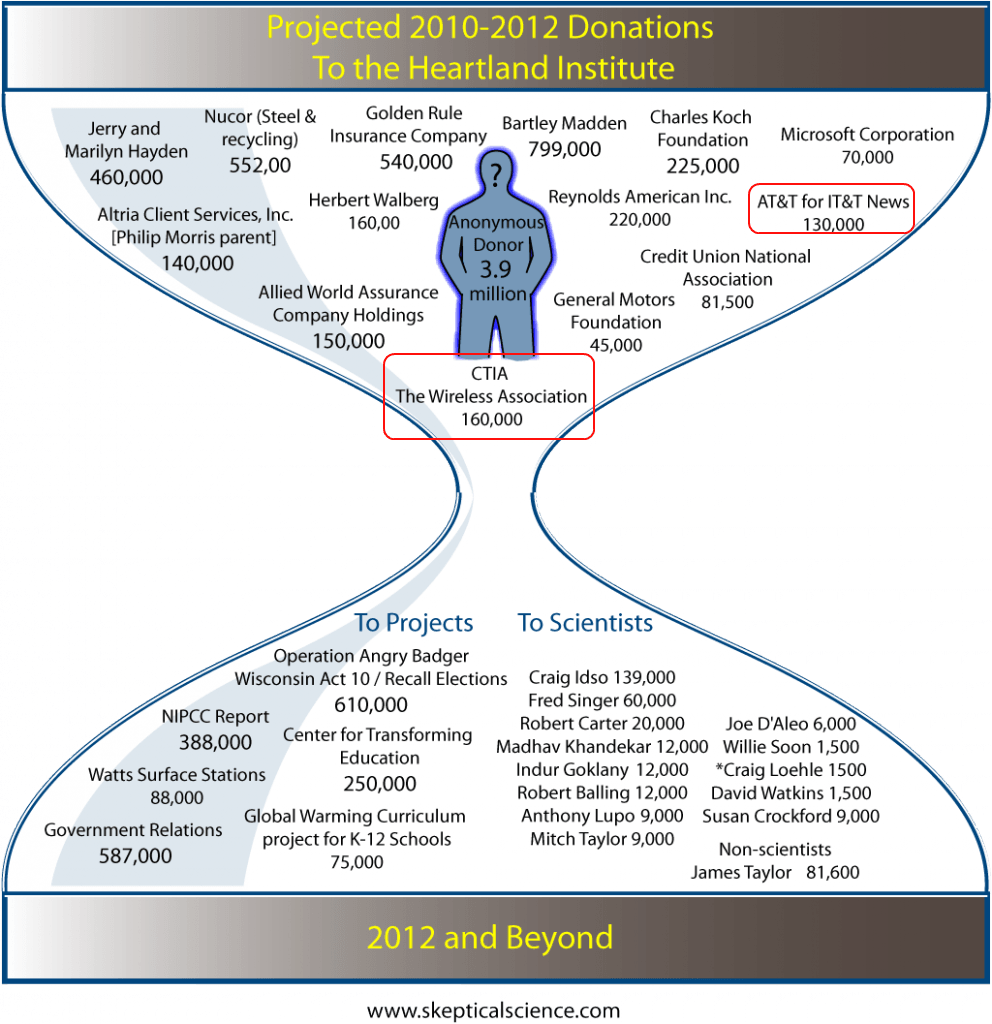
Skeptical Science produced this infographic of the Heartland Institute’s funding sources and where the money goes.

The Heartland Institute, a corporate-backed astroturf operation that has steadfastly supported cable and phone companies against the interests of consumers, has threatened legal action against activists, bloggers, and other journalists who published stories about recently-acquired documents connecting the group with major corporate donors.

Among telecommunications companies, both AT&T and Time Warner Cable show up in the alleged donor documents, which Heartland officials claim were obtained under false pretenses and, in some cases, were altered or forged.

Jim Lakely, communications director for the group, was unhappy:

We respectfully ask all activists, bloggers, and other journalists to immediately remove all of these documents and any quotations taken from them, especially the fake “climate strategy” memo and any quotations from the same, from their blogs, Web sites, and publications, and to publish retractions.

The individuals who have commented so far on these documents did not wait for Heartland to confirm or deny the authenticity of the documents. We believe their actions constitute civil and possibly criminal offenses for which we plan to pursue charges and collect payment for damages, including damages to our reputation. We ask them in particular to immediately remove these documents and all statements about them from the blogs, Web sites, and publications, and to publish retractions.

The fact the group implies it will take legal action against those who published stories not to the group’s liking will only draw added attention to the scandal.  Stop the Cap! has tangled with this group several times over the years whenever AT&T and Time Warner Cable’s corporate agendas are being challenged.

The group has steadfastly refused to release their donor lists, at one point telling us, “by not disclosing our donors, we keep the focus on the issue.”

Not really.  That’s because the first rule of politics is to “follow the money.”  Most of these groups do not sing their songs for free, and knowing who paid the songwriter can be very revealing.

The Associated Press found no evidence Heartland’s budget or fundraising documents leaked to the media were faked or altered:

Because Heartland was not specific about what was fake and what was real, The Associated Press attempted to verify independently key parts of separate budget and fundraising documents that were leaked. The federal consultant working on the classroom curriculum, the former TV weatherman, a Chicago elected official who campaigns against hidden local debt and two corporate donors all confirmed to the AP that the sections in the document that pertained to them were accurate. No one the AP contacted said the budget or fundraising documents mentioning them were incorrect.

Heartland can best salvage its reputation and put this behind them by releasing the names of their largest donors, letting consumers decide whether this organization truly represents their interests, or those of the corporations writing the big checks.  In addition to corporate contributions, Heartland’s operations rely on a single person identified only as “Anonymous Donor.” In the past six years, the man has given $14.26 million to the institute, nearly half its $33.9 million in revenue, according to the AP.

Grassroots this is not.

Astroturf Group Heartland Institute Lies About Chattanooga’s EPB Fiber Network: “They Only Sell a Gig”

Heartland Institute: "By not disclosing our donors, we keep the focus on the issue."

In an eyebrow-raising exchange between the Heartland Institute’s Bruce Edward Walker and Dr. Joseph P. Fuhr, Jr., who produced a dollar-a-holler “research report” on behalf of corporate-backed astroturf group the Coalition for the New Economy (which lists the Heartland Institute’s Florida chapter as a member), the two dismiss Chattanooga’s award-winning EPB Fiber Network as providing lesser service than private competitors AT&T (also a member of the Coalition) and Comcast, in part because EPB “only sells customers a gig.”

An exchange between Heartland Institute’s Bruce Edward Walker and Dr. Joseph P. Fuhr, Jr. fundamentally misrepresents Chattanooga’s EPB Fiber network. At no point does Walker disclose Heartland Institute’s chapter in Florida is a member of the group that sponsored the production of Fuhr’s report. (1 minute)
You must remain on this page to hear the clip, or you can download the clip and listen later.

Walker: The government broadband services are always one step behind private industry and I’m thinking in Chattanooga, the law [sic] that they have the fastest download speeds of all government broadband in the United States, but they only offer 1Gbps service.

Fuhr: Well, one of the issues there is, well, the supply is there but they kind of have the feeling that if you build it, they will come.  Well, they haven’t come.  I mean they are charging $350 a month for that service and very few people are willing to subscribe.  People are, for the most part, happy with slower speeds.  Who really needs a gigabyte (sic) and the market shows that people don’t really need that.

Dr. Fuhr apparently does not know the difference between a “gigabyte” and a “gigabit,” so I am not sure how seriously we are supposed to take this “broadband expert.”  He also does nothing to challenge Walker’s wholly-inaccurate declaration that EPB only sells customers $350 1Gbps broadband.

In fact, most of Heartland Institute’s views about EPB broadband are a big bucket of wrong:

  1. EPB Fiber offers the fastest fiber broadband in the United States.  It is “private industry” providers Comcast and AT&T who are more than one step behind, and they refuse to sell faster service and upgrade their networks to the speeds seen in Asia and Europe that Chattanooga’s EPB customers can have today.
  2. There is no “law” involved in the delivery of broadband by EPB.  In fact, EPB fought off attempts by incumbent operators to sue the municipally-owned provider out of the broadband business, and some of those same companies are backing the “Coalition for the New Economy” in their efforts to curtail community broadband with new laws that would make networks like EPB next to impossible to provide.
  3. EPB does not only offer 1Gbps service.  Consumers and businesses are free to choose between several different speed tiers.  As any commercial entity will tell, you 1Gbps at just $350 a month is a steal compared to the prices AT&T and Comcast would charge.
  4. When EPB built their fiber network, private businesses did come.  In addition to media reports documenting expansion in Chattanooga from one Knoxville business, Amazon.com has announced hundreds of millions of dollars in new investments building and expanding distribution centers in and around Chattanooga, in part because EPB Fiber was available for their use.
  5. People are not happy with the slow speeds some providers force them to accept.  It is no surprise, however, that industry-funded astroturf groups would repeat the usual provider line that people “don’t need” fast broadband that they have no plans to deliver anyway.

Another Bought & Paid-For Anti-Community Broadband Bill Appears in Georgia

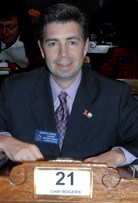
Sen. Chip Rogers, a new-found friend of Comcast, AT&T, Charter Cable, Verizon, and the Georgia state cable lobby.

A new bill designed to hamstring local community broadband development with onerous government regulation and requirements has been introduced by a Republican state senator in Georgia, backed by the state’s largest phone and cable companies and the astroturf dollar-a-holler groups they financially support.

Sen. Chip Rogers (R-Woodstock), is the chief sponsor of the ironically-named SB 313, the ‘Broadband Investment Equity Act,’ which claims to “provide regulation of competition between public and private providers of communications service.”  The self-professed member of the party of “small government” wrote a bill that creates whole new levels of broadband bureaucracy, and applies it exclusively to community-owned networks, while completely exempting private companies, most of which have recently contributed generously to his campaign.

SB 313 micromanages publicly-owned broadband networks, regulating the prices they can charge, the number of public votes that must be held before such networks can be built, how they can be paid for, where they can serve, and gives private companies the right to stop the construction of such networks if they agree to eventually provide a similar type of service at some point in the future.

Even worse, Rogers’ bill would prohibit community providers from advertising their services, defending themselves against well-financed special interest attacks bought and paid for by existing cable and phone companies, and requires publicly-owned networks to allow their marketing and service strategies to be fully open for inspection by private competitors.

Rogers’ legislation is exceptionally friendly to the state’s incumbent phone and cable companies, and they have returned the favor with a sudden interest in financing Rogers’ 2012 re-election bid.  In the last quarter alone, Georgia’s largest cable and phone companies have sent some big thank-you checks to the senator’s campaign:

  • Cable Television Association of Georgia ($500)
  • Verizon ($500)
  • Charter Communications ($500)
  • Comcast ($1,000)
  • AT&T ($1,500)

A review of the senator’s earlier campaign contributions showed no interest among large telecommunications companies operating in Georgia.  That all changed, however, when the senator announced he was getting into the community broadband over-regulation business.

It is difficult to see what, besides campaign contributions, prompted Rogers’ sudden interest in community broadband, considering Georgia has not been a hotbed of broadband development.

Rogers claims cities like Tifton, Marietta and Acworth have tried unsuccessfully to be public providers and that the legislation “levels the playing field for public and private broadband providers.”  Hardly, and the senator’s dismissal of earlier efforts fails to share the true story of broadband expansion in those communities.

The new owner of Tifton's CityNet carries on the tradition the city started providing broadband to a woefully underserved part of Georgia.

Tifton: Either the city provides broadband or no one else will

Tifton’s misadventure with the city-owned CityNet, eventually sold to Plant Communications, was hardly all bad news.  When city officials launched CityNet a few years ago, much of the community was bypassed by broadband providers.  Today, the new owner Plant continues competing with bottom-rated Mediacom, which admitted in 2001 it bought an AT&T Broadband cable system that “underserved” the residents of Tifton.  At the same time, the Tifton Gazette, which has loathed CityNet in editorials from its beginnings, freely admits the network brought lower prices and competition to Tifton residents over its history:

At the same time, having CityNet here has meant increased competition and therefore lower service rates for residents. We would probably have had to wait longer for high-speed Internet to make it to Tifton, and the system makes it possible for local governments to receive services here.

That’s a far cry from Rogers’ claim that the “private sector is handling [broadband] exceptionally well.”

“What they don’t need is for a governmental entity to come in and compete with them where these types of services already exist,” Rogers added.

In fact, in Tifton they needed exactly that to force Mediacom to upgrade the outdated cable system they bought from AT&T.

The Curious Case of Marietta FiberNet: When politics kills a golden opportunity

On track to be profitable by 2006, local politics forced an early sale of the community fiber network that was succeeding.

In Marietta, the public broadband “collapse” was one-part political intrigue and two-parts media myth.

Marietta FiberNet was never built as a fiber-to-the-home service for residential customers.  Instead, it was created as an institutional and business-only fiber network, primarily for the benefit of large companies in northern Cobb County and parts of Atlanta.  The Atlanta-Journal Constitution reported on July 29, 2004 that Marietta FiberNet “lost” $24 million and then sold out at a loss to avoid any further losses.  But in fact, the sloppy journalist simply calculated the “loss” by subtracting the construction costs from the sale price, completely ignoring the revenue the network was generating for several years to pay off the costs to build the network.

In reality, Marietta FiberNet had been generating positive earnings every year since 2001 and was fully on track to be in the black by the first quarter of 2006.

So why did Marietta sell the network?  Politics.

Marietta’s then-candidate for mayor, Bill Dunway, did not want the city competing with private telecommunications companies.  If elected, he promised he would sell the fiber network to the highest bidder.

He won and he did, with telecommunications companies underbidding for a network worth considerably more, knowing full well the mayor treated the asset as “must go at any price.”  The ultimate winner, American Fiber Systems, got the whole network for a song.  Contrary to claims from Dunway (and now Rogers) that the network was a “failure,” AFS retained the entire management of the municipal system and continued following the city’s marketing plan.  So much for the meme government doesn’t know how to operate a broadband business.

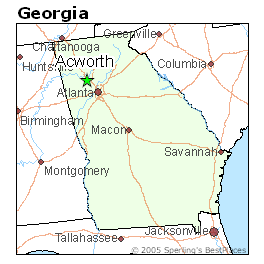
Acworth: Success forces the city to sell to a private company that later defaults

Acworth CableNet: Too popular for its own good?

But of all the bad examples Rogers uses to sell his telecom special interest legislation, none is more ironic than the case of Acworth, Ga.  The Atlanta suburb suffered for years with the dreadfully-performing MediaOne.  Throughout the 1990s, MediaOne spent as little as possible on its antiquated cable system serving the growing population, many working high-tech day jobs in downtown Atlanta.  MediaOne had no plans to get into the cable broadband business, while other cable systems around metro-Atlanta had already begun receiving the service.  That left Acworth at a serious disadvantage, so local officials issued $6.8 million in tax-exempt bonds to construct Acworth CableNet.  Demand was so great, the city simply couldn’t keep up.

As Multichannel News reported in 2002, “the Atlanta suburb of Acworth, Ga., isn’t selling because business is bad. Rather, officials said they’ve received so many requests for service from outside the city limits that they’ve decided to sell the operation to an independent company that may expand beyond Acworth’s borders.”

That is where the trouble started.  The city contracted with United Telesystems Inc. of Savannah, Ga., a private company, first to lease and then eventually buy the cable system, maintaining and expanding it along the way.  But in 2003, United Telesystems defaulted on its lease-sale agreement, forcing the city to foreclose on the system and ultimately sell it to a second company.

Acworth’s “failure” wasn’t actually the city’s, it was the private company that defaulted on its contract.

So much for Rogers’ record of municipal broadband failure.

The Hidden Problems of Industry-Funded Research Reports

In fact, many of Rogers’ talking points about his new bill come courtesy of the industry-backed astroturf group, the “Coalition for the New Economy.”  With chapters in the Carolinas, Georgia, and Florida, this tea-party and AT&T/Time Warner Cable-funded group takes a major interest in slamming community broadband.

Most of their findings come courtesy of a shallow dollar-a-holler study, The Hidden Problems with Government-Owned Networks, by Dr. Joseph P. Fuhr, Jr., professor of economics at Widener University.  The report, mostly an exercise in Google searching for cherry-picked bullet points highlighting what the author sees as weaknesses and failures in community broadband, even slams success stories like EPB Fiber.  The Chattanooga, Tenn., network just earned credit for helping to attract hundreds of millions in new private investment and jobs from Amazon.com, but Fuhr’s conclusion is that EPB operates without any “real business plan concerning EPB’s investment.”

Fuhr and his friends at Heartland Institute even misrepresent EPB as delivering only 1Gbps service at $350 a month in an attempt to illustrate municipalities are out of touch with the private broadband marketplace.

Christopher Mitchell at Community Broadband Networks dismisses the bill as more of the same from a telecommunications industry that wants to tie down community broadband networks in ways that guarantee they will fail:

In short, this bill will make it all but impossible for communities to build networks — even in areas that are presently unserved. The bill purports to exempt some unserved areas, but does so in a cynically evasive way. The only way a community could meet the unserved exemption is if it vowed to only build in the least economical areas — meaning it would have to be significantly subsidized. Serving unserved areas and breaking even financially almost always requires building a network that will also cover some areas already served (because that is where you can find the margins that will cover the losses in higher expense areas).

The bill is presently in the Senate Regulated Industries and Utilities committee.  Stop the Cap! urges Georgia residents to contact state legislators and ask they oppose this special-interest legislation that is designed primarily to protect the broadband status quo and provider profits in Georgia, instead of allowing communities to manage their broadband needs themselves.  After all, they are accountable to the voters, too.

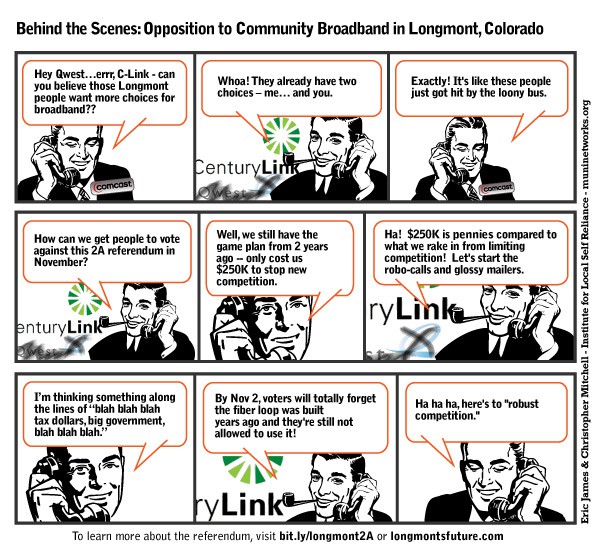
Big Telecom’s Astroturf Snowjob: Blizzard of Bull from CenturyLink and Comcast to Kill Competition

You can look all over this astroturf group's website and never find the fact it's bought and paid for on behalf of Colorado's largest cable company -- Comcast.

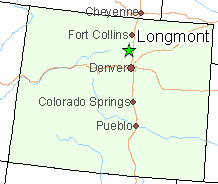
The next time Comcast or CenturyLink wants to increase your rates because of the “increased costs of doing business,” you might want to ask them why they have collectively spent more than $300,000 on an astroturf campaign to stop the city of Longmont, Col. (pop. 86,000) from using excess fiber capacity to provide competition to the phone and cable company without raising taxes a penny.

Longmont voters are headed to the polls today with a simple question to answer: should the city be allowed to open their fiber network to all-comers to provide competitive video, data, and telephone services to city residents.  Longmont’s fiber network was constructed in the 1990s as part of its electrical infrastructure.  Some utility companies buried enormous amounts of fiber intending to use it to electronically collect usage data from ratepayers so meter readers could become a thing of the past.  Like in other cities, Longmont now has a fiber network that is woefully underused, and the city wants to open up the tremendous excess capacity for telecommunications uses.  They are even open to allowing Comcast and CenturyLink to use the network to help service their own respective customers, but the thought a new competitor (including a community-owned provider) might deliver service over that network has created an absurd $300,000 Hissyfit.

Comcast has been caught funding the majority of the opposition, the so-called “No on 2A” and “Look Before We Leap” projects, sponsored primarily by the Colorado Cable Telecommunications Association, which counts Comcast as a member.

But visitors to the campaign’s cheesy website never realize who is running the show because the effort hides its association with Big Telecom.

It’s a classic example of Astroturf Fear, Uncertainty, and Doubt.  Scare residents into believing the city will raise taxes or go into financial distress.  Raise uncertainty by claiming important details are being left out.  Encourage doubt by comparing the advanced fiber network with anemic public Wi-Fi failures of the past involving Earthlink (remember them?).

But the No on 2A campaign is also willing to check themselves into a deluxe suite at the Hypocrisy Hotel, accusing city officials of hiding the names of their pro-fiber supporters and backers, including (gasp!) a company based in France!

The No on 2A website breathlessly relates the incriminating documents were unearthed from “previously secret emails just made public thanks to a Colorado Open Records Act.” They suggest a nefarious connection with Alcatel-Lucent because that company, which sells products and services related to fiber networks, communicated with the city in a handful of e-mail messages last summer.  You know those French, always up to something.

When it doubt, blame the French for being in on it.

The rich, buttery irony of a “group” secretly funded by the state’s largest cable company accusing others of keeping secrets is ignored at Kabletown.

But then I’ve received e-mail from Alcatel-Lucent (and Comcast) myself.  And I have a French last name.  Sacrebleu!

The website’s “opponents,” evidently gleaned from the few hundred residents that signed their visitor’s book, includes names like Joanna Crawford, “Garrett County,” and El Cordova, which we think could be the name of a Mexican pro-wrestler, we’re not sure.

City officials are stunned by the sheer amount of money being spent by cable and phone companies to keep competition far, far away.  So apparently is the local media, which has taken to identifying the “grass roots” opposition right down to their job title and name of the lobbying firm they work for.

Take Times-Call, which helpfully discloses “Look Before We Leap” spokesman George Merritt is actually a senior strategist for Onsight Public Affairs of Denver.  That’s a real nice way to say “lobbying firm hired to develop social media strategies to snooker influence public opinion on behalf of corporate clients.”

You know you’re not dealing with a neighborhood group lobbying to reduce road speeds in the neighborhood or sign a petition for improved trash collection when you read Leap’s financial disclosure reports:

  • $120,913.64 to mass communications firm SE2 of Denver for a variety of services, including mail pieces, consulting, two television buys and ad production and design.
  • $70,500 to Rocky Mountain Voter Outreach of Denver for “canvass, management rent and miscellaneous associates.”
  • $37,500 to OnSight Public Affairs for consulting.
  • $22,000 to Drake Research and Strategy of Boulder for polling.
  • $15,776.84 to Zata3 for phone work.
  • $12,260 to Holland and Hart of Denver for legal expenses.
  • $8,000 to EIS of Grand Junction for consulting.
  • $4,334.65 to Campaign Products of the Rockies, of Denver, for a voter file, mailing lists, stickers and yard signs.
  • $2,500 to Mark Stevens of Denver for research.
  • $743.75 to Tim Thomas of Boulder for general campaign work.

The whole dog and pony show of Big Telecom money has bemused Longmont mayor Bryan Baum, who supports the 2A measure and believes the distortion campaign has gone way over the top.

“It doesn’t really matter at this stage of the game,” Baum told the newspaper. “It’s going to the electorate. The electorate will vote. And we will know on Tuesday how they voted – if they believe a $300,000 ad campaign, or if they believe the people they’ve entrusted their votes to.”

Some of that $300,000 has also gone into vilifying a real grass-roots effort in support of the Longmont fiber initiative — Longmont’s Future.  Comcast’s front group tried to raise questions about where that pro-fiber group got their backing and money.  The newspaper discovered Longmont’s Future isn’t backed by any French conglomerate or nefarious outside interest.  It’s the work of Jonathan Rice, who operates the website all by himself, spending a grand total of $353 to fight Comcast’s $300,000.

“Every single candidate for office and every incumbent, in every race, supports this measure,” says Rice. “But Comcast and its friends are more interested in profit than progress, and continue to run a smear campaign to spread misinformation and outright lies – they recently posted Mayor Baum’s name as an opponent of 2A when he is actually a vociferous supporter.”

Community Broadband Networks has compiled a series of articles detailing the project and helping to expose the so-called “grassroots” opponents.  We encourage readers to become better acquainted with the underhanded tactics community broadband opponents will use to stop anything that resembles competition.

Search This Site:

Contributions:

Recent Comments:

Your Account:

Stop the Cap!