Home » Providers » Recent Articles:

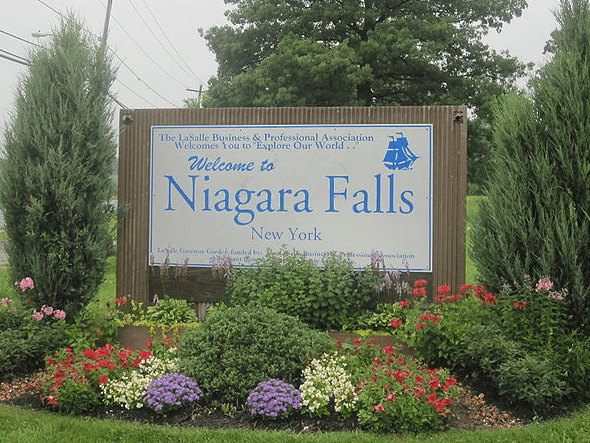
Comparing Broadband Prices: Niagara Falls, Ontario vs. Niagara Falls, NY

Phillip Dampier February 2, 2011 Broadband Speed, Canada, Competition, Consumer News, Data Caps, Rogers 1 Comment

Despite claims from Canadian Internet Service Providers that Internet Overcharging schemes like “usage-based billing” are about pricing fairness, paying for what one uses, and keeping prices down, comparing broadband prices across the west and east sides of the Niagara River tell a very different story.

We went shopping for the lowest possible prices for standalone broadband service from two cable companies serving the Niagara Falls area, on both sides of the border.

Here is what we found (prices roughly equivalent in CAD/USD at today’s exchange rate of $1US = $0.99CAD):

Niagara Falls, N.Y. — Time Warner Cable

$34.95/month


Road Runner Standard Service: 10/1Mbps
No Usage Limit
No Overlimit Fee
No Modem Rental Fee
No Contract Commitment

Niagara Falls, Ontario — Rogers Communications

$39.00/month

Rogers Express Service: 10Mbps/512kbps
60GB Monthly Limit with $2/GB Overlimit Fee
$14.95 Installation Fee
One Year Contract Required
(Price above reflects a one-year promotion that includes the monthly Home Gateway Rental ($4.50 value) for one year, $5.50 per month thereafter, effective 3/2011)

The $46.99 price noted above reflects regular Rogers pricing, before the modem rental fee.

Harper Gov’t Issues Statement on Usage-Based Billing Cable Company Misrepresents As Approval

Clement

On Monday, the Federal Minister of Industry Tony Clement issued a statement about Internet Overcharging that was so non-committal, media companies are interpreting his comments as “for” and “against” usage-based billing.

Tony Clement’s full statement:

“On Tuesday, January 25, 2011, the CRTC announced its decision to allow wholesale and retail internet service providers to charge customers for exceeding the monthly usage of data transfer permitted with their broadband Internet package. This will mean, for the first time, that many smaller and regional internet service providers will be required to move to a system of usage-based billing for their customers.

I am aware that an appeal has been initiated by a market participant. As Canada’s Industry Minister, it is my job to help encourage an innovative and competitive marketplace, and to ensure Canadian consumers have real choices in the services they purchase. I can assure that, as with any ruling, this decision will be studied carefully to ensure that competition, innovation and consumers were all fairly considered.

The Harper Government is committed to encouraging choice and competition in wireless and internet markets. Increased choice results in more competition, which means lower prices and better quality services for Canadians. We have always been clear on our policies in this regard and will continue on this path.

Our Conservative Government is focused on the economy and creating a positive environment for job creators and business to flourish. Canadians can count on us to do what is in the best interest of consumers.”

AgenceQMI and Videotron are both owned by Quebecor Media

CBC Radio made mention of Clement’s comments and indicated the minister had expressed concerns about the billing scheme, but readers of wire service reports from AgenceQMI are getting an entirely different view — Clement’s approval of the new pricing scheme.

In a French language story headlined, “Minister Clement justifies the end of unlimited Internet packages,” the news agency got just a little creative in interpreting Clement’s statement (roughly translated from the French original):

He also argues that billing based on actual usage would more efficiently manage Internet traffic and bandwidth and provide a better experience for light users, currently impacted by massive data exchanges among the Internet’s heaviest users.

Minister Clement, who supports this decision, said in a statement that it is his duty to encourage a more competitive market.

It’s hardly a coincidence that AgenceQMI‘s creative spin of Clement’s statement just happens to match the position of Videotron, Quebec’s largest cable company.  They are both owned by Quebecor Media.  Videotron engages in Internet Overcharging that left one Montreal student with an $1,800 broadband bill.

Wi-Fi Ripoff? NYC Parks Hand Over Wireless Space to Time Warner and Cablevision

NY City Council members are reviewing an application by Time Warner Cable and Cablevision to offer Wi-Fi services in 32 New York-area parks… for a fee that could bring the companies as much as $10 million dollars a year in new revenue.

The controversial proposal would frustrate efforts by the nonprofit group NYCWireless to find free Wi-Fi providers to deliver service in New York’s public parks.

In September, the city of New York renewed franchises for both Cablevision and Time Warner Cable that included a commitment to spend $10 million to install Wi-Fi service in area parks.  But nobody said the companies had to provide the service for free.

Instead, users will only get free samples — up to three ten-minute sessions per month.  Additional time on the network will cost 99 cents per day.  Cable customers will get unlimited access for free.

Dana Spiegel, executive director of the nonprofit NYCWireless, says handing over the wireless space in public parks to private fee-based providers is “absolutely unconscionable.”

City council members don’t have a final say over the deal — a state commission does — but intends to investigate the deal and its fairness to New York residents.

Verizon FiOS has a growing presence in New York City, and those customers would be locked out of free Wi-Fi access on the proposed park network.

NYCWireless offered the council several reasons why relying on cable companies to deliver public park Wi-Fi was not a great deal:

First, the plan does not establish any form of “Free Public Wi-Fi”, an amenity of New York City parks since NYCwireless began our work, and one replicated by the Parks Department and many other organizations around the City. Free Public Wi-Fi Hotspots were a very significant recommendation of the Diamond Consulting “Broadband Needs Assessment Study,” and the “Free” part of these public hotspots are exactly the part of these amenities that make them so valuable and essential for local residents.

Make no mistake: DoITT’s plan establishes a $1 per day fee for internet service in parks. There may be a few free 10-minute blocks per month, and there may be ways to hide the $1 per day charge in a resident’s cable service internet bill, but with DoITT’s plan, NYC won’t have Free Wi-Fi. We’ll have $1 per day Wi-Fi, delivered to public spaces that are maintained by our tax dollars, paid to a couple of huge private corporations.

In fact, Cablevision and Time Warner Cable stand to make tens of millions of dollars per year providing this service. Central Park gets about 25m visitors per year, and if we ignore all other parks, and figure that fewer than half of those visitors buy one day of internet service per year, Time Warner Cable and Cablevision get paid $0.99 x 10 million visitors = $10,000,000.

Second, the industry standard for gaining access to such types of subscription service as are contemplated by DoITT and the cable companies requires that a prospective user of a fee-based Parks Hotspot will need to create an account and enter their billing information. This requires the submission of identity, address, and credit card information into a web form prior to gaining access to the hotspot. Essentially, by promoting this solution, DoITT is pushing NYC citizens and visitors to hand over deeply personal and secure information to a private organization over which neither the user nor DoITT has any control.

Contrast this to the way that NYCwireless offers free Wi-Fi to citizens: we do require registration of a user account so that we can track agreement to our Acceptable Usage Policy. However we require only a valid email address. No billing address, no credit card, no other identity information.

Personally, I am fearful of handing over such information to such private organizations, though I have in the past. But I am more fearful for the harm that will be done to those that depend more significantly upon Park Hotspots. How many city residents don’t have a credit card? How many children in playgrounds who couldn’t get a credit card even if they wanted to? Adults? How many city residents live in neighborhoods that are otherwise safe, but in which they would prefer not pulling out their wallet and a credit card just to get what should be Free Internet Access? How many city residents depend upon Free Wi-Fi because they live below the poverty line, and because they can’t afford or don’t want cable internet, cannot afford the $5 it would cost them to get internet access in a city park during the week?

Lastly, because of DoITT’s “whole package solution”, most NYC residents and visitors won’t see any Wi-Fi, for free or for fee, for years, since local organizations that would otherwise have sponsored the creation of a Free Public Wi-Fi Hotspot say “oh, well, the city is going to do this someday, so we won’t bother doing this now for our community.” If past experience is any predictor of future performance, it will be years before the first Paid Wi-Fi Hotspot is opened, and many more before many others are opened, if at all. Meanwhile, DoITT’s actions will have stopped in its tracks any plans for more hotspots that local organizations may be contemplating.

[flv width=”640″ height=”500″]http://www.phillipdampier.com/video/NY 1 Time Warner Cable Offers Free WiFi Hotspots For City Customers 3-26-10.flv[/flv]

NY1 reported on Time Warner Cable’s expanded Wi-Fi hotspots in New York in this story from last March.  (1 minute)

When Providers Oversell the Network: Paying for 10Mbps Service, Getting 1.2Mbps Instead

"It's like night and day."

Tim pays Time Warner Cable around $45 a month for 10/1Mbps service.  Jake pays Comcast $35 a month for 12/2Mbps service.  Neither reader of Stop the Cap! actually receives those speeds once the sun goes down, however.

Jake, who lives in a neighborhood near Philadelphia populated by loads of college students watches his download speed plummet to 4Mbps in the evening, even lower on weekends.  Tim, a reader in the North Ponds Park region of Webster, N.Y., does even worse — 1.2Mbps evenings and weekends.

Neither reader is alone.  The disparity in marketed speeds vs. actual speeds reveals the truth about cable modem technology — if not properly managed, congestion can bring the broadband party to a sudden halt (or at least rebuffering.)

Both are examples of “overselling,” the practice of piling too many customers onto too small a broadband pipe.  If nobody is using the connection in the neighborhood, speeds are great.  But as students get out of class and mom and dad get home from work, everyone wants to be online.  Soon enough, the pipeline gets filled and speeds drop as the network tries to accommodate everyone.

Most cable companies use fiber optics to bring a limited amount of bandwidth into individual areas of their network.  Some might cover the better part of a town, others only a few city blocks.  Every customer in the area shares that bandwidth.  Cable companies monitor these connections looking for signs they are becoming overcongested during peak usage times.  When those alarms start sounding consistently, companies are supposed to upgrade the area (or divide it up) to keep broadband service working close to advertised speeds.

But some companies are waiting until broadband service becomes practically unusable before spending the money to upgrade their networks.

“I knew they were overselling this area when I noticed downloads speeds fell off the cliff, but the upload speed was near normal,” Jake writes. “The time of day also tells the story.  Starting after 4pm, speeds begin to drop and become downright terrible after dinner and on weekends.  Sunday night is always the worst.”

It’s a similar story in west Webster, near Lake Ontario, where neighborhoods several miles apart all watch their Road Runner speeds slow to a crawl.

“Browsing is slow, downloads are painfully slow, latency is very high and streaming any sort of video online is impossible,” Robert, another Webster resident, told Time Warner Cable (and us).  “I have been a customer since 1998 and for me to not even be able to download at a 1 Megabit speed when this service is supposed to be 10 megs (and more with PowerBoost) is inexcusable.”

The problem of overselling is also common in larger cities like New York and Philadelphia, where some neighborhoods endure “broadband” speeds that resemble “dial-up” when customers pile on the network.

“Comcast says they never see a problem and have repeated that to me over and over, even when they send a truck out,” Jake tells Stop the Cap! “Of course, their truck rolls in the daytime when there isn’t a problem.”

Time Warner customers in eastern Monroe County have been told the cable company is well aware of the congestion problems, and technicians dispatched to area homes candidly admit the company has not kept up with the growth of new housing developments.  Several customers have asked for, and won, several months of service credits for broadband they simply cannot use.

Tim says the entire affair has left him with doubts about Time Warner’s reputation to provide quality broadband service.

“At one time, I considered myself a candidate to upgrade to Time Warner wideband when it became available,” he tells us. “My thinking on that has changed and I am looking into viable alternatives to Time Warner. Money has become of less importance to me than principle, and I may end up with a higher cost solution than staying with Time Warner.”

Ground Zero Bandwidth: The impacted area of Webster, N.Y.

With our encouragement, these customers (among others) have filed complaints with the Better Business Bureau and have tried to get attention focused on their neighborhoods.
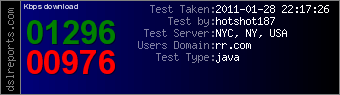
A broadband speed test in Webster, N.Y.

A representative of Time Warner today told Robert the company has confirmed Webster has a problem and it is being worked on, but no specific date has been offered when things will return to normal.  He received a credit for one month of service.

Jake wants answers about how a company the size of Comcast can ignore a problem of this magnitude.

“Is it really about the money,” he asks.  “This company just bought NBC and doesn’t have the resources to sell Internet service that at least comes close to the speeds they advertise?”

Stop the Cap! advises customers with speed problems to make your feelings known.  The squeaky wheel gets the upgrade.  Start with customer service and work your way up.  Demand service credits, an in-person repair visit to check your lines, and then escalate complaints to supervisors and social media networks like Twitter and Facebook.  Also consider contacting local media “consumer reporters,” and file complaints with the Better Business Bureau.  Sooner or later, a manager will escalate your case to a department that is empowered to authorize upgrades without red tape.

Considering the enormous amount of revenue earned from selling broadband service, it is only fair to expect you will have access to something close to the speeds offered when you signed up.


Netflix Says Frontier Is America’s Worst Ranked Wired Internet Service Provider

Gertraude Hofstätter-Weiß January 27, 2011 Broadband Speed, Canada, Consumer News, Frontier, Online Video, Wireless Broadband 7 Comments

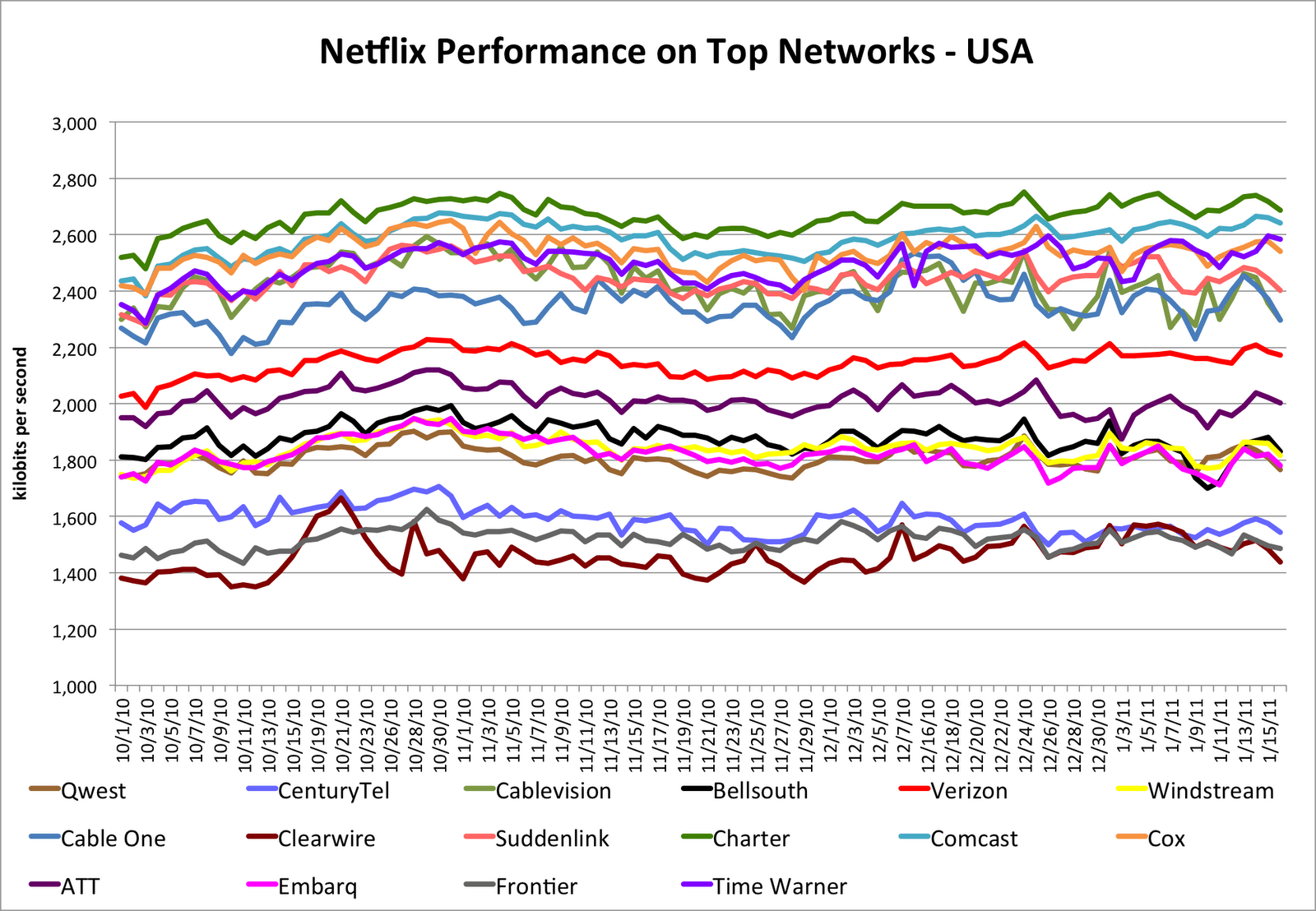
Netflix today released statistics showing Frontier Communications was America’s worst ranked wired Internet Service Provider, ranking at the bottom for quality and speed when using Netflix’s streamed content.

Only Clearwire, a heavily-throttled wireless provider scored worse than Frontier Communications.  This says nothing good about Frontier considering they are a wired provider.

Charter Cable scored highest — a surprise from a company that scores near the bottom in Consumer Reports broadband rankings:

Charter is in the lead for US streams with an impressive 2667 kilobits per second average over the period. Rogers leads in Canada with a whopping 3020 kbps average.

Canada’s higher speed performance comes even as providers claim they need to implement Internet Overcharging schemes to handle congestion on their networks — congestion not apparent from Netflix’s online video performance. Perhaps Canadians have been already grown accustomed to avoiding too much online video.

Netflix promises to release their streaming performance statistics on a monthly basis. Track your ISP from the charts below:

Netflix USA Speed Rankings

Netflix Rankings for Canada

(Our reader Paul sent us a news tip about this story.  You can send yours using the Contact Form linked above.)

Search This Site:

Contributions:

Recent Comments:

Your Account:

Stop the Cap!