Home » Providers » Recent Articles:

Telecom Dividend Cash Bonanza – Landline Customers Drop, But Stockholder Payouts Rise

Phillip Dampier February 10, 2011 AT&T, Bell (Canada), Frontier, Rural Broadband Comments Off on Telecom Dividend Cash Bonanza – Landline Customers Drop, But Stockholder Payouts Rise

The telephone landline business is hardly a growth industry, as an average of 5-7 percent of customers disconnect their home phone service every quarter, but you wouldn’t know that from the dividends being paid to stockholders.

From AT&T, Bell Canada, Frontier to Qwest — the companies that speak in terms of keeping their customer defection rates down are paying dividends that often exceed earnings.

Among the worst of all — Frontier Communications, whose outsized dividend is expected to reach 75 cents a share.  That, despite the fact analysts predict the phone company will earn only 40 cents a share or so this year.

Where do these phone companies expect to make their money?  Their broadband and wireless divisions.  AT&T and Bell Canada are able to cover landline losses with enhanced profits from their IPTV services like U-verse and Fibe.  Frontier and Qwest expect to survive on providing cheap-to-deploy DSL service in rural areas avoided by cable operators.

Shaw Launches Listening Tour on Internet Overcharging; Will They Hear? Probably Not

Phillip "I've heard this all somewhere before" Dampier

Shaw Communications today suspended its Internet Overcharging scheme as Canada’s firestorm over Internet Overcharging continues.  Western Canada’s largest cable company is taking a page from Time Warner Cable’s 2009 failed playbook and promising a ‘listening tour’ to “hear the views” of their customers on the subject of usage-based billing.

Evidently, the half-million Canadians signing Openmedia’s petition rejecting this kind of pillage pricing out of hand isn’t sufficient, nor are polls showing overwhelming opposition to the end of flat rate usage plans in the country.  So in a bold PR move, Shaw is throwing the doors open to listen to their customers.*

It’s all just wonderful….  Hey, wait a minute.  Is that a speck on my monitor?  What is that spot at the end of the sentence up there?

Uh oh, it’s an asterisk.  I’d better scroll down to find out what that is all about:

|

|

|

|

|

|

|

|

Are you still with me?  We’re on a tour of our own….

|

This part of the tour is brought to you by Shaw.

|

|

|

(*- If you want to be involved in the discussions, which are being held face to face – then you’ll need to email [email protected] to ask for an invite.  Use “Please send me an invitation to attend the Internet usage discussion” as the subject line.)

Oh.  You have to be “invited” to attend.  Because I need permission to speak my mind about Shaw’s overcharging schemes.

Yes folks, it’s all very reminiscent of the Tweeting Trio at TWC back in 2009, who promised us they’d value our feedback, right up until we learned they deleted it, unread.

It’s really quite simple.  The overwhelming majority of Shaw customers are already paying good money for the service they receive today, and they don’t want to pay a penny more.  Shaw is not hurting financially — Internet Overcharging just adds more sugar to the quarterly financial reports.

But Shaw persists in writing replies like this to those writing them on the subject:

Thank you for your interest in voicing your opinion over this controversial topic.

We will be posting a detailed signup form within the next week or so once we get venues arranged. Times will also be posted once venues are established. At this point in time though, only customers like yourself will be invited to attend. Please check back on the 14th of February (Monday) for the posted meeting dates and times. The site to visit will be: http://shaw.ca/Internet/New-Data-Usage/

In its current form, UBB has been put on hold until we can determine the more customer friendly approach to this topic. It will still be rolling out as the objectives are the same – increase overall effectiveness of the network, manage the high users, and improve overall functionality/customer experience with our products. As the current model has caused all kinds of backlash from our customer population, your input as to what would make the process amicable to you would be appreciated.

If you have any other questions or concerns, please don’t hesitate to contact us.

Cheers,

Neil – Rep 7368

eCare Team

Shaw Cablesystems GP

The “customer friendly approach” to Internet Overcharging is not to engage in it.  The “signup form” and meeting dates provide Shaw with a nice list from which to handpick those selected to attend.  What they’ll be treated to is a circus of slides showing why Shaw simply must overcharge Canadians for their Internet service.  There is no surprise why ordinary citizens have caused all kinds of backlash.  These wounds are self-inflicted.

A better idea is to set up an independent debate on the subject, say with representatives from Shaw and Openmedia.ca and let the truth prevail.  Throw the doors open to anyone who wants to attend.  If Shaw wants to really listen, let them hear.

Unfortunately, I fear Shaw is not in a listening mood, otherwise they would scrap their usage based billing schemes and deliver quality service at a fair price, no invitation required.

AT&T’s Microcell Giveaway: Holding Onto (Some) Rural Customers With Mini Cell-Towers

Gertraude Hofstätter-Weiß February 9, 2011 AT&T, Competition, Consumer News, Wireless Broadband Comments Off on AT&T’s Microcell Giveaway: Holding Onto (Some) Rural Customers With Mini Cell-Towers

Here in West Virginia, cell phone reception is often by the grace of God.  The incredibly mountainous state makes “line of sight” communications a real problem when the nearest cell tower is blocked by a gigantic shale rock formation someone blasted through to build a road decades earlier.

AT&T probably still delivers the largest coverage of rural areas in the state because its towers expand beyond the major highways other carriers cover. But even with that expanded service, using a smartphone indoors is going to be a problem in many places.

Recently, AT&T sent letters to approximately 7.5 percent of their customers in the rural areas most likely to have reception problems, offering a free “MicroCell,” which is comparable to a mini cell tower inside your home or office.  The equipment works with your existing broadband connection to expand “coverage” inside your home.  For data purposes, the MicroCell doesn’t deliver anything your personal Wi-Fi connection couldn’t, but if you rely on a cell phone, having signal bars makes all the difference if you are waiting for an important call.

A considerable number of those letters reached families in West Virginia, and that is no surprise considering the state is by far the most difficult to blanket with wireless coverage in the eastern half of the country.
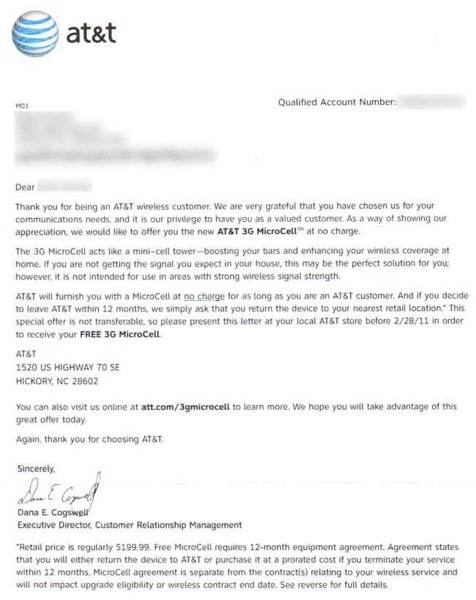
A letter to AT&T customers inviting them to receive a free MicroCell

But the problem is, some families are receiving the free offers, while others are not, and that is creating reception envy.
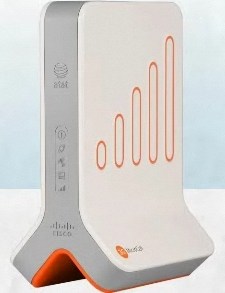
AT&T 3G MicroCell

Charlotte, who lives in Whipple, W.V., outside of Oak Hill, was visiting with her neighbor Joy last week and noticed her husband fiddling with the latest gadget on his computer desk.

“It looked odd because of the way it spread out on the bottom, so I asked Joy what in the world he was installing,” Charlotte says.

“It’s a cell tower thing AT&T gave us to get better reception,” Joy responded.

Despite the fact the two families live only a few homes apart and signed up for AT&T service with the exact same phones within weeks of each other, Charlotte was never offered AT&T’s MicroCell.

AT&T notified qualified customers with a letter containing a personal reservation code, and the offer was not transferable.

“Maybe you got it and threw it away,” Joy offered.

“No, ever since the credit card companies started changing terms on us, we open every envelope that comes into this house,” Charlotte replied.

Assuming it must be an oversight, Charlotte dropped by her local AT&T store to inquire about the offer.

“We quickly learned we were not the first family to bring up this issue with AT&T as the store manager told us he was fielding complaints from all over town about the highly-selective offer,” Charlotte said.

Even worse, there was nothing the manager could do to rectify the situation.

“His hands were as tied as my patience was tried,” Charlotte tells Stop the Cap!

“The store manager offered to sell me the MicroCell for around $100 with a rebate, but why should I pay AT&T for better reception they should already be providing?” Charlotte asks.  “It seems to me if they are giving away these things to some people in a neighborhood, they should be doing it for everyone, because we pay the same bill our neighbors do.”

The seemingly random offers of MicroCell units are not limited to West Virginia.  We’ve noticed complaints from residents in northern California, the Pacific Northwest, and northern New England from others who get reception while outdoors or on the go, but find their phones useless for making and receiving calls at home.

In most cases, irate customers seeking redress from AT&T run into a bureaucratic brick wall.

Rick McGee, commenting on Engadget’s website:

I have talked to Marketing, Technical Support, and my local store, and nobody can tell me who to contact to qualify for a MicroCell. I have been an AT&T Mobility customer for over four years, with four family plan phones and two more phones on corporate contracts. The reception at my house is usually zero, at times maybe one bar, but never enough to maintain an incoming call or make an outgoing call. I guess I am a glutton for punishment, but this is the last straw.

If AT&T does not magically send me one of the MicroCell coupons, I will total up my termination fees and determine the earliest date I am willing to dump AT&T and try another carrier. In addition to the cell phones, I have two AT&T land lines, plus an AT&T internet account, so I am likely in the top tier of residential customers. With no reception at my house, I don’t see how I would fail to qualify for a MicroCell, but AT&T has no process to help individual customers with bad reception. Everyone I talk to claims ignorance. I’ve done my part, AT&T — either step up, or I am gone.
Others find similar experiences — apologies from in-person sales staff about the corporate roadblocks even they cannot navigate around.

But every once in awhile, one does.  Casey Robinson’s neighborhood lost all AT&T cell phone service when their local cell tower was destroyed in a storm.  The replacement redirected most of its signal elsewhere, leaving them with no bars.

After arguing with corporate phone support in the AT&T store for 2 hours they told me pay the $149 [for a MicroCell] or tough luck. I responded by telling them to take my family plan +2 lines, my roommates family plan +3 lines, and our Uverse U400 package with high speed internet and shove it, we will be changing carriers immediately since I have tower data from AT&T pre and post storm to show they breached our contract.

The AT&T store rep was amazing through all of this. He apologized continuously and said if it was up to them they would give out the MicroCell as soon as we walked in the door, unfortunately their computers physically block them from comping a MicroCell. While I was very distraught on the phone with AT&T, he called his manager at home and explained the situation. She drove in to the store, again apologizing for everything we had to go through, checked us out with the MicroCell then credited our account for the full purchase price and credited a month’s service to both my line and my roommate’s line for the issues we had been having. They are the only reason we still have AT&T. Of course we wrote to their district manager and AT&T corporate applauding the employee and manager, and of course from what we’ve heard they still haven’t been acknowledged for their good work.

Some others have had recent success filing complaints with the Better Business Bureau, when executive level customer service representatives come to the rescue with a free MicroCell.

Charlotte’s family intends to deal with the MicroCell Gap in their own way — by switching to Verizon Wireless, which improved service in the Oak Hill region a few years ago while they’ve been under contract with AT&T.

“We were willing to put up with the MicroCell doing the job their own cell towers should be doing, but because they don’t care about us, we’re done with them,” Charlotte says.

Customers accepting AT&T’s free offer must verbally commit to stay with the carrier at least 12 months or return the MicroCell when they depart.  If they don’t, AT&T will bill an equipment fee up to $199.
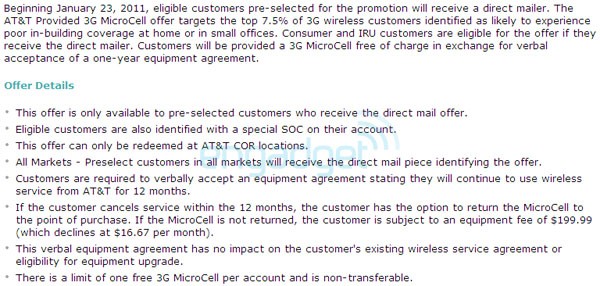
Engadget obtained this inside memo about the MicroCell offer.


26% Of AT&T Users, 44% Of Verizon’s Existing Smartphone Owners Will Move to VZ iPhone

Gertraude Hofstätter-Weiß February 9, 2011 AT&T, Competition, Consumer News, Verizon, Video, Wireless Broadband Comments Off on 26% Of AT&T Users, 44% Of Verizon’s Existing Smartphone Owners Will Move to VZ iPhone

Standing in line for an iPhone tonight will be a little less comfortable than Apple's traditional summer release dates.

More than one quarter of AT&T’s iPhone customers and nearly half of Verizon’s existing smartphone customers are prepared to leave their current phones behind for Verizon’s iPhone.

That stunning conclusion from online research firm uSamp is raising eyebrows because of the shockingly high number of people willing to brave the elements (and the cost) to grab iPhone 4 on Verizon’s network, even if it means pitching their existing phone in the waste bin.

Smartphone-lovers will have that chance as customers queue up tonight for Verizon’s iPhone tomorrow.

uSamp surveyed more than 700 smartphone users, finding that 29 percent of AT&T customers who intend to switch to Verizon for the iPhone are willing to wait in line on Feb. 10 to get it. Among existing Verizon customers who plan to get the iPhone, 24 percent report a willingness to stand in line, too.  When weighted across customers willing to switch handsets, more than one-quarter of all current iPhone owners will end their contracts with AT&T sometime this year.

For young consumers, devotion to the iPhone is even more intense: among AT&T customers intending to switch, 35 percent of those ages 18-24 and 50 percent of those ages 25-34 are willing to wait in line on the Feb. 10 launch day.

For Verizon’s current BlackBerry and Android users who report plans to switch to the iPhone, 46 percent of those ages 18-24 and 34 percent of those ages 25-34 agree they will wait in line on day one.

uSamp’s research shows diverging reasons for the willingness to switch.  For current AT&T customers, displeasure with AT&T’s network is by far the most important reason.  Nearly half of all respondents planning to leave cite dropped calls, followed by complaints about coverage and customer service.

The most recent example of AT&T’s high-profile failures was a very unhappy Will.i.am, whose attempts to tweet messages during the Super Bowl were met with frustration at every turn.  It seems AT&T didn’t deliver a reliable signal inside the stadium in Dallas, ironic considering AT&T is headquartered in that city.

“Att crashed … ahhhh!!!! The worse [sic],” tweeted Will.i.am, who has more than 800,000 followers of his Twitter account. That was shortly followed with “At&t??? Wow…no service during halftime…unbelievable.”

For Verizon customers, the largest group planning to abandon their existing phones are Blackberry owners.  Nearly two-thirds of respondents are prepared to give up a phone that used to be known as a “Crackberry.”  Why?  It’s yesterday’s phone, according to many respondents prepared to move on.

Many Android owners are also prepared to switch to the iPhone, even if their existing phones are just months old. These customers originally craved the iPhone, but settled on an Android phone just to stay with Verizon.  Now that they can have both the phone and the carrier, they will.

uSamp even measured regional differences in the motivation to switch.  Southern Verizon customers are most eager for the iPhone (30 percent), Midwesterners the least (13 percent).  AT&T customers who consider that company’s service as worthwhile as a stale Triscuit are evenly spread from coast to coast, averaging around 28 percent of all customers surveyed.

Tomorrow’s introduction will be followed by the next generation of iPhones early this summer, so some are planning to wait before upgrading.

[flv width=”640″ height=”500″]http://www.phillipdampier.com/video/WTTG Washington ATT v Verizon iPhone 2-3-11.flv[/flv]

WTTG-TV in Washington, D.C. explores the differences between AT&T and Verizon iPhones with Mark Kellner, technology correspondent for the Washington Times.  (5 minutes)

AT&T Unveils Unlimited ‘Mobile to Any Mobile’ Calling for Qualifying Customers

Phillip Dampier February 9, 2011 AT&T, Consumer News, Issues Comments Off on AT&T Unveils Unlimited ‘Mobile to Any Mobile’ Calling for Qualifying Customers

AT&T, trying to maintain its visibility on the eve of the release of the Apple iPhone on Verizon’s network, today announced it was giving away unlimited mobile-to-mobile calling, regardless of what cell phone carrier the called party uses.

Beginning Thursday, Mobile to Any Mobile will be available to new and existing AT&T customers with qualifying Nation and FamilyTalk voice plans who also subscribe to unlimited messaging plans. Existing customers with an unlimited messaging plan can activate Mobile to Any Mobile by visiting www.att.com/anymobile. The URL will be available beginning Thursday.

An unlimited messaging plan costs an extra $20 per month for individuals, $30 per month on a FamilyTalk plan, covering up to five lines.

Mobile to Any Mobile is an exciting offer that will keep our customers connected to the people they want to talk to, when they want to talk to them, without the hassle of watching minutes,” said David Christopher, chief marketing officer, AT&T Mobility and Consumer Markets.

Search This Site:

Contributions:

Recent Comments:

Your Account:

Stop the Cap!