Home » Providers » Recent Articles:

Gizmodo Gets What CNN’s Ali Velshi Misses About AT&T: Reduced Competition = Higher Prices

Gertraude Hofstätter-Weiß March 21, 2011 AT&T, Competition, Editorial & Site News, Public Policy & Gov't, T-Mobile, Video, Wireless Broadband Comments Off on Gizmodo Gets What CNN’s Ali Velshi Misses About AT&T: Reduced Competition = Higher Prices

[flv width=”640″ height=”380″]http://www.phillipdampier.com/video/CNN ATT Merger with TMobile 3-21-11.flv[/flv]

Gizmodo’s Matt Buchanan helped educate viewers of CNN’s American Morning about the implications of AT&T’s merger with T-Mobile.  While Ali Velshi tried to deliver AT&T talking points about “decreased” wireless pricing, Buchanan took him to school with the fact an increasing number of wireless customers are paying higher bills because of indefensible SMS text message charges, mandatory data plans, and other extras that pad today’s cell phone bills.  Additionally, the one company that challenged the nearly-identical prices and plans from AT&T and Verizon like none other was T-Mobile.  Now, with T-Mobile out of the way, every American faces paying the same high prices for cell service.  (5 minutes)

AT&T Faces High Hurdles in its Planned Acquisition of T-Mobile

Gertraude Hofstätter-Weiß March 21, 2011 AT&T, Competition, Public Policy & Gov't, T-Mobile, Video, Wireless Broadband Comments Off on AT&T Faces High Hurdles in its Planned Acquisition of T-Mobile

[flv width=”360″ height=”290″]http://www.phillipdampier.com/video/Bloomberg Nelson Says ATT Faces High Hurdles in T-Mobile Buy.mp4[/flv]

Getting AT&T’s deal with T-Mobile approved by U.S. regulators could be difficult, as the Obama Administration contemplates the loss of the fourth largest national carrier, leaving just three national players.  Michael Nelson, analyst at Mizuho Securities USA Inc., discusses AT&T Inc.’s agreement to buy Deutsche Telekom AG’s T-Mobile USA unit for $39 billion in cash and stock. Nelson talks with Erik Schatzker on Bloomberg Television’s “InsideTrack.”  (5 minutes)

AT&T Promises Its Worst-Rated Service Will Improve In Merger With Second Worst-Rated T-Mobile

Dismissing the implications of an antitrust regulatory review not seen in the United States for years, AT&T this morning officially unveiled its intention to acquire T-Mobile in a $39 billion deal that will give AT&T nearly 40 percent of the American wireless market.

With a combination of the two companies, the new super-sized AT&T would become America’s largest wireless operator, and deliver nearly three out of every four wireless customers to just two companies — AT&T and Verizon.

Wall Street is delighted.

“Phenomenal deal if it happens,” said Jonathan Chaplin, an analyst with Credit Suisse Group AG. “Huge upside for AT&T — [T-Mobile owner] Deutsche Telekom getting a great price; however, we believe regulatory risk is enormous.”

That may prove an understatement, if public interest groups have their way.

“The combination of the second-largest wireless carrier, AT&T, with the fourth-largest, T-Mobile is, as former FCC Chairman Reed Hundt once said, ‘unthinkable,'” said Public Knowledge President Gigi Sohn. “We urge policymakers to think similarly today. The wireless market, now dominated by four big companies, would have only three at the top. We know the results of arrangements like this – higher prices, fewer choices, less innovation.”

“It’s difficult to come up with any justification or benefits from letting AT&T swallow up one of its few major competitors,” said Parul P. Desai, policy counsel for Consumers Union. “AT&T is already a giant in the wireless marketplace, where customers routinely complain about hidden charges and other anti-consumer practices.”

...Ourselves with AT&T

“I think it could reach some level of controversy,” said an antitrust expert, who worked for the Justice Department’s antitrust division. “There’s going to be spectrum issues. This is going to be a complex deal and I don’t think it’s a foregone conclusion that it will be approved.”

Despite the concerns, AT&T is confident that regulators have been sufficiently cowed by the company’s lobbyists to approve just about anything they bring to the table.

AT&T CEO Randall Stephenson told reporters on a conference call that the company spent plenty of time doing “homework” on how to get the deal to pass regulator scrutiny.

The American carrier even bet its winning outcome with a $3 billion cancellation fee, payable to Deutsche Telekom if the deal cannot be consummated.

In AT&T’s presentation this morning, the company promised they would improve America’s worst-rated cell phone company by merging with America’s second worst-rated cell phone company.  Specifically, AT&T says the deal will bring T-Mobile’s wireless spectrum allocations to the larger carrier, which can alleviate spectrum shortages.  The company also promised, in return for deal approval, expand service in more rural locations and quicker upgrades to the next generation of speedy wireless data — LTE.

Ralph de la Vega

Ralph de la Vega, AT&T’s president and CEO of Mobility and Consumer Markets, showed slides promising T-Mobile customers would benefit from new choices in cell phones and would enjoy AT&T’s far larger nationwide network, delivering improved service.  But he also hinted it would cost value-oriented T-Mobile customers, promoting the deal’s potential of winning new revenue from customers soon forced to pay AT&T’s significantly higher prices.

AT&T claimed the company still would face robust competition from Verizon, Sprint, and a number of much-smaller regional carriers like MetroPCS and Leap Wireless’ Cricket — themselves under pressure to merge.  But consumer groups are skeptical.

“Don’t believe the hype: There is nothing about having less competition that will benefit wireless consumers,” said Free Press Research Director Derek Turner. “And if regulators approve this deal, they will further cement duopoly control over the wireless market by AT&T and Verizon.”

“The FCC’s National Broadband Plan, issued last year, warned about the absence of sufficient competition in the wireless market. The possibility that three players would control nearly three-quarters of that market will surely trigger intense scrutiny by the agencies,” said Andrew Schwartzman of Media Access Project.

The deal has been under negotiation for several months between the German carrier and AT&T.  Many Wall Street analysts see the deal as a major win for T-Mobile, which has struggled mightily against the AT&T and Verizon juggernauts.  The German company wins a seat on AT&T’s board, a part interest in the carrier, and a high valuation on its network.  AT&T gets the country’s only other major carrier using the same technology it does — GSM — and picks up the potential of more robust coverage in the urban and suburban areas T-Mobile focuses on.  AT&T will also follow the time honored tradition of buying something they cannot afford outright — they will finance it with a generous credit line arranged by J.P. Morgan Chase.

[flv]http://www.phillipdampier.com/video/CNBC Mergers and Acquisitions ATT and T-Mobile Merger to Create Industry Giant 3-21-11.flv[/flv]

CNBC managed to achieve an exclusive interview with the CEOs of AT&T and T-Mobile about their merger.  As with most business media, don’t expect a lot of challenging questions in response to the claims made by the company executives about the merger or its impact on consumers.  (20 minutes)

Verizon Does the Right Thing and Will Not Cap Its DSL or FiOS Customers

Verizon delivers fiber-to-the-home service over its FiOS network.

Verizon Communications says it will not run an Internet Overcharging scheme on its wired broadband customers.

The company that knows about investment and upgrading their networks like few others — bringing true, fiber-to-the-home FiOS service to customers across several states — says it has no need to impose usage caps or metered billing on its wired broadband customers.

“This is something we have looked at in the past, and we’ll continue to evaluate what’s best to ensure our customers get the best broadband service for the best value,” Verizon spokesman Bill Kula told Broadband Reports. “We have no plans to implement usage-based pricing for our fixed broadband customers,” Kula says.

Verizon’s announcement provides additional ammunition against AT&T’s unjustified 150-250GB usage caps over claims it faces congestion issues.

The company doesn’t share AT&T’s “congestion problem,” probably for two reasons:

  1. Because it does not exist.
  2. Verizon has upgraded their network to keep up with demand, winning new customers with their top-rated FiOS fiber to the home network.

Karl Bode sees right through AT&T’s arguments:

If you believe AT&T’s claim that the new pricing is about congestion and not about protecting U-Verse revenues from a Internet video — and many don’t — Verizon’s decision to spend $24 billion on upgrading more than half of their network to fiber to the home would make a Verizon decision to follow suit a very tough sell. AT&T has previously stated their last-mile customers see little to no congestion, and Verizon’s seeing even less.

Kula notes Verizon doesn’t oppose the use of usage caps, but their TOS allows them to handle any users they deem particularly gluttonous, and even then — Verizon makes it clear to us they’ve never disconnected one of these users. “Verizon terms of service were written in a way to allow us to terminate users if they violate our acceptable use policy, and excessive use ‘could’ constitute a violation,” says Kula. “However, we’ve not disconnected any consumer, small business or mass market customers to date.”

Stop the Cap! has never objected to terms and conditions which provide an escape clause for a provider that encounters a customer creating significant problems on its network, such as e-mail spamming, illegal activity, or causing serious problems for other users.  These terms and conditions are a part of every Acceptable Use Policy, and responsible providers don’t activate those provisions on a whim.

It’s too bad some AT&T customers can’t choose an alternative to a company who promised great things with U-verse, and then put unjustified limits on customer enjoyment.

South Africa Celebrates One Year of Uncapped Broadband Tomorrow; Rivals’ Money Party Ruined

Phillip Dampier March 16, 2011 Broadband Speed, Competition, Consumer News, Data Caps, MWEB (South Africa), Net Neutrality, Wireless Broadband Comments Off on South Africa Celebrates One Year of Uncapped Broadband Tomorrow; Rivals’ Money Party Ruined

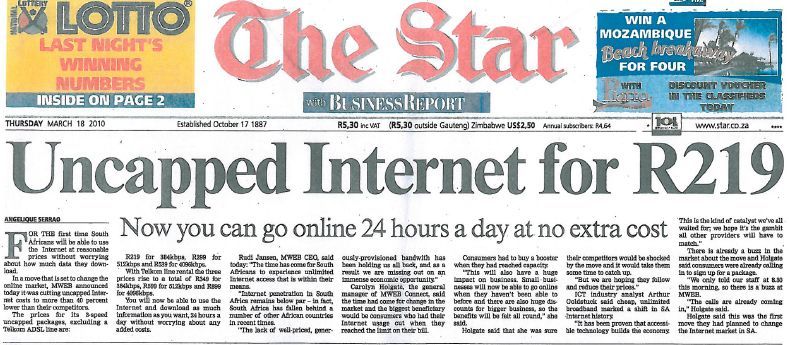
South Africans won uncapped broadband service one year ago tomorrow when an upstart provider — MWeb — unveiled its “Free the Web” campaign, delivering usage-limit free Internet access to customers across South Africa.

The company’s move to unlimited, flat rate service was heavily criticized by competing providers, who enforce draconian usage limits and have tried to convince customers the global trend was moving towards metered broadband.  But MWeb president Rudi Jansen dismisses the notion limiting broadband is the way to go, suggesting usage caps and meters are more about profits than serving customers.

Today, MWeb’s uncapped broadband is a runaway success, with more than 50 percent of its customers switching to the meter-free service.  It has been profitable, too.

“We are running ahead of our business plan and all our products are profitable,” Jansen tells TechCentral.

Now the nation’s semi-privatized, 39% state-owned phone company Telkom is widely expected to stop the erosion of its own broadband customers by adopting flat rate broadband service itself.

For Jansen, that would represent a welcome move.  The Internet visionary wants to transform South African broadband away from its current expensive pricing model and throw the Internet wide open.

“I’m looking forward to it,” Jansen says. “The sooner they launch it the better.”

The arrival of flat rate broadband made headlines across the country in 2010. (click to enlarge)

South African broadband has coped with challenges few other countries endure.  International connectivity has always been one of the biggest — sustaining traffic on satellite backbone links or underpowered undersea cables first forced providers to limit Internet use because of capacity concerns.  But new fiber-based underseas cables from Seacom and Wacs, including the forthcoming 5.1Tbps West African Cable System project will dramatically increase capacity and slash costs.

Jansen (Courtesy: TechCentral)

Yet several of his competitors want to keep the caps on and prices high, earning lucrative profits on a service Jansen says is becoming less costly to deliver every day.

Jansen admits MWeb is currently forced to traffic shape certain activities on his network, particularly bandwidth-intensive peer to peer traffic, because other providers in the country don’t agree with his wide-open view of the Internet.

He wants every provider in South Africa to agree to “open peering,” a practice that allows providers to exchange traffic with each other without charging transit fees.  He also wants to see wholesale mobile wireless pricing come down.  In Africa, mobile broadband has a strong place in a market where cable infrastructure (and broadband speed) is often lacking.

Telkom, South Africa’s equivalent to AT&T or Bell, is cited by Jansen as the biggest impediment to his plan to deliver truly unfettered, unlimited access.

Some South Africans deride the state phone company as "Hellkom"

In South Africa, broadband customers pay two providers — Telkom for the monthly rental of the telephone line and an ISP for the DSL service that connects through it.  Jansen says Telkom’s broadband line rental prices are too high.  But more importantly, the interconnection fee Telkom charges providers to access its network is “absolutely ludicrous.”

“Those prices are far more than the price of international connectivity,” Jansen says. “Telkom charges us to get access to their last mile and then charges end users to get access to the same last mile, so they make double money on it. And it’s completely mispriced.”

Despite the challenges from other providers, MWeb will celebrate the first anniversary of uncapped broadband tomorrow with a surprise announcement, probably targeting small business clients.

Search This Site:

Contributions:

Recent Comments:

Your Account:

Stop the Cap!