Home » Providers » Recent Articles:

LightSquared Fail? America’s Newest Wireless Competitor Could Wipe Out Your GPS

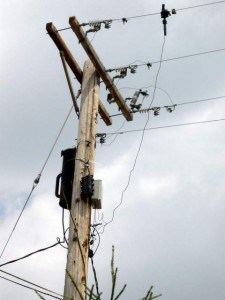
The Rochester, Minn. Amateur Radio Club spent months documenting potential interference from another problem technology: Broadband Over Power Lines.

Back in 2004, the Federal Communications Commission was looking for ways to expand broadband competition.  Borrowing from a mild success story in Europe, the Washington regulator, with the help of a well-financed lobbying campaign, approved new technology that would deliver broadband service over power lines, known as BPL.  The promises were great — fast access over an extensive, already-wired network that reached virtually every home in the country.  Glossy brochures promising a new generation of broadband and new competition were sent to every member of Congress.  Dollar-a-holler groups like the New Millennium Research Council produced “research reports” claiming the technology would advent a broadband revolution.  Some investors used to sleepy returns from utility companies dreamed about the promise of a rich new revenue stream pitching broadband service.

But there was a slight problem.  The technology worked better on paper than it did in real life.  Even more importantly, it carried more baggage than USAir.  Delivering wideband broadband signals over unshielded power cables never designed to carry radio frequencies meant interference — a lot of it, to any radio band the broadband signal occupied.  That meant a horrible listening experience on AM, and practically no listening at all over the shortwave bands, designated for military communications, international broadcasters, and the amateur radio community.

The FCC approved and supported the technology anyway, promising filters and other mitigation for those impacted by interference — a notion scoffed at by the American Radio Relay League, a group representing amateur radio operators.

So why don’t we have that third choice for broadband today?  BPL technology buried itself as its woeful performance could never match the high-flying marketing promises found in the brochure.

Fast forward to 2011 and manufacturers of satellite navigation devices, popularly known as GPS units, are terrified America is about to embark on another dreadful mistake.

LightSquared, a new entrant in the telecommunications marketplace, is constructing a nationwide 4G wireless broadband network with traditional ground-based antenna towers supplemented with a satellite system providing coverage in rural areas.  The company’s new network will occupy a frequency band just adjacent to that used by global positioning satellites, the backbone of the GPS system that some LightSquared critics contend will be crippled if the company’s 4G network is ever switched on.

[flv width=”640″ height=”388″]http://www.phillipdampier.com/video/LightSquared Intro.flv[/flv]

LightSquared released this promotional video talking up their future network.  (2 minutes)

Early interference tests conducted by a federal working group show those critics may be right.  Because satellite signals are so weak, manufacturers like Tom-Tom and Garmin must create highly sensitive GPS receivers to handle the faint signals.  Because these units are not always selective enough to reject adjacent signal interference, a neighboring transmitter delivering a much more powerful signal — such as that from LightSquared — could overwhelm them.

Independent testing found serious interference problems even for professional grade GPS units used by civil aviation, ships, and emergency responders.  A sampling:

  • GM’s OnStar system received significant interference, making it difficult to identify the location of crashed vehicles and disrupting turn-by-turn directions and other navigation services;
  • In recent tests in New Mexico, LightSquared caused GPS receivers used by nearby police, fire and ambulance crews to lose reception;
  • John Deere’s agricultural equipment incorporating GPS technology failed to receive signals during the LightSquared testing;
  • Both the Coast Guard and NASA reported significant interference to their GPS receivers;
  • The Federal Aviation Administration reports their GPS receivers completely failed while the tests were conducted.

The red box identifies the spectrum assigned to LightSquared. Its immediate neighbors are faint signals from communications satellites. (click to enlarge)

With complaints like that coming after a small-scale test, the thought of 40,000 ground-based LightSquared towers obliterating the nation’s access to GPS is more than just a little concerning to users and manufacturers.

“LightSquared’s network could cause devastating interference to all different kinds of GPS receivers,” Jim Kirkland, vice president and general counsel of Trimble Navigation Ltd., told the Washington Post.  Trimble manufactures GPS devices.

The Radio Technical Commission for Aeronautics advised the FAA its own independent tests of the LightSquared system found the consequences of turning this 4G wireless service on would be cataclysmic for GPS signals, making most satellite navigation equipment completely useless in most major metropolitan areas.

LightSquared executive vice president Jeffrey Carlisle told the Post he remained confident that the two systems could co-exist, even admitting he expected to find interference issues.  Carlisle says the real question is how to mitigate it.

This is not the first time interference issues have come before the FCC.  Nearby spectrum neighbors often don’t get along, especially when one licensed user relies on weak signals from space and the other utilizes more powerful ground-based transmitters.  The Commission has even fielded complaints over garage door openers interfering with certain military radios.

LightSquared’s network concept isn’t by itself the problem.  XM Radio manages to operate its mix of satellite-delivered radio and 900 ground-based repeater transmitters without creating interference for other users.

Deere Companies produced this diagram showing a comparison of the respective power levels of LightSquared signals vs. satellite navigation signals.

Unfortunately for LightSquared, it has several problems to contend with, the most significant being its “zoning problem.”  The souped-up 4G network is simply not in character for the spectrum neighborhood it calls home.  It’s a McMansion being built in a neighborhood of cottages.  LightSquared’s neighbors are low powered satellite signals in the 1-2Ghz range, including those from the satellites which provide GPS.  In certain cases, receiver equipment can be designed to reject the adjacent interference a network like LightSquared could create, but with millions of existing GPS units already in use, that may prove impractical.

LightSquared has tried to rope off its channel space as much as possible, trading spectrum with other nearby users to create a nearly contiguous 20Mhz slice it can dedicate to its signals, in hopes of reducing interference.  But the recent tests suggest this may not be enough.  General Motors suggested LightSquared needs to find a better neighborhood — one more suited to the kind of signal it wants to offer.  That could come from a spectrum trade or a frequency reallocation by the FCC.

The FCC is taking a “wait and see” approach so far, claiming further tests are needed.  But the agency earlier pledged it would not allow LightSquared to operate its network if it created major interference problems for other spectrum users.  Some GPS manufacturers think that commitment is too vague, because “major interference” is in the eye of the beholder.

Those concerns may be warranted, considering the FCC earlier found its way clear to ignore the documented interference Broadband Over Power Lines created over both the AM and shortwave radio dial.  Even after a blizzard of lobbying and campaign contributions won support for BPL in Washington, the ultimately inferior product that resulted couldn’t win the support of the group that ultimately mattered most — paying customers.

[flv width=”640″ height=”500″]http://www.phillipdampier.com/video/Bloomberg Ahuja Says LightSquared to Finish 4G Network Before 2016 6-11-11.flv[/flv]

Sanjiv Ahuja, chief executive officer of LightSquared, talks about the company’s efforts to build a wireless broadband network as other spectrum users challenge the company’s potential to create interference.  (7 minutes)

Cattle Ranchers for AT&T T-Mobile Merger: Will ‘Improve’ Rural Broadband and Other Tall Tales

Phillip Dampier June 15, 2011 Astroturf, AT&T, Broadband Speed, Competition, Data Caps, Editorial & Site News, Net Neutrality, Public Policy & Gov't, Rural Broadband, T-Mobile, Wireless Broadband Comments Off on Cattle Ranchers for AT&T T-Mobile Merger: Will ‘Improve’ Rural Broadband and Other Tall Tales

The U.S. Cattlemen’s Association this week took some time out to go all out for AT&T’s proposed merger with T-Mobile.  In addition to successfully navigating the FCC’s arcane comment filing system to submit their comments in favor of the merger, the group also penned a lengthy, favorable guest blog for Washington, D.C. inside-the-beltway-favorite, The Hill newspaper:

The expansion of next-generation wireless broadband envisioned by the T-Mobile and AT&T merger, for example, is critical for the next stage of rural America’s evolution and success. It will allow ranchers, farmers, and all rural residents who have been traditionally underserved to finally gain access to the best that mobile broadband has to offer, including faster and more reliable connections. We strongly encourage the Federal Communications Commission to support these developments as an investment in both the current and future generations of agricultural producers and small communities across rural America.

The cattlemen’s group has had a lot to say about telecommunications issues, especially mergers and acquisitions.  It was cited by Verizon as a supporter of its merger with Alltel in 2008, signed a joint letter in 2008 from industry-connected Connected Nation for a broadband plan compatible with the interests of the nation’s largest cable and phone companies, wrote a letter to the FCC opposing Net Neutrality in 2009, and submitted two pages of comments in May favoring the merger between AT&T and T-Mobile.

Apparently there is plenty of free time on the ranch to ponder billion dollar telecommunications mergers.

The argument from the group is that permitting mergers and blocking open net policies like Net Neutrality will convince carriers to provide enhanced service in rural areas where cattle ranches predominate.  But facts in evidence illustrate how wrong-headed that argument is:

  • Verizon’s merger with Alltel has done nothing to bring its LTE network to rural America.  Verizon is focusing LTE upgrades on the markets where it makes the most business sense, and that does not include rural Texas or Oklahoma;
  • The National Broadband Plan has directed stimulus funding for rural projects that are most likely to reach their ranch members — wireless ISPs and rural DSL.  The cattlemen’s group has nothing to say about either provider;
  • Net Neutrality and the policies of an open and free Internet have no real impact on rural broadband deployment.  The same companies refusing to provide service yesterday are still refusing to provide service today, and that includes completely exempted wireless providers;
  • T-Mobile’s urban-suburban focus is a mainstay of its business plan.  T-Mobile has never prioritized rural America as a viable service area, relying on roaming agreements to fill in service gaps.  Combining its urban-focused wireless infrastructure with AT&T will add nothing to the rural wireless experience.

The Washington Post finds financial connections between AT&T and the cattlemen group.

Advocating for a merger with T-Mobile makes about as much sense as the group advocating for a T-Mobile merger with Leap Wireless’ Cricket or MetroPCS.  All have a record of indifference about providing service in rural areas themselves.

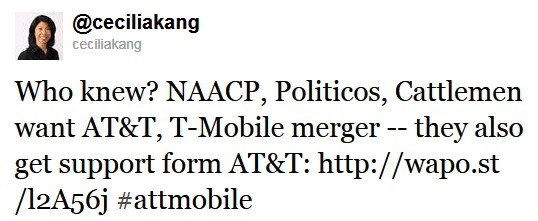
So why does the group persist in fronting for AT&T’s public policy agenda?  Cecilia Kang at the Washington Post tweeted the obvious answer — they receive support from AT&T.

The piece for The Hill was penned by Jess Peterson, the cattlemen group’s executive vice president.  But Peterson has a second career: president of Washington, D.C.-based Western Skies Strategies, a lobbying firm that promises “success and profitability to our valued clients every time.”

The concept of dollar-a-holler public advocacy is not new, but AT&T is the Master of the Astroturf Universe.  The Center for Responsive Politics notes that from 1989 to 2010, no single company spent more on campaign contributions than AT&T.  Since 2008, more than $1.25 million has been “donated” to politically-connected charities and those willing to lend their name and reputation to back the company’s public policy agenda.

Facts have a hard time penetrating piles of cash, but here are some anyway:

  1. T-Mobile’s combination with AT&T may create additional capacity for the combined company, but almost entirely in urban and suburban areas that will do nothing to help rural wireless.
  2. No telecommunications company has a track record of providing service in areas unprofitable to serve or fail return on investment demands.  No merger will change that.
  3. Promises for network upgrades already committed in long-range business plans do not sweeten a bitter deal for Americans concerned about competition in the wireless marketplace.
  4. T-Mobile’s track record as being the most market-disruptive in pricing and innovation will be eliminated in a merger with America’s lowest rated wireless carrier.
  5. Any excitement for rural wireless broadband from AT&T is tempered when would-be customers realize the company enforces a 2GB usage cap with an overlimit fee on their smartphone data plans — an Internet Overcharging scheme more punishing than either Verizon or Sprint.

WildBlue’s Satellite ISP Federal Stimulus: Gov’t. Helps Defray Cost of 1Mbps ‘Fraudband’

Get government subsidized satellite "broadband" at speeds up to 1Mbps, as long as you honor strict usage limitations.

With much fanfare, ViaSat’s WildBlue has unveiled a special discounted satellite “broadband” offer that comes courtesy of United States government taxpayer funding:

WildBlue’s same great service at an ultra-low price, courtesy of the U.S. government.

WildBlue, through the U.S. Recovery Act brings a special offer for high-speed Internet to areas unserved by wireline providers. It’s the most affordable deal we’ve ever offered, and the monthly price for this special package is guaranteed for as long as you remain a WildBlue customer. Take advantage of government funds to get High Speed Internet at discounted rates.

For $39.95 per month, WildBlue will provide the satellite equipment to deliver qualified subscribers up to 1Mbps service, subject to a monthly download limit as low as 7.5GB per month for downloads, 2.3GB per month for uploads.  Customers who exceed the limits will have their 1Mbps service throttled to near-dial-up speed until usage falls below the company’s “fair access policy.”

WildBlue explains the limited-time offer is made possible by funding from the American Recovery and Reinvestment Act of 2009.  Through a grant from the Department of Agriculture’s Rural Utilities Service (RUS), certain rural customers might qualify for the discounted pricing.

WildBlue only received authorization to deliver the discounted service to locations west of the Mississippi — specifically those not within an existing RUS project zone, are located in a defined rural area, and cannot receive service from a telephone, cable, or fiber provider.  Current WildBlue customers also do not qualify.

The grant funding covers installation and equipment charges, the client only pays for the service itself.  But would-be customers are required to commit to at least one year of service or face an early termination penalty and must pass a credit check.

WildBlue customers, as well as those of other satellite providers, have given satellite Internet access low satisfaction scores, primarily because of speed and usage limitation issues.  But for some without any other choice, it is a service they live with for basic web access.

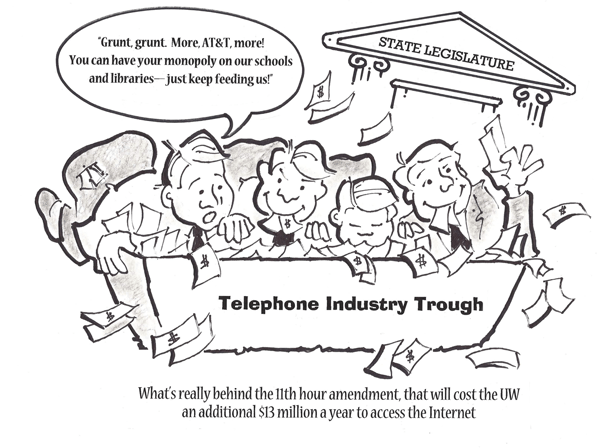
Wisconsin Legislature Now Owned and Operated By AT&T, Please Deposit Another $13 Million

Christopher Mitchell at Community Broadband Networks has been doing some excellent reporting on a story we covered earlier this year.  Where AT&T is concerned, there is never enough time for just one group to uncover all of their anti-consumer endeavors, so we appreciate Mitchell’s very detailed analysis of the latest ripoff in the making.

The Wisconsin state legislature, vying for most corrupt body this side of Huey Long’s Louisiana, is trying to kill WiscNet, the state’s public institutional broadband network.  In its place, they propose to pay AT&T more money to run a far inferior service.  Would you spend $13 million more in taxpayer dollars for a network that delivers less service than the existing network?  You do when the company behind the proposal hands out enormous campaign contributions.

The rhetoric from AT&T’s supporters borders on hysterical, with the usual memes about the government not being able to run anything correctly — despite the fact WiscNet delivers better service for less money than AT&T wants, and the claim that government shouldn’t be involved in broadband because it is the domain of the free market and private enterprise (free to charge top dollar).

Now, AT&T and their dollar-a-holler friends want Wisconsin Gov. Scott Walker to approve the budget-busting change, even though many of AT&T’s best friends in the legislature are the same ones screaming about the need to cut state spending.  It’s Big Telecom-sponsored corruption on the highest level, and Wisconsin taxpayers will pay the price.  If you live in Wisconsin, take a few minutes to read Mitchell’s stories and then get on the phone to Madison and let them know if they vote for this, they are next in line to be disconnected.

Coverage:

Providers Big and Small Can Deliver 1Gbps Broadband At a Fair Price – Why Can’t Yours?

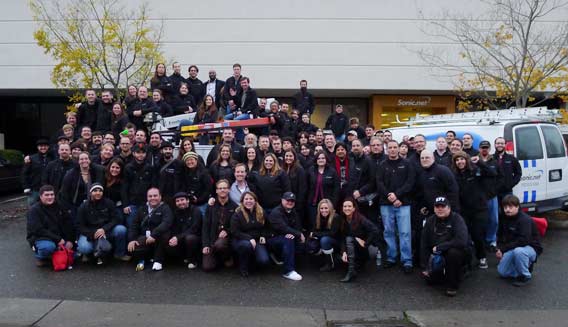
The employees of Sonic.net, a California ISP that threatens to expose the chasm between the cost of providing broadband and the profits reaped from it.

It doesn’t take trillions of dollars to offer world class broadband service in America.  Companies large and small are building gigabit broadband networks to reach customers at prices your local phone or cable company would charge at least $1,000 a month or more to receive, if you consider many charge around $100 a month for 100Mbps.  Now, 700 families in California are going to be offered 1,000Mbps service for just $69.99 per month — including a phone line.

Sonic.net has been in the ISP business for more than 15 years, selling DSL service to California customers at prices that offer value for money.  Most recently, Sonic has been pitching bonded DSL service offering speeds upwards of 40Mbps for the same price it plans to sell its new Fusion gigabit fiber broadband.  For customers who don’t need that much speed, Sonic recently reduced the price for its 20Mbps service to $39.95 per month (including phone line.)

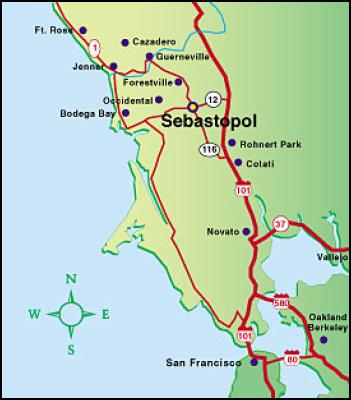
For those in the Sebastopol area lucky enough to qualify for fiber service, Sonic promises unlimited access and an exceptional online experience.

Sonic’s qualifications to run the project are not in question, considering Google selected the company to operate and support the trial fiber-to-the-home network the search giant is building at Stanford University.

Google itself is building an extensive fiber to the home network to serve Kansas City residents and businesses, and promises service at a profitable, but reasonable price.  So has Sonic.net CEO Dane Jasper, whose written views on the state of American broadband explains his personal drive to make Internet access better and faster, without ripping people off with Internet Overcharging schemes or unjustified high monthly prices.

Jasper recognizes much of North America is trapped in a broadband duopoly that delivers all of the benefits to investors, while leaving the continent saddled with slow and overpriced service.  Nine months ago Jasper explained the business model to Benoit Felten, a Yankee Group broadband analyst:

During the construction of this network we have given a lot of thought… to the business model in the US, and how we could do things in a different and more interesting way. The natural model when you have a simple duopoly capturing the majority of the market is segmentation: maximize ARPU [average revenue per user] by artificially limiting service in order to drive additional monthly spending. But fundamentally this is the wrong model for a service provider like us, and we have looked to Europe for inspiration. The model pioneered by Iliad under the Free brand is a better fit, both for us and for our customers.

As the marginal cost of providing more bandwidth or less, and providing [phone service] or not are both minimal, we have adopted a simple flat rate model instead of the more typical US model of “$5 more goes faster”… I believe that removing the artificial limits on speed, and including home phone with the product are both very exciting.

It’s exciting to customers as well, most who give the company nearly five star reviews for excellence, without five-star pricing.  An added bonus: Jasper occasionally responds to customer service inquiries himself.

Reviewing Sonic.net’s blogs and website shows off a company that loves the business it’s in.  If a switch 100 miles away has a problem that interferes with Sonic’s service, you will promptly read about it on the company’s technical blog.

There are houses for sale in Sebastopol, Calif., if you want affordable gigabit broadband.

Jasper’s frustration with the enormous corporate-owned ISPs that dominate the country (and Washington) was on full display in a blog entry in March, answering a question about why American broadband is lagging behind:

[…] In 2003 and 2004, the then Republican led FCC reversed course [on policies guaranteeing a level playing field for broadband], removing shared access to essential fiber infrastructure for competitive carriers and codifying instead a policy of exclusive use and “multi-modal competition”.

This concreted our unique US duopoly: cable versus telco, the two broadband choices that most Americans have today.

In exchange for a truly competitive market, the US received promises of widespread deployment. And, to some degree this has worked. Unfettered by significant competition or price pressure, broadband in at least in its most basic form can now be delivered to most homes in America, albeit at a comparatively high cost to the consumer.

What was given up in exchange for this far-reaching but mediocre pablum was true competition and innovation.

Elsewhere in the world, regulatory bodies followed the lead of the US Congress and separated essential copper and fiber infrastructure from the services and providers who used them, and the result has been amazing. In Asia and Europe, Gigabit services are becoming common, and the price paid by consumers per megabit is a tiny fraction of what we pay here at home.

I won’t deny the innovation that has occurred in the telco/cable duopoly. They’ve got TV, Internet and telephone bundles designed to serve up prime time network shows in over-saturated HD glory, with comparatively middling Internet speeds, all offered with teaser rates and terms that would baffle an economics professor. The clear value of the bundle is to baffle, and pity the consumer who wants to shed a component. At least during the intro periods, it’s often cheaper to take the whole package than just a component or two.

For cable companies, the entrenched interest in the television entertainment portion creates a clear conflict: why should they offer an uncapped broadband connection that can deliver enough video entertainment to allow consumers to cut the TV cord? And if you do drop the TV, up goes the price for even this slow and capped Internet connection, so you pay more either way. And now that telcos have gotten into the television business too, their interest in slowing the pace of increasing broadband speed is aligned as well.

This has yielded a competitive truce in America.

In a slow tide, back and forth, cable delivers a slightly better product, then telco slightly better again, all at the highest possible cost. It is iterative, not innovative, and Americans deserve more. After all, we invented the Internet, right?

Among the giant phone and cable companies providing broadband today are a growing number of innovation outliers — companies challenging the prevailing views that Americans don’t need or want fiber-fast speeds (not at the prices some providers charge), that there is no economic justification for the capital spending required to construct fiber networks when incremental upgrades can suffice (the Wall Street view), or that the best way to drive increased revenue from a maturing broadband market is to throw away today’s flat rate pricing model and establish a guaranteed growth fund collecting tolls on Internet traffic that is sure to rise in the days ahead (Time Warner Cable’s CEO).

Google cannot understand why 1Gbps broadband “doesn’t work” in the United States and intends to construct its own network to prove otherwise.  EPB, a municipal utility in Chattanooga, Tenn. sells gigabit broadband, in their words, because they can.  The concept of a provider offering the fruits of their innovation, even if they aren’t certain how to price or sell the service, is a remarkable and refreshing change from the usual obsession with nickle-and-dime “extras” for add-on features or not selling service that your marketing department does not understand or find useful.

It also exposes the indefensible gap between the cost of providing the service and the price paid to receive it.

Thanks to Stop the Cap! reader Mark for sharing news about Sonic.net’s fiber network.

Search This Site:

Contributions:

Recent Comments:

Your Account:

Stop the Cap!