Home » Providers » Recent Articles:

Hulu for Sale? Restrictions for Non Cable/Satellite Subscribers May Be Forthcoming

Phillip Dampier June 23, 2011 Comcast/Xfinity, Online Video, Video 2 Comments

Hulu has received an unsolicited, and still private offer to buy the company lock, stock, and barrel — disengaging some of America’s largest television networks from the online streaming business Hulu represents.

With an offer in hand, Hulu’s owners News Corp., Walt Disney, and Comcast/NBC have decided to hire investment bankers to solicit any competing offers for the service.  Yahoo! may be one of the companies interested.

Hulu has always represented an irritation for program buyers — notably cable networks and television stations — that purchase programming to rerun on cable networks and television stations.  Because Hulu gives away most of its content for free, these buyers argue it devalues the programming they are buying.

In short, if everyone has already been able to watch 30 Rock several times online, for free, why pay top dollar to buy the series to show on a local television station?

The problem is even worse from the perspective of cable, phone, and satellite companies in the business of selling video packages to customers.  As soon as viewers discover they can watch all of their favorite shows online, again for free, why buy the cable TV or satellite package?

The Los Angeles Times reports Hulu may have some bad news in store for cord cutters: it may implement its own “authentication” system that would only allow instant access to those with a verified subscription to a pay television package.  All others would need to wait just over a week before they can watch popular shows during a limited viewing window.

For many analysts, that will slash the service’s net worth to a would-be buyer.  So would the inability of the new owners to win long-term contracts for the rights to keep popular series and shows on Hulu for the indefinite future.  In the case of Comcast/NBC, it’s a classic case of being torn between bringing your programming to more viewers and eroding away your company’s own cable subscriber base.

[flv width=”360″ height=”290″]http://www.phillipdampier.com/video/Bloomberg Olson Says Yahoo Google Amazon Potential Hulu Buyers 6-22-11.mp4[/flv]

Bloomberg News reports on rumors Yahoo!, Google, and Amazon may be interested in acquiring Hulu.  (5 minutes)

Harry Reid’s Chief of Staff Scores $1.2 Million for His Condo, Courtesy of Comcast

Phillip Dampier June 22, 2011 Comcast/Xfinity, Public Policy & Gov't 2 Comments

Krone

When David Krone decided to quit his job as senior vice president of corporate affairs at Comcast to go to work as Sen. Majority Leader Harry Reid’s top aide, he got quite the parting gift from Comcast — $1.2 million to cover the cost of the condo he bought just a year earlier.

Comcast’s agreement to make Krone whole, even during one of the worst real estate markets in recent history, was quite a relief for the man who had to make do with a severance package worth $2.9 million.  Now Krone is slumming it on a Senate aide’s salary — $165,000 a year.  That is less than the $270,000 Krone contributed to various candidates, mostly Democrats, since 1989 according to the Center for Responsive Politics.  The Center for Public Integrity says he is Reid’s biggest donor over the past two decades.  Now Reid is his boss.

According to the Wall Street Journal, Krone spent years as a cable industry lobbyist, living in a penthouse unit above Reid’s own condo at Washington’s Ritz-Carlton.  Reid even sought to help Krone win a commissioner position at the Federal Communications Commission — an agency that oversees the cable industry Krone lobbies for, a position Krone declined.

In January 2008, Mr. Krone became a top executive at Comcast, working on public affairs, government relations and public-policy issues. He moved to Philadelphia, paying $1.95 million for a condo, real-estate records show.

After less than 10 months, however, Mr. Krone decided to bail out of the job. Friends say he was unhappy because he had expected to be more involved in top-level decision making than he ended up being.

By then, the real-estate market had declined. When he told Comcast he was quitting, the company agreed to pay him $2.07 million—allowing him to recoup his original purchase price, plus closing costs, according to Mr. Reid’s office.

Companies often cover real-estate losses when trying to woo prospective employees. It is extremely rare for them to do so when an employee quits, say executive-compensation experts. “Severance benefits and even golden parachutes generally don’t protect executives against personal real-estate losses,” says Chuck Yen, an executive-compensation consultant with Grant Thornton LLP.

“Comcast did not know that David Krone was going to Harry Reid’s office or to any other government or regulatory agency” when his separation agreement was negotiated, according to company spokesman John Demming.

Some people familiar with the matter say the company wanted to make sure that he didn’t harbor any ill will after leaving, given his connections. As a heavily regulated cable and media company, Comcast has a lot at stake in Washington.

When Mr. Reid invited him to Capitol Hill several weeks after he left Comcast, Mr. Krone thought it was to discuss another FCC post, Mr. Krone told friends. Instead, Mr. Reid offered him a job, and Mr. Krone accepted.

In April 2009, four months after Mr. Krone started in the Senate, the property sold for $1.09 million, $980,000 less than Mr. Reid’s office said he received from Comcast.

“Whether or not they lost money when they sold it is irrelevant,” said Jon Summers, Mr. Reid’s spokesman.

LightSquared’s Last-Minute ‘Solution’ to GPS Interference Gets Skeptical Response from Some

Phillip Dampier June 22, 2011 LightSquared, Wireless Broadband 1 Comment

LightSquared, feeling pressure after independent studies showed significant interference problems created by its wireless broadband network, suddenly announced a “solution” to the problem — one getting skeptical reviews from those critical of the project.

The would-be mobile broadband provider claims it will abandon a 10MHz band adjacent to that used by GPS, moving further down “the dial” in hopes of avoiding future interference problems.  Company officials hailed the move, claiming it solves the GPS interference problem except for certain high precision GPS receivers that could still suffer from the further distant LightSquared signals.

“This is a solution which ensures that tens of millions of GPS users won’t be affected by LightSquared’s launch,” said Sanjiv Ahuja, LightSquared chairman and CEO. “At the same time, this plan offers a clear path for LightSquared to move forward with the launch of a nationwide wireless network that will introduce world class broadband service to rural and underserved areas which still find themselves on the wrong side of the digital divide.’’

But LightSquared’s decision to remain in the same vicinity of low powered satellite signals has not impressed its critics.

Among the largest is Save Our GPS, a coalition of GPS users and manufacturers who fear LightSquared could ruin GPS service for millions of Americans.

“This latest gambit by LightSquared borders on the bizarre,” said Jim Kirkland, vice president and general counsel of Trimble, a founding member of the Coalition. “Last week LightSquared unilaterally delayed filing of the study report that culminated months of intensive work to evaluate interference to GPS, because they purportedly needed two more weeks to analyze the results. LightSquared’s supposed solution is nothing but a ‘Hail Mary’ move.  Confining its operation to the lower MSS band still interferes with many critical GPS receivers in addition to the precision receivers that even LightSquared concedes will be affected.”

Kirkland said it’s time for LightSquared to find an entirely different set of frequencies for its service, well away from GPS.

As LightSquared’s challenges continue, the one potential bright spot may be its agreement with Sprint Nextel allowing Sprint to resell LightSquared’s 4G network.  The agreement includes sharing upgrade and equipment expenses, but could be extended to include spectrum resources owned or controlled by Sprint.

Law Firm Reminds Consumers of Mobile Broadband Class-Action Lawsuit Against Verizon

Phillip Dampier June 22, 2011 Consumer News, Verizon, Wireless Broadband 3 Comments

Verizon is charging customers for text messages sent to mobile broadband devices, even though the devices themselves have no effective way to view the messages.  That allegation is the subject of a class-action lawsuit filed against the wireless carrier by Hagens Berman LLP, a law firm representing consumers who were unfairly billed for text messages from July 28, 2004 to the present.

The lawsuit, originally filed August 4, 2010, in the United States District Court for the District of New Jersey, seeks compensatory damages and an injunction prohibiting Verizon from billing customers for text messages sent to mobile broadband devices.  The law firm sent out a reminder this week for customers either billed in the past or still being billed they still have a chance to join the lawsuit.

Verizon’s mobile broadband devices allow its customers to access the Internet through Verizon’s wireless network. Each device is assigned a unique 10-digit telephone number and therefore, text messages can be sent to the 10 digit number associated with the device. However, according to the lawsuit, the devices have no screens and users have no effective way to view them.

If Verizon billed you for text messages you cannot access in connection with your Verizon Mobile Broadband device, you can request further information or join the case at the firm’s website or by email at [email protected].

Verizon Wireless Ends “Unlimited” July 6th; Existing Customers Can Keep Their Unlimited Plans

Phillip Dampier June 21, 2011 Competition, Data Caps, Verizon, Wireless Broadband 15 Comments

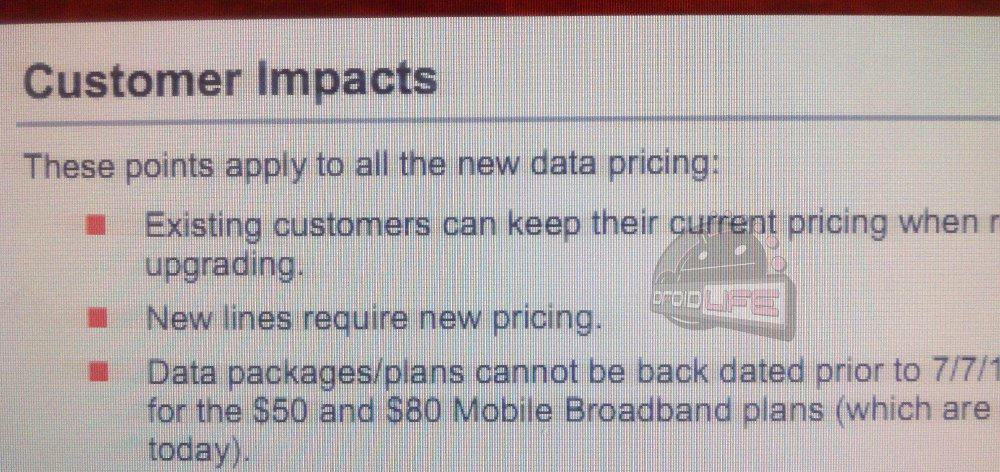
Verizon Wireless will end its unlimited data smartphone plan on July 6th, pushing future customers to choose usage tiers priced at $30 for 2GB, $50 for 5GB, or $80 for 10GB.  But existing customers with either 3G or 4G phones can keep their existing unlimited data plans indefinitely, according to leaked Verizon memos.

Droid Life has become information central about the end of unlimited data at Verizon, thanks to some good connections with employees willing to share internal company memos.  They’ve learned Verizon also plans to make some other price adjustments effective July 7th:

Tethering pricing (in addition to your existing data plan, charged separately):

  • 2GB — $20/month
  • 4GB – $50/month
  • 7GB – $70/month
  • 12GB – $100/month

Overlimit fee: $10 per gigabyte.

Tablet plan pricing changes: Delete $20-1GB tablet plan, replaced July 7th with a $30-2GB plan.

From a Verizon memo to employees:

Data Pricing Evolution…The Present
Our legacy data pricing structure was designed to address a somewhat different customer need profile than what we are seeing and can expect in the future.

Consider this. Data usage has more than doubled over the last three years. Consumers and business users alike are doing more and more with their mobile devices. The notion of “send and end” has migrated to “managing multiple aspects of one’s lifestyle through mobility.” Whether it’s social media (85%+ of Smartphone users), mobile internet (88%+ of Smartphone users), or email/applications (71%+ of Smartphone users), this usage has one thing in common—dramatically increased demand for data and media consumption.

As a result, we are evolving our approach around how we package our data solutions and pricing to our customers. Coming soon, Verizon Wireless will move from our existing pricing format to a structure designed to allow customers to choose the right data solution that best aligns with their needs.

The Value Benefit Equation…
With the new usage based pricing plans, the vast majority of our customers will be able to enjoy their typical level of data consumption for the same value that they outlay today. Additionally, for those who have greater requirements for data, we will have solutions that they can tailor to their unique needs.

Perhaps more importantly, given our strong desire to continue to provide enhanced capability and value to our customers, the new data pricing will apply to both our 3G AND 4G LTE networks. So in essence, for those customers in our ever and rapidly expanding 4G LTE network coverage footprint, users will gain the benefit of the fastest and most advanced 4G LTE network in the U.S. all for the same usage based value. More speed. More functionality. Same value.

When Verizon first spoke about AT&T ending its unlimited use plans, we noted company officials seemed hesitant to sign on to AT&T’s specific pricing model.  We interpreted that to mean AT&T was being too stingy in Verizon’s eyes.  Stupid us. Instead, Verizon is going to charge $5 more than AT&T for most of its data plans, presumably milking its much-better reputation for service and reliability.

The existing price for Verizon’s unlimited smartphone data plan is $29.99 per month.  After July 7th, one penny more buys you only 2GB on Verizon’s network.

Customers can lock in unlimited data if they sign up for service before the end of the day on July 6th.  All existing customers who want to keep their unlimited data plan can, apparently even when changing phones, for the foreseeable future.  But nothing is forever with AT&T or Verizon.  We suspect “forever” will expire when average smartphone data usage approaches the 2GB limit their future $30 plan will feature.  Currently, the vast majority of smartphone users consume less than 750MB of data per month.

Search This Site:

Contributions:

Recent Comments:

Your Account:

Stop the Cap!