Home » Providers » Recent Articles:

Randall’s Revenge: AT&T CEO Fills GOP Coffers After Democrats Diss T-Mobile Buyout

Phillip Dampier May 30, 2012 AT&T, Competition, Consumer News, HissyFitWatch, Public Policy & Gov't, Wireless Broadband Comments Off on Randall’s Revenge: AT&T CEO Fills GOP Coffers After Democrats Diss T-Mobile Buyout

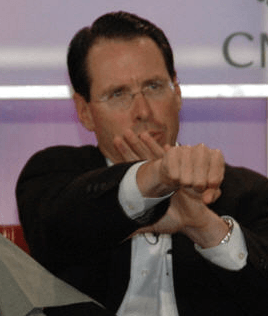
Stephenson: Payback time.

Six weeks after AT&T’s colossal $39 billion dollar merger with T-Mobile USA fell apart, AT&T CEO Randall Stephenson opened his checkbook and donated $30,800 (the maximum allowed under federal law) to the Republican National Committee.

That contribution dwarfs Stephenson’s largest previous donation over the past twenty years: $5,000, according to the Center for Responsive Politics.

Bloomberg reports that Stephenson took a credibility and pay hit from the merger debacle, forcing AT&T to turn over $4 billion in deal penalties to its rival, T-Mobile, including precious wireless spectrum. The deal’s collapse personally cost Stephenson more than $2 million in bonus pay.

Although AT&T is not commenting, Wall Street analysts are, and they suspect Stephenson is sending the Obama Administration a clear message that he is upset with the decision to challenge the merger. The rest of AT&T appears to be following suit, with nearly two-thirds of political contributions, mostly from company executives, going to the Republican party which has traditionally maintained a much more friendly relationship with the communications giant.
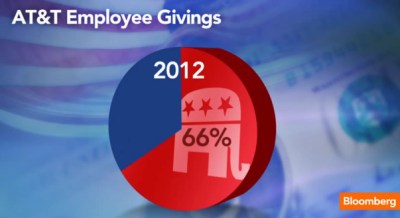
Several Republicans criticized the Justice Department and Federal Communications Commission for interfering with the merger deal which consumer advocates argued would reduce competition and raise prices for wireless services. Republicans have also expressed near-universal support for AT&T’s policy positions on Net Neutrality, community broadband, usage-based pricing, spectrum and price deregulation, removal of state oversight of telecommunications services, and marketplace consolidation.

AT&T is a major sponsor of this summer’s Republican National Convention in Tampa, Fla. Several former lobbyists for AT&T are now working with the Romney campaign and its money bundling operations on behalf of the Republican presidential candidate.

The center reports no personal political contributions from the heads of either Verizon Wireless or Sprint.

Roger Entner, an analyst with Recon Analytics in Dedham, Massachusetts, notes AT&T was still trying to make nice with Obama Administration officials as late as last December, sending ornate cupcakes to various administration officials, including those at the FCC.

Entner noted it didn’t work.

[flv width=”640″ height=”380″]http://www.phillipdampier.com/video/Bloomberg ATT CEO Stephenson Maxes Contribution to GOP 5-29-12.flv[/flv]

Bloomberg News takes note AT&T CEO Randall Stephenson maxed out in contributions to the Republican Party just six weeks after the Obama Administration effectively nixed the $39 billion merger between AT&T and T-Mobile.  (2 minutes)

AT&T Forcing Some DSL Customers to Upgrade to U-verse or Face Service Suspension

Phillip Dampier May 29, 2012 AT&T, Broadband Speed, Competition, Consumer News 6 Comments

Upgrade or else.

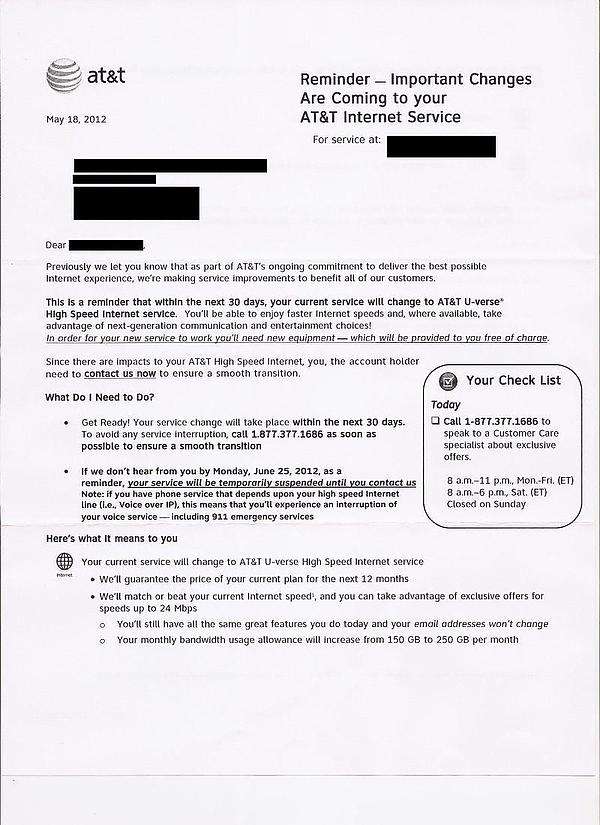
AT&T is now forcing some of their customers relying on the company’s traditional DSL service to upgrade to AT&T U-verse or face service suspension.

The latest customers impacted by AT&T’s forced upgrade are in parts of Connecticut.

“This is a reminder that within the next 30 days, your current service will change to AT&T U-verse High Speed Internet,” reads the letter mailed to customers facing the mandatory transition. Unfortunately, customers have to call AT&T to arrange for new equipment if they want their service to continue uninterrupted — existing DSL modems don’t work with U-verse.

Callers who dial the toll-free number in the letter get to order the U-verse equipment for free, but they routinely endure a hard sales pitch selling U-verse video and phone service as well, at a corresponding higher price. Customers are sent self-install kits at no charge and are offered the same rate they currently pay for DSL, sometimes with faster speeds on the U-verse network. But after one year, regular U-verse prices apply, and they are often significantly more expensive than traditional DSL service.

A Broadband Reports reader in Conn. shared a copy of the AT&T U-verse upgrade letter posted on that site's AT&T forum.

The promotional prices offered to Stop the Cap! reader Ralph were not as good as what he was currently paying for basic DSL on a promotion he purchased earlier.

“I am now paying $14.95 a month under the promotion I am on now and AT&T first tried to sell me a plan that cost $5 more,” Ralph writes. “They quickly agreed to keep my current promotional price after I told them about it, but what they will not tell me is what I will pay after the one year is up, nor can I find U-verse regular pricing on AT&T’s website.”

This special offer bundle comes with a surprise after the promotion ends -- a much higher bill.

AT&T is currently promoting Internet-only promotional pricing as follows: Basic Internet: $19.95, Express Internet: $19.95, Pro Internet: $19.95, Elite Internet: $24.95, Max Internet: $29.95, Max Plus Internet: $34.95, Max Turbo Internet: $44.95. We could not find a disclosure of what the regular prices would be after the one-year contract expired, and that bothers Ralph.

“I realize they are going to match my 3Mbps service on U-verse, but somehow I suspect the regular U-verse price is going to come higher than the DSL service I have been using,” he says.

Ralph’s intuition is correct. Stop the Cap! called AT&T at the number provided on the letter and spoke with a customer service representative at the AT&T Web Sales Center. Although AT&T will ship the required equipment (a wireless router/modem combo) at no charge, AT&T will eventually make that money back charging customers higher prices for Internet service.

Current regular pricing for Ralph’s DSL service after his promotion ends will cost him $24 a month for 3Mbps service.  U-verse charges $38 a month (off promotion) for the same speed service — a $14 monthly difference.

“That sucks,” Ralph said after we shared the news. “Why should I have to change what works fine right now?”

AT&T says keeping DSL in certain U-verse upgrade areas is not possible. In fact, AT&T’s letter warns, if customers do not call to arrange for the U-verse “upgrade” by a certain date, their broadband service will be suspended. That could be a problem for customers who also use their broadband account with an Internet-based phone line.

“There goes 911 or any other emergency calling,” Ralph reminds us. “Thanks, AT&T.”

Some customers who have completed their U-verse upgrade report AT&T messed up their subsequent billing, charging full price instead of an agreed-upon promotion. Slickdeals members report AT&T often requires constant reminding to fix billing errors that generally hand customers higher bills than they expected.

“I am trying real hard to figure out how this represents the ‘next evolution of communications’ AT&T writes about in their letter,” Ralph concludes. “All I am going to eventually get is a much higher bill for a service I don’t want or need. I guess it’s time to call the cable company again.”

Rogers’ “Unconscionable” Service Contracts & Bell’s Touch-Tone Fee Ripoff

Phillip Dampier May 29, 2012 Bell (Canada), Canada, Consumer News, Rogers, Video Comments Off on Rogers’ “Unconscionable” Service Contracts & Bell’s Touch-Tone Fee Ripoff

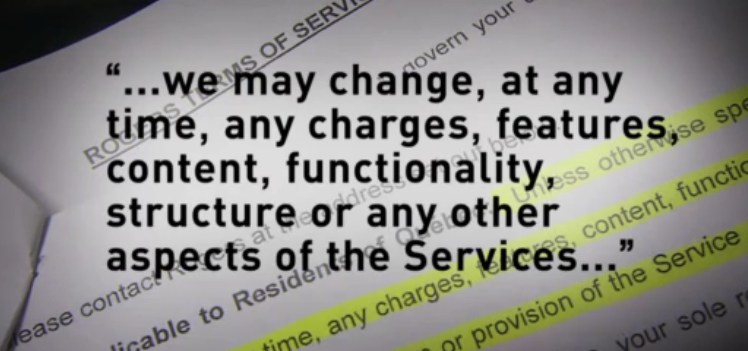
Rogers' "unconscionable" service contract allows the company to do just about anything.

Did you know that signing a contract with Rogers Communications for your broadband, phone, and cable television service will not protect you from the company’s annual rate increases?

It represents a classic example of an “unconscionable term” in a contract, according to Anthony Daimsis, a contract law professor at the University of Ottawa. Not because Rogers has inserted language that allows the company to raise rates on contract customers at will, but rather because consumers cannot escape the contract without paying a stiff early termination fee, usually approaching $200.

Rogers says its service contracts do not guarantee stable rates, instead providing a discount for bundling its services together. Most Canadians asked by CBC’s Marketwatch thought otherwise, believing it should lock in current rates for the term of the agreement.

The consumer show also chases Bell for charging Canadians $2.80 a month for touch-tone service — a fee that disappeared off most other phone company bills 20 years ago. Bell claims the touch-tone fee was introduced because the company met opposition from rotary phone customers when it tried to bundle the fee into its general price for phone service.

These days, buying a rotary dial phone requires a visit to an antique shop, but should you acquire one just to escape paying the phone company an extra $33 a year, it won’t work. Bell says the fee is now mandatory for all customers, rotary or otherwise — no one can “opt out.”

Bell’s touch tone bill padding rakes in an extra $100 million a year in revenue, all for a service upgrade paid for decades ago.

[flv width=”640″ height=”380″]http://www.phillipdampier.com/video/CBC Busted 04-2012.flv[/flv]

CBC Marketplace presents “Busted,” a special marathon edition exposing consumer ripoffs and deceptive advertising. In this clip, the show chases down Bell’s bill padding touch tone fee and Rogers’ notorious service contracts that lock customers in place -and- subject them to annual rate increases.  (13 minutes)

PBS Documentary: Subcontracting Cell Tower Work Has a Human Toll

Phillip Dampier May 24, 2012 AT&T, Consumer News, Public Policy & Gov't, Sprint, T-Mobile, Verizon, Video, Wireless Broadband Comments Off on PBS Documentary: Subcontracting Cell Tower Work Has a Human Toll

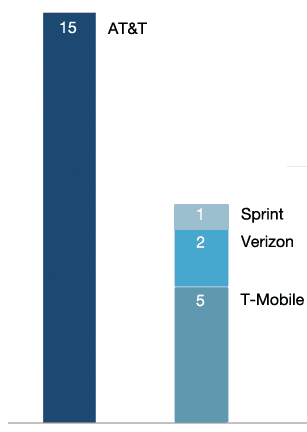
Data provided by OSHA statistics

A new joint investigation by Frontline and ProPublica reveals serious lapses in safety for America’s cell tower workers, a career now considered one of the most hazardous and life-threatening in America.

In the last eight years, 50 climbers have died, with many more injured installing and servicing cell sites for AT&T, Verizon Wireless, Sprint, and T-Mobile. The investigation finds many of these deaths and injuries were preventable, but as America’s profitable cell phone companies outsource jobs to cut-rate subcontractors (and the sub-contractors they often use themselves), safety measures take a back seat to low-ball bidding and profits.

Efforts to hold companies accountable are stymied by the byzantine layers of third party companies hired to do the work, an under-equipped federal safety agency, and difficulty assessing where the responsibility lies when things go wrong.

From ProPublica and Frontline:

From their perch atop the contracting chain, carriers typically set many of the crucial parameters for work on cell sites, including deadlines, pay rates and even technical specifications, down to the exact degree an antenna should be angled. An analysis of cell tower deaths by ProPublica and PBS “Frontline” showed that tight timetables and financial pressure often led workers to take fatal shortcuts or to work under unsafe conditions.

“We’ve had a number of situations where we think that accidents were caused by companies trying to meet deadlines and … cutting corners on safety in order to meet those deadlines,” said Jordan Barab, OSHA’s deputy administrator.

But Barab said it’s difficult for the agency to hold cell companies responsible for safety violations involving subcontractors. In most cases, federal officials have interpreted OSHA regulations to mean that carriers can be held accountable only if they exercised direct control over subcontractors’ work or were aware of specific unsafe conditions.

OSHA has not sanctioned cell carriers for safety violations implicated in any subcontractor deaths on cell sites since 2003, a review of agency records by ProPublica and PBS “Frontline” found.

OSHA has made little effort to systematically connect the deaths of tower workers to specific carriers and had not known until ProPublica and PBS “Frontline” told them that there have been 15 fatalities on AT&T jobs since 2003 – more than at the other three major carriers combined over the same period.

The agency attempted to fine a carrier just once and failed, losing a nearly three-year legal battle with a regional cell company in Kentucky. The agency has never taken on the four major carriers – Verizon, T-Mobile, AT&T and Sprint – even though there have been almost two dozen fatalities on jobs done for their networks.

Most of OSHA’s enforcement efforts have focused on a transient cast of small subcontractors, though they, too, typically have eluded significant penalties. Over the last nine years, the median fine levied for safety violations linked to a fatal tower accident was $3,750, an analysis by ProPublica and PBS “Frontline” showed.

[flv width=”512″ height=”308″]http://www.phillipdampier.com/video/PBS Frontline Cell Tower Deaths 5-23-12.flv[/flv]

Watch this segment from PBS Frontline exploring ‘Cell Tower Deaths,’ and what can be done to stop them.  (30 minutes)

Broadband for Rural Minn. Threatened By Diversion of Ratepayer Money to AT&T and Verizon

Northern Minnesota's Paul Bunyan Communications is threatened by FCC reforms that they claim favor larger phone companies.

Northern Minnesotans will have to wait longer for broadband after a telephone co-op announced it was suspending its $19 million broadband expansion project because funding is being diverted to more powerful phone companies like AT&T and Verizon — neither of which have any concrete plans to improve rural wired broadband.

Bemidji-based Paul Bunyan Communications, which serves 28,000 hearty Minnesota customers, has been working on broadband expansion for several years, bringing broadband to customers who have known nothing except dial-up since the Internet age began. Only now the project is threatened because of well-intentioned plans by the Federal Communications Commission to expand rural broadband, but in ways that cater primarily to larger phone companies that lobbied heavily for the changes.

At issue is Universal Service Fund reform, which plans to divert an increasing share of the surcharge all telephone customers pay away from rural basic phone service and towards broadband expansion in rural America.

Paul Bunyan used their share of USF funding to scrap the company’s existing, antiquated copper-wire network in favor of fiber optics. Other phone companies have traditionally used the money to keep their existing networks running. Now the independent phone company says large phone companies like Verizon and AT&T have successfully changed the rules in their favor, and will now benefit from a larger share of those funds, ostensibly to expand broadband to their rural customers.

Bissonette (Courtesy: MPR)

But neither AT&T or Verizon have shown much interest in rural broadband upgrades. AT&T, which recently announced it concluded its U-verse rollout in larger cities, has also thrown up its hands about how to deal with the “rural broadband problem” and plans no substantial expansion of the company’s DSL service.

Verizon also announced it had largely completed the expansion of FiOS, a fiber to the home service. Verizon has also been discouraging customers from considering its DSL service by limiting it only to customers who also subscribe to landline phone service.

Verizon Wireless has introduced a wireless home broadband replacement that costs considerably more than traditional DSL, starting at $60 a month for up to 10GB of usage.

As a result of the funding changes, Paul Bunyan is reconsidering plans to expand its broadband, phone and television services to Kjenaas and about 4,000 other residents in rural Park Rapids and a township near Grand Rapids.

It may also have to cut workers.

“It’s kind of ironic,” Paul Bunyan’s Brian Bissonette tells Minnesota Public Radio. “The mantra of these changes is to create jobs. It’s killing jobs.”

Minnesota Public Radio explores how rural Minnesota broadband is being threatened by a telecom industry-influenced plan to divert funding to larger companies like AT&T and Verizon for rural broadband expansion those companies have no plans to deliver. (May 23, 2012) (4 minutes)
You must remain on this page to hear the clip, or you can download the clip and listen later.

Search This Site:

Contributions:

Recent Comments:

Your Account:

Stop the Cap!