Home » Providers » Recent Articles:

Time Warner Cable Wants $850 from Homeowner to Move Lawn Pedestal It Put in the Wrong Place

Phillip Dampier September 11, 2012 Consumer News, Grande, Public Policy & Gov't 3 Comments

Neighborhood terminal pedestals can serve from a half-dozen to 200 customers. This one is designed to service a small neighborhood.

Time Warner Cable is asking a Padre Island, Tex. customer to pay $850 to move a cable company pedestal box installed in her front yard by mistake.

Dorothy Harper’s home is located right on the shoreline, so utility companies have traditionally placed their equipment in a utility easement adjacent to the street. But Time Warner Cable, for whatever reason, decided to install their unsightly neighborhood terminal pedestal in the middle of her front yard, in front of her home, despite the city’s request that cable operators keep their equipment in a designated easement along the property line.

Harper has been trimming around the pedestal for years, irritated by its presence but infinitely patient that one day the company would do the right thing and move it to its proper location.

Her patience wore out when competing cable company Grande Communications expanded service on Padre Island and felt its own pedestal box would be right at home next to the improperly located one owned by Time Warner. Harper arrived home one afternoon to find both boxes happily creating a tremendous eyesore.

Harper told The Caller she called Grande Communications, which eventually moved their pedestal to the proper location. But Time Warner Cable proved infinitely more stubborn, even when the city got involved:

Edward Villarreal, who issues fiber optic and utility permits for the city’s Development Services, visited Harper’s property. He took photos of the cable pedestal and made phone calls to Time Warner on her behalf, without success, he said.

“It’s definitely an eyesore I wouldn’t want in the middle of my property,” Villarreal told Troubleshooter Thursday.

Harper got tired of the fight with Time Warner and backed off for a while, she said.

“Every time I drive up to our home, I am angered again at Time Warner and their negative response to a problem that their workers created,” she said.

Recently she called Time Warner again and was told they would move the pedestal if she paid $850, Harper said.

The newspaper’s troubleshooter intervened, calling Time Warner’s regional headquarters looking for a resolution and found someone a bit more sympathetic.

Jon Gary Herrera, regional vice president of communications for the cable operator said complaints about unsightly cable pedestals are common, but the company would be willing to move the one in front of Mrs. Harper’s home if the mistake was theirs.

If not, Time Warner has a solution to quiet chronic complainers. The company has been known to provide a rock facade to cover the ugly pale green lawn stump and make things more landscape friendly.

One reader had a last-ditch solution in case that did not work:

Make the switch to Grande and then arrange for someone to “accidentally” do a hit and run on the cable box thus forcing Time Warner to come out and place it in the proper location.

Frontier Boosting DSL Speeds in Kanawha, Putnam County, W.V.; 25Mbps $54.99/Month

Phillip Dampier September 11, 2012 Broadband Speed, Competition, Consumer News, Frontier 5 Comments

Frontier Communications is ready to deliver some customers faster DSL speeds in portions of West Virginia that have, until now, been stuck with 3-6Mbps from the phone company.

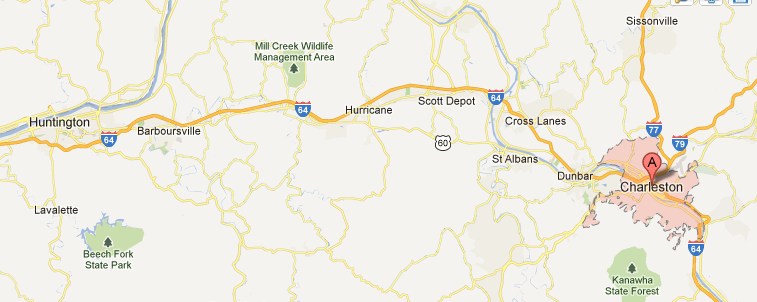
Residential and business customers in certain exchanges within Kanawha and Putnam counties can now upgrade to speeds up to 25Mbps for $54.99 a month, which Frontier claims also includes a combination modem-wireless router. Small business customers can get up to 40Mbps DSL service, where available.

Dana Waldo, senior vice president and general manager for Frontier’s operations in the state told the Charleston Daily Mail the company’s new Broadband Ultra and Ultimate DSL will be gradually extended within both counties by the end of this year. In order to sell faster DSL service, Frontier has to replace portions of its existing network with fiber optics and install new equipment to reduce the length of copper wire between the phone company and the customer.

Larger businesses in West Virginia are being marketed an even faster Metro Ethernet product, which can deliver gigabit speeds and beyond, for an exceptional amount of money.

The speed expansion, which covers both the city of Charleston and the growing suburbs to the west in Putnam County along Interstate 64 towards Huntington, is likely designed to curb customer defections to competing cable providers, which have delivered faster speeds in the rapidly growing region.

Frontier has not indicated when it plans faster broadband service for the rest of the state.

Faster Frontier DSL Arrives in Ohio… If You Qualify

Phillip Dampier September 6, 2012 Broadband Speed, Consumer News, Frontier, Rural Broadband 7 Comments

Frontier’s headquarters in Rochester, N.Y.

Frontier Communications has boosted speeds for some customers in 28 communities in Appalachian Ohio, but Stop the Cap! readers report actually qualifying to get faster broadband can be hit or miss.

Frontier has deployed ADSL2+ bonding technology in several exchanges throughout the region, which means customers can potentially double their current broadband speeds. The company says it will now sell residential customers up to 12/2Mbps and business customers up to 15/2Mbps DSL.

“With Frontier’s recent deployment of the latest broadband technology, residential customers can get the speeds they need to stream high-definition videos, run multiple devices, do online gaming and surf the net without lag,” said Dave Davidson, senior vice president and general manager for Frontier’s Ohio operations. “The ADSL 2+ Bonding technology also allows us to offer business customers super-fast speed that’s perfect for sending large files and for videoconferencing.”

The communities where Frontier recently deployed technology for increased broadband speeds in Appalachian Ohio include:

  • Central Ohio — Logan
  • Eastern Ohio — Bowerston, Byesville, Cambridge, Cooperdale, Flushing, Freeport, Knoxville, Lowell, Lower Salem, North Georgetown, New Philadelphia
  • Southern Ohio — Albany, Athens, Portsmouth, Guysville, Wellston, Idaho, Jackson, Lucasville, New Marshfield, Otway, Pomeroy, Shade, Piketon, Wellston
  • Southwest Ohio — Felicity, Manchester

But several Stop the Cap! readers in Ohio told us even though their communities are on Frontier’s upgrade list, they still don’t qualify for anything above 3-5Mbps service.

“Frontier’s online qualification tool rarely works, and is generally useless for predicting your likely speed, so I called Frontier this morning to inquire about 12Mbps service and was told my exchange does not yet qualify for the new speeds,” writes Dana B. from Jackson. “It would have been nice because I currently consider it a good day when a speed test shows I reach 3Mbps on my Frontier DSL.”

Ken, who lives near Manchester, found out he could not get the faster speed either.

“Frontier’s national customer service really was not much help as they simply processed my order,” says Ken. “Several hours after I was confirmed for the new speeds, I got a call back saying my line could not handle anything faster than around 5Mbps, which is about what I have now thanks to the hard work of a local lineman who tuned up my DSL service during an earlier service call.”

“It’s a real bummer because Frontier is charging me some very high prices for what I can manage to get, but unless and until a cable company wires my street, I do not have any other option.”

If anyone is able to get 12/2Mbps service from Frontier in Ohio, share your thoughts in our comment section.

For more information on Frontier’s Internet services, residential and business consumers may call 1-800-921-8101.

Special Report: Money Party — AT&T’s Secret Cash ‘n Stash at the RNC/DNC Conventions

Corporations like AT&T may not be visible on television during the Republican and Democratic National Conventions, but they are throwing lavish parties and shaking hands behind the scenes. They’ll get their money’s worth later.

Behind the scenes at both the Republican and Democratic National Conventions, AT&T is throwing secretive parties, handing out “schwag bags,” and engaging in a legal form of influence peddling to buy themselves goodwill with the eventual election winners.

The Republican National Convention held a week ago in Tampa, Fla. featured lavish, invitation-only parties for politicians attending the convention, sponsored quietly by AT&T.

AT&T went over the top at the Republican event, handing out goodie bags with stuffed elephants emblazoned with the company’s logo, convention pins, and other handouts designed to keep their name front and center with GOP movers and shakers. Tampa Bay Online found the phone company rented out one upscale, popular Tampa restaurant for the entire week, throwing expensive private parties for various state delegations.

The restaurant: Jackson’s Bistro, which locked the doors and turned its back on local regulars for the benefit of GOP high-rollers.

The sponsor: After digging, it turns out the money to rent the upscale eatery came from AT&T, but you wouldn’t know it from the restaurant owner and staff, which have been told to keep their mouths shut about who was paying for supper.

The sneaky: AT&T discovered it could easily navigate around loophole-ridden campaign finance laws which limit corporate-sponsored dinners, but have nothing much to say about “cocktail events.” So as long as diners are standing up while they munch, shake hands, and chat, it’s a-okay.

The mission: To get face time and establish goodwill with political movers and shakers. Feed them, toss them some AT&T flair, and let them know you will be calling on them soon. But no need to overdo it: AT&T can do more talking later… after the politicians get elected and the time is right to get the company’s agenda into the law books.

Keenan Steiner from the non-profit Sunlight Foundation says “this is where the seeds are planted for laws to be written in Washington and in state capitols all over the country.” He notes how important it is for both political parties to have the overwhelming corporate presence that most Americans never understand exists at both conventions:

The significance is, they wouldn’t be here, able to have a good time the whole time, without these corporations. It’s a sort of starting process to become dependent on these corporations. And in Washington, lawmakers require the about 100 lobbyists, over 20 lobbying firms that AT&T hires—they require the work of these folks to get their work done. They’re a sort of legislative subsidy. And they also require these corporations to get re-elected. They want to stay in office, and you better be friends with the Chamber of Commerce, with the NRA, with the big nonprofit groups, the shadowy nonprofit groups, that you really better be friends with them, because, if not, they could drop a lot of money in your district, and they could make you lose an election.

The Sunlight Foundation is tracking corporate money used to break bread and hand out cocktails to your lawmakers.

The Sunlight Foundation reports AT&T has been tilting toward the GOP: The contributions from AT&T’s PAC, employees and their family members to federal candidates total about $3 million for the 2012 cycle, with about two-thirds of the money going to Republican federal officeholders and candidates. Sunlight’s Political Party Time website helps break down where AT&T spends even more money wining and dining legislators.

The Michigan Republican delegation threw its kickoff party there Saturday night, which featured top state lawmakers. Guests at the event went home with a stuffed elephant with an AT&T logo, the Detroit News reported. AT&T also sponsored an Illinois delegation event there on Tuesday afternoon. The Chicago Sun-Times reported that the telecom giant is sponsoring the event, and events lists showed that the Illinois delegates was at Jackson’s that afternoon.

At this week’s Democratic National Convention at the Time Warner Cable Arena in Charlotte, N.C., AT&T’s Death Star logo isn’t hard to spot either.

Amidst the goodie bags and handouts from Indian tribes trying to secure lucrative casino laws, big pharmaceutical companies asking for special favors, and giant energy companies was once again: AT&T.
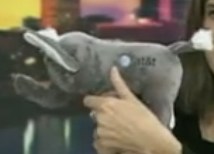
AT&T’s stuffed GOP elephant. (Democracy Now)

On Tuesday, Rep. Debbie Wasserman Schultz (D-Fla.), Democratic national chairwoman, lectured the Republicans about the influence of special interest cash at the Republican National Convention. She referred to the GOP affair as “last week’s special-interest funded, corporate-infused, backroom-deals, smoke-filled room, invitation-only affair that was held in my home state.”

Only the breakfast event where she made the remarks was bought and paid for by AT&T.

AT&T does not splurge on upscale dining for Democrats though. The party that largely opposed AT&T’s merger deal with T-Mobile and often supports Net Neutrality is making due with a far-smaller AT&T hospitality suite serving scrambled eggs and bagels at the inelegant Airport DoubleTree Inn, quite a step down from the Caramelized Diver Scallops and Red Snapper on the menu for the corporate-friendly GOP.

AT&T’s pervasive presence at the Charlotte convention is also upsetting union workers, who turned out in large numbers at the convention. Unionized employees are still fighting with AT&T for a new contract. Already uncomfortable in a state where union workers are virtually an endangered species (to add insult, unions were booked in non-unionized hotels), many were unprepared to feast at AT&T’s breakfast buffet.

“This is one breakfast I won’t be eating,” William Henderson, the president of Local 1298 of the Communications Workers of America told the CT Mirror. “I won’t eat their stuff.”

Only he didn’t say “stuff.”

[flv width=”640″ height=”380″]http://www.phillipdampier.com/video/William Henderson Boycotts ATT Breakfast.flv[/flv]

William Henderson, president of a Connecticut chapter of the Communications Workers of America, stands outside leafleting an AT&T-sponsored breakfast in Charlotte, N.C., displaying a bumper sticker: “AT&T=Greed.”  (1 minute)

What should a good union worker with a gripe against AT&T do instead?  Leaflet the event, to the great potential embarrassment of AT&T officials and Connecticut Democratic lawmakers holding a union grievance brochure in one hand and an AT&T coffee cup in the other.

The room eventually quieted down to listen to former Connecticut Sen. Chris Dodd make remarks… on behalf of the Motion Picture Association of America, who he now represents.

Despite the Snapper-Gap between the two political parties, you cannot miss AT&T in Charlotte. Although convention spokespeople officially refer to corporate sponsors as “providers,” AT&T’s corporate logo is “provided” on every last lanyard handed to delegates and journalists, right next to Barack Obama’s campaign logo.

In case you forgot to charge your cell phone, two AT&T officials are permanently on hand at a table near the entrance to the event offering free battery boosters. But don’t worry, they’ll get paid back for that goodwill later.

[flv width=”448″ height=”276″]http://www.phillipdampier.com/video/Party Time RNC Cash.flv[/flv]

Democracy Now talks with Sunlight Foundation’s Keenan Steiner who shares the secrets of corporate cash at the Republican National Convention in Tampa.  (18 minutes)

Head of Verizon FiOS TV Doesn’t Watch Much Live TV; Nothing on Data Caps “Just Yet”

Maitreyi Krishnaswamy, Verizon’s head of FiOS TV admits she practically never watches live television — she records everything on her DVR first.

Krishnaswamy has been responsible for many of the interactive video services offered on Verizon’s FiOS TV platform, including on-screen apps, the media program guide, and how customers connect various devices to the FiOS television experience.

Now she’s directing Verizon’s consumer video services — deciding which channels make the lineup on FiOS TV and the networks available for streaming to mobile devices.

Krishnaswamy told the Tampa Tribune she recognizes the way Americans watch television has changed over the past few years, and she admits it has led to the “growing” trend of customers’ cord-cutting their cable TV subscriptions in favor of online viewing.

Krishnaswamy

“The question is: Is it growing enough for us? For us, it’s a matter of cord-cutters versus cord-shavers — people who switch to smaller tiers,” Krishnaswamy said. “Is the migration to a-la-carte enough that we can go that route? It has a way more important impact that just on them. It impacts how we negotiate TV contracts with studios. It’s not something we can do overnight, but definitely something we’ve been looking at.”

Verizon has made it clear it intends to compete for customers regardless of how they watch television, but Krishnaswamy signals the company is also considering protecting their core video business model, and would only say Verizon had no announcements to make “just as yet” regarding an Internet Overcharging scheme including usage caps and overlimit fees. Critics of data caps argue that limiting broadband usage prevents customers from taking their viewing experience online because it threatens consuming the majority of their monthly data use allowance.

But Verizon does not mind offering customers a TV Everywhere experience — streaming video content over its broadband network, so long as a customer also subscribes to its TV package. The company already offers live streaming television of many channels on its lineup and wants to bolster that with on demand content. Verizon also is experimenting with non-traditional set top boxes, and although Krishnaswamy had nothing to say about supporting the forthcoming Apple TV, she is actively working on improving how Verizon’s television service works away from the traditional company-provided set top box.

Some highlights:

  • Verizon’s partnership with Redbox will let the company offer a new streaming and DVD rental service for customers, regardless of whether they live in a Verizon FiOS area or not. Customers will be able to access the service over mobile broadband, Wi-Fi, or any home broadband connection;
  • Verizon will introduce an online viewing app for forthcoming versions of Amazon’s Kindle;
  • The company has thus far only managed to secure streaming rights for in-home viewing and has run into difficulty getting content providers to let customers watch shows while on the go;
  • Google Fiber is “interesting,” but Krishnaswamy doesn’t believe they are “a real operator” when only offering service in one city. She thinks the project is a good idea, however, because it forces competing providers “to increase your speed;”
  • Verizon is considering simplifying its family of apps to reduce customer confusion. They currently have different apps for home security, home media, the remote control, and the program guide. Verizon wants its MyFiOS app to become a “super-app” that manages everything.

[flv width=”640″ height=”500″]http://www.phillipdampier.com/video/TVnext Interview – Maitreyi Krishnaswamy Verizon FIOS 1-28-11.m4v[/flv]

Back in 2011, Maitreyi Krishnaswamy explained her thinking about where Verizon FiOS was taking the TV experience. Many of these applications have since been released, but Verizon — like most providers — still runs into brick walls with content providers getting licensing to allow more flexible viewing of content.  (12 minutes)

Search This Site:

Contributions:

Recent Comments:

Your Account:

Stop the Cap!