Home » Providers » Recent Articles:

Frontier Attempts to Win Over Dissatisfied Cable Customers Plagued With Rate Hikes, Outages

Phillip Dampier September 27, 2012 Broadband Speed, Competition, Consumer News, Frontier, Rural Broadband Comments Off on Frontier Attempts to Win Over Dissatisfied Cable Customers Plagued With Rate Hikes, Outages

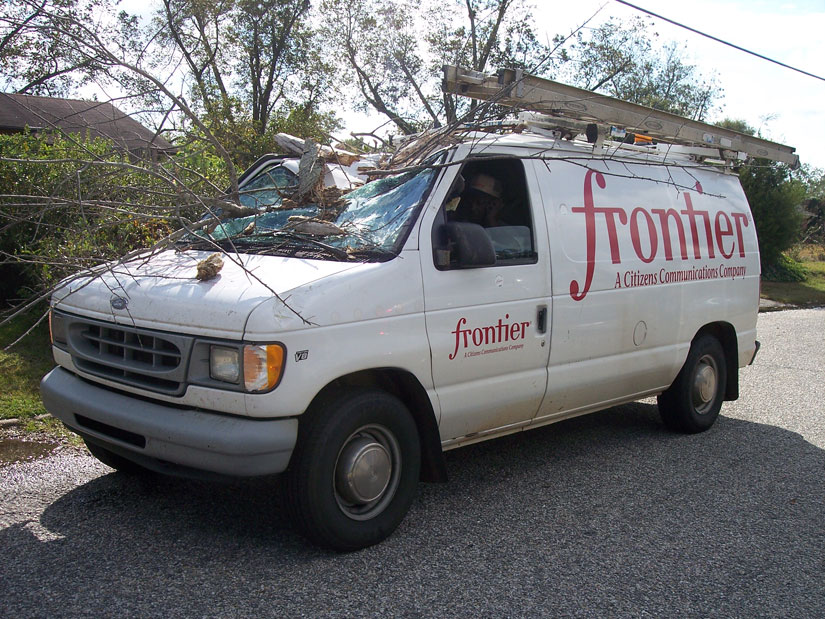
Frontier Communications is targeting promotional offers to customers that have been impacted by cable service outages and rate hikes, despite having a relatively poor service record itself.

Frontier president and chief operating officer Dan McCarthy told investors attending the recent Goldman Sachs Communicopia Conference the company was pulling out all the stops looking for surgical marketing opportunities.

“People don’t wake up every day, and say, ‘I want to switch broadband providers.’ It’s really about finding what is that lever to pull. Sometimes it’s a message at a key point — it could be during an outage, it could be during change of prices for them. It could be there are some substandard speeds that are being offered,” McCarthy said. “We are looking at what is the right mix of messaging and promotional offers that really allow us to do that. I think you’ll see us be pretty aggressive in that area,” he added.

But Frontier itself has had plenty of service problems, and was the only major Internet provider in the country to have lost ground in a July FCC report measuring broadband quality. The company continues to face extensive service outages when fiber cables are cut or copper wiring is stolen by thieves. Recent storms this past summer disrupted 277 Frontier central offices in the Carolinas, Indiana, Pennsylvania, and West Virginia, according to a Securities and Exchange Commission filing. The repair work, including overtime and equipment, is expected to cost the company at least $15 million.

Frontier reports it expected to replace at least 167,000 feet of damaged or stolen copper cable and purchased 203,000 backup power generators to keep central exchanges up and running during extended electric outages.

This week, a major service outage struck customers in parts of Ft. Wayne, Ind. after an accident severed an important cable.

A number of customers in Frontier service areas have already disconnected their landlines with the company, but where cable companies do not provide service, Frontier reports it is having success selling a standalone DSL product it dubs, “Simply Broadband.”

“We are seeing success in attracting and retaining customers with this product and it is having a positive impact on our Q3 residential customer counts,” Frontier reports in an SEC filing.

Frontier has also recently announced speed boosts in several states that can deliver up to 25Mbps DSL service to certain customers.

Lafayette’s Fiber to the Home Network Creates High-Tech Haven in South-Central Louisiana

Phillip Dampier September 27, 2012 Broadband Speed, Community Networks, Consumer News, LUS Fiber, Public Policy & Gov't, Video Comments Off on Lafayette’s Fiber to the Home Network Creates High-Tech Haven in South-Central Louisiana

Lafayette, Louisiana has never sit still for private companies bypassing the heart of Cajun country. When electric companies refused to wire the city, the community elected to do it themselves. When Cox Cable and AT&T said no to providing the kind of cutting-edge broadband that would allow Lafayette to protect its reputation as an entrepreneur-driven community, publicly owned utility LUS constructed a fiber to the home broadband network for every resident and business. Today, LUS Fiber has helped transform the parish, with half the unemployment rate of the rest of the country and an attractive place for digital economy jobs. It has even helped curtail well-educated recent graduates moving away in search of high-tech employment.

“There really is no infrastructure more important in the 21st century economy than fiber,” said Geoff Daily, executive director of Fibercorps, a non-profit group promoting digital economic development in Lafayette.

[flv width=”640″ height=”380″]http://www.phillipdampier.com/video/FTTH Council – LUS Profile 9-24-12.flv[/flv]

Watch how LUS Fiber has transformed the lives of students, attracted new high-tech business, and promoted job growth with broadband infrastructure most cable and phone companies simply won’t provide.  (9 minutes)


AT&T’s Rural Solution? FCC Supports AT&T’s 2.3GHz WCS Spectrum Plan for Nationwide 4G LTE Service

AT&T has secured support from the Federal Communications Commission for authority to deploy 4G LTE service within a 20MHz portion of the 2.3GHz WCS band after cutting a deal with a next door neighbor especially sensitive about potential interference.

WCS spectrum holders have fought for years to develop commercially viable wireless service, but faced regular opposition from the satellite radio industry concerned that interference problems would result from using the band for mobile data. Right in the middle of the WCS band is Sirius XM, which depends on sensitive receivers to pick up the company’s satellite signal.

But now AT&T and Sirius XM have worked out a compromise both companies believe will protect mobile data and satellite radio. AT&T has conceded 10MHz of its total WCS spectrum for two 5MHz guard bands, devoid of signals, around Sirius XM’s frequencies. Sirius XM signal engineers believe this, combined with power limits, will protect radio receivers from overloading whenever near AT&T’s ground-based LTE cell towers.

In August, AT&T announced its intention to acquire WCS spectrum from NextWave Wireless, a spectrum-squatting holding company, for $600 million. The phone company is also attempting to acquire the remainder of WCS spectrum from the last two significant holders — Comcast and Horizon Wi-Com, which both have between 10-25MHz of spectrum in 149 and 132 communities respectively.

When the acquisitions are complete, AT&T will have WCS spectrum covering virtually the entire nation.
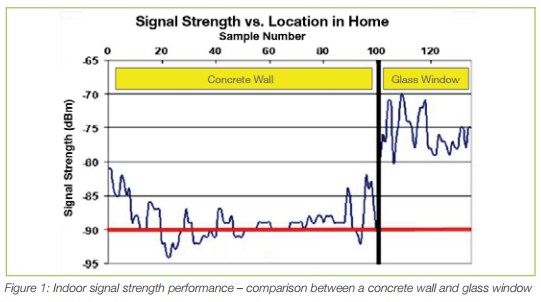
Frequencies in the 2.3GHz band are best received outdoors. Signals crossing windows and walls lose potency. (Courtesy: Greenpacket)

AT&T says it needs the spectrum to further deploy 4G LTE data service across the country. But the company admits it will take up to five years before it can switch on the new frequencies — no current smartphones support the 2.3GHz WCS band.

AT&T has also included provisions to ensure fixed wireless base stations will be able to utilize AT&T’s WCS spectrum, within reasonable limits to protect Sirius XM radios from harmful interference. That has important implications for AT&T’s long-term view that rural landline and broadband service is best delivered over a wireless network.

A major limitation of spectrum in the 2GHz band is the quality of indoor coverage it can deliver. As many Clearwire customers can attest, these frequencies suffer from high transmission loss, poor ability for diffraction, and most importantly, poor building penetration — especially in urban and suburban areas. Tall nearby buildings, homes, and even trees all impede WCS reception. According to Andrea Goldsmith in her book Wireless Communications, there is also a 6dB penetration loss when 2.5GHz signals cross un-insulated glass windows and a 13dB loss for concrete walls, with wood falling somewhere in-between.

But rural areas do better, in part thanks to the higher likelihood of unimpeded line-of-sight access between a cell tower and receiver. AT&T’s fixed wireless solution would place a small antenna on the roof or side of a home, positioned for maximum reception from the nearest cell tower. The signal is then brought indoors through cabling (or in some cases Wi-Fi) and available to customers, comparable to a home broadband connection.

AT&T’s strong spectrum position in WCS gives the company an opportunity to construct a robust, near-nationwide wireless network suitable for rural wireless communications. In more urban areas, WCS could operate seamlessly with AT&T’s lower frequency holdings and offer an extension of its current LTE service.

AT&T’s acquisition of WCS has several important implications for the wireless marketplace:
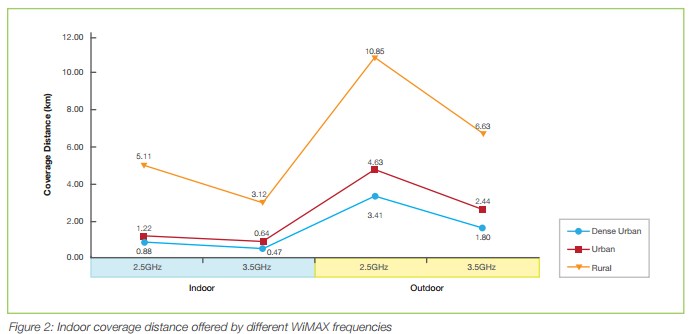
2GHz signals travel the least distance in urban and suburban areas, often blocked or degraded by buildings or trees. But better results in rural areas suggest AT&T’s WCS spectrum could partly be deployed as a fixed wireless broadband solution, if enough towers are available to support it. (Courtesy: Greenpacket)

1. It proves AT&T never needed to acquire T-Mobile USA. Through spectrum acquisitions like WCS, AT&T can still find relatively inexpensive spectrum suitable for mobile broadband use, without spending tens of billions to acquire a competitor just to poach its spectrum and eliminate a competitor.

2. The Competitive Carriers Association worries AT&T’s acquisition of secondary spectrum holders is allowing the company to gather a massive amount of spectrum.

CCA President & CEO Steven K. Berry said, “Allowing the largest carriers to obtain unlimited amounts of  spectrum on the secondary market raises serious competitive concerns.  The only way for the FCC to truly see the devastating consequences of further spectrum aggregation is by consolidating the proposed applications.  On their own, AT&T’s proposed license acquisitions may not seem significant, but when added together, it totals to a significant amount of spectrum.”

Berry continued, “Should the FCC decide to approve the transactions, it must impose conditions to ensure interoperability across the Lower 700 MHz band and to ensure data roaming – both are absolutely essential ingredients to a healthy, competitive marketplace.  Competitive carriers need access to usable spectrum, and I urge the Commission to carefully review the negative impact these transactions will have on the wireless marketplace.”

3. Clearwire’s 2.5GHz spectrum could become more valuable if AT&T can demonstrate its 2.3GHz service can deliver robust service, if provisioned adequately for customers. Clearwire’s capital investments and overall performance of its limited coverage WiMAX network have been deemed inadequate by its biggest partner Sprint, now constructing its own 4G LTE network to replace Clearwire’s WiMAX network.

4. Credit Suisse analyst Jonathan Chaplin notes Verizon will still have a better standing in spectrum even with AT&T WCS: “AT&T will have the following available for LTE: 20 MHz of 700 MHz nationwide; 20 MHz of WCS nationwide; a few AWS licenses (5 MHz on average). With Verizon’s deal with large cable companies, Verizon will have: 20 MHz of 700 MHz nationwide; 20 MHz of AWS nationwide; another 10 MHz of AWS in 60 percent of the country (13 MHz on average). In addition, Verizon’s spectrum is usable immediately, while AT&T’s WCS will take three to five years to deploy.”

The AT&T/Verizon Wireless Duopoly: “Humpty Dumpty Has Been Put Back Together Again”

Phillip Dampier September 26, 2012 AT&T, C Spire, Competition, Public Policy & Gov't, Sprint, T-Mobile, Verizon, Wireless Broadband Comments Off on The AT&T/Verizon Wireless Duopoly: “Humpty Dumpty Has Been Put Back Together Again”

AT&T and Verizon: The Doublemint Twins of Wireless

Wireless carriers other than AT&T and Verizon Wireless have joined forces asking federal regulators to help level the playing field in wireless competition.

At this week’s convention of the newly-relaunched Competitive Carrier Association (CCA), Sprint, T-Mobile USA, Clearwire, C Spire, and more than 100 other small regional rural carriers joined forces in Las Vegas to sound the alarm about a wireless duopoly restraining competition and raising prices for consumers.

“Humpty Dumpty has been put back together again,” said C Spire CEO Hu Meena. “And while the identical twins sometimes agree to meet and discuss industry issues with other industry players, they seldom, if ever, support action that might better the industry as a whole.”

C Spire should know. The company filed a lawsuit against AT&T earlier this year claiming the phone giant manipulated its 700MHz band allocation to lock C Spire customers out of getting access to the latest smartphones.

“At some point, and that time is coming, regulators and politicians are going to have to acknowledge they have a choice to make: they are going to have to decide whether the communications industry, the fundamental driver of the information economy, is going to be regulated by true, healthy competition or by the government,” Meena said.

In the last 20 years, rampant consolidation has reduced the number of national wireless carriers down to four — Verizon Wireless, AT&T, Sprint, and T-Mobile. Filling in the gaps are various regional providers, all who depend on one of the major four to provide reasonable roaming service for customers traveling beyond the service areas of smaller companies. Without reasonable roaming, competitors are left at a serious disadvantage.

Another major problem is access to the latest smartphones. Major manufacturers largely design and market cell phones for the largest four companies, often relegating smaller providers to sell older or less prominent phones to customers. When phones do not work on the spectrum acquired by smaller competitors, roaming becomes a problem.

But beyond those issues is the question of wireless spectrum. Traditionally sold in competitive auctions, the deepest pocketed companies traditionally win the bulk of frequencies, leaving competitors with less desirable spectrum that has difficulty penetrating buildings or requires a more robust cell tower network.

Meena

Members of the CCA recognize that mergers and consolidation can bring costs down through economy of scale, but in their eyes, AT&T and Verizon’s actions have promulgated a new paradigm for wireless on Wall Street: consolidation around a handful of wireless carriers is healthy; having too many competitors is inefficient.

“Consolidation can introduce business efficiencies,” said Michael Prior, CEO of Atlantic Tele-Network. “But government has a role in making sure that infrastructure is used in a way that works for the entire country. All we’re asking the FCC to do is to make sure there is a level playing field.”

Observers expect the CCA to ask the FCC to set aside spectrum in future wireless auctions exclusively for smaller carriers to help protect what competition still exists.

“There used to be dozens of railroad companies,” Prior noted. “But the government didn’t allow certain companies to develop rails that wouldn’t allow trains to interconnect to rails run by other companies.”

Meena warned the same thing could happen in the wireless industry.

“We know what happened in the first 20 years of the industry where we have had many healthy competitors,” Meena said. “There remains a false hope among too many carriers that the duopoly will one day become reasonable. But, we all know, whether we choose to admit it or not, that until all competitive carriers become fully committed to work together for open competition, the wireless industry playing field will remain harmfully tilted toward the duopoly. They will never give an inch unless and until they have to do so.”

Exploiting America’s Utilities for Fun and (Endless) Profits: The Big Telecom Swindle

Phillip Dampier September 25, 2012 AT&T, Broadband Speed, Competition, Consumer News, Editorial & Site News, Public Policy & Gov't, Rural Broadband, Verizon, Video, Wireless Broadband Comments Off on Exploiting America’s Utilities for Fun and (Endless) Profits: The Big Telecom Swindle

[flv width=”448″ height=”276″]http://www.phillipdampier.com/video/David Cay Johnston The Fine Print How Big Companies Use Plain English to Rob You Blind 9-19-12.mp4[/flv]

Fellow Brighton, N.Y. resident and Pulitzer Prize-winning journalist David Cay Johnston hits the nail right on the head describing the Big Telecom Swindle that promised America it was going to get something magical called “the information superhighway.”

Over a half-trillion dollars in rate increases later, AT&T and Verizon instead spent a lot of that money on an enormously profitable wireless business that redefines the average American family’s monthly phone bill at $100+. Johnston talks about the broken industry promises of ubiquitous broadband, leaving millions of potential FiOS and U-verse customers behind.

With vast lobbying arms, large cable and phone companies have manipulated public policy to assure they can gouge customers, shortchange workers, and erect barriers to fair play. If consumers don’t pay attention, politicians armed with fat campaign contributions will continue to represent corporate interests, not those of the average American.  

[Note to Mr. Johnston: He isn’t the only reporter paying attention. Hat tip to Stop the Cap! reader Pat McDermott who shared the video.]  (17 minutes)


Search This Site:

Contributions:

Recent Comments:

Your Account:

Stop the Cap!