Home » Providers » Recent Articles:

Washington Business Community Fed Up With Comcast/CenturyLink, Expands Community Fiber/Wireless

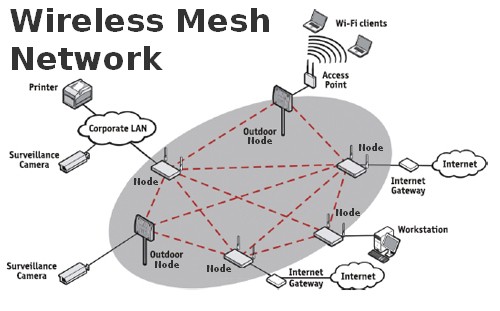
meshThe business community of Poulsbo, Wash., a Seattle suburb of 9,000 in Kitsap County, is fed up waiting around for CenturyLink and Comcast to increase broadband speeds in the area so several have joined forces to share the city’s underused, existing fiber-optic cables to offer free Internet access for area businesses and residential users.

The Kitsap Public Utility District has launched a public-private partnership that offers free wireless mesh antennas to businesses willing to host them and pay any power costs incurred, so long as they agree to let customers and others in range of the network use it at no charge. The wireless mesh technology, more robust than traditional Wi-Fi, costs the public utility district between $7,000-$12,000 per site, but the resulting wireless coverage is cheap compared to wiring individual homes and businesses with fiber.

Local businesses, community leaders and the public consider it a win-win for everyone, especially because the existing institutional fiber network already in place is underutilized. The comparatively inexpensive wireless technology has not created any significant issues for area taxpayers or ratepayers, which effectively underwrite the antenna purchases, installation, and maintenance.

The wireless network offers speedy connections — as much as six times faster than the current broadband speeds sold by Comcast and CenturyLink in the county.

So far, four antennas have been installed downtown at local restaurants and a Lutheran church.
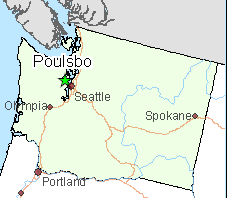
Poulsbo_WAStephen Perry, the PUD’s superintendent of telecommunications, says the new network is a pilot program to test if an economic model can be created to sustain the service and eventually expand it.

“The whole idea was to have it be a community network. It’s community based and owned so to have the community step up and want to take ownership of it … thought we’d have to force it on people,” Perry told the Kitsap Sun, noting district workers “can’t go fast enough” responding to fiber-optic interest.

The surprising support from the local business community has helped drive the project and publicize it. Local businesses love the new service, which they consider more reliable than paying for and maintaining a Wi-Fi network and Internet connection from Comcast or CenturyLink. The service does not require a password or complicated setup to access and has proved more reliable than older Wi-Fi solutions. Customers also enjoy the higher speeds.

Ed Stern, a member of the city council, said wireless mesh technology represents a major improvement over traditional Wi-Fi.

“It’s not a typical ‘hot spot’ limited to that business or specific location, but rather like ‘umbrella’ coverage, in that the antennas join together to create seamless coverage of everything and everybody throughout the area,” Stern said, adding network expansion is now inching into residential neighborhoods as well. “It’s really exciting.”

With countless towns and cities equipped with underutilized institutional fiber broadband networks lacking money to install direct fiber connections to homes or businesses, the wireless mesh option can offer an affordable introductory solution to expand service, publicize the community broadband initiative, and build support for even more ambitious public broadband opportunities in the future.

One local resident told the newspaper it was about time.

“The privatization business model has proven a failure,” wrote one reader. “Kitsap PUD needs to offer retail broadband to residents and businesses. These fiber cables are just sitting there doing nothing. There is one at the end of my driveway, but no one will sell me the service. Why would CenturyLink bother when they can continue to get overpaid for very slow speeds. In most places, there aren’t choices.”

More AT&T Job Slashing: 75 Workers in Greensboro, N.C. Wished a Merry Xmas And Told Goodbye

Phillip Dampier January 2, 2013 AT&T, Video 2 Comments

att_logoAT&T has told more than 75 call center workers in the Triad they have three weeks to either start looking for another job or consider relocating to Birmingham, Ala. if they wish to remain employed by the telecom giant.
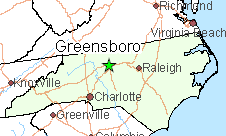
The holiday layoff took workers partly by surprise, but some told a local Fox affiliate they felt something was coming when they noticed AT&T stopped updating the affected workers’ training to handle customer calls.

The Communications Workers of America called the announcement devastating news for career employees and their families during the holiday season. The union is trying to get AT&T to extend the deadline to give workers more time to consider their options.

Local AT&T workers have had a tough year at the company, with difficult contract talks and technicians complaining about the company’s policy to allow customers to have AT&T U-verse installed on Christmas Day.

greensboro_ncCWA’s Local 3902 chapter, which represents AT&T workers in the Triad, claims the company has systematically tried to drive its workers out of the middle class with benefit and pay reductions and a race to the bottom mentality cutting labor costs and demanding longer work hours for less money:

[CEO Randall] Stephensons’ philosophy is as old as time. It is a belief that he is entitled and workers are not.  It has been called “wage slavery” and worse. People rose against it. Governments that stood by it have been toppled.

In America, the people began to say no more beginning in the late 1880’s. It took the Great Depression of the 1930’s to cause our great-grandparents to finally hit the streets. CWA began to see real successes in the 1950’s. A strike that lasted 72 days in 1955 set the stage for our best days. The strike itself did not win much, but it left a scar AT&T did not soon forget. Contract negotiations after that were easier. That period lasted through 1980. In that period we won solid pensions and no-premium healthcare. By 1980 we were a solid part of the middle class and thought we would be always.

By 1981 we had begun to lose our way. Those hired during the boom of the ’70’s did not want to hear of  the prior struggles. They just happily enjoyed the hard won gains of the generation before them. They began to vote against their own interests. They began to believe that AT&T and BellSouth loved them and would always take care of them. That is the period we find ourselves in today. But we are beginning to see it for what it is.

During this period we have lost most of our pension gains. We are again paying a large part of our healthcare. Our wages are stagnant. Workers are fired almost at will. AT&T is out of control. Politically, they control the state legislatures who deregulate the industry. They run roughshod over the American worker. They contract out and off-shore at will. It has been a devastating period for CWA and for all unions.

[flv width=”640″ height=”380″]http://www.phillipdampier.com/video/WGHP Greensboro ATT to eliminate 75 jobs in Greensboro 12-17-12.flv[/flv]

WGHP in Greensboro covered the sudden holiday announcement AT&T was letting go at least 75 North Carolina workers by the end of December unless they agreed to relocate to an AT&T call center in Birmingham, Ala.  (2 minutes)

95% of Vermont Has Access to Broadband; 100% May Have It in 2013

VTA_logoAt least 95 percent of Vermont residents will have access to broadband by the end of today, because of a combination of private investment, public funding, and innovative service solutions for some of the state’s most rural areas.

State officials say 2012 was an important year for broadband availability in Vermont, as dominant phone company FairPoint Communications made inroads in expanding its DSL service in areas that never had access before.

In 2011, Governor Shumlin set an ambitious goal to see 100 percent of Vermont covered by broadband by the end of 2013, and the state appears on track to achieve that target in the coming year.

[flv width=”640″ height=”380″]http://www.phillipdampier.com/video/Ask The Governor Broadband 2-3-11.flv[/flv]

Gov. Shumlin answered questions from state residents regarding his plan to see 100% broadband coverage in Vermont by the end of 2013. (Feb. 3 2011) (3 minutes)

Vermont’s small size would seem to make it an easy target for total broadband coverage, but significant rural areas have made it unprofitable for commercial phone and cable companies to make inroads.

Comcast, the state’s largest cable operator, has not grown much geographically over the past five years. FairPoint, which took control of much of the state’s landline network from Verizon in 2008, has been compelled to achieve broadband expansion as part of an agreement that approved the sale.

logo-broadbandVTKaren Marshall, who heads a state effort to expand both cell phone and broadband access in Vermont says the remaining areas without coverage will be a difficult challenge, but one that can be achieved with the help of private and public investment.

“The last 5 percent are the needle in the haystack,” Marshall told Vermont Public Radio. “They are the most far-flung, probably the most expensive and sometimes even the most physically challenging to get to.”

Wireless is often the most cost-effective solution, both for broadband and cell expansion, and Marshall suggested Vermont would use microcell technology along Vermont’s rural roadways.

“I think we will be one of the first places in the country that is deploying microcell technology for example, on the top of telephone poles or utility poles, kind of like a daisy chain,” Marshall said.

The rural Vermont Telephone Company won a $5 million state grant to cover Vermont’s southernmost counties with a combination of wireless phone and broadband service.

While areas of rural Vermont will likely have broadband access for the first time, improvements have also been available to those who already have the service.

Marshall estimated the average broadband speed in the state has increased from 5.5 to 9.7Mbps, which is above the national average.

Vermont Public Radio surveys how the state is doing meeting Gov. Shumlin’s goal to see broadband service available to every Vermonter. (December 28, 2012) (2 minutes)
You must remain on this page to hear the clip, or you can download the clip and listen later.

Cablevision West For Sale: Time Warner Cable, Charter, Suddenlink All Submit First-Round Bids

Here today, gone tomorrow.

Here today, gone tomorrow.

Cablevision West, formerly known as Bresnan Communications, has been up for sale for weeks, and at least three major cable operators have submitted bids to acquire its 300,000 customers in Montana, Wyoming, Colorado and Utah.

Cablevision bought Bresnan Communications in 2010 for $1.37 billion. The cable operator invested millions updating the cable properties in the mountain west, but ultimately decided the more rural cable systems were too far away from its hometown systems in densely populated suburban New York, New Jersey, and Connecticut.

Selling Cablevision West would improve Cablevision’s balance sheet and allow the company to concentrate on its highly competitive home territory in the northeast, where Verizon FiOS frequently competes.

Among the three vying for Cablevision West, Charter Communications seems to be the best positioned to win. Charter already operates cable systems in the central and western United States, mostly in smaller cities and rural areas. Former Cablevision CEO Thomas Rutledge was in charge when Cablevision bought Bresnan Communications, and in his new role as CEO of Charter, he told CNBC he still admires those western systems.

Suddenlink has attained deeper pockets after its acquisition earlier this year by the Canada Pension Plan Investment Board, European private equity firm BC Partners and the cable operator’s current management. With money to spend, Suddenlink Communications could find itself the highest bidder. Suddenlink currently serves over 1.4 million residential and commercial customers, primarily in Texas, West Virginia, North Carolina, Oklahoma, Arkansas and Louisiana.

Time Warner Cable, the second-largest U.S. cable provider, is also among the stingiest of the three bidders. CEO Glenn Britt has consistently told investors the company will not engage in bidding wars or overpay for acquisition opportunities. The company has passed on several earlier opportunities for cable systems up for sale, although it did successfully acquire Insight Communications earlier this year.

The winner will likely be announced as early as January and then customers will have to prepare, once again, for another owner to take control.

Comcast Wants 40% Rate Increase Across New Jersey: $21/Month for Local TV Channels

Phillip Dampier December 27, 2012 Comcast/Xfinity, Consumer News, Public Policy & Gov't Comments Off on Comcast Wants 40% Rate Increase Across New Jersey: $21/Month for Local TV Channels

Comcast-LogoComcast is asking New Jersey regulators for permission to raise rates for its Limited Basic service, offering primarily local television channels, by 40% in 2013.

Comcast of Central New Jersey has filed a request with the Board of Public Utilities to adjust the rate for limited basic service from around $15 a month to more than $21.

The company blamed inflation, programming and “external” costs for the rate increase, which is just shy of the maximum amount permitted by law.

Federal law permits regulators to oversee cable rates for the broadcast basic tier, which provides customers primarily with local television service. All other tiers of service are unregulated.

New Jersey officials are asking state residents to comment on the proposed rate increase until Jan. 17. Comments may be sent in writing to:

Acting Director, Office of Cable Television
New Jersey Board of Public Utilities
44 South Clinton Avenue 9th Floor
P. O. Box 350
Trenton, NJ 08625-0350

Comcast has no intention of waiting for approval, however. It will begin charging the new, higher rate on Jan. 1. Should the board reject the rate increase, customers will be given a refund.

Search This Site:

Contributions:

Recent Comments:

Your Account:

Stop the Cap!