Home » Providers » Recent Articles:

Frontier Admits It Lost 62% of Its Landline Customers in Wash.; 15,310 Departed In the Last 9 Months

Phillip Dampier February 5, 2013 Competition, Frontier, Public Policy & Gov't 2 Comments

frontierFrontier Communications has admitted in a December regulatory filing it lost a combined 60 percent of its residential and business landline customers in Washington over the last decade, with more than 15,000 more departing during the first nine months of 2012.

The company revealed those numbers as part of an effort to win “minimal regulation” in the state of Washington, claiming its cable, wireless, and Voice Over IP competitors have eaten away its customer base. During the period between 2000 and 2011, the number of access lines served by Frontier in Washington declined from 895,435 to 342,869.

Frontier revealed it lost 15,310 more customers from March-September 2012 in cities like Everett (1,302), Marysville (2,009), and Redmond (2,975). Many of those customers took their business to Comcast. Others rely on wireless service Frontier does not provide.

washington-mapFrontier claims it faces robust competition in Washington and should be entitled to deregulation.

“These alternative providers have captured a significant share of the market for business and residential telecommunications services and additional features,” Frontier’s filing says. “Frontier is no longer the largest or predominant provider of telecommunications service.”

In Washington, companies like Frontier now just hold 19% of the voice telephone business. Wireless providers are now the predominant voice service provider, serving 6.1 million subscribers in Washington.

Frontier admits the competition has been beating the company’s pants off:

“The alternative service providers have clearly been successful in competing with Frontier as evidenced by the persistent and continuing loss of access lines by Frontier,” Frontier’s filing says. “As noted above, Frontier has experienced a 62% reduction in the number of access lines it serves in Washington from 895,435 as of January 1, 2001 to 342,869 as of September 30, 2012. This loss of access lines has been ubiquitous across Frontier’s exchanges in that all but one of Frontier’s 102 exchanges has experienced line losses since 2009.”

Deregulation would allow Frontier to increase prices or change how its markets and bundles certain products. It would also reduce the amount of oversight the company faces from state regulators.

The Washington Utilities and Transportation Commission temporarily set aside Frontier’s request at a meeting held Jan. 31. The regulator wants further time to investigate Frontier’s petition and will schedule future hearings on the matter in the future.

Thanks to Stop the Cap! reader Steve who first noticed the regulatory filing.

Reports of “Free Nationwide Wi-Fi” Network are Overhyped; No ‘Obama-Wi-Fi’ Forthcoming

Phillip Dampier February 5, 2013 AT&T, Broadband Speed, Community Networks, Competition, Consumer News, Editorial & Site News, Public Policy & Gov't, Verizon, Video, Wireless Broadband Comments Off on Reports of “Free Nationwide Wi-Fi” Network are Overhyped; No ‘Obama-Wi-Fi’ Forthcoming
A big 40oz can of Hype from the Washington Post.

A big 40oz can of Hype from the Washington Post.

Conservative bloggers are calling it socialized “Obama-Wi-Fi,” broadband advocates claim it represents salvation from high-priced wireless service plans, and the media echo chamber is amplifying reports that the federal government in on the verge of launching a nationwide free Wi-Fi network.

Sorry folks, it is not to be.

An article in Sunday’s Washington Post originally titled, “FCC Proposes Large Public WiFi Networks” got the ball rolling, and almost 3,000 reader comments later, a full-scale debate about the merits of government-supplied Wi-Fi Internet access is underway.

Cecilia Kang and her headline writer mislead readers with statements like these:

The federal government wants to create super WiFi networks across the nation, so powerful and broad in reach that consumers could use them to make calls or surf the Internet without paying a cellphone bill every month.

[…] If all goes as planned, free access to the Web would be available in just about every metropolitan area and in many rural areas.

There is nothing new about the FCC’s effort to set aside unlicensed spectrum for so-called “white space” Wi-Fi. As the spectrum wars continue, wireless companies like Verizon and AT&T are pushing proposals to further shrink the number of channels on the UHF television band and repurpose them for expanded cellular data networks. That newly available spectrum would be secured through an FCC auction. FCC chairman Julius Genachowski wants to set aside some of that available spectrum for unlicensed use, including the next generation of Wi-Fi, which will greatly extend its range and speed.

There is no proposal on the table for the government to fund or create a free, national Wi-Fi network as an alternative to paid commercial services. At issue is simply how 120MHz of newly-available television spectrum would be made available to new users. Republicans and large wireless companies like Verizon and AT&T are demanding the vast majority of that spectrum be auctioned off. AT&T and Verizon would like to expand their spectrum holdings, and a straight “highest bidder wins” auction guarantees the vast majority of it will be divided by those two companies. Many Democrats and broadband advocates want a portion of that spectrum set aside to sell to AT&T and Verizon’s competitors — current and future — to promote competition. They also support set-asides that make frequencies available for unlicensed uses like Wi-Fi.

Genachowski’s proposal could potentially spur private companies or communities to build community-wide Wi-Fi networks operated on unlicensed frequencies. With more robust signals, such high speed wireless networks could be less costly to construct and serve a much wider geographic area.

The potential for competition from the public or private sector is what bothers companies like AT&T and Verizon. Both argue that since they had to pay for their spectrum, allowing other users access to free spectrum would be unfair, both to themselves and to the government’s effort to earn as much as possible from the auction. AT&T has been the more aggressive of the two companies, repeatedly attempting to insert language into legislation curtailing the FCC’s ability to set aside a significant amount of spectrum for unlicensed use. While AT&T’s lobbyists do not go as far as to advocate banning such networks, the technical conditions they demand would make them untenable. AT&T and others also demand the FCC must close down unlicensed networks if they create “harmful interference,” which is open to interpretation.

Helping the wireless companies in the campaign against the next generation of Wi-Fi are hardware manufacturers like Cisco, which has been trying to deep six the proposal for at least two years. Why? Because Cisco’s vision of wireless networking, and the products it has manufactured to date, are not in sync with the kind of longer distance Wi-Fi networks the FCC envisions. Cisco faces overhauling products that were designed under the premise Wi-Fi would remain a limited-range, mostly indoor service for consumers and businesses.

The threat to incumbent Internet Service Providers is clear enough. If a new version of Wi-Fi launched that could blanket entire neighborhoods, communities, non-profits, or even loosely-knit groups of altruistic individuals could launch free Wi-Fi services sharing their Internet connection with others. If the technology allowed users to seamlessly hand off wireless connections from one free Wi-Fi hotspot to another, much like cell sites do today, customers might downgrade their wireless data plans with big telecom companies. Machine-to-machine networking could also rely on Wi-Fi instead of commercial wireless data plans. It could threaten billions in potential revenue.

Stopping these networks is a priority for corporate interests with profits at stake. But one thing they do not have to worry about, at least for now, is the federal government getting into the wireless Internet business.

[flv width=”640″ height=”380″]http://www.phillipdampier.com/video/Washington Post FCC offers path to free Internet access 2-4-13.flv[/flv]

After the original story ran in the Post, Cecilia Kang participated in this interview which clarified what the FCC is actually proposing. This video explains what spectrum allocation and unlicensed spectrum is all about. Kang clarifies her article, explaining private companies and/or communities will have to decide what to do with the unlicensed spectrum. The federal government is only facilitating the space and has no plans to run a national network itself. (5 minutes)

https://www.washingtonpost.com/business/technology/tech-telecom-giants-take-sides-as-fcc-proposes-large-public-wifi-networks/2013/02/03/eb27d3e0-698b-11e2-ada3-d86a4806d5ee_story.html

Dark Money: Inside the Internet Innovation Alliance’s Guide to Total Deregulation, Abandoning Rural America

Phillip Dampier February 4, 2013 Astroturf, AT&T, Broadband "Shortage", Consumer News, Editorial & Site News, Public Policy & Gov't, Rural Broadband, Wireless Broadband Comments Off on Dark Money: Inside the Internet Innovation Alliance’s Guide to Total Deregulation, Abandoning Rural America

iiaThe Internet Innovation Alliance this week unveiled its 2013 Broadband Guide to the 113th Congress, outlining recommendations for a better broadband future that just so happen to fall in step with AT&T’s lobbying action agenda, guaranteeing near-total telecom deregulation and abandoning rural America’s wired telecommunications networks.

That should come as no surprise, because the IIA’s principal backer is AT&T, along with a host of public interest and non-profit groups that have received significant contributions and backing from the phone giant.

The IIA’s chief recommendation: allow phone companies to abandon wired landline networks in favor of all-IP-based technologies that escape most regulatory requirements and are not subject to much oversight by local, state, or federal officials.

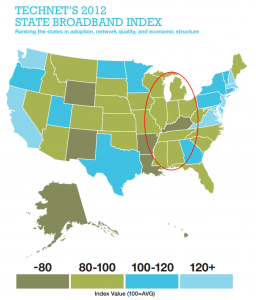
The IIA guide unintentionally discloses that its largest service area in the central and southern U.S. has some of the worst broadband service in the country.

The IIA guide unintentionally illustrates that AT&T’s largest service area in the central and southern U.S. has some of the lowest broadband rankings in the country.

In order for consumers to enjoy the speed and bandwidth capacity of IP networks and to take advantage of the programs and services (including education, gaming, entertainment, social media) that require fast and robust data transmission, the United States should encourage the upgrade to a digital, all-Internet Protocol (IP) broadband infrastructure. Current legacy wired networks fail to meet the FCC’s definition of broadband, yet outdated laws essentially assume that incumbent telephone companies continue to maintain and operate these slow, antiquated networks, even as incumbents invest and deploy separate IP infrastructure and fewer and fewer consumers rely on the outdated voice-only networks.

Requiring incumbent telephone providers to maintain costly antiquated networks siphons investment away from deployment of advanced, high-speed next-generation IP-based networks that consumers prefer. Reforming antiquated 1930s regulations designed for monopoly providers in a copper-wire, analog era will encourage the private sector investment needed to upgrade non-IP-based facilities with newer and faster broadband infrastructure, creating jobs and growing our economy.

In addition, today’s 4G LTE wireless networks are IP-based, but the spectrum required to fuel consumers’ advanced wireless devices on these networks is becoming severely congested. Releasing more spectrum, the radio waves that carry everything from television to texts to mobile video, is necessary to maintain and improve service quality on wireless networks. The government controls the allocation of spectrum and should reallocate more of it for consumer use in order to sustain the increasing public demand for data and continue the benefits offered by the mobile revolution.

Nowhere in IIA’s guide does the “Alliance” disclose its largest backer is AT&T, one of the “telephone providers” IIA talks about as if it was a third party that had no direct connection to the group.

IIA’s guide takes care not to come down too hard on its benefactor for not upgrading rural telecommunications networks to support next generation broadband. In fact, AT&T has dragged its feet providing even ordinary DSL service in many of its rural service areas. The IIA is also careful not to disclose AT&T’s real plan: not to upgrade existing networks to fiber but rather abandon them altogether in favor of its high-profit, high revenue wireless service. That assures everyone deemed unworthy of wired broadband investment will be relegated to the company’s high-cost wireless platform with paltry usage caps and speed throttles.

At the start of 2013, we are witnessing exciting changes enabled by mobile broadband: an app economy that didn’t even exist five years ago now employs more than 500,000 Americans, according to Economist Michael Mandel; the inexorable shift to the cloud and its more efficient information storage; proliferating creative tools that are transforming consumers’ business and personal lives; rapacious appetite for faster speeds, greater bandwidth opportunity and more capacious storage; overwhelming competition with 90 percent of consumers able to choose from at least five different providers, as reported by the FCC; and accelerating innovation cycles where tomorrow’s technology is invented today. The future of broadband is bright and the benefits to consumers and our nation could be boundless. To realize these benefits we need only to let our innovators innovate, our entrepreneurs compete, and ensure our consumers have the knowledge and freedom to make the most of the technology available to them.

…and let AT&T do whatever and charge whatever it wants, while depriving rural America of a wired broadband future.

The IIA hopes its message gets through to members of Congress. Helping make that happen are two former Washington, D.C. insiders that have bipartisan support for AT&T’s agenda.

“We love technology here and believe in its power to change the country, the world, and that it’s a non-partisan issue,” gushes Bruce Mehlman, IIA’s founding co-chairman and former assistant secretary of commerce for technology policy in the George W. Bush Administration.

Mehlman was recognized by Washingtonian Magazine as one of the city’s top lobbyists and is a founding partner of his own lobbying firm. Mehlman is considered an expert in running issue campaigns and “developing advanced lobbying strategies that achieve impactful policy outcomes.” At least AT&T hopes so.

Mehlman's D.C. lobbying firm promises to "get things done in Washington." At least AT&T hopes they can.

Mehlman’s D.C. lobbying firm promises “we get things done in Washington.”

“It’s critical that policymakers be well-informed as they make decisions affecting the Internet in order to promote and encourage the expansion of Internet investment, access and adoption,” echoed IIA honorary chairman Rick Boucher, a former Democratic member of Congress from the state of Virginia.

Boucher has never strayed too far from AT&T money either. AT&T was his third largest contributor overall from 1989 until he lost re-election in 2010. Today, Boucher is a partner in the law firm of Sidley Austin, which has represented AT&T’s interests for over 100 years.

AT&T Approved to Install Distributed Antenna System ‘Mini-Cell’ Antennas In Palo Alto

AT&T's proposed DAS antenna

AT&T’s proposed DAS antenna

AT&T’s ambitious plans to fill in cellular coverage gaps with smaller cellular antennas won approval in Palo Alto, Calif. last week, despite protests from residents who live adjacent to one of the 75 future antenna sites.

AT&T’s new Distributed Antenna System (DAS) is designed to cover reception gaps and cope with congestion-related issues in urban and residential areas. The new antennas will be mounted on top of existing utility poles, extending their height approximately nine feet.

AT&T said the new DAS system was necessary in Palo Alto because of the city’s unique topography and building density. The company hopes the lower profile antennas, designed for neighborhood-wide coverage, will also reduce traffic on its existing cellular network. AT&T expects to install one DAS antenna every 1/4 to 1/3 of a mile.

The new antennas will be serviced from a cabinet mounted on the pole or sidewalk-based concrete pad. This cabinet houses a fiber connection from AT&T’s U-verse network as well as power and monitoring systems necessary to operate the antenna.

AT&T earlier announced it intended to deploy smaller, more-localized cell sites to bolster coverage and network capacity. Many of these antennas will be located in residential and suburban areas that have traditionally rejected large cell towers.

Although the antennas are designed to be fitted to pre-existing utility poles, some residents object to their additional height, which can bring them into view above nearby buildings and trees.

Dorianne and Roy Moss will have one of the antennas as a new neighbor, and they don’t like it.

“When I open my eyes in the morning I see a tree line,” Dorianne Moss said. “The current proposal would be to put a box 9 feet above that.”

attLocal residents want AT&T to consider shielding certain antennas from public view and AT&T insists it took residents’ complaints into account.

Paul Albritton, AT&T’s counsel, told Palo Alto city officials the company chose locations away from block corners and close to foliage.

Residents in other cities may find AT&T seeking to install similar antennas in the coming year.

Frontier’s Bungled Website Causing Customer Confusion; Stop the Cap! Confirms It Ourselves

Phillip Dampier January 31, 2013 Consumer News, Editorial & Site News, Frontier 1 Comment
Grab this bargain: Frontier's website accidentally placed two different DSL packages on our order despite only ordering one of them.

Grab this bargain: Frontier’s website accidentally placed two different DSL packages on our order despite only requesting one. We didn’t ask for the phone line or satellite TV either, but there they are.

Frontier Communications is in the process of redesigning their website — a project long overdue in an age where customers can pre-qualify themselves for service and schedule installation from most cable operators without ever picking up the phone. If you also plan to improve the visual appeal and functionality of your website, you may need to seek the services of a memphis web design company. Make sure to hire a professional like this website design company who has years of experience in website development services.

But judging from some e-mail from Frontier employees working on the project, the forthcoming “upgrade” is about to make a bad situation much worse.

Frontier is the sixth largest phone company in the country with customers in 27 states, but they have never run a modern, well-functioning website. Frontier’s service pre-qualification tool has never worked properly in Rochester, N.Y., the largest city where Frontier provides service, and placing an order for service is fraught with confusion for customers who don’t speak telecom jargon.

Based on a reader tip, we tested the website this afternoon here at Stop the Cap! HQ.

Placing an order for DSL service is currently based on your street address, but the order process gives no indication if the company can actually provision service at the speeds requested.

As a customer journeys through a cumbersome 10-step order process, it becomes easy to be sidetracked with endless promotional tricks and traps in numbers I haven’t seen since last ordering a domain name from GoDaddy. The shopping cart also erroneously added two different broadband service packages on our order, despite only selecting one.

Step 1 offers murky promotions such as the impenetrable “Shop Promo VISA CD 100 2Y Challenger.” Promotions do not clearly disclose their terms up front. This one only discloses the two year service agreement with a steep early termination fee with the designation: “2Y.” Avoiding promotions still did wonders for our monthly bill, especially considering we were just looking for broadband service. We found Frontier quietly added a “digital unlimited phone” we could care less about for $30.99 a month, America’s Top 120 (presumably satellite TV we did not request) for $44.99 a month, Broadband Max (the slower DSL service we did not want) for $34.99 and Simply Broadband Ultimate (the service we did) for an extra $59.99. Our out the door price for what was supposed to be broadband-only service? A low, low $170 a month minus a $5 service loyalty credit for taking two services.

Step 2 piled on another $5 fee for satellite-delivered local channels for the satellite package we never asked for, but the duplicate broadband service was gone. Now we were stuck with the slower Broadband Max. Step 3 forced us to wade through more than a dozen phone feature packages for the phone line we don’t need. Step 4 sticker-shocked us with installation fees ranging from $50 for a self-install kit to $175 for a home installation of DSL and Wi-Fi. Those fees can be waived with a perpetually-renewing two year service contract (up to a $135 credit). At that point we had enough and bailed on the order.

This represents Frontier’s online shopping experience today. A Frontier employee who wishes to remain anonymous warns Stop the Cap! things could get much worse.

Our source tells us Frontier has outsourced much of the work on its forthcoming redesigned website to third party contractors who are now reportedly in over their heads, unaware that Frontier operates with a range of very different products and services depending on the service area. For them, one-size-fits-all seemed good enough:

[These contractors] don’t understand products or how those products interact with each other, yet they have been put in charge of creating the ability for customers to order them based on where they live.  The company has current issues with their website in that they can’t figure out how to get the right products to display for a customer in Rochester, N.Y. vs. a customer in Fort Wayne, Ind. Instead, Frontier has products configured by region, then broken down by zip code, and then by the customer’s phone exchange.

Unfortunately, new customers don’t know what phone number they will be assigned and that leaves them unable to determine what products are actually available to them. The products offered should be based on the customer’s actual service address, but these contractors don’t appear to have the expertise to make that adjustment.

frontierThe shopping cart application has also proved a problem, according to our source. Internal testing of the new site’s functionality has proved distressing because components of the site are still being developed. Recent tests found customers could not correctly select products available in their area or the site could not properly apply them to the shopping cart (a problem we found ourselves using the live site available now).

Our source tells us Frontier’s project manager is hell-bent on bringing the site up by Feb. 9, ready or not.

“We have brought up the fact that there are HUGE navigation issues that are completely not friendly to the customer,” says the employee. ” They are not concerned with any of those issues at the moment, just getting the product to launch. We have been told to manipulate the processes we are to use in order to be able to get any testing done.”

The whistleblower informs us customers are likely to have a range of problems using the new site if it launches in its current state:

  • Customers will be able to place orders for products they can’t get;
  • Customers will receive inaccurate information about the products and pricing;
  • Customers will not be able to get any promotions that they can currently get on the existing Frontier.com application;
  • Customers may not be correctly informed about installation charges or taxes, deposit requirements, credit validations, etc.

Frontier needs to take a lesson from some of their competitors that have greatly simplified the ordering process for consumers that can get quickly confused. Frontier should de-emphasize the tricks and traps from the many add-ons and service commitment agreements thrown at customers. Efforts to repeatedly up-sell customers on products and services should be managed separately, perhaps in a follow-up verification phone call where a customer service agent can handle any order changes required. With customers getting a choice between a cable, satellite, or a telco provider, those overwhelmed by one company’s website will simply find another provider.

In the meantime, those with questions or concerns about Frontier might do better just calling them directly at 1-800-921-8101.

Search This Site:

Contributions:

Recent Comments:

Your Account:

Stop the Cap!