Home » Providers » Recent Articles:

Cable Cartel: Comcast Drops the Ball on Shreveport – Outages, Poor Service Predominate

Phillip Dampier March 12, 2013 Comcast/Xfinity, Competition, Consumer News, Public Policy & Gov't, Video Comments Off on Cable Cartel: Comcast Drops the Ball on Shreveport – Outages, Poor Service Predominate

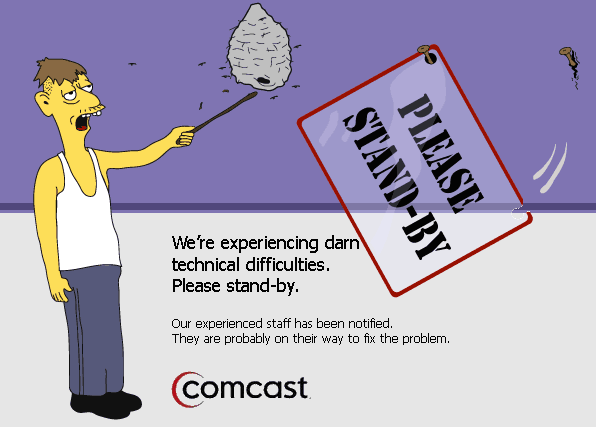
comcast technical difficultiesThe Oscars viewing party in Shreveport nearly never happened late last month when Comcast dropped the ball and left a “Technical Difficulties” message on subscribers’ screens for several hours. An enterprising technician at a local TV station saved the day when he found old-fashioned rabbit ears and a digital tuner in the back of his truck and was able to get the local ABC affiliate’s over-the-air signal on the big screens at the Robinson Film Center.

The technical foul-up was just the latest embarrassment for Comcast, not only because the outage impacted subscribers across a 75-mile radius, but also because Shreveport has a thriving partnership with the film industry. It also may be the breaking point for city officials tired of hearing complaints Comcast refuses to fix themselves.

Comcast blamed the latest widespread outage on a power problem.

“Comcast experienced a commercial power outage Sunday night,” said Frances Smith, a representative from Comcast’s government and regulatory affairs. “We are investigating and indications are that a resulting power surge damaged the switch that transfers the headend operation to a generator. We restored the majority of service within two hours and deeply regret the inconvenience to our customers.”

No refunds or service credits for customers are planned, unless those affected specifically ask for them within 30 days of the outage.

Comcast’s 15-year franchise with the city of Shreveport expired at the end of 2012 and the company is not making any friends on the Shreveport City Council as renewal discussions plod on while complaints from subscribers continue to pour in.

Most of the problems with Comcast service in Louisiana’s third largest city relate to the length of service outages, unresponsive customer service, and the quality of cable TV reception.

Webb

Webb

Comcast officials promised upgrades six years ago to address reliability issues, but city councilman Ron Webb says he hasn’t seen them and Comcast never delivered.

“We’re not trying to run them out of town,” Webb told KTRE-TV. “I want them to provide a good service. I have everything that I own bundled with them, and I’m paying dearly for it. But I’m happy to have the service. But I just want to see those improvements. I have the same problems.”

City officials are expecting Comcast officials to appear before the city council this evening to explain themselves and report on what plans they have to fix ongoing service complaints.

As it stands, Comcast continues to operate in Shreveport on a month-to-month basis until either a new franchise agreement is signed or another cable company responds to the city’s invitations to apply for a franchise. To date, no cable company has been willing to challenge Comcast’s presence in the city. In fact, Dale Sibley, the city’s chief administrative officer told the Shreveport Times no company even responded to their requests.

[flv width=”640″ height=”380″]http://www.phillipdampier.com/video/KTBS Shreveport Comcast Contract Expires 9-19-12.flv[/flv]

Comcast’s problems have been ongoing in Shreveport for years. Last September, KTBS hinted that the city was considering replacing Comcast with a different cable operator. But as other cities have already learned, no major cable operator is willing to challenge another. (Sept. 19, 2012) (3 minutes)

[flv width=”480″ height=”290″]http://www.phillipdampier.com/video/KTBS Shreveport Comcast Outage Contract 2-25-13.mp4[/flv]

The night of the Academy Awards was a low-key affair in Shreveport after Comcast went out of service across the city for at least two hours, leading to questions from city officials. KTBS in Shreveport rescued at least some viewers attending a downtown reception when a station technician hooked up an antenna and picked up the station’s broadcast signal. (3 minutes)

[flv width=”440″ height=”276″]http://www.phillipdampier.com/video/KMSS Shreveport Comcast issues statement about cable outage 2-25-13.flv[/flv]

At least 24 hours after Comcast’s February outage, some subscribers were still without cable service, despite claims from the cable company the outage only lasted two hours. KMSS in Shreveport reports.  (1 minute)

[flv width=”640″ height=”500″]http://www.phillipdampier.com/video/KSLA Shreveport Cable outage sparks heat between Comcast city official 2-24-13.mp4[/flv]

KSLA in Shreveport says Comcast’s ongoing service problems are being heard by members of the city council. Now some say the company never followed through on service improvements promised six years earlier.  (2 minutes)

[flv width=”480″ height=”288″]http://www.phillipdampier.com/video/Shreveport Times Comcast-talk-council-about-service-improvements 3-12-13.flv[/flv]

The Shreveport Times talks about tonight’s city council meeting which is scheduled to discuss Comcast’s service problems, the company’s franchise renewal, and obstacles that prevent another provider from taking over and delivering better service.  (3 minutes)
Verizon Reaffirms No Usage Caps; Speed Matters: Almost 50% Opt for 50-75Mbps FiOS Service

Phillip Dampier March 11, 2013 Broadband Speed, Competition, Data Caps, Verizon, Video 1 Comment

[flv width=”360″ height=”290″]http://www.phillipdampier.com/video/Bloomberg Verizons Fios Gaining Market Share 3-4-13.mp4[/flv]

Bob Mudge, president of consumer mass business markets at Verizon Communications, Inc., has reaffirmed Verizon FiOS has no plans to implement usage caps or consumption billing on its fiber to the home broadband customers. Mudge also told Bloomberg News that broadband speed really does matter. Nearly 50 percent of FiOS customers have chosen to upgrade to at least 50Mbps service, which is priced just $10 higher than its entry-level 15Mbps plan. Mudge also talked about changes Verizon is making for FiOS installations in New York City. Twenty-five so-called “Magic” buses will replace 250 single technician trucks, transporting teams of technicians to small businesses and homes in and around the Big Apple.  (6 minutes)

Windstream Exposed: Provider Under Investigation in Georgia for Ripping Off Broadband Customers

windstreamWindstream Communications is under investigation by the Governor’s Office of Consumer Protection because of allegations the company is advertising broadband speeds and performance the company simply cannot deliver its customers in Georgia.
A Windstream employee in a company retail office in Dawsonville told an undercover CBS Atlanta photographer that the company can offer Internet speeds up to 24Mbps. He guaranteed service no slower than 6 to 12Mbps. But Mark Creekmore, who lives in Dawsonville, reports his speeds sometimes barely reach 1Mbps during the afternoons.

Duane Hartness, a Windstream customer, says Windstream has oversubscribed their service by continuing to sell broadband on a network that is overcrowded as-is, which slows speeds for every customer.

“Every customer they add to their oversubscribed DSLAM increases their revenue while further degrading your bandwidth,” Hartness said. “Lacking competition, they can ignore any and all complaints.”

Creekmore wants every Windstream customer in Georgia that is dissatisfied with their broadband service to file complaints with the state agency.

“The more complaints, the more likely the Office of Consumer Protection is to take action,” Creekmore said. “Please make sure to include that you are not getting what you are paying for and any other personal detail that would help them understand what you have gone through. If you have had multiple communications with Windstream, please include those details as well. In short, the more detail the better.”

[flv width=”640″ height=”380″]http://www.phillipdampier.com/video/WGCL Atlanta Windstream Exposed for Not Providing Speeds Promised 3-7-13.mp4[/flv]

WGCL — CBS Atlanta reports there are new developments in Georgia regarding Windstream: It is under investigation by the governor’s office for misleading subscribers with broadband speeds the company cannot actually deliver.  (3 minutes)

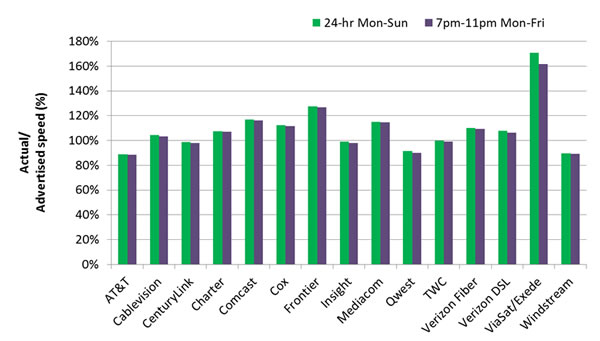
The FCC finds Windstream is the worst of the worst DSL providers, only giving customers advertised speeds 81 percent of the time.

The FCC finds Windstream is the worst of the worst among DSL providers, only giving customers advertised speeds 81 percent of the time. AT&T, Georgia’s largest phone company, doesn’t do much better.

Windstream is the worst-performing DSL provider in the country according to the Federal Communications Commission, with just 81 percent of customers getting the broadband speeds marketed.

After complaints about the company helped derail H.B. 282 — a bill Windstream heavily lobbied for that would have eliminated possible competition from community-owned providers — Windstream representatives quickly began promising upgrades.

“We’re asking our customers to be patient with us because we’re on it. We understand that they have issues and we’re working to upgrade their network,” Bettye Willis, a regional vice president at Windstream, told the CBS station in Atlanta.

Willis added Windstream was committed to solving its Internet speed problems, but not for everyone.

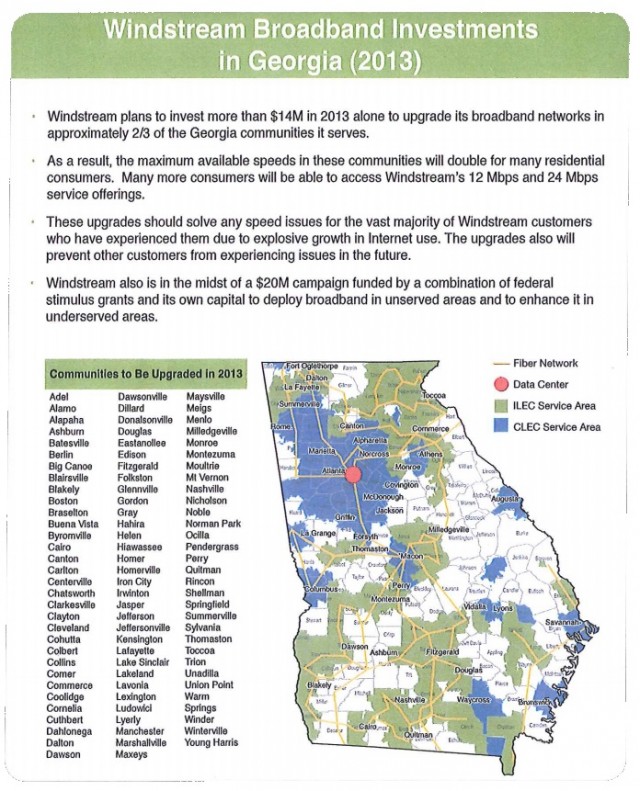
The company released this map showing planned service upgrades for "two-thirds of the communities it serves" in Georgia. But the company warned not everyone would receive improved service. For the remaining one-third, "take it or leave it" broadband service will continue.

The company released this map showing planned service upgrades for “two-thirds of the communities it serves” in Georgia. But the company warned not everyone would receive improved service. For the remaining one-third, “take it or leave it” broadband service will continue.

Comcast Executive David Cohen Raised $500,000 for Obama Re-Election in 2012

Phillip Dampier March 7, 2013 Comcast/Xfinity, Public Policy & Gov't Comments Off on Comcast Executive David Cohen Raised $500,000 for Obama Re-Election in 2012
Cohen

Cohen

Comcast executive David Cohen and his wife, Rhonda, raised more than $500,000 for President Obama’s re-election campaign from contributions from friends and corporate associates.

In addition to straight contributions, the Cohens were among the top three money-bundlers for the Obama campaign in the greater Philadelphia area, funneling large sums of cash from a variety of sources to the Obama re-election effort.

Critics contend this level of money in politics assures large corporate donors can get access to top elected officials and bend their ears on administration policies. It also could get donors more favorable treatment from regulators beholden to the administration or Congress.

Although the Cohens have been legendary fundraisers for Democratic candidates for years, the Pennsylvania press buzzed over word Cohen intended to support the re-election of Republican Gov. Corbett in 2014. In January alone, Cohen and his wife raised $200,000 for Corbett at a single fundraiser, according to the Philadelphia Inquirer.

Cohen told the newspaper he has had a long-term relationship with Obama, dating to when Obama was a state senator in Illinois, and a 20-year relationship with Vice President Biden.

“I know them personally, like and respect them, and believed that they were the superior choice,” Cohen said.

Time Warner Cable’s $5.26 Million Grant from NY Taxpayers Ruins Their Rhetoric

Phillip Dampier March 7, 2013 AT&T, Comcast/Xfinity, Community Networks, Competition, Editorial & Site News, Public Policy & Gov't, Rural Broadband, Verizon, Windstream Comments Off on Time Warner Cable’s $5.26 Million Grant from NY Taxpayers Ruins Their Rhetoric
corporate-welfare-piggy-bank

Time Warner Cable objects to publicly-owned broadband networks because they represent “unfair” publicly-funded “competition,” despite the fact TWC is also on the public dole.

The next time a cable operator or phone company claims community-owned broadband providers deliver unfair competition because they are government-funded, remind them that quite often that phone or cable company also happens to be on the public dole.

Take Time Warner Cable, which this week won a $5,266,979 grant courtesy of New York State taxpayers to extend their cable system to 4,114 homes in rural parts of upstate New York just outside of the cable company’s current service areas. That equals $1,280.26 in state tax dollars per household. For that public investment, Time Warner will reap private profits for shareholders from selling broadband, cable-TV, phone, and home security services to its newest customers indefinitely.

Now unlike some of my conservative friends, I am not opposed to the state spending money to wire rural New York. It is obvious cable and phone companies will simply never wire these areas on their own so long as Return on Investment conditions fail in these places. What does annoy me are the endless arguments we hear in opposition to public broadband from these same companies, claiming with a straight face that community-owned networks represent “unfair competition” because they are publicly funded. Time Warner Cable is no stranger to public taxpayer benefits itself, having won millions in tax abatements and credits in North Carolina, Ohio and a cool $5 million courtesy of Mr. and Mrs. N.Y. Taxpayer.

Many of the nation’s private telecommunications companies have plenty of love for federal, state, and local officials who have passed favorable tax laws and policies at their behest:

So let us end the silly rhetoric about public vs. private broadband being a question of fairness. This is really a question about who controls your broadband future,  your community or big telecom corporations.

In states like Georgia, elected politicians like Rep. Mark Hamilton want those decisions made by Comcast (Pennsylvania), Windstream (Arkansas) and AT&T (Texas). His bill would make it next to impossible for a local community to do anything but beg and plead the phone company to deliver something, anything that resembles broadband service. For a good part of rural Georgia (and elsewhere), the answer has always been a resounding “no,” at least until the federal government steps up and kicks in your money to help defray the costs of extending Windstream or AT&T’s sub par DSL service that slows to a crawl once the kids are out of school.

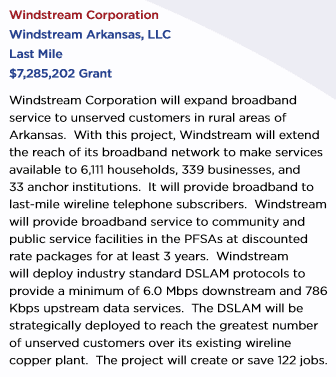
Windstream waited for the federal government to kick in $7.28 million in taxpayer dollars before it would agree to extend its DSL service to customers in its own home state of Arkansas.

Windstream waited for the federal government to kick in $7.28 million in taxpayer dollars before it would agree to extend its DSL service to rural customers in its own home state of Arkansas.

You have to wonder about the Republicans in Georgia these days who used to fight for local and state control over almost everything. It should be instinctive for any conservative to want out-of-state pointyheads out of their business, but Rep. Mark Hamilton, himself a business owner, seems content forfeiting those rights to companies headquartered hundreds of miles away. If it was the federal government telling Georgia what kind of broadband service it deserves, do you think Mr. Hamilton would be so amenable? Unfortunately, should Hamilton have his way, for the foreseeable future, residents and business owners in Gray, Sparta, or Eatonton to count just a few will have broadband just the way the state’s phone companies want it — super slow DSL, dial-up or satellite fraudband.

Search This Site:

Contributions:

Recent Comments:

Your Account:

Stop the Cap!