Home » Providers » Recent Articles:

Comcast Getting Heat in Florida for Not Accepting Gun Advertising

Phillip Dampier April 25, 2013 Comcast/Xfinity, Consumer News, Public Policy & Gov't Comments Off on Comcast Getting Heat in Florida for Not Accepting Gun Advertising
Comcast says gun stores need no longer apply to purchase ad time on their cable systems.

Comcast says gun stores need no longer apply to purchase ad time on their cable systems.

The Lake County (Fla.) Commission is calling Comcast’s decision to no longer accept advertising from businesses that promote gun sales “discrimination,” and they are calling on the Florida legislature to pressure the cable operator to change its mind.

Local gun shops in central Florida are angry Comcast has stopped accepting their advertising and say the operator has an advertising monopoly that guarantees their ads will not be seen.

“I’ve advertised over 20 years with Comcast,” Carey Baker of Peterson’s Gun Shop told WFTV. “My business has no other choice. I can’t advertise on any other cable company.”

Both Time Warner Cable and Comcast have ceased running advertising from gun shops after the Sandy Hook Elementary School shootings in Connecticut. Comcast said they simply adopted a pre-existing policy already in place at NBC after buying the network.

Many broadcast stations and networks also maintain restrictions on gun or ammunition-related advertising, some banning those commercials outright, others approving them on a case-by-case basis.

Some commissioners said the cable operator’s decision was just as unacceptable as not allowing a gun shop owner to eat in a local restaurant. But another commissioner dissented, claiming Comcast has the right to run its business as it pleases.

The matter of cable advertising is completely unregulated, and attempts by state or local governments to enforce ad content policies would likely be challenged in the courts by affected cable operators.

But Baker says local municipalities do retain some leverage, as they can deny the renewal of a cable franchise to those no longer seen serving the best interests of the community.

[flv width=”640″ height=”380″]http://www.phillipdampier.com/video/WFTV Orlando Lake Co gun shop owner upset Comcast no longer allowing gun ads 4-24-13.flv[/flv]

WFTV in Orlando talks with Carey Baker, owner of a local gun shop that can no longer advertise on Comcast Cable.  (2 minutes)

Cable One Commits to Major System Upgrades: More Speed, Better Reliability Promised

cableoneCable One has announced it will invest $60 million in network upgrades across 42 cable systems in its mostly rural footprint to enhance reliability and deliver faster Internet service.

The cable operator, owned by the Washington Post, has been criticized for outdated infrastructure and poor service, particularly in Mississippi.

”We’re committed to delivering the best possible experience to our customers,” said Cable One CEO Tom Might. “We’re confident that this investment will ensure that our customers will receive superior service in the speed, reliability, and the overall performance of our services.”

The two-year upgrade project aims to replace amplifiers, split broadband customers who share a backbone connection into smaller groups, replace aging coaxial cable and improve the cable company’s fiber optic backbone.

The upgrade might allow the company to consider relaxing its draconian usage cap and speed throttle policies, which force customers to choose between an uncapped 5Mbps connection (with a speed throttle for those using more than 3GB per day) or a 50/2Mbps connection with caps as low as 50GB per month (overlimit fees: $0.50-1.00/each extra gigabyte.)

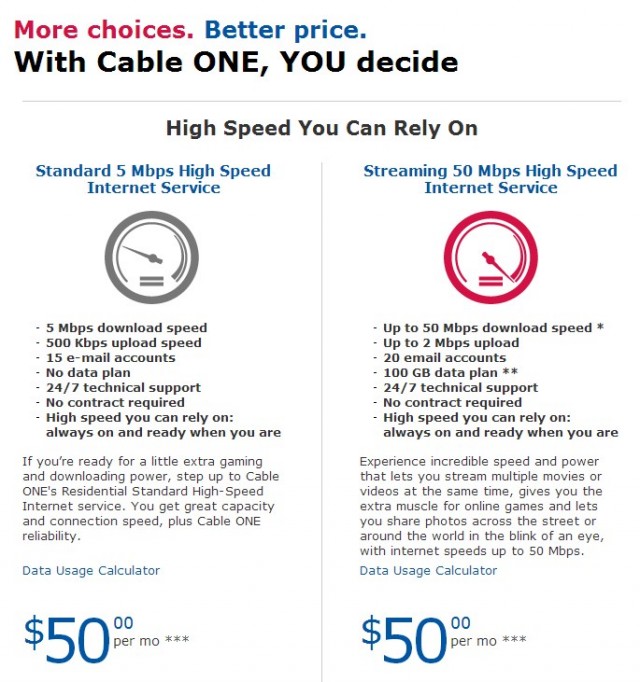
Cable One currently offers two levels of Internet service: an uncapped 5Mbps plan for $50 a month and a 50/2Mbps plan for $50 a month with a 50-100GB monthly usage cap, depending on the package bundle. Usage is measured between 8am-12 midnight. Users on the uncapped 5Mbps plan are subject to speed throttling if they exceed 3GB of usage per day.

Cable One now offers two levels of Internet service: an uncapped 5Mbps plan for $50 a month and a 50/2Mbps plan for $50 a month with a 50-100GB monthly usage cap, depending on the package bundle. Usage is measured between 8am-12 midnight. Users on the uncapped 5Mbps plan are subject to speed throttling if they exceed 3GB of usage per day.

Sprint Signals New Focus on Profitability; Cutting Back Upgrade Promotions, Discounts

Phillip Dampier April 24, 2013 Broadband Speed, Competition, Consumer News, Sprint, Virgin Mobile, Wireless Broadband Comments Off on Sprint Signals New Focus on Profitability; Cutting Back Upgrade Promotions, Discounts

SprintSprint will focus its postpaid wireless business on profitability in 2013, with reductions in customer discounts and a tighter upgrade policy that will raise prices for some and slow down others seeking new subsidized smartphones.

CEO Dan Hesse today told Wall Street investors Sprint will be leveraging its upgraded LTE network to help hold the line on discounts and early upgrades, reminding customers Sprint’s Network Vision plan is delivering better service with faster speeds and fewer dropped or blocked calls.

Sprint released its 1st quarter 2013 earnings this morning, showing the company reduced its quarterly losses from $863 million in the same quarter last year to $643 million. The company spent $1.4 billion during the first quarter on network upgrades, primarily on forthcoming 4G LTE network roll-outs.

Steve Elfman, Sprint’s president of network operations reported the company activated more than 12,000 LTE-upgraded cell towers by the end of the quarter, slowed only by inclement weather. This year will see a massive increase in those numbers.

“We now have zoning complete on over 32,000 sites and leasing complete on over 31,000 sites. More than 25,000 sites already or have already begun construction,” Elfman reported. “Our weekly construction starts are now at a level to achieve our goals for the year. There are over 600 cities under construction and we have now launched 4G LTE in 88 cities with over 170 expected to launch in the months to come.”

Hesse

Hesse

While Elfman oversees LTE upgrades, Sprint is also busy working towards decommissioning its Nextel network on June 30. Despite repeated warnings Nextel’s demise was close at hand, at least 1.4 million Nextel customers, nearly all business accounts, are still active on that network. Sprint is focusing most of its promotional budget again this quarter on convincing those customers to convert to Sprint service. But only 46 percent of Nextel customers took Sprint up on their repeated offers during the first quarter. Many others left for Verizon Wireless, switching off not only their Nextel commercial phones, but also those on Sprint’s network as well.

Sprint expects to hold on to a declining number of its Nextel customers as the second quarter progresses, until the network is switched off for good at the end of June.

That hurts, because Sprint has also been losing customers due to “pardon our dust” construction-related service interruptions as part of LTE 4G upgrades. Those disruptions are expected to accelerate  as more cities are prepared for LTE service.

Sprint’s Lifeline cell phone service for the poor, Assurance, also took major hits during the quarter after the FCC tightened eligibility requirements for the free/low-cost cell phone service. The company switched off 224,000 accounts in the last three months that either failed to re-certify eligibility or were never qualified in the first place. Sprint’s wholesale customers, which resell access on the Sprint network, are also busy deactivating unqualified Lifeline wireless lines, so Sprint expects a similar number of disconnects during the second quarter as those accounts are dropped from the network.

As Sprint turns its attention to profitability, revenue numbers at Sprint improved slightly. Sprint’s prepaid division added 568,000 net prepaid customers, and Virgin Mobile raised its minimum top up amount for 90 days of service to $20 (up from $15 with a credit card). As customers upgrade their Sprint postpaid phones, more customers are also encountering Sprint’s $10 “premium data” surcharge.

Customers will also discover a tightening of Sprint’s discounts and upgrade promotions. Among the efforts underway:

  • curtailing or eliminating certain customer credits and discounts;
  • tightening device upgrade policies to end early upgrades, although Sprint still retains its 20 month upgrade policy for now;
  • holding the line on phone subsidies for increasingly expensive smartphones.
Sprint's prepaid mobile division

Sprint’s prepaid mobile division

Slowing phone upgrades is particularly important for Sprint’s bottom line.

“I think the policy shifting is important in the industry because subsidies just keep going up and I think from the economic model perspective of the carriers we just can’t afford to upgrade as often,” said Sprint CEO Dan Hesse. “We’re not seeing any evidence yet that customers are interested in upgrading less often if they see less difference or improvement year-over-year in terms of what’s going on with these devices. In fact the opposite might be true which means these policies are really quite important for the industry.”

Hesse admitted that the drive to increase profits could cost Sprint some of its postpaid business, and probably already has over the last three years. But Hesse noted many of those contract customers have migrated to the company’s prepaid service, which keeps revenue in-house. Hesse expects as long as popular phones are available on prepaid plans, price-sensitive customers will continue to migrate towards prepaid service.

“I think what you are seeing is maturing of the U.S. markets beginning,” Hesse noted. “The U.S. has always been or traditionally been almost exclusively postpaid and it’s beginning to look like other markets that have a higher prepaid mix in terms of the number or percentage of customers.”

Deutsche Telekom’s New 384kbps Speed Throttle “Emasculates the Internet in Germany”

Phillip Dampier April 24, 2013 Broadband "Shortage", Broadband Speed, Competition, Consumer News, Data Caps, Net Neutrality, Online Video, Public Policy & Gov't, Telekom Deutschland, Video Comments Off on Deutsche Telekom’s New 384kbps Speed Throttle “Emasculates the Internet in Germany”
The German Internet is functionally broken.

The German Internet is functionally broken.

Deutsche Telekom, the largest telecommunications company in Germany, has announced it will introduce a brazen Internet Overcharging scheme for customers signing up for its broadband DSL service, including a throttle that reduces speeds to just 384kbps after as little as 75GB of monthly broadband usage.

For now, only new Telekom Deutschland customers signing up after May 1 will be affected by the usage limits. Customers will be offered the option of upgrading their Call & Surf package to get a larger usage allowance, although many parts of Germany are still reliant on DSL and its variants that cannot deliver the advertised speeds that go with the larger allowances:

  • Up to 16Mbps: 75GB per month
  • Up to 50Mbps: 200GB per month
  • Up to 100Mbps: 300GB per month
  • Up to 200Mbps: 400GB per month

“We want to offer customers the best network in the future and we will continue to invest billions to make that happen,” said Michael Hagspihl, marketing director of Telekom Deutschland. “However we cannot continue to sustain higher usage demand while lowering our prices. Customers with very high data volumes will have to pay more in the future.”

Company officials argue German broadband usage demands are accelerating at an ever-increasing rate, putting strain on the company’s network resources.

But critics question if usage demands are the root of the problem, why is DT exempting itself and its “preferred partners” from the data cap, including certain services that offer very high bandwidth video?

The Net Neutrality activist group Netzpolitik.org says DT is “massively violating Net Neutrality while the federal government looks away dreaming that the free market will solve the problem somehow.”

The group points out DT has admitted the speed throttle only applies to content providers who have not partnered up with the German telecom giant.

DT is exempting all of its own in-house content providers, the private television service Entertain, and telephone services (when provided by DT). For everyone else: the speed throttle gets closer the more customers use services like Apple iTunes or Amazon’s Lovefilm service. But DT says those companies can also get special treatment for the right price.

DT’s preferred partner cooperating agreements let “high quality content producers” pay for a managed services contract that guarantees exemption from the speed throttle and prioritization of their traffic on DT’s network, even if it means slowing down non-preferred partner content.
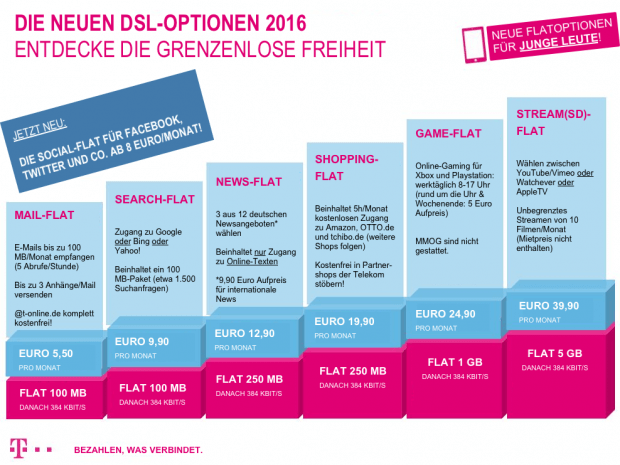
A parody future offer from DT.

A parody future offer from DT.

“You cannot thumb your nose at Net Neutrality principles any better if you tried,” said Rene Pedersen, an Internet activist in Köln. “DT will have their emasculated two-tier Internet and all of Germany will have to suffer the consequences. Their own arguments do not even make sense. If there is a capacity crisis, how can they exempt some video providers that now consume the most network resources?”

throttle“Until a few years ago, providers – just like the post – were just deliverers of packages,” said Netzpolitik’s Andre Masters. “This principle is called Net Neutrality – the equal treatment of data packets on the Internet, regardless of sender, recipient, or content. Now providers want to have a direct influence on the content sent, because they want to earn more money.”

Technology publisher Heise Online says the new usage restricting tariff has “triggered a veritable sh**storm” among net users who consider a 75GB usage limit untenable, particularly for families with multiple Internet users.

Heise is also critical of claims DT has made in the press that suggests German Internet users must either accept the usage caps or understand the company will have to spend at least €80 billion ($108 billion) to build a national fiber network to manage growing traffic.

In contrast, Goldman Sachs last year estimated the cost of wiring every home in the United States with Google Fiber would cost $140 billion, a number now considered inflated. Verizon FiOS managed to get costs down for its own fiber network to a level that suggests Google would only need around $90 billion — $10 billion more than DT claims it needs.

“DT is being disingenuous when they suggest it will cost €80 billion to solve their capacity problem. For that amount every household in Germany would get their own fiber cable with 200Mbps speeds or more,” Heise writes in their editorial. “To avoid slowing users down with a speed throttle, only a small fraction of this amount is needed to extend the Internet backbone and peering agreements between providers. For years network traffic has grown exponentially and DT has kept up with demand. So why does DT suddenly need to reshuffle the cards now?”

DT has also received criticism for how it has depicted its heavy users — mostly as content thieves and software pirates using file swapping networks to steal copyrighted works. But instead of dealing with copyright violations, DT wants a sweeping usage cap system that punishes every customer that wants to use their broadband connection.

“Customers are not insatiable Gierschlünde who want everything for free,” writes Heise. “They already pay a lot of money to Telekom: 12.5 million DSL customers roughly translates into around a half billion euros in sales per month.”

Back to the future.

Back to the future.

The German news magazine Spiegel writes DT’s usage limits strangle the Internet for millions of Germans, especially for competing video providers:

When throttled, customers will need more than 23 hours to watch a DVD-quality movie. At Blu-ray resolution, it will take about two weeks to watch just one film.

[…] The implications of the end of Net Neutrality in Germany represents a form of economic censorship, and German politicians are standing by to watch it happen.

The federal government sees the Internet as a political bargaining chip and not as the social, cultural and economic tool it represents. The government acts in the interests of certain lobbyists, not Germany’s digital future. This allows German telecommunications companies to focus on their economic self-interests without government policies that demand investment in digital infrastructure.

A number of German Internet users are expected to switch to a cable provider, where available, to escape DT’s impending speed caps.

According to the Frankfurter Rundschau, many German cable companies also reserve the right to limit speeds for customers. But in practice, most don’t impose limits until traffic exceeds 60GB daily, and the speed cap is lifted the next day. A cable industry official says its cap currently impacts about 0.1 percent of customers, almost all who use peer-to-peer file swapping networks. Exempt from measurements that bring customers closer to a speed cap: web browsing, video streaming, and video-on-demand.

For now, Germany’s cable operators facing the same traffic growth DT speaks about find no need to impose further limits, stating their networks are handling the traffic with network upgrades as a normal course of business.

“It calls out DT’s claims as fraudulent, because cable Internet users visit the same websites and do the same things DT’s customers do and there only seems to be an ‘urgent’ problem in need of a speed throttle solution on BT’s network,” says Pedersen. “What needs to be throttled are the financial expectations of DT management and shareholders. The Internet is not their personal vault waiting to be plundered.”

[flv width=”640″ height=”380″]http://www.phillipdampier.com/video/What if Net Neutrality.mp4[/flv]

What if Net Neutrality did not exist?  [Subtitled] (1 minute)

Verizon Wireless Quietly Introduces 24-Month Upgrade Policy (No More Early Upgrades)

Phillip Dampier April 23, 2013 Competition, Consumer News, Verizon, Wireless Broadband 1 Comment

The foundation for future profits come from data usage.

Verizon Wireless is continuing its efforts to pull back on customer promotions that lower the price of your next phone. After eliminating discounts for loyal customers renewing their contracts, introducing a $30 “upgrade fee” for each new phone activated on an account, and eliminating one-year contracts, the wireless carrier is ending its 20-month upgrade policy, requiring customers to complete a full two-years of service before they can get their next subsidized phone.

The change was a point of contention on Verizon’s quarterly earnings conference call, as investors fretted about dissatisfied customers already upset that the wireless industry relies on two-year contracts while phone manufacturers release coveted device upgrades at least annually.

The wireless industry is already under pressure from Wall Street, prepaid providers and T-Mobile to abandon the traditional ‘subsidized phone for a two-year contract’-business model in favor of no-contract, carrier-financed phones.

In response to that pressure, Verizon Wireless has also introduced a 12-month optional financing plan targeting early upgraders, those who have lost or damaged their phones, or customers trying to hang on to their grandfathered unlimited data plans.

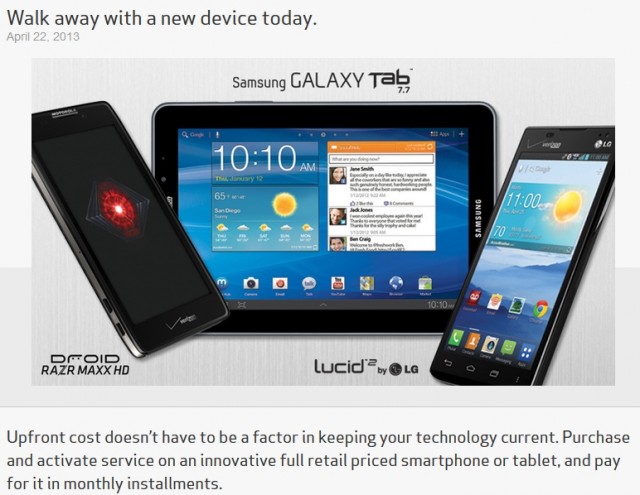
Verizon Wireless introduces its 12-month financing plan for devices.

Verizon Wireless introduces its 12-month financing plan for devices.

Under the plan, credit-qualified customers can finance devices starting at $349.99 for 12 equal installments (and a $2 monthly finance charge) charged to your Verizon Wireless bill (first payment due at time of purchase).

Customers can prepay a portion of their purchase upfront to cut the monthly payment — an important option for premiere smartphones like the Apple iPhone 5 ($650) and the Samsung Galaxy S3 ($600). Finance that iPhone and your Verizon Wireless bill will increase by $56.25 a month, including the finance charge, for the next year. You will still pay Verizon’s regular plan prices, which are artificially inflated to recoup a device subsidy customers are not getting under Verizon’s finance plan.

Verizon Wireless says the total owed balance cannot exceed $1,000 per customer, which makes it less useful for families (and even for those two-person households who want the latest and greatest). There is also a limit of two financed devices at any one time. But customers can pay off the plan balance early, which stops the $2 monthly finance charge and opens the door to finance something else.

Shammo

Shammo

Verizon confirmed customers grandfathered on discontinued unlimited data plans can also take advantage of the financing offer and not lose their unlimited data service. Verizon earlier announced it would allow customers to keep those plans indefinitely, as long as they paid the full price for subsequent device upgrades.

A $30 upgrade fee still applies for each new device activated on your account.

Revenues at Verizon Wireless rose 8.6 percent to $16.7 billion in the last quarter, accounting for more than half of Verizon’s overall revenue. The company has received accolades from Wall Street for implementing its revenue-enhancing Share Everything plans, which have turned into a major money-maker for the wireless carrier, even though only 30 percent of existing Verizon Wireless customers have been enrolled in the new plans to date. Verizon expects to shepherd an increasing number of existing customers to the Share Everything plans in future quarters.

Verizon chief financial officer Fran Shammo said he does not expect much pushback from Verizon Wireless customers upset about the promotional cutbacks.

“We don’t anticipate a lot of dissatisfaction,” Shammo told investors. “We’re not seeing a lot of resistance here.”

Search This Site:

Contributions:

Recent Comments:

Your Account:

Stop the Cap!