Home » Providers » Recent Articles:

Frontier Considers Backup Connectivity for Some Communities Hit by Fiber Cuts

Phillip Dampier June 13, 2013 Consumer News, Frontier, Rural Broadband Comments Off on Frontier Considers Backup Connectivity for Some Communities Hit by Fiber Cuts

frontierFrontier Communications is considering adding redundant backup fiber service in certain areas to prevent major customer outages when fiber cables get severed by contractors or storm events.

In May, 26,000 customers in the Palouse, Idaho area and all of Benewah County lost phone and Internet service after a fiber cut. Communities also lost 911 access.

Martin Erkela, Frontier general manager in Moscow, told city councilors the company is considering adding backup connections available to route around fiber cuts.

Similar redundancy would have also helped customers in the Eastern Panhandle of West Virginia who lost service for more than 14 hours after a fiber cut occurred there.

This morning, a number of West Virginians are also experiencing weather-related outages in the Morgantown, Fairmont, Wheeling and Martinsburg areas.

Frontier has experienced a number of service outages related to cable cuts, most accidentally severed during storms or by independent contractors working for other utilities or doing road maintenance or construction.

Redundant backup connections can be used to restore service when a primary fiber link is broken. Providers often don’t invest in backup service for cost reasons, especially if those circuits go unused when primary service is working normally.

Cable Industry Readies DOCSIS 3.1 – Up to 10/1Gbps, If They Decide You Need It

Werner

Werner

Cable operators are getting ready for competition from Google and other fiber providers with an upgrade to the cable broadband standard DOCSIS that will support up to 10/1Gbps service.

Comcast chief technology officer Tony Werner told attendees at the Washington, D.C. Cable Show that DOCSIS 3.1 will deliver about a 50% improvement in spectrum efficiency.

The new standard relies on orthogonal frequency-division multiplexing (OFDM), a standard already used by the wireless industry to get tighter performance from existing wireless spectrum.

The cable industry’s weakness remains its broadband upstream capacity. Standards originally developed for cable broadband assume users will download far more content than upload, so the focus has always been on download speeds. Upload speeds have been anemic in comparison. Until recently, cable technicians worried they would have to dedicate considerably more bandwidth for faster upstream speeds, but with improved standards, that may no longer be true.

Time Warner Cable’s chief technology officer Mike LaJoie is convinced his company will not have to widen upstream bandwidth. Time Warner has been among the stingiest providers of broadband speed upgrades,  still offering residential customers in most service areas a maximum of 50/5Mbps service, even as Comcast has upgraded to 305Mbps in certain markets, mostly in the northeast. This week Comcast demonstrated 3Gbps broadband, primarily to prove the cable broadband platform will be able to compete with fiber technology.

LaJoie

LaJoie

The first trials of the new broadband standard are anticipated in 2014, with modems for sale later that year or early 2015. Comcast is expected to begin buying and deploying DOCSIS 3.1-capable modems “when it makes financial sense.”

Major speed increases will require cable companies to accelerate the transition to all-digital video platforms to free up available cable spectrum. The faster the offered speeds, the more channels must be dedicated to providing broadband. Operators don’t see a space crunch anytime soon, especially if they move towards an all-IP platform that would support all services through a giant broadband pipe.

Cox Cable, for example, is planning to move more of its analog channels to digital to free up capacity for faster broadband speeds.

But exactly when consumers will be able to use the faster speeds possible from DOCSIS 3.1 is up to your provider.

Time Warner Cable is not convinced customers even need or want 100Mbps speed, so expect some cable companies to not even attempt gigabit broadband for years to come.

LaJoie dismissed triple digit megabit speeds as a novelty that is not “very deeply penetrated” in the marketplace — marketspeak for “not attracting many customers.”

“There has not been a demonstrated appetite for it,” LaJoie said.

Cable Companies Offer Incentives, Threats to Keep Programming Away from Online Competitors

Phillip Dampier June 12, 2013 AT&T, Charter Spectrum, Competition, Online Video, Public Policy & Gov't Comments Off on Cable Companies Offer Incentives, Threats to Keep Programming Away from Online Competitors

carrot stickCable companies, including Time Warner Cable, are offering a mix of threats and financial incentives to keep popular cable programming away from online video competitors.

Bloomberg News today reported the private discussions primarily target upstart streaming video services from companies like Intel, Apple, and Google, which are all proposing multichannel streaming video services that could one day replace the local cable company.

All three would-be competitors have been stymied, some for years, from signing contracts with popular cable networks like HBO, USA, ESPN and Comedy Central. If a viewer wants to watch those networks, they usually have to authenticate themselves as existing cable, satellite, or telco-TV customers to get access to live and recorded programming. The cable industry prefers it that way as a customer retention tool.

Time Warner Cable CEO Glenn Britt admitted to Wall Street analysts attending this week’s Cable Show his company probably insists on contract language that bars programmers from providing content to online video services.

“We may well have ones that have that prohibition,” Britt said at the conference in Washington. “This is not a cookie-cutter kind of business.”

Some cable company contracts are more benign, only requiring programmers to license content on the same terms offered to their online competitors. Britt said some of Time Warner Cable’s contracts fall into this category.

Britt

Britt

Britt has repeatedly emphasized Time Warner wants to license content more broadly to allow the company to include it in its TV Everywhere platform, which streams video content to wireless devices. The cable operator adopted a policy in 2009 that sought to deliver content to customers on any device they wish. Restrictive contracts have kept that policy from being fully implemented.

AT&T U-verse says it won’t pay full price for cable programming sold to its online competitors.

“If they’re going to go over-the-top, then that’s a very different conversation and a very different value for our customers,” Jeff Weber, president of content, said last month at an investor conference. “Exclusive versus non-exclusive has materially different value for our customers. And I think we would want that reflected.”

Restrictive contracts are all about protecting the existing pay television ecosystem, according to Charter’s chief financial officer, Chris Winfrey.

“It’s in everybody’s mutual interest that we are protecting the ecosystem in a way that continues to keep the value of that programming that we have and the way it’s delivered to our subscribers today,” Winfrey said added.

Consumer groups say restrictive contracts are the epitome of anticompetitive industry behavior that should be examined by the Justice Department.

“Is it anticompetitive generally? Of course it is, they are keeping programming from their competitors,” said Gigi Sohn from Public Knowledge.

Satellite companies were originally in this same position, unable to carry popular cable networks on reasonable terms at fair prices until the 1992 Cable Act mandated reforms that required non-discriminatory access to cable programming. Online video providers have not yet been able to demand the same terms for their competing services.


Mediacom Joins Pack of Cable Companies Selling Home Automation, Security Systems

Phillip Dampier June 11, 2013 Consumer News, Mediacom Comments Off on Mediacom Joins Pack of Cable Companies Selling Home Automation, Security Systems

Mediacom is joining many other major cable operators with plans to offer customer home security and automation powered through its broadband network.

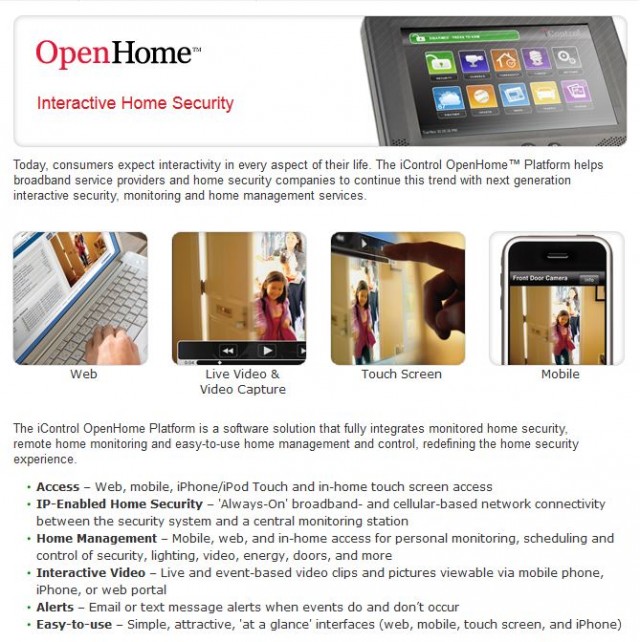
The cable company is joining the Comporium Security, Monitoring and Automation Dealer Program — the first step towards introducing the iControl OpenHome platform, an outsourced “managed solution” also used by Comcast, Time Warner Cable, Cox, Rogers, and Bell Aliant to offer the service.

icontrol platform“This partnership with Mediacom marks a significant milestone in the continued expansion of our dealer program,” said Comporium SMA Dealer Program general manager Dan Lehman. “We are excited that consumers in Mediacom’s markets will have the opportunity to experience the iControl OpenHome platform that has made the connected home a reality, enabling broadband service providers to offer the next generation of home management, security and connectivity to their customers.”

New Jersey Train Commuters May Eventually Get Optimum Wi-Fi; Free for Customers

Phillip Dampier June 11, 2013 Cablevision (see Altice USA), Competition, Public Policy & Gov't, Wireless Broadband Comments Off on New Jersey Train Commuters May Eventually Get Optimum Wi-Fi; Free for Customers
optimum wifi

Optimum Wi-Fi is available from thousands of “hotspots” across New York, New Jersey and Connecticut. You can find them by starting your Wi-Fi device and viewing the available networks in range. The network name will be ‘optimumwifi’.

Cablevision broadband subscribers may soon get free Optimum Wi-Fi service on New Jersey commuter trains and inside railway stations, if the NJ Transit board approves an agreement with the cable company.

On Wednesday, the board will vote on a 20-year contract with Cablevision to build and maintain a wireless network entirely at the cable company’s expense and offer NJ Transit free use of its facilities to assist in its operations.

With more than two-thirds of all rail commuters using Internet service during their travels, the network will vastly improve Wi-Fi access and offload data traffic from nearby cellular towers.

Providing Wi-Fi on trains has proved more difficult than Cablevision and the transit group originally thought.

The NJ Transit system first issued a “request for proposals” from interested Wi-Fi vendors back in 2010. Three years later, the transportation agency finally chose Cablevision over Illinois-based RAILband Group.

Cablevision has also been dragging its feet installing Wi-Fi on the Long Island Railroad and Metro North, despite agreeing to offer service by 2011.

“Wi-Fi on the trains is complicated,” explained Tad Smith, Cablevision president of local media.

On a March 2013 conference call with Wall Street analysts, he admitted the service is still not up and running, but should be sometime in the future.

“We are in active, productive, very positive conversations with the trains,” said Smith. “I am optimistic for the future.”

nj transitThe project in New Jersey is not anticipated to be complete until 2016. Wi-Fi will first be made available in railway stations. Individual railway cars will then gradually get the service.

Cablevision now provides its Optimum Wi-Fi service as a benefit exclusively for subscribers. Non-subscribers are limited to three 10-minute sessions per 30-day period, with a further limit of one 10-minute session per day.

The MTA required Cablevision to provide “reasonable” access to non-Cablevision subscribers, which may include daily, weekly, or monthly access passes at an additional cost. But no pricing or further details are now available.

NJ Transit is the nation’s largest statewide public transportation system providing more than 895,000 weekday trips on 240 bus routes, three light rail lines and 12 commuter rail lines. It is the third largest transit system in the country with 165 rail stations, 60 light rail stations and more than 18,000 bus stops linking major points in New Jersey, New York and Philadelphia.

Search This Site:

Contributions:

Recent Comments:

Your Account:

Stop the Cap!