Home » Providers » Recent Articles:

AT&T U-verse Broadband Speed Upgrades Rumored, But Your Results May Vary

Phillip Dampier June 19, 2013 AT&T, Broadband Speed 1 Comment

u-verseAT&T U-verse broadband has not kept up with the times, limiting speed-craving customers to a comparatively slow 18-24Mbps that hasn’t changed much in a few years. But an AT&T employee claims in the company forums that is all about to change, with new broadband speeds up to 48-60Mbps downstream and up to 10Mbps upstream on the way.

The improvements will not just mean faster Internet speeds, but also better television service. U-verse is an IP-based network using a DSL variant to deliver a broadband pipe into customer homes. That pipe is divided up between television, broadband, and phone service. Previously, U-verse limited television viewing to a handful of concurrent television streams — a problem in large households with heavy TV and DVR usage. The network upgrade won’t eliminate that problem, but it will make it more rare with up to six channels viewed simultaneously.

AT&T customers will also eventually benefit from a switch to “cloud storage” DVR equipment, which will record and store TV shows remotely and stream them back to your television on-demand. This will allow AT&T to sell customers different levels of storage capacity and reduce customer inconvenience should they lose all of their recordings if a hard drive happens to fail.

The employee predicts the speed increases will begin rolling out in July, beginning in Texas.

Not all markets or customers will be able to get the fastest speeds offered by AT&T because U-verse is still dependent on copper wire between a customer’s home or business and the nearest fiber optic link. AT&T intends to boost speeds for some customers using pair bonding to eke more performance from their aging wiring. Customers already buying U-verse’s top 24Mbps tier will receive a free upgrade to 30Mbps when the new speeds are introduced.

Some leaked pricing for the new speeds (discounts may apply in bundled packages):

  • 3/1Mbps — $41
  • 12/1.5Mbps — $51
  • 18/1.5Mbps — $56
  • 30/3Mbps — $66
  • 45/6Mbps — $86
  • 60/6Mbps — $106
  • 75/10Mbps — $121

No word on if AT&T plans adjust its barely enforced U-verse usage cap (250GB).

Guest Editorial: Verizon Remains Committed to Fire Island With Voice Link

Tom Maguire

Tom Maguire

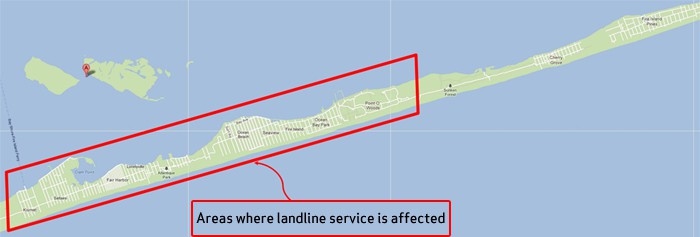
Recently, Stop the Cap! published stories about Verizon’s decision to discontinue traditional wired landline service for approximately 500 customers on Fire Island and offer them a wireless alternative called Voice Link. This is an important change for Verizon and our customers, and we wanted to clarify several points about the service and how Verizon is deploying it.

In places like Fire Island, New York and some communities along the Jersey Shore, such as Mantoloking and Seaside Heights, Verizon evaluated the extent of the damage to its facilities – which in many cases were literally washed away by Super Storm Sandy – and conducted extensive research before deciding the best course of action to take in terms of restoration.

Fire Island is a popular beach community with only a few hundred year-round residents, but the population swells each summer. Verizon’s equipment on the eastern side of the island was not too heavily impacted, so repairs were made and services restored.

On the western side of the Island, however, a large percentage of Verizon’s copper facilities were damaged beyond repair.

We studied the voice traffic on and off the island and where it was originating from on both Verizon’s wireline and wireless networks.  The company discovered that 80 percent of the voice traffic was already wireless.  If other wireless providers were factored in, it is likely that the percentage is closer to 90 percent.  This made it clear that people had already made the decision as to what technology works best. They had abandoned copper long before Sandy.

Where Sandy did the most damage on Fire Island

Where Sandy did the most damage on Fire Island.

Another part of Verizon’s analysis looked at the number of permanent residents on Fire Island, which number about 500, and the costs that Verizon would incur to install and connect new landline facilities there.  It would range from $4.8 million to more than $6 million. A multimillion dollar investment with no guarantee that residents of the island will even subscribe to our services makes no economic sense. In fact, that’s probably why Verizon is the sole provider on the island. None of the companies we compete with in other parts of New York offer services on the island.

Verizon-logoVerizon’s commitment is to provide our customers with voice service, and Voice Link is another way that Verizon is using technology to reliably deliver on that commitment for customers. And Voice Link does so by using wireless technology that has been proven effective over the last 20 plus years.

Verizon will maintain the copper network where it makes customer service and business sense to do so.  Please keep in mind that the vast majority of our copper customers have no issues at all with their service; we are only considering the universe of customers where the copper network is not supporting their requirements.  Again, the exception is the storm-impacted areas in the western portion of Fire Island and a few New Jersey Barrier communities where copper facilities were damaged beyond repair.  In these locations Voice Link will be the single voice option available to customers. Verizon will offer these customers the opportunity to use our state-of-the-art, tried and tested wireless network at the same rate (or better) that they pay today.

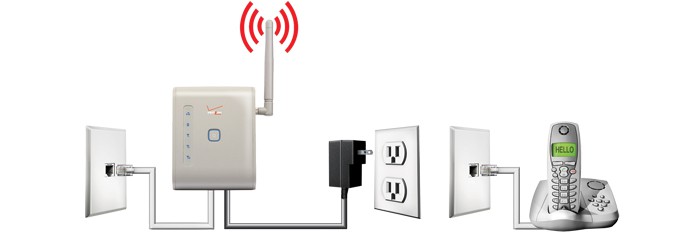
Here is how Verizon Voice Link works with your existing home phones.

Here is how Verizon Voice Link works with existing home phones.

Some additional points for clarification:

  • The service does offer a variety of popular calling features including Call Waiting and Caller ID with Name.  Some articles mistakenly reported to the contrary;
  • Another article cited a Communications Daily piece that incorrectly reported 40,000 people participated in a blind test of Voice Link. Actually, that test group consisted of 20 people;
  • Current Voice Link models include a rechargeable battery that offers 36 hours of standby and two hours of voice service. Future devices will work with standard AA batteries, giving customers an easy alternative for replacing batteries and maintaining communications in an extended power outage;
  • Although the device is not presently data capable, the team is working to change that. Nevertheless we have always said that it was not Verizon’s original intent to use Voice Link for customers with DSL. If a customer had an issue with their copper and they had DSL, we would repair the copper.  Unfortunately Sandy changed these plans for a handful of customers on Fire Island and the New Jersey Barrier where the copper is beyond repair.

What’s the Deal With Copper?

In areas where Verizon’s fiber and copper network ran side-by-side, Verizon began to ask certain copper customers with a history of trouble to move their service to fiber. In some cases the equipment supporting the copper service was so outdated that we could not even find replacement parts because the equipment had been discontinued. The objective was to improve service quality and customer satisfaction using the best communications network, and the result was clear: the program has been very successful. More than 300,000 customers migrated to Verizon’s fiber-optic network.  These customers enjoy super-reliable, faster fiber at the same rates they were paying all along.

In non-fiber areas, Verizon developed Voice Link to take advantage of wireless technology to address voice customers served on the copper network who have had chronic repairs issues.

[flv width=”640″ height=”380″]http://www.phillipdampier.com/video/Verizon Voice Link Keeps Customers Connected After Hurricane Sandy 5-31-13.flv[/flv]

After Sandy hit, Verizon realized that wireless technology also would be an ideal solution for customers in areas the storm destroyed or severely damaged. It has helped us reconnect hundreds of people and businesses. Don’t take our word for it. See what these customers have to say. (3 minutes)

Tom Maguire is Verizon’s senior vice president of network operations support.

W.V. Officials Blame Japanese Tsunami, Sandy, the Environment for Huge Fiber Cost Overruns

frontier wvWest Virginia has spent nearly three times more than it anticipated for each mile of fiber optics being laid by Frontier Communications as part of the state’s taxpayer-funded broadband expansion project, according to a new report.

The Saturday Gazette-Mail reports that state officials originally planned to spend $17,000 for each mile of fiber cable laid to community institutions including schools and libraries. Instead, it is paying $47,500 per fiber mile, more than double the industry average of $20,000.

Frontier Communications is getting at least $45 million in taxpayer dollars towards construction costs and will end up owning the completed fiber network that won’t directly deliver broadband service to a single home or business in the state.

West Virginia will make use of a 675-mile institutional fiber network when the project is finished, 25 percent smaller than the 900-mile network originally proposed.

State officials including Homeland Security director Jimmy Gianato have come up with some novel defenses for the cost overruns, blaming:

  • The 2011 Japanese earthquake/tsunami that allegedly spiked fiber prices to as much as $50,000 per mile;
  • Superstorm Sandy which delayed the project and caused $14 million in damage;
  • The cost of environmental impact studies.

The state is in a hurry to spend down the remaining funds left over from the $126.3 million taxpayer grant before they expire September 30. The broadband project has been mired in controversy from almost the beginning, including allegations that major telecom company employees serving as consultants steered project managers to invest in expensive, oversized routers intended to serve college campuses that ended up installed in tiny community libraries.

State officials also found many of the institutions slated to receive fiber upgrades already had fiber service. That left officials scrambling to find any schools, libraries, hospitals — even prisons where taxpayer-funded fiber broadband would prove useful.

In the end, Frontier will be the biggest beneficiary of the project and state officials predict $4-8 million will remain in unspent funds when the project is complete.

“If people step back, they can see this monstrosity in all its true glory,” says Jan Huntser. “Private companies like Frontier don’t want taxpayer money building public fiber networks for homes and businesses because that represents unfair competition. Instead, Frontier pockets taxpayer money to build a private fiber network they will end up owning that taxpayers cannot access. Instead, we’ll keep using their slow DSL service.”

Huntser says if taxpayer money is spent to build fiber networks, taxpayers ought to be able to use them.

“None of this makes any sense,” Huntser adds. “Frontier tells friends to buy a satellite dish for broadband because they will never offer it while a library in that town has four terminals and enough broadband equipment to support a business with hundreds of employees. They can’t even understand how to make it work, so they still rely on their DSL service to run the Wi-Fi connection instead.”

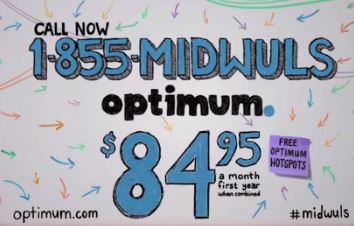
Cablevision’s Ads Get Even More Stupid: MIDWULS? Really?

We saved the only good part.

We saved the only good part.

The best part of Cablevision’s latest ridiculous advertising campaign is the 12-month introductory price new subscribers will pay for phone, broadband, and television service: $84.95 a month. Not bad. The same cannot be said to the advertising agency that created this mess and the executives who approved it.

Richard Greenfield from BTIG Research, which covers Cablevision for Wall Street, isn’t impressed with Cablevision’s ads either:

We believe it is time for Cablevision to find a new ad agency, bring in some new marketing executives internally and seriously rethink what their consumer proposition is – going back to pitching the triple-play at an ever lower (now $84.95 price point) is not particularly compelling. Cablevision already has very high level of bundling of video, data and voice services across its customer base.  Given that, Cablevision should be devising a marketing approach to upsell existing customers, especially higher speed, higher ARPU broadband services (given their high margin).

Consumers concerned about the high cost of cable may not agree with Greenfield’s assessment. Paying $85 a month for a triple play package is a great deal, at least until it expires.

But we suspect a lot of consumers will never get that far through the ad, particularly when most viewers don’t pay that much attention to advertising in the first place.

Michael Bolton was bad. This is worse:

[flv width=”640″ height=”380″]http://www.phillipdampier.com/video/Cablevision Ad – MIDWULS 6-2013.flv[/flv]

Cablevision tries to spell something out based on its toll-free number. MIDWULS is the embarrassing result. We’re especially not buying the culturally updated West Side Story gang encounter. (1 minute)

Why Big Telecom’s Rural Wireless ‘Solution’ Is No Replacement for Upgraded DSL/Fiber

Phillip Dampier

Phillip Dampier

It is no secret that there is an urban-rural broadband divide.

The market-driven, private enterprise broadband landscape delivers the best speeds and service to urban-suburban areas, particularly those in and around large cities, short-changing rural communities.

This is true regardless of the technology: the fastest fiber optic services are delivered in large population centers, and wireless speeds are fastest there as well. But as the National Telecommunications and Information Administration has discovered, the further away you get from these urban sectors, the poorer the service you are likely to get.

The NTIA’s findings present a significant challenge to phone company claims that rural customers would be better served with wireless broadband instead of spending money to support and upgrade landline infrastructure, which supports DSL and is upgradable to fiber optics.

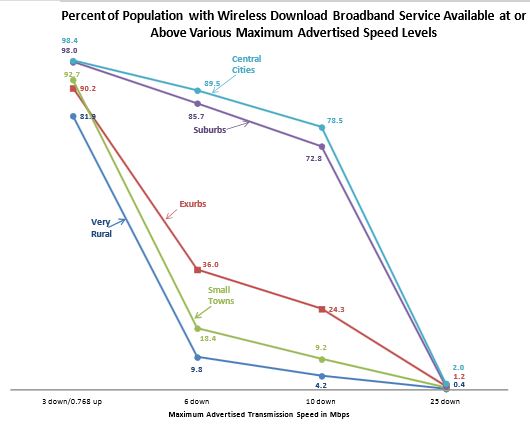
The NTIA finds these rural wireless networks to be severely lacking:

Not only are far fewer rural residents than urban residents able to access 4G wireless services (i.e., at least 6Mbps downstream), but a further divide also exists within rural communities. For wireless download services greater than 6Mbps, Very Rural communities have approximately half the availability rate of Small Towns, and Small Towns have about half the availability rate of Exurbs (10, 18, and 36 percent, respectively).

This represents nothing new. AT&T and Verizon have shortchanged their rural customers with catastrophically slow DSL service (or none at all) for years:

For wireline download service, Very Rural communities also have the least availability of all five areas. Though a rural/urban split continues to be useful in providing generalized information about availability, a five-way classification uncovers a more refined picture of the divide in broadband availability across the nation. For example, at wireline download speeds of 50Mbps, broadband availability varies from 14 percent (Very Rural), 32 percent (Exurban), 35 percent (Small Town), 62 percent (Central City), to 67 percent (Suburban), even though the overall broadband availability was 63 percent in urban areas compared to 23 percent in rural areas. In addition, wireline and wireless broadband availability, particularly at faster speeds, tends to be higher within Central Cities and the Suburbs compared to everywhere else.

Why the disparity? It is a simple case of economics. Wealthy suburbs can afford the ultimate triple play packages, so providers prioritize the best service for these areas, even above less costly to serve urban centers. Rural residents either get no service at all or only basic slow speed DSL. The Return on Investment to improve broadband is inadequate for these companies in rural areas.
Source: NTIA

Source: NTIA

The same is true with wireless 4G service. Rural areas struggle for access or endure poor reception because fewer towers provide service away from major highways or town centers.

The NTIA observed wireless download speeds of 6Mbps or more were available to 90% of urban residents, but only 18% of small town residents. Wireless upload speeds of 3Mbps or greater were found in only 14% of small towns.

Dee Davis, president, Center for Rural Strategies, based in Whitesburg, Va. said the implications were clear.

“The market’s always going to go to the well-heeled communities,” Davis observed. “It’s going to go to the densest population.”

Folks in rural communities end up paying more for a lower level of service, Davis said.

“That also means that they don’t get the same chance to participate in the economy,” Davis added. “They don’t get to bring their goods and services to market in the same way. They don’t always get to participate.”

The economics of cutting off rural landlines delivers most of the benefits to providers, and assures decades of inferior service to consumers.

Economic market tests, including Return on Investment, that impact rural broadband availability will not disappear if AT&T and Verizon abandon their rural landline networks. While cost savings will be realized once rural wired infrastructure is decommissioned, there is no free market formula that would encourage either provider to pour investment funds into rural service areas. For the same reasons rural customers are broadband-challenged today, their comparatively smaller numbers and economic abilities will continue to fail investment metrics for innovative new services tomorrow.

The primary reason broadband speeds are lower in rural areas is inferior network infrastructure. Providers argue it does not make economic sense to invest in network upgrades to boost speeds for such a small number of customers. While wireless technology can be cheaper to deploy than the upkeep of a deteriorating landline network, it is not cheap or robust enough to deliver comparable broadband speeds now available in urban areas, especially as broadband usage continues to grow.

Verizon’s chief financial officer Fran Shammo admitted as much during remarks at the at JPMorgan Global Technology, Media and Telecom Conference in May:

If you recall, way back I guess about two years ago we did a trial with DirecTV in Erie, Pa., where we did broadband on the side of a house and offered a triple-play, if you will, which consisted of broadband, voice, and linear TV provided by DirecTV.

What we found was people were adoptive to the broadband; but because of the consumption of broadband through that LTE network, it was really detrimental to the spectrum and to the network performance. Because they used so much data, it soaked up so much of the spectrum.

So what we felt was LTE for broadband works in certain rural areas, but you can’t compete LTE broadband in those dense populated areas because you can’t — first of all, you can’t match the speed with a 50-megabit or a 100-megabit delivery between cable and FiOS and U-verse. And you literally don’t have enough spectrum to be able to use that much consumption.

So what we felt was by partnering with the cable companies, and delivering our LTE network with voice and data, and having that hardwired connection into the home was a better financial way to do it than trying to go LTE broadband. Because we just didn’t see where the spectrum could hold up to the volume that would be demanded.

Without rural cable companies to partner with, Verizon’s decision to move rural broadband to wireless guarantees rural Americans will not benefit from ongoing speed and capacity upgrades that are necessary to support the evolving Internet.


Search This Site:

Contributions:

Recent Comments:

Your Account:

Stop the Cap!