

 Subscribe
 Comcast rates are going up again this fall in the Pacific Northwest, now exceeding $70 a month.
At least 600,000 cable customers in Oregon and southwestern Washington will pay 4.4 percent more for 100-channel television service beginning this October, raising the cost of Standard basic cable to $70.49 a month.
Despite threats of cord cutting, customers in the Pacific Northwest have remained loyal to the idea of paying for television, according to Fred Christ, policy director for the Metropolitan Area Cable Commission in Washington County.
“Subscriber numbers remain steady,” Christ told The Oregonian. “People still don’t see an easy alternative to Comcast, Frontier (FiOS TV), or the satellite providers, all of which cause more or less the same amount of pain.”
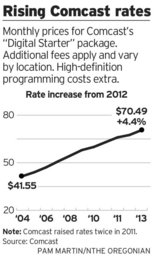
The newspaper notes sports programming may not be the cause of this year’s rate increase.
The cost of Comcast’s discounted “Digital Economy” cable package, which excludes most expensive sports networks, is rising at nearly double the rate of Standard Cable, up 8.6 percent this fall to $37.95 a month.
For those who cannot afford traditional Standard cable television, Comcast’s limited basic service, which primarily consists of local TV channels, runs $12-22 a month depending on the customer’s location. It also increased in price by about $1.30 a month in August.
Comcast may not mind cord cutters too much, because it reaps significant profits from the broadband service that powers online viewing. Comcast raised speeds from 15 to 20Mbps last spring along with the price. The popular “Performance” tier now costs $53.95 a month.
Comcast is testing the reintroduction of usage caps in a handful of service areas, typically providing up to 300GB of usage per month before overlimit fees kick in. But those Internet usage limits do not yet apply in the Pacific Northwest.
Comcast blamed the rate increases on network enhancement investments including faster Internet speeds, more multi platform video and better customer service. Comcast is currently introducing its new X1 cable box that makes finding programming easier.
Customers can avoid the worst of the price increases by choosing a bundled service package, which will see a lower rate increase. Current customers can also call Comcast to negotiate a better deal by threatening to cancel service.

 Cablevision has tried to avoid being picked off by the likes of neighboring Comcast or Time Warner Cable by trying (and failing) to go private in 2005 and 2007. Cablevision’s service area formerly extended well into western New York — especially in small communities and rural towns, before selling out to Time Warner Cable and retreating to its home base of Long Island, a few New York City boroughs, and parts of Connecticut and New Jersey.
 Cablevision has recently taken steps that only make a sale more likely, shutting down ancillary businesses like Newsday Westchester, OMGFAST! — a start-up wireless broadband provider in Florida, and selling off Clearview Cinemas, AMC Networks, and reducing holdings in sports programming.
 Sure enough, Robert Mercer, a DirecTV spokesman, explained the satellite provider pulls a credit report on every potential customer to determine their financial viability. DirecTV doesn’t want deadbeat customers, not after spending close to $900 to install satellite television in the average home.
 the worst-rated cable operator in the United States, claims it needs usage caps and consumption billing to force heavy users to pay for needed upgrades. But that isn’t what Mediacom’s executives are telling investors and the Securities and Exchange Commission (SEC).
 “
“
 Other customers incensed about the new usage limits have called to cancel service only to be threatened with steep early termination fees.
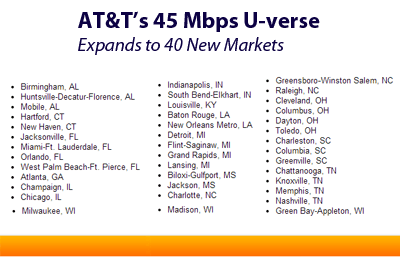 AT&T has boosted the maximum available broadband speed for its U-verse Internet offering to 45/6Mbps service in 40 cities across 15 states.